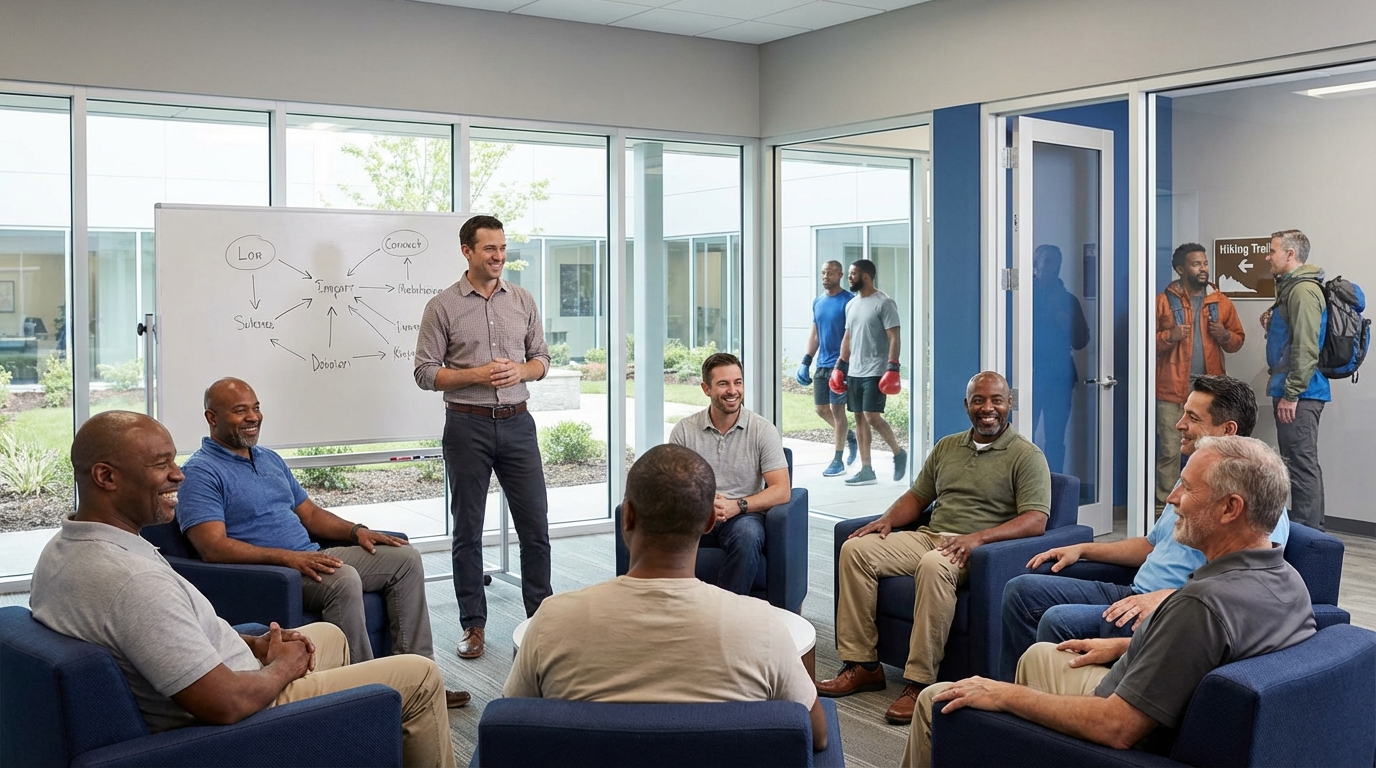


Choosing Men's Active Rehab in Knoxville
Start Your Journey NowWritten and reviewed by the clinical team at Trifecta Healthcare Institute, a men’s-only treatment center in Tennessee specializing in substance use, mental health, and dual diagnosis care.
Why Knoxville Men's Active Rehab is Essential
Beneath the Sunsphere and alongside the Tennessee River, men in Knoxville face some of the steepest challenges in the state when it comes to substance use and mental health recovery. Areas like Bearden, Fountain City, North Knoxville, and Downtown all reflect a growing need for effective support tailored to men’s unique experiences with addiction and trauma. Knoxville men's active rehab is not just a preference; it is a necessary evolution in care.
Movement-based approaches are reshaping outcomes by harnessing physical activity, brotherhood, and accountability to keep recovery on track. Local men—whether rebuilding in Old City or seeking change in Sequoyah Hills—are discovering recovery that speaks directly to their strengths, challenges, and the community they call home.
Understanding Knoxville's SUD Landscape
Knoxville’s substance use disorder (SUD) landscape is shaped by local realities: opioid-related emergency calls in North Knoxville, community outreach events near Market Square, and persistent treatment shortages in neighborhoods like Lonsdale and Mechanicsville. The rising presence of fentanyl and polysubstance use in East Tennessee communities has intensified the urgency for accessible, evidence-based solutions.
"71% of Tennesseans who need SUD treatment are not getting any formal help, fueling a concerning cycle of relapse and untreated co-occurring mental health conditions in the Knoxville area." [1]
Programs like Knoxville men's active rehab are designed in direct response to these gaps—addressing not only addiction but also the mental health challenges that so often go unmet in regional care systems. As we explore deeper, the opioid crisis uniquely shaping East Tennessee demands our attention.
East Tennessee's Opioid Crisis Reality
East Tennessee’s opioid crisis hits hardest in the very neighborhoods that shape Knoxville’s identity—where emergency rooms in North Knoxville and hospitals near Fort Sanders see a steady rise in fentanyl-involved overdose cases each year. Recent health data confirms opioid use disorder now impacts around 2% of adults locally, with overdose deaths continuing to climb in Knox County and surrounding communities [1].
This ongoing crisis is especially evident in East Knoxville and areas near the University of Tennessee campus, where rapid access to potent street opioids and polysubstance use create added hurdles for those seeking help. Integrated, evidence-based approaches—combining clinical care and physical activity—are increasingly recognized as essential for battling opioid addiction in Knoxville’s unique, high-risk environment [1].
Treatment Gaps Across Knox County
Across Knox County, neighborhoods such as Lonsdale, Mechanicsville, and South Knoxville face significant gaps in access to qualified substance use treatment and integrated mental health support. For men, barriers like limited program slots, waitlists, and a shortage of movement-based therapies make it harder to find the help they need close to home.
Integrated programs address these local service shortages, blending evidence-based clinical care with physical and peer-driven approaches—a model proven to improve engagement and outcomes for men in East Tennessee [1][8].
Why Movement-Based Therapy Works for Men
Movement-based therapy is uniquely effective for men in active recovery because it harnesses both body and mind, directly counteracting the isolation and restlessness that often fuel relapse. Evidence shows that exercise—whether it’s boxing, martial arts, or strength training—reduces cravings, stabilizes mood, and activates the brain’s natural reward systems, which are often underactive after substance use [8].
Programs like Knoxville men's active rehab foster peer support and brotherhood, encouraging men to regain purpose while working through stress and trauma in a supportive, physically engaging environment. This approach has consistently led to greater engagement and long-term retention for men compared to traditional, talk-only treatments.
Neuroscience Behind Physical Recovery
Recent neuroscience research reveals why movement-based recovery unlocks brain healing so effectively for men battling substance use. Substance use disorders change the brain’s reward system, especially in areas like the prefrontal cortex and dopamine pathways, often leading to powerful cravings and low mood [7].
These effects are even stronger when men exercise alongside supportive peers, as group movement boosts feelings of self-worth and accountability. This science-backed approach isn’t just about getting active; it’s about retraining the brain to handle stress and build resilience without substances.
Overcoming Male Help-Seeking Barriers
Men in Knoxville often face extra hurdles when it comes to seeking help for addiction and mental health—not because support isn’t needed, but because traditional ideas about toughness and independence can make reaching out feel risky or unfamiliar. In neighborhoods like South Knoxville, Bearden, and North Knoxville, stigma and fear of judgment remain barriers to entering treatment.
Evidence shows men are significantly less likely than women to seek mental health or SUD services, leading to higher rates of untreated depression and relapse risk in local male populations [3]. Trifecta Healthcare Institute addresses these challenges by fostering a brotherhood approach, where men find solidarity and encouragement in small groups, physical activity, and shared accountability.
Inside the Knoxville Men's Active Rehab Experience
What truly sets Knoxville men's active rehab apart is its dynamic, movement-focused environment combined with clinical best practices—all delivered in the heart of local neighborhoods from Fountain City to Bearden and South Knoxville. In these programs, daily life blends structured exercise, trauma-informed group activities, and one-on-one evidence-based therapy.
Whether boxing in a gym near the Old City, joining adventure therapy in East Tennessee’s foothills, or reconnecting in small peer groups, men discover practical ways to rebuild both their bodies and sense of belonging. Research shows programs using exercise-based interventions for substance use disorder in Knoxville yield greater mood improvements, lower cravings, and stronger long-term engagement than traditional talk-based models alone [8].
Evidence-Based Movement Interventions
Evidence-based movement interventions are anchoring the transformation happening at Trifecta, with modalities like boxing, martial arts, outdoor adventure, and cold exposure proven to reduce cravings, stabilize mood, and support long-term recovery [8]. These interventions are carefully chosen for their ability to engage body and mind.
| Modality | Primary Benefit | Typical Frequency |
|---|---|---|
| Boxing & Martial Arts | Trauma processing & discipline | 2-3 sessions/week |
| Outdoor Adventure | Resilience & team building | Weekly or Bi-weekly |
| Cold Exposure | Dopamine regulation & focus | Daily or per session |
Boxing & Martial Arts for Trauma Healing
Boxing and martial arts are cornerstones of trauma recovery in Knoxville men's active rehab, creating both an outlet for stress and a path to renewed confidence. Through non-contact group boxing sessions at partner gyms in Bearden and tailored jiu-jitsu classes in Old City, men report feeling safer sharing their challenges and more disciplined in their recovery routines.
Research shows these movement practices meaningfully reduce symptoms of PTSD, anxiety, and depression—while boosting mood and self-worth for men facing long-term healing journeys [9]. Peer encouragement during martial arts also activates brain areas linked to self-esteem and positive choices.
Outdoor Adventure Therapy in East TN
Outdoor adventure therapy has become a standout feature, drawing on the diverse East Tennessee landscape to provide real-world healing experiences. Men from neighborhoods like Fountain City, Bearden, and South Knoxville set out on guided hikes in the Smoky Mountain foothills, team kayaking trips on the Tennessee River, and group mountain biking just minutes outside the city.
These activities build resilience and trust within the brotherhood, while physical exertion reduces cravings and releases stress. Research consistently finds that integrating outdoor movement into substance use treatment leads to stronger engagement and improved mood, especially for men recovering from trauma or anxiety [8].
Cold Exposure & Biohacking Approaches
Cold exposure, including practices like cold-water immersion and guided ice baths, is increasingly woven into the program to boost resilience and accelerate brain healing. This science-guided approach draws upon new research showing that short, controlled cold exposure triggers endorphin release, sharpens focus, and dampens stress [8].
In Knoxville, groups often gather at local gyms or riverside spots—like those near South Knoxville and the Old City—to support each other during these invigorating biohacking sessions. By sharing these challenging experiences, men reinforce brotherhood and practice mindfulness in a way that talk therapy alone can’t offer.
Integrated Clinical & Physical Programming
Integrated clinical and physical programming is at the core of Knoxville men's active rehab, setting programs in neighborhoods from Bearden to South Knoxville apart from more traditional models. Here, men receive evidence-based therapies—such as cognitive behavioral therapy (CBT), dialectical behavior therapy (DBT), and trauma-focused EMDR—in tandem with movement modalities.
This dual approach helps men address substance use disorder and mental health needs in one place, a strategy shown to lower relapse risk and boost engagement by over 60% compared to standalone treatments [8]. The synergy of clinical therapy with physical routines supports healing on every level.
Combining CBT, DBT, and EMDR with Movement
Integrating CBT, DBT, and EMDR with movement is at the heart of what sets this approach apart. In neighborhoods like Bearden and South Knoxville, men engage in evidence-based therapy sessions followed by group exercise, boxing, or martial arts—allowing new skills and insights to become lived experience.
Research shows this combined approach not only reduces cravings and depression, but also boosts treatment retention rates by providing both mental and physical outlets for stress, self-reflection, and trauma healing [8][10]. Programs that weave DBT skills practice or EMDR trauma processing with activities like martial arts deliver superior long-term outcomes versus talk therapy alone.
Treating Co-Occurring PTSD and Addiction
Treating co-occurring PTSD and addiction means addressing both trauma and substance use together—never in isolation. Men in local neighborhoods like Fountain City, Bearden, and North Knoxville are up to 14 times more likely to experience substance use disorder if they also live with PTSD, emphasizing why these conditions demand integrated care [6].
At Trifecta Healthcare Institute, licensed clinicians and movement-based coaches create a safe, brotherhood-rooted environment where trauma can be processed alongside group exercise, martial arts, and peer accountability. Research shows that combining trauma-informed therapies with physical activity improves retention and lowers relapse risk for men facing both PTSD and substance use challenges [8].
Knoxville Neighborhoods & Service Access
Knoxville men's active rehab is intentionally woven into the neighborhoods that shape this city’s fabric, from vibrant Bearden and Fountain City to historic Old City, Farragut, and South Knoxville. Each community brings its own strengths and obstacles, whether it’s easy highway access near I-40, bustling downtown energy by Gay Street, or the natural beauty of Sequoyah Hills and along the Tennessee River.
Trifecta Healthcare Institute ensures every man can access movement-based, brotherhood-driven recovery close to home, reducing barriers like long commutes, limited parking, and local traffic around downtown and North Broadway. By offering convenient, locally-rooted solutions—including partnerships with gyms near downtown, adventure outings in the foothills, and peer groups right in West Knoxville—men find lasting support in the communities they trust.
Communities We Serve Across Knox County
Trifecta Healthcare Institute brings active rehab to every corner of Knox County. Location matters—program sites are positioned near familiar local spots like West Town Mall, Downtown’s Market Square, and the greenways threading through Sequoyah Hills, so men never have to travel far or face cross-city traffic.
| Neighborhood | Key Accessibility Feature | Local Vibe |
|---|---|---|
| West Knoxville / Farragut | Close to I-40 & Pellissippi Pkwy | Suburban, private, convenient |
| Downtown / Old City | Walkable, near transit | Urban, energetic, connected |
| South Knoxville | Access to Ijams & Urban Wilderness | Nature-focused, adventurous |
West Knoxville & Farragut Residents
West Knoxville and Farragut men find Knoxville men's active rehab easily accessible, thanks to locations near West Town Mall, Kingston Pike, and convenient connections to I-40 and Pellissippi Parkway. This area, known for neighborhoods like West Hills, Rocky Hill, and Fox Den, benefits from Trifecta Healthcare Institute’s commitment to reducing barriers such as traffic congestion and limited daytime parking.
Participants from Farragut regularly share how movement-focused peer groups and martial arts classes near their homes make recovery feel both practical and personal. "Having access to group meetings by West Town gave me hope—and kept me coming back," one West Hills resident reflected.
Downtown, Old City & North Knoxville
Downtown, Old City, and North Knoxville offer unique energy, diversity, and accessibility—making these neighborhoods central to outreach. With program sites steps from Market Square and Gay Street, and quick access via Broadway and I-40, men from neighborhoods like Fourth & Gill, Old North Knoxville, and Edgewood can join group runs, martial arts classes, or trauma-informed therapy without worries about parking or long commutes.
Local men who participated in movement-based recovery downtown described reconnecting with community, while a North Knoxville resident shared, "Joining boxing classes by the Old City helped me believe in myself again—and gave me a circle of brothers who understood my struggle."
South Knoxville & Sevierville Areas
Men from South Knoxville and the Sevierville area are finding renewed hope and accessibility through programming strategically located near Chapman Highway and along the Tennessee River, close to natural spaces like Ijams Nature Center. Residents of Fort Sanders, Island Home, and suburban Sevierville appreciate minimal commuting, easy onsite parking, and connection to peer groups rooted in the unique culture of South Knox.
Trifecta Healthcare Institute meets the region’s need for flexible, movement-based recovery by coordinating adventure therapy on local greenways and facilitating support groups that honor both small-town and city identities. Local success stories include a South Knoxville participant who noted, “Early-morning workouts near Ijams kept me grounded and made group recovery feel like a brotherhood, not a chore.”
Levels of Care & Insurance in Knoxville
Knoxville men's active rehab is structured to ensure that men from neighborhoods like Bearden, Fountain City, Old City, Farragut, and South Knoxville can access the right level of care. This includes starting with detox referrals, moving into day or evening intensive outpatient programming (IOP), or engaging in ongoing peer support and movement-based therapies.
Trifecta Healthcare Institute works alongside local clinicians and insurance partners to coordinate care transitions and reduce the risk of falling through the cracks. Most active rehab participants find that their commercial or Tennessee state insurance covers a broad range of services, including evidence-based therapy, trauma support, and movement-based interventions.
From Detox to IOP: Your Care Continuum
The care journey is designed to meet you where you are, providing a smooth transition from medically supervised detoxification (at a trusted local partner) into the hands-on, movement-driven programming Trifecta Healthcare Institute offers. After detox—often necessary for men from neighborhoods like Bearden or Fountain City—participants progress into intensive outpatient programming (IOP).
This continuum is backed by robust local connections: men from Old City, Farragut, or South Knoxville can attend sessions that fit their schedules, with minimized risk of falling through the cracks thanks to high-engagement follow-up and flexible entry points. Research consistently shows that individuals who receive a full continuum of care are much more likely to sustain long-term recovery [8].
Cost, Coverage & Financial Options
Cost and insurance coverage should never stand between Knoxville men and life-changing recovery. Most participants use commercial insurance or Tennessee state coverage to access movement-based therapy, co-occurring mental health care, and peer-led support. Typical time investments for IOP range from 9 to 15 hours per week, allowing for a balance with work or school.
Trifecta Healthcare Institute offers financial guidance, works directly with local insurers, and sometimes provides scholarships for qualified men to help bridge the gap. For those facing out-of-pocket costs or high deductibles, the admissions team reviews every available route, ensuring brotherhood-driven rehab remains accessible to Knoxville’s diverse communities.
Starting Your Recovery Journey in Knoxville
Beginning your journey with Knoxville men's active rehab means stepping into a supportive community—one where brotherhood, accountability, and movement create the foundation for lasting change. Men from neighborhoods like Bearden, North Knoxville, and South Knoxville regularly describe how Trifecta’s movement-based approach replaced old cycles of isolation with new habits, purpose, and encouragement.
You’ll find evidence-based structure and accessible programming close to home, with every day offering practical pathways to healing. Whether you’re reconnecting with peers at a gym near Old City or starting structured activities in Fountain City, programs are designed to meet you with compassion, safety, and clear direction.
What to Expect in Men's Active Rehab
Men entering the program can expect a daily rhythm grounded in movement, clear structure, and a profound sense of brotherhood. Trifecta’s programs prioritize hands-on activity such as boxing, group workouts, and outdoor adventures, all woven with evidence-based therapy validated to improve outcomes in Knoxville [8].
Small peer groups, mentorship, and accountability meetings ensure no one feels alone in their journey. Whether you’re navigating early recovery or rebuilding after relapse, each day brings meaningful structure, physical engagement, and the support of men who understand what you’re facing.
Brotherhood Philosophy & Peer Support
Brotherhood is at the core of the experience, with every day built around genuine connection and shared accountability. Men from Fountain City, Sequoyah Hills, and Bearden often remark how quickly they felt part of something bigger—small peer groups, group workouts, and team challenges replace isolation with purpose.
This approach directly addresses the higher risk of untreated depression and relapse that men face when they lack supportive relationships [3]. By building trust and camaraderie through movement and open conversation, participants inspire each other and hold one another to their commitments, supporting both substance use and co-occurring mental health recovery.
Building Purpose Through Structure
Structure is a lifeline for men in Knoxville men's active rehab, providing a reliable daily rhythm that helps transform good intentions into meaningful progress. Each session begins with clear goals—whether it's a strength-training circuit near Fountain City or a skill-building group in Bearden—pairing physical movement with coaching and check-ins.
Research shows that structured routines, especially those rooted in movement and accountability, directly support the formation of healthy habits and reduce relapse risk [8]. In neighborhoods like Sequoyah Hills and Old City, men find that knowing what to expect each day relieves anxiety and creates space to set new personal milestones.
Taking the First Step in Knox County
Choosing to begin your recovery is often the most courageous—and most life-changing—step on the path to health. Men throughout Knox County, from Bearden to North Knoxville and Norris, are encouraged to take this first step knowing they’ll receive support grounded in respect, privacy, and brotherhood.
- Initial Contact: Reach out via phone or secure online form.
- Confidential Assessment: A private conversation to understand your substance use history and movement readiness.
- Plan Creation: We design an individualized program addressing co-occurring challenges and neighborhood accessibility.
- Integration: Immediate introduction to your peer group and movement schedule.
Confidential Assessment & Admissions
Every man's journey begins with a confidential, judgment-free assessment—created to understand where you’re coming from and what you hope to achieve. This initial step, available to residents from Norris, Bearden, and throughout Knox County, takes place in a private, supportive setting either in-person or virtually.
Guided by trained staff rooted in the local community, your assessment covers substance use history, mental health needs, and movement readiness, forming a complete picture to tailor your path forward. Research confirms that admissions processes built on trust, privacy, and immediate peer introduction lead to stronger engagement and long-term results [8].
Connecting with Trifecta Knoxville
Connecting with Trifecta in Knoxville means immediate access to a compassionate, movement-focused team deeply rooted in neighborhoods like Bearden, North Knoxville, and Old City. Men ready to begin their journey can reach out by phone, secure online form, or even schedule a tour near their home—all handled confidentially and with understanding.
Staff respond promptly, mindful of the stress and urgency that often accompanies taking the first step, and can answer city-specific questions about schedules, parking, or how to join a local small group. Every inquiry is welcomed as a sign of courage and the beginning of a recovery journey grounded in brotherhood, accessibility, and trust.
Conclusion
The journey to lasting recovery for Knoxville men is one built on movement, brotherhood, and a steadfast commitment to whole-person healing. With 71% of local men who need substance use treatment not accessing formal care, programs like Knoxville men's active rehab fill a vital need by blending evidence-based movement therapy and peer-driven support right in the heart of neighborhoods such as Bearden, Old City, North Knoxville, and South Knoxville [1][8].
Research shows that integrating structured physical activity with counseling and community not only supports brain recovery but also dramatically boosts engagement and reduces relapse risk for men facing co-occurring mental health challenges [8]. Choosing this path means more than just overcoming addiction—it’s about joining a community where every man is understood, encouraged, and equipped to build a stronger future. For those ready to take the next step, Trifecta Healthcare Institute stands ready with accessible, locally rooted care and a team who believes in your capacity for transformation.
Frequently Asked Questions
If you’re exploring Knoxville men's active rehab, you likely have important questions about neighborhood access, evidence-based programming, and how Trifecta Healthcare Institute ensures a smooth, compassionate recovery journey for every man. This Knoxville-specific FAQ was created for men from every part of the city—from Bearden to Fountain City, North Knoxville to Old City—offering straightforward answers and local insight based on your most common concerns.
Does Trifecta serve men from specific Knoxville neighborhoods like Bearden or Powell?
Yes, Trifecta Healthcare Institute proudly serves men from every Knoxville neighborhood—including Bearden, Powell, Fountain City, East Knoxville, North Knoxville, and Old City—ensuring accessible, movement-based recovery wherever you call home. Locations are thoughtfully chosen for their convenience, minimizing stressful commutes and addressing parking or traffic concerns in busy areas like Downtown or North Knoxville. Local men have benefited from group runs near lakes in Bearden and small peer groups rooted in Powell, each experience designed to foster genuine brotherhood and support.
What happens if I need detox before starting active rehab in Knoxville?
If you require detox before enrolling in Knoxville men's active rehab, Trifecta Healthcare Institute will help coordinate a smooth, supportive transition for you. Most men start their journey with a brief medically supervised detox at a trusted local partner—often necessary for those entering from neighborhoods like Bearden, North Knoxville, or Fountain City. After completing detox, you’re welcomed directly into Trifecta’s movement-based, brotherhood-focused programming, ensuring no one faces a gap between care levels.
Is the Knoxville program appropriate for veterans or first responders with PTSD?
Yes, the program is highly appropriate for veterans and first responders who face PTSD and substance use challenges. Research shows that men with PTSD are up to 14 times more likely to develop substance use disorder, making it essential to address trauma and addiction together in a safe, supportive environment [6]. Trifecta’s team includes clinicians and movement-based coaches trained in trauma-informed care, offering evidence-based therapies like EMDR, cognitive behavioral therapy, and group exercise.
How does Trifecta's IOP work for men who need to keep working in Knoxville?
Trifecta's intensive outpatient program (IOP) is specifically designed so Knoxville men can keep working while prioritizing recovery. Flexible daytime and evening groups are offered throughout the week, giving men from neighborhoods like Fountain City, West Knoxville, and Old City the ability to attend sessions that fit around their job schedules and commutes. Movement-based therapy, evidence-backed clinical support, and peer accountability are woven together—so even those with demanding work hours can benefit from the structure.
What makes a men's-only rehab more effective than co-ed treatment?
Men’s-only rehab tends to be more effective than co-ed treatment for several important reasons. First, research shows that men often face unique barriers around stigma, help-seeking, and managing emotions in mixed-gender settings, which can limit openness and engagement in traditional programs [3][8]. Active, male-specific environments foster a strong sense of brotherhood and accountability, making it easier for men to participate honestly, support one another, and address personal issues tied to identity and masculinity.
Where should I park when visiting Trifecta's Knoxville location?
When visiting Trifecta Healthcare Institute’s Knoxville location, you’ll find on-site parking available for clients and visitors. The parking lot is adjacent to the main entrance, with clearly marked spaces that accommodate vehicles of all sizes—including accessible spots for those with mobility needs. Men from Bearden, Downtown, and Old City have shared that safe, convenient parking helped ease their first visit and reduced the stress of finding a spot during busier hours.
How long does it take to drive to Trifecta from downtown Knoxville?
Driving from downtown Knoxville to Trifecta Healthcare Institute typically takes less than 15 minutes, depending on your exact starting point and the day’s traffic patterns. The main active rehab location is convenient to Market Square, Old City, and neighborhoods along Gay Street—making it easy to reach by car via I-40 or Broadway, even during busier times. Local feedback confirms that men living in downtown, North Knoxville, and Fourth & Gill rarely face long commutes.
Can I participate in boxing and jiu-jitsu if I've never done them before?
Absolutely—you do not need any prior boxing or jiu-jitsu experience to participate. All movement-based sessions are guided by trauma-informed coaches who meet you right where you are, focusing on safety, comfort, and gradual skill-building. Research shows that both boxing and martial arts, even for first-timers, help reduce anxiety, depression, and trauma symptoms while building confidence and peer connection [8][9].
References
- National Survey on Drug Use and Health (NSDUH) — Tennessee State Tables, 2022. https://www.samhsa.gov/data/sites/default/files/reports/rpt44486/2022-nsduh-sae-state-tables/NSDUHsaeTennessee2022.pdf
- SAMHSA — National Survey on Drug Use and Health (NSDUH). https://www.samhsa.gov/data/data-we-collect/nsduh-national-survey-drug-use-and-health
- CDC — Mental Health. https://www.cdc.gov/mentalhealth/index.htm
- SAMHSA — Medications for Opioid Use Disorder. https://www.samhsa.gov/medication-assisted-treatment/medications-counseling-related-conditions
- Tennessee Department of Mental Health and Substance Abuse Services — Substance Abuse Services. https://www.tn.gov/behavioral-health/substance-abuse-services
- Conceptualization, Assessment, and Treatment of Traumatic Stress Disorders in First Responders. https://pmc.ncbi.nlm.nih.gov/articles/PMC6624844/
- The Neurobiology of Substance Use, Misuse, and Addiction (NIH — National Center for Biotechnology Information). https://www.ncbi.nlm.nih.gov/books/NBK424849/
- Exercise-Based Treatments for Substance Use Disorders (NIH — National Center for Biotechnology Information). https://pmc.ncbi.nlm.nih.gov/articles/PMC4831948/
- Boxing as an Intervention in Mental Health: A Scoping Review (NIH — National Center for Biotechnology Information). https://pmc.ncbi.nlm.nih.gov/articles/PMC10328201/
- Dialectical Behavior Therapy for Substance Abusers (NIH — National Center for Biotechnology Information). https://pmc.ncbi.nlm.nih.gov/articles/PMC2797106/