



How to Vet and Choose a Rehab for Alcoholics Near Me
Learn how to evaluate a rehab for alcoholics near me by checking licensure, accreditation, therapies, medication use, and long-term care quality.
Read More
Stay connected with Alumni Events for a Nashville, TN Rehab. Trifecta offers peer support and active outreach to strengthen recovery and prevent relapse.
Start Your Journey NowWritten and reviewed by the clinical team at Trifecta Healthcare Institute, a men’s-only treatment center in Tennessee specializing in substance use, mental health, and dual diagnosis care.
Alumni life at a Nashville rehab is less of a calendar and more of a rhythm. For men leaving treatment in Spring Hill, it usually means a standing weekly time slot, a group of men who understand their recent experiences, and a physical activity that gives the gathering shape. This could be a Tuesday night boxing session, a Saturday morning hike on a Middle Tennessee ridge, or a cold plunge after a workout. The activity itself is secondary; the primary goal is consistent participation.
Most men envision alumni programming as occasional reunions or guest-speaker nights. The reality is closer to ongoing membership in a group that meets regularly. SAMHSA defines recovery as "a process of change through which individuals improve their health and wellness, live self-directed lives, and strive to reach their full potential". This definition highlights that recovery is not a finish line at discharge but a continuous journey, and alumni events are integral to sustaining that journey week after week.12
For a men's rehab in Nashville, the alumni experience typically integrates three key components: a fitness or movement element (such as boxing, jiu-jitsu, CrossFit, or hiking), a peer support element where men with more recovery experience connect with those newer to it, and a check-in element, which can be formal or simply a conversation after an activity.
This intentional mix provides men with a place to go, individuals to be accountable to, and a body that feels progressively better. These three elements, consistently repeated, define the true nature of alumni life.
Discharge from a Nashville rehab is not the conclusion of treatment. It marks the point when the support structure that sustained a man for thirty, sixty, or ninety days is transitioned to him to maintain independently. Alumni programming exists because this transition period carries significant risk, and research on continuing care clearly indicates effective strategies.
There is a significant difference between aftercare that actively engages a man and aftercare that passively waits for him to initiate contact. Recovery management counseling with active outreach has consistently demonstrated better substance use outcomes and quicker re-entry into treatment during a return to use, compared to assessments without follow-up. The mechanism is straightforward: when someone is struggling, it's often easiest to withdraw. A program that proactively reaches out removes that option for disengagement.5
Alumni events at a Nashville men's rehab function similarly. The Tuesday boxing class, the Saturday hike, or a text from a peer noticing an absence—these are forms of active outreach. They enable a structured community to maintain connection with its members without feeling intrusive.
Retention data from related research further illustrates the importance of structured continuing community. A systematic review of recovery housing found an outpatient treatment retention rate of 89% among residents, significantly higher than the national average of approximately 43% for outpatient treatment generally. While recovery housing differs from alumni programming, they share a common underlying factor: peers in a shared physical space, on a regular schedule, with built-in accountability. When this infrastructure is present, men remain engaged with treatment at roughly twice the national rate.3
Retention is not merely a process metric; it correlates with long-term outcomes, including reduced substance use and therapeutic success. Simply put, the longer a man remains in some form of structured care post-discharge, the better his prognosis. Alumni events represent one of the most affordable and sustainable forms of this structure, requiring a consistent time, a location, and committed participants rather than residential beds.7
For a Nashville rehab, this is why alumni programming is considered essential continuing care, not just a social benefit. It is a foundational component supporting sustained recovery.
Many men leave treatment with an unspoken expectation of being "done" by a certain point. However, the federal definition of recovery contradicts this perspective. SAMHSA describes recovery as a process of change through which individuals improve their health and wellness, live self-directed lives, and strive to reach their full potential. It emphasizes a continuous process, not a singular event.12
This language is crucial because it redefines the purpose of alumni events. They are not a celebration of completion but the next phase of ongoing work, supported by community scaffolding rather than clinical structures.
SAMHSA's broader recovery-oriented systems of care framework formalizes this approach. This model outlines a range of individualized, person-centered, strength-based services that combine clinical care with recovery support services, such as peer recovery coaching, peer-run programs, recovery community centers, and ongoing housing or employment assistance. Alumni programming fits within this framework as a recovery support service that maintains a man's connection to the system after formal treatment concludes.10
For a Nashville men's rehab, the practical implication is clear: the therapeutic work, movement, and brotherhood established during PHP or IOP do not end at discharge. Instead, they continue in a modified form. The boxing gym replaces the daily boxing block, and Saturday trail adventures continue the outdoor programming. The men in the room are familiar faces, often the same, sometimes with new additions.
Alumni events are how a program upholds its initial definition of recovery. If recovery is a process, then care must also be a continuous process.
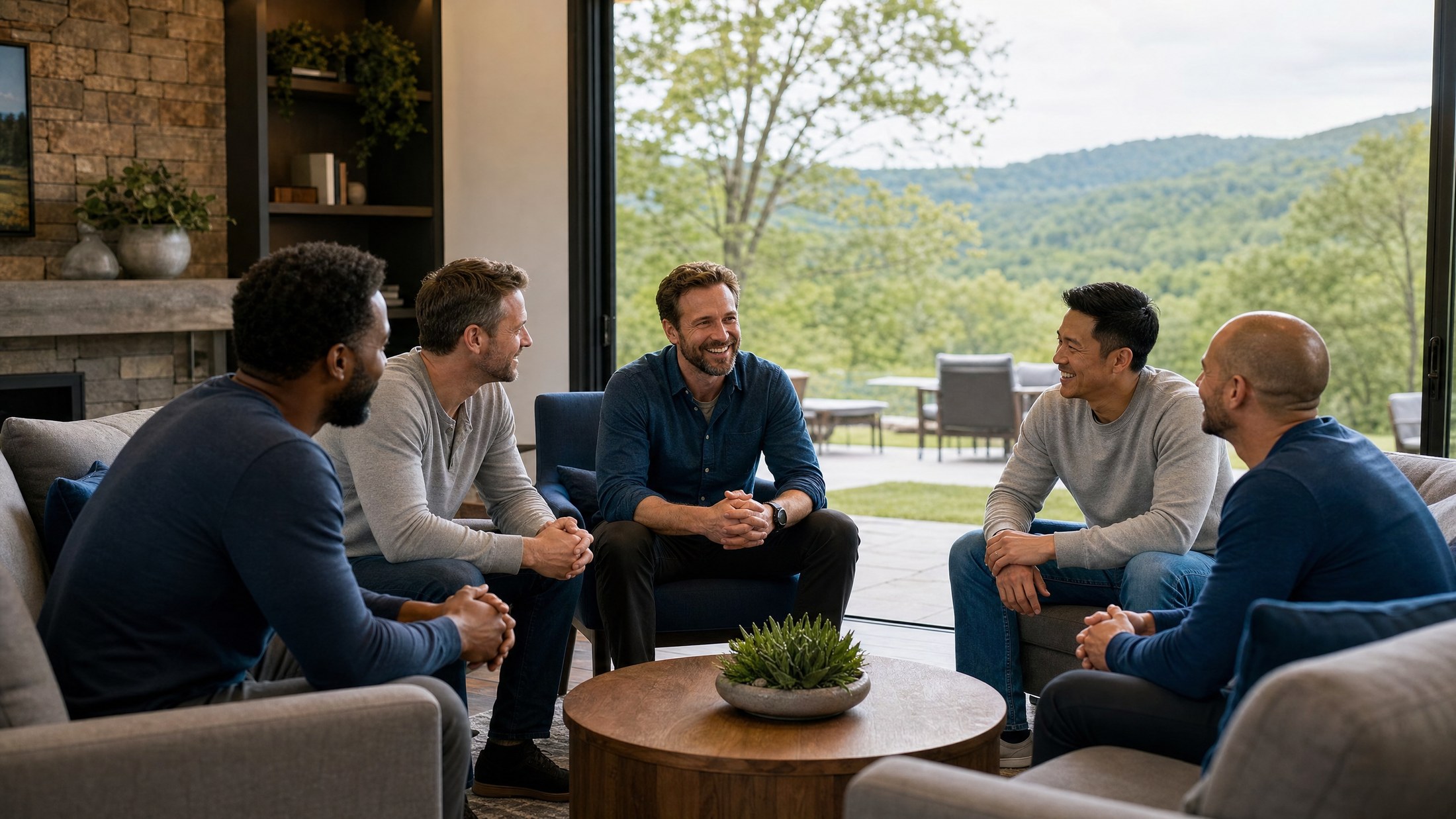
The term "brotherhood" is frequently used in men's recovery, so it's important to define its meaning within a Nashville men's rehab. It's not merely a slogan; it represents a dedicated group of men who consistently gather in the same place at the same time, notice absences, and engage in challenging physical activities together. Accountability is not enforced by a clinician but by a peer who trained alongside them the previous week.
This section explores why this type of peer connection correlates with reduced returns to use and identifies who typically leads effective alumni events.
The rationale for brotherhood is not sentimental; it's evidence-based. Peer support groups in addiction treatment are associated with higher rates of abstinence, greater treatment satisfaction, and significant reductions in relapse and homelessness, especially when groups are structured around self-determination rather than top-down directives. The men in the room are not just companions; they are an active component of recovery.2
Mutual help groups centered on peer connection demonstrate similar positive outcomes. A recent review found that illicit-drug-focused 12-step mutual help groups are effective in reducing substance use and related problems. While formats vary—some are 12-step, some are not, some focus on movement—the underlying mechanism remains consistent: peers who have progressed in their recovery provide support for those still on their journey.8
One clear illustration of how structured, ongoing community correlates with lower relapse rates comes from collegiate recovery programming. A scoping review of CRPs found that 2.2% of current participants at a Midwestern university had returned to harmful use after six months, compared to 10.2% of alumni in national samples. While this data is specific to college students in a CRP, the broader implication is valuable: consistent engagement with a structured recovery community leads to lower rates of return to use compared to when that structure diminishes.1
Alumni events at a Nashville men's rehab are designed to provide this ongoing structure for adults. A boxing class can be seen as a peer support group with a physical component. A Saturday hike functions as a mutual help meeting that also involves physical exertion. The format may change, but the core mechanism—men in recovery, in regular contact, observing each other's patterns—remains constant.
This is why brotherhood is considered clinical infrastructure, not just a marketing phrase. The connection itself is a vital intervention.
In a well-managed alumni event at a Nashville rehab, leadership is typically multi-layered. Often, a masters-level clinician or program staff member is present. Almost always, a peer support worker or recovery coach participates. Additionally, alumni who are further along in their recovery contribute through example, not just by title.
SAMHSA defines peer support workers as individuals who have successfully navigated the recovery process and assist others facing similar challenges. This lived experience is not merely supplementary to clinical work; it enables newer alumni to receive difficult feedback without defensiveness. A man who has experienced detox, PHP, and the initial challenging months post-discharge can communicate with peers with a unique authority that a clinician cannot replicate.9
Data on recovery coaches supports their effectiveness. A review of recovery support services indicated that 54% of participants found recovery coaches helpful in fostering a sense of community. More than half of individuals in these services identified their coach as a primary reason for feeling a sense of belonging. Belonging is not a minor outcome; it's often the motivation that encourages a man to attend an event on a Tuesday night when he might prefer to stay home.6
Recovery coaches have also demonstrated effectiveness across four domains relevant to alumni programming: improved relationships with providers and social supports, increased treatment retention, enhanced satisfaction with the treatment experience, and reduced rates of relapse. This highlights the broad impact of their role.6
For a Nashville men's rehab, the leadership structure of an alumni event is carefully considered. The clinician ensures safety, the peer leader provides credibility, and the alumni in the room cultivate the culture. When all three elements are present, the group itself becomes a powerful learning environment.
Between facility size limits, waivers, and state-by-state rules, figuring out your Medicaid or private insurance benefits can feel like its own full-time job. Our admissions team will verify your coverage in minutes and walk you through exactly what's available — no guesswork required.
Verify Insurance Benefits →No commitment required. Confidential & HIPAA-protected.
Nashville offers a recovery community more than just a zip code; it provides terrain. The hills west of the city, its rivers, and the vibrant gym culture in and around Spring Hill all become resources for an alumni schedule. The purpose of integrating these geographical elements into events is not aesthetic but practical: it enhances reliability. A weekly rhythm requires accessible, memorable locations that offer sufficient physical engagement.
The indoor components of the alumni week typically take place in gyms: boxing on one night, jiu-jitsu on another, CrossFit, and an ice bath following an intense session. For a Nashville men's rehab, these activities are not optional additions; they are integral to the schedule.
Movement plays a crucial role in alumni programming for several reasons. A boxing class provides an outlet for energy that might otherwise lack a healthy channel. Jiu-jitsu demands present-moment focus, making it difficult to dwell on anxieties when actively engaged. CrossFit places individuals alongside peers who are counting reps with them, fostering camaraderie without the pressure of an interview-style check-in. The cold plunge resets the nervous system and creates a shared, memorable experience.
The clinical foundation for this approach is clear: peer support groups are associated with higher abstinence rates and greater treatment satisfaction among individuals with substance use challenges. The gym, in this context, functions as a peer support group in an active setting. Men in the room, having completed detox, PHP, or IOP at a Nashville rehab, often understand each other's journeys without needing explicit discussions.2
Spring Hill and the surrounding Nashville area boast numerous boxing gyms, BJJ academies, and CrossFit boxes that are well-suited for this purpose. Alumni programming partners with these venues rather than attempting to replicate them. This allows men to continue attending the same gym even after their formal program involvement concludes, ensuring that the healthy habit outlasts the structured program.
This continuity is a subtle yet crucial aspect. The Tuesday class becomes a consistent part of a man's life, attended with familiar faces, long after initial treatment.
The outdoor activities during the week offer a different experience: slower, longer, and often quieter. A Saturday morning hike on the Mossy Ridge trail at Percy Warner Park, a paddle on the Cumberland or Harpeth River, or an afternoon at a state park within an hour of Spring Hill—these are settings where conversations unfold naturally, side-by-side, rather than face-to-face.
Spring Hill serves as an ideal home base for this type of programming due to its location. It's south of Nashville proper, making it accessible for men residing in areas like East Nashville or Germantown, while also being close enough to natural ridges and rivers to facilitate outdoor events without extensive logistical challenges. The campus acts as the meeting point, and the trail becomes the learning environment.
SAMHSA's recovery-oriented systems of care framework considers this type of community-based programming a core service, not an ancillary offering. The model outlines a menu of person-centered, strength-based services that integrate clinical care with recovery support, including peer-run programs and recovery community centers. A Saturday hike led by alumni and a peer support worker fits seamlessly within this framework. SAMHSA defines peer support workers as individuals who have successfully navigated recovery and assist others in similar situations, which describes many of those who lead trail days.9,10
The local geography also helps keep these events affordable, which is important. Trailheads and rivers are free to access. Maintaining low barriers to participation encourages consistent attendance.
This establishes the rhythm: indoor activities during the week, outdoor adventures on the weekend, with Spring Hill as the central hub.
The initial ninety days following discharge from a Nashville rehab are often the most vulnerable period in recovery. The structured environment of PHP or IOP is gone, daily routines are less rigid, and previous environments become accessible again. Alumni programming is designed to provide a framework for these ninety days that offers more resilience than individual willpower alone during challenging times.
The first thirty days typically involve frequent contact. A man might attend alumni events two or three times a week—perhaps a boxing class on Tuesday, a group check-in on Thursday, and a Saturday hike. Given the recent clinical transition, the schedule is intentionally robust. This period also sees the most active outreach from peer support workers and recovery coaches. A check-in text after a missed session is not merely a kind gesture; it's a crucial intervention. Recovery management counseling with active outreach has consistently yielded better substance use outcomes and quicker re-entry into treatment if a return to use occurs, compared to aftercare that passively waits for contact.5
Days thirty through sixty usually establish a consistent rhythm. The man becomes familiar with the group and has established connections with peers for support beyond program logistics. Events begin to feel less like appointments and more like an integrated part of his week. This is where the benefits of retention, as described in research, become evident: sustained engagement and adherence over time are linked to reduced substance use and stronger long-term outcomes.7
During days sixty through ninety, two things often happen concurrently: the man's life outside of recovery—work, family, fitness, sleep—begins to stabilize, and the temptation to gradually reduce alumni event attendance grows as life feels more manageable. This is a critical window where men either solidify a sustainable routine or begin to drift. The alumni community is designed to detect this drift. A peer support worker, defined by SAMHSA as someone with lived recovery experience who helps others in similar situations, is typically the first to reach out.9
This process is rarely linear; some weeks are intense, while others are uneventful in the best sense. The purpose of the ninety-day framework is not to grade progress but to provide a clear answer to the question of where to be on Tuesday night, every Tuesday night, while the rest of his life is still finding its equilibrium.
Recovery does not occur in isolation, nor does alumni programming. The men in the community have wives, partners, children, parents, and close friends who also experienced the challenges leading up to treatment. Family events at a Nashville men's rehab offer these individuals a way to connect without requiring them to participate in activities like a Tuesday boxing class.
Most alumni networks offer a separate track for family involvement. This typically includes quarterly family days at the Spring Hill campus, a partners' support meeting on its own schedule, and occasional cookouts or outdoor gatherings where alumni can bring their loved ones. The format is intentionally less intense than the men's events; no one is asked to participate in jiu-jitsu.
The clinical rationale is straightforward: peer support extends to families. Partners benefit from connecting with others who have shared similar experiences during detox, and children benefit from seeing other families navigating similar challenges. Recovery support services consistently improve relationships with social supports, which includes family members at home.2,6
Regarding access, Trifecta Healthcare Institute works with major insurers, including Aetna, Anthem, BCBS, Cigna, United Healthcare, and Tricare, for the clinical aspects of continuing care. The alumni events themselves are part of the brotherhood and are not a billable service.
Alumni programming is not a graduation gift; it is the form recovery takes once clinical hours conclude. For men leaving a Nashville rehab, the crucial question is not whether to stay connected, but where to be on Tuesday night, who will notice an empty seat, and what physical activity will engage the body while the mind adjusts.
At a Spring Hill men's rehab centered on brotherhood and movement, the answer is often specific: a boxing class, a Saturday hike on a Middle Tennessee ridge, or a cold plunge with men who have shared similar experiences. It includes a peer who texts when a session is missed. Individually, these actions may not seem dramatic, but collectively, they are profoundly impactful.
This cumulative quality is essential. Recovery, as framed by SAMHSA, is a process of change rather than a single event. Alumni events provide a consistent space for this process to unfold week after week—a regular time, a familiar environment, and men committed to showing up.12
Staying engaged is the work, and the community makes that work possible.
When you or someone you love are ready to begin healing—mind, body, and spirit—connect with Trifecta Healthcare Institute. We help men thrive in and out of treatment.
Most Nashville men's rehab alumni networks welcome men who completed their primary treatment elsewhere, especially if they are interested in movement-based programming and brotherhood. The intake process is typically informal—a phone call, a visit to the Spring Hill campus, and an introduction at a regular event. Consistent participation and engagement with peers are more important than discharge paperwork.
Ideally, within the first week. Continuity is more important than perceived readiness. Recovery management counseling with active outreach has shown better substance use outcomes than aftercare that passively waits for individuals to reach out. The same principle applies to alumni events: the sooner a man attends a Tuesday class or Saturday hike, the more quickly the environment becomes familiar. Waiting until life feels stable often means missing the critical window when alumni programming provides the most benefit.5
Yes, with a caveat. Virtual check-ins serve as a valuable bridge for men who live an hour or more from Spring Hill, travel for work, or have inflexible schedules. They help maintain connection with peers and a recovery coach between in-person events. However, they are not a complete substitute for the physical activities—boxing, jiu-jitsu, hiking, cold plunges—so most men use them in conjunction with, rather than instead of, in-person attendance.
Some events, yes. Most alumni networks at a Nashville rehab offer a separate family track, which may include quarterly family days at the Spring Hill campus, partner support meetings, and occasional cookouts or outdoor gatherings where alumni can bring their loved ones. The men's-only movement events remain exclusive to men to preserve the brotherhood format. Family programming provides partners and children with their own peer support and space, which generally works better for everyone.
The clinical aspects of continuing care—outpatient sessions, therapy, medication management, and co-occurring mental health support alongside SUD treatment—are generally covered by major insurers Trifecta works with, including Aetna, Anthem, BCBS, Cigna, United Healthcare, and Tricare. The alumni events themselves are part of the brotherhood and are not billed as a clinical service. A quick call to the admissions team can confirm specific plan coverage for continuing care that complements alumni participation.
The community is designed to address this possibility, not to condemn it. A return to use is treated as information, not a final judgment. Peer support workers, defined by SAMHSA as individuals with lived recovery experience who help others in similar situations, typically make the initial contact and assist the man in quickly re-engaging with clinical care—which might involve a return to IOP, detox, or a more intensive alumni schedule. The community he returns to is the same supportive one, emphasizing continuity.9
Whether it's you or someone you love, our team can help you figure out the next step — what treatment looks like, what's covered, or just someone to talk to.
Talk to Our TeamConfidential. No commitment required.


July 30, 2026