



How to Vet and Choose a Rehab for Alcoholics Near Me
Learn how to evaluate a rehab for alcoholics near me by checking licensure, accreditation, therapies, medication use, and long-term care quality.
Read More
Trifecta offers alumni services for active men seeking change. Maintain your momentum with peer support, movement programs, and coordinated care.
Start Your Journey NowWritten and reviewed by the clinical team at Trifecta Healthcare Institute, a men’s-only treatment center in Tennessee specializing in substance use, mental health, and dual diagnosis care.
Discharge from a residential program or an intensive outpatient program is often treated like a finish line. It isn't. It's the moment the slower, harder, more rewarding work begins — the work that decides whether the gains made inside a treatment center hold up against a Tuesday night, a job loss, or a funeral. For active men leaving Nashville rehab or Knoxville rehab, what happens in the months and years after that last group session is what alumni services exist to shape.
Recovery is a process of change, not a single event with a date stamped on it. SAMHSA frames it as ongoing — people improving their health, finding direction, and building a life they actually want to live in. Roughly 50.2 million American adults consider themselves to be in recovery, which says something quiet but important: this is not a fringe experience, and the men walking out of a Spring Hill or Knoxville facility are joining a population that has already figured out one thing — the work continues.1
The Institute of Medicine's continuum of care names four dimensions that hold a recovery life together: health, home, purpose, and community. None of those four arrive at discharge. They get built. A man might leave residential care with sobriety, a treatment plan, and a packed gym bag, but the home he returns to, the purpose he hasn't quite named yet, and the community he needs to stay accountable to — those are constructed week by week.8
This is why framing alumni services as a goodbye gift misses the point. They aren't a thank-you packet. They are the structure that catches a man during the long arc when treatment is technically over but recovery is very much in progress. For men who came into care with a body that craves activity and a temperament that needs other men around to stay honest, the arc bends differently. It bends toward movement, toward repetition, toward showing up — and toward a peer group that doesn't disappear once insurance stops paying.
The useful question after discharge is not "Am I done?" It's "What's the next ten years going to look like, and who's walking it with me?"
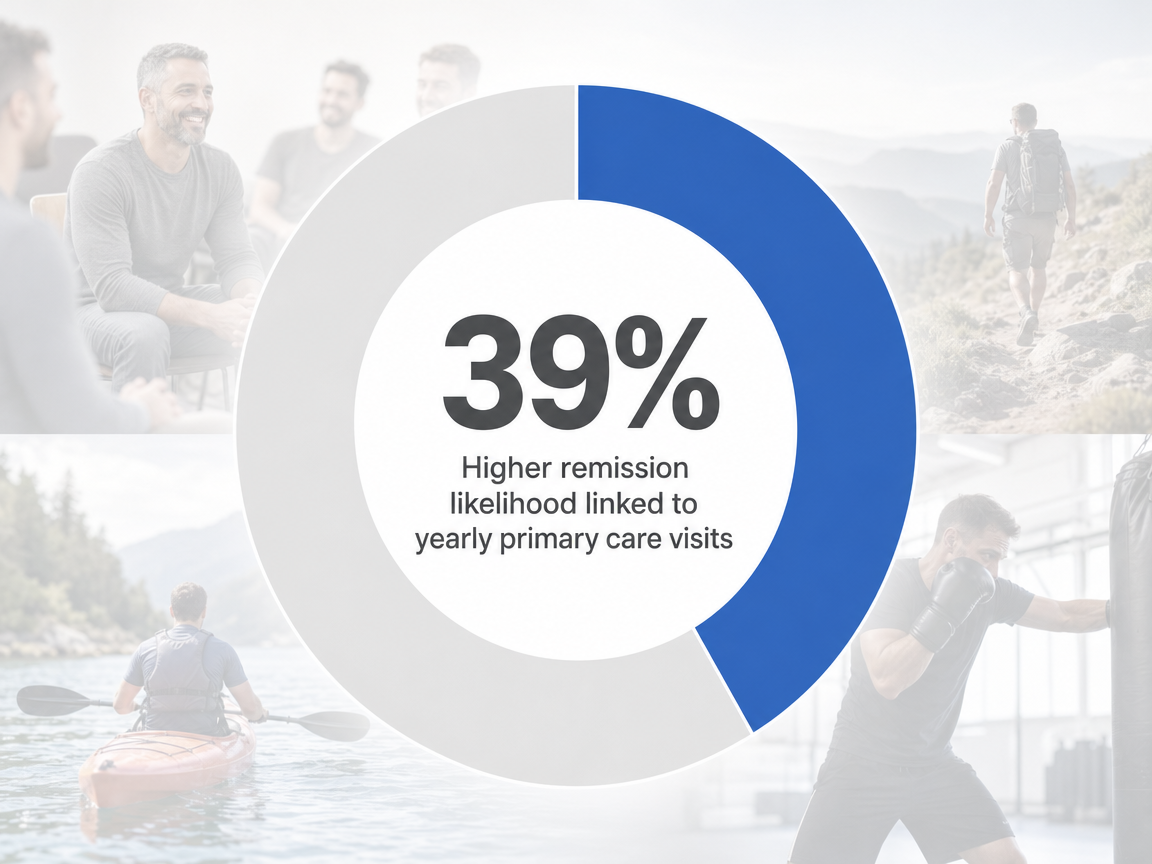
There is one finding that should reshape how men, families, and clinicians think about life after primary treatment. A nine-year prospective study of 991 adults in a managed care health plan found that people receiving continuing care had twice the odds of achieving remission at follow-ups compared to those without it (p<.001). The same study found that having a yearly primary care visit was associated with a 39% higher chance of remission (OR=1.39, CI=1.11–1.75).9
A few things deserve to be said plainly about that data. The study tracked 991 adults inside a managed care population, not the entire country, and "continuing care" in the research meant a combination of primary care, specialty substance abuse treatment as needed, and ongoing monitoring — not any single program. So the takeaway isn't that one alumni meeting per quarter doubles anyone's chances. The takeaway is that men who stay tethered to a structured care relationship — medical, clinical, and peer — measurably outperform men who don't. That's the hinge of this article.
What changes when continuing care is real? The texture of the week changes. A man has a place to be on Thursday night that isn't a bar. He has a primary care doctor who knows his history and isn't surprised when he asks about sleep, mood, or a flare-up of old pain. He has someone to call when a craving lasts longer than the usual ten minutes.
Alumni services for active men package those mechanisms into something that fits a life already in motion — work, family, training, faith, the rest of it. The clinical evidence is not asking men to attend more meetings. It is asking them to stay connected to care long enough for the brain, the body, and the relationships to settle into a new pattern. Two times the odds of remission is what shows up on the other side of that consistency.9
Alumni programs vary wildly in what they actually deliver. Some are little more than a Facebook group and a once-a-year barbecue. Others are tightly engineered systems of peer leadership, scheduled checkups, group programming, and movement. For active men leaving treatment in Tennessee, the difference between those two ends of the spectrum is not a matter of taste — it shows up in whether the next year holds.
Two elements separate a real alumni program from a thin one: a brotherhood structure that functions as clinical infrastructure, and a cadence of contact that doesn't drift after the first ninety days.
The word "brotherhood" gets thrown around in men's recovery marketing until it stops meaning anything. Inside an alumni program, it should mean something specific: a group of men with shared lived experience, organized into regular contact, with trained peer leaders inside the room.
That structure is not soft. A 2021 meta-analysis of group peer support interventions across mental health and co-occurring substance use conditions found moderate-to-large effect sizes for improvements in social support, reductions in isolation, and gains in treatment engagement. The authors note that group-based models are particularly effective for building recovery identity and sustaining long-term engagement. Translated for an active man in Spring Hill or Knoxville: showing up to a Tuesday night men's group is not a vibe — it's an intervention with measurable outcomes on the things that most often unravel in the second year.4
What makes it clinical rather than casual is who runs the room. SAMHSA defines peer support workers as people with shared lived experience plus professional training, working inside clear role boundaries. They handle advocacy, skill-building, community-building, mentoring, and goal-setting — and they reduce the likelihood of relapse through the kind of mutual empowerment that a clinician, however skilled, can't supply from the outside. A trained peer is not a sponsor and not a therapist. He's the third leg of the stool.1,7
Men-only group composition matters here too. The meta-analysis flagged group structure and homogeneity as variables affecting outcomes. For a man working through shame, fatherhood, anger, or the specific way substance use can hollow out male friendship, sitting in a room of other men carrying similar weight changes what gets said. The conversation goes places it doesn't go in mixed-gender continuing care — not because mixed groups are wrong, but because some material moves faster among peers who recognize the terrain.4
A real brotherhood structure inside an alumni program, then, has three parts: regular group contact, trained peer leaders, and shared identity in the room. Knoxville rehab for men and Tennessee men's addiction treatment programs that take this seriously schedule it, staff it, and protect it. The men who stay tethered to that room a year out tend to be the same men still in recovery five years out.
Engagement decays without a schedule. That's the quiet problem with informal alumni networks: motivation runs hot for ninety days, then life crowds in. A real alumni program builds a cadence — a rhythm of contact that survives a busy quarter, a new job, a move across town.
The research points to specific frequencies. The nine-year managed care study found that yearly primary care visits were associated with a 39% higher chance of remission, and post hoc analyses showed that visits every other year were only marginally associated with remission — frequency mattered, not just presence. A 2024 systematic review of peer recovery support services and recovery coaching reinforced the cadence point on the peer side: peer-led interventions produced significant improvements in treatment adherence and sustained recovery outcomes compared with standard care, with engagement frequency a recurring variable in positive outcomes.9,10
That cadence does a few things at once. The weekly touchpoint — a boxing class, a hike, a jiu-jitsu roll, a coffee before group — keeps a man in physical contact with other men in recovery, which is where most early warning signs surface first. The monthly group adds depth: longer conversation, structured topics, a peer leader running the room. The quarterly recovery checkup is the underrated piece. It's a scheduled appointment with a recovery coach or clinician to review what's working, what's slipping, and what the next ninety days look like — short, specific, and on the calendar before it's needed.
The yearly primary care alignment is the part most alumni programs ignore. A primary care doctor who knows the recovery history, screens for sleep, mood, pain, and medication interactions, and coordinates with the alumni team turns continuing care from a peer experience into a medical one. That's the combination the data keeps pointing back to: peer support plus medical continuity, on a schedule that doesn't depend on willpower.9
None of this requires heroic effort. It requires a calendar, a peer leader who follows up when a man misses two weeks, and an alumni program willing to reach out rather than wait. For Nashville rehab and Knoxville rehab graduates, the practical version looks like this: a standing weekly slot for movement with the brotherhood, a monthly men's group, a quarterly fifteen-minute recovery checkup, and a yearly physical that loops back to the recovery team. That rhythm is what holds.
Between facility size limits, waivers, and state-by-state rules, figuring out your Medicaid or private insurance benefits can feel like its own full-time job. Our admissions team will verify your coverage in minutes and walk you through exactly what's available — no guesswork required.
Verify Insurance Benefits →No commitment required. Confidential & HIPAA-protected.
Most aftercare programs treat exercise like a wellness amenity — a yoga class on the schedule, a walking group on Saturdays. That framing undersells what movement actually does inside SUD recovery. A 2024 systematic review of integrated physical activity and behavioral interventions found that combining the two produced significantly better substance use outcomes and psychological well-being than behavioral therapy alone, and that movement-based group activities strengthened social cohesion and recovery identity among participants. For active men, that shifts movement from optional to clinical.3
The rest of this section looks at what that means in practice — first inside the gym and on the mat, then outside on the trail and in the cold water.
Walk into a boxing gym at 6 a.m. and watch what happens. Men who would never sit in a circle and talk about their fathers will hold mitts for each other, correct each other's footwork, and ride home in the same truck afterward. Something gets transacted in that hour that a clinician cannot manufacture from across a desk.
The systematic review on integrated physical activity and behavioral interventions makes the mechanism less mysterious. Physical activity, layered on top of behavioral therapy, reduces cravings, improves mental health outcomes, and strengthens peer bonding — and group-format movement does that bonding work measurably better than solo training. The review flags three mechanisms that matter for active men in alumni status: craving reduction, mood regulation, and recovery identity formed through shared physical effort.3
Boxing does specific work. The combination of breath, repetition, and a partner who is paying attention to a man's body for an hour cuts through the fog that often follows early recovery. CrossFit does similar work in a different vocabulary — short cycles of measurable effort with other men watching, counting, and finishing the round together.
Jiu-jitsu adds something the striking arts don't. Rolling on the mat is cooperative and competitive at the same time, and it requires a kind of physical trust that men in recovery often have not practiced in years. A man who has spent a decade keeping people at arm's length learns, three nights a week, to let another man into his guard and out of it. That is not metaphor. It is the same skill the group room is asking for, rehearsed in the body first.
None of this replaces the men's group or the recovery checkup. It runs alongside them. A Knoxville rehab for men program with a real alumni structure schedules the boxing class, the jiu-jitsu open mat, and the CrossFit session as part of the continuing care calendar — not as extras a man finds on his own — and pairs them with peer leaders who notice when someone stops showing up.
Tennessee gives an alumni program something most states can't. The Great Smoky Mountains sit a short drive from Knoxville, and the hills around Spring Hill open into trail systems that absorb a Saturday without effort. For men whose recovery depends on being outside and moving, that geography is part of the treatment plan.
A day hike with a group of men in alumni status does three things at once. It pulls the nervous system out of the indoor, screen-lit pattern that often holds cravings in place. It produces hours of unstructured conversation, the kind that doesn't happen in a fluorescent group room. And it ties recovery to a place — a ridgeline, a creek crossing, a particular overlook — that a man can return to alone or with his kids years later. The integrated physical activity review notes that group-format outdoor movement strengthens recovery identity in exactly this way, by linking sustained effort with shared experience.3
Ice baths do something different and more specific. Cold exposure, repeated weekly with a group of men breathing through it together, trains a man to stay calm inside acute discomfort. That is the same skill a craving requires. The mat teaches it through pressure; the cold tub teaches it through stillness. Both pathways feed mood regulation and the kind of bodily confidence that erodes during active substance use.3
Ropes courses, white-water trips, and longer outdoor weekends layer in trust and shared risk — small, controlled doses of fear handled with other men. The point is not adrenaline. It is the rehearsal of doing hard things on purpose, with a brotherhood, and walking out the other side intact.
For Nashville rehab graduates and Tennessee men's addiction treatment alumni, the practical version is less exotic than it sounds: a standing Saturday hike, a Tuesday cold plunge, a quarterly weekend in the mountains with peer leaders running the day. Built into the calendar, those events stop being trips and start being infrastructure — the outdoor half of a continuing care life.
Most men who walk into Nashville rehab or Knoxville rehab for men are not dealing with substance use alone. Anxiety sits underneath the drinking. Depression shadows the cocaine. Untreated trauma drives the opioid use that started after a back injury or a deployment. When primary treatment ends, those mental health threads don't end with it — they walk out the door alongside the man, and they show up again in month four, in month nine, in year two. An alumni program that ignores this part of the picture is only handling half the work.
A word on scope before going further. Trifecta Healthcare Institute treats co-occurring mental health conditions alongside substance use disorders. It does not provide primary mental healthcare or inpatient psychiatric services. For men whose primary diagnosis is severe mental illness, the right care lives elsewhere. For men whose anxiety, depression, or trauma is woven into a substance use disorder, alumni services that integrate dual-diagnosis follow-through are exactly the right address.
The Institute of Medicine's continuum of care names community and purpose as two of the four dimensions a recovery life rests on, alongside health and home. Co-occurring mental health support is where those four dimensions either knit together or fray. A man with untreated depression rarely sustains community. A man with active trauma symptoms struggles to hold purpose. Alumni programming that takes mental health seriously builds checkpoints into the cadence already in place — the weekly movement touchpoint, the monthly group, the quarterly recovery checkup — so that a slipping mood or a returning panic pattern gets caught early rather than after a relapse.8
The research on continuing care frames this carefully. The nine-year managed care study noted that psychiatric services were often needed but found a complex relationship between psychiatric service use and remission, with timing and severity acting as moderators. The honest read is not that mental health treatment hurts recovery — it's that mental health support has to be coordinated with the rest of continuing care rather than bolted on during a crisis. That coordination is what an alumni program with co-occurring capacity actually delivers: medication management aligned with the recovery plan, trauma therapy scheduled alongside group, a clinician who talks to the peer leader, and a primary care doctor looped into both.9
For active men, movement carries some of this load too. The integrated physical activity review found that combining behavioral therapy with physical activity produced measurable gains in psychological well-being, not only substance use outcomes. A boxing round, a hike with the brotherhood, a cold plunge on a Tuesday morning — these are not substitutes for trauma therapy or an SSRI when one is indicated. They are mood regulation in the body, supporting the clinical work happening in the office.3
What to look for in a Tennessee men's addiction treatment alumni program: explicit dual-diagnosis follow-through, masters-level clinicians available beyond the discharge date, medication management coordinated with primary care, and peer leaders trained to recognize when a man's mental health is shifting before he names it himself. The men who stay tethered to that integrated structure tend to be the men whose second and third year of recovery hold.
The men who hold recovery over the long arc are rarely the ones with the most willpower. They are the ones with the best infrastructure — a brotherhood that calls when they go quiet, a movement schedule that doesn't require a decision on a hard morning, a recovery coach who knows their patterns, and a primary care doctor who reads their chart with the substance use history in mind.
For active men leaving Nashville rehab or Knoxville rehab for men, the work after discharge is less dramatic than the work inside the facility, and more decisive. It looks like a Tuesday boxing class, a Saturday hike up a familiar ridgeline, a fifteen-minute checkup on the calendar every quarter, and a men's group that meets whether the room is full or not. Built right, it stops feeling like maintenance and starts feeling like a life.
For men not yet connected to care, SAMHSA's National Helpline runs free, confidential, 24/7 referrals to local resources. For men already on the other side of primary treatment, the next step is smaller and more specific: name the brotherhood, mark the calendar, and walk forward with other men doing the same work.2
There is no graduation date. The continuing care research that anchors this question tracked outcomes across nine years, not nine months, and the men who held remission were the men still tethered to structured care years out. A practical floor is two years of active engagement — weekly peer or movement contact, monthly group, quarterly recovery checkup. After that, cadence often loosens but rarely disappears. Many men in long-term recovery stay connected to a brotherhood for life, shifting from receiving support to mentoring newer alumni. The right length is the length that keeps the rhythm honest.9
Recovery housing — sober living homes, structured residences with house rules and peer accountability — is one of the four recovery support services named in the Institute of Medicine continuum, alongside mutual aid groups, peer support services, and recovery community centers. For a man in the first six to twelve months after primary treatment, it covers the home dimension of recovery while the rest is still being built. The value is not the bed. It is waking up around other men in recovery, sharing chores, and walking out the door each morning into a day already shaped by accountability.8
Yes, with deliberate handoff. The mechanisms that make alumni care work — peer contact, group structure, recovery checkups, primary care alignment — are portable, but they don't transplant themselves. A man relocating from Spring Hill to Atlanta or from Knoxville to Denver should leave with a written continuing care plan, warm introductions to peer support and clinical resources in the new city, and a commitment to keep monthly contact with his original brotherhood by video or phone. Distance erodes engagement faster than people expect. Calendar holds and named contacts on both ends are what keep the cadence intact.
Group composition is a measurable variable in peer support outcomes, with homogeneity flagged as one factor influencing engagement and identity formation. For men working through fatherhood, anger, sexual shame, or the specific way substance use can hollow out male friendship, a men-only room often surfaces material that stays buried in mixed groups. The point is not exclusion. It is that some recovery work moves faster among peers who recognize the terrain without translation. Tennessee men's addiction treatment programs built around a men-only alumni structure are leaning into that dynamic rather than treating gender composition as a marketing detail.4
Family integration usually runs on a parallel track rather than the same one. A wife, a parent, or an adult child has their own recovery work to do — understanding the disorder, rebuilding trust, and sometimes addressing their own patterns. Strong alumni programs offer family education sessions, separate family support groups, and structured family therapy when the recovery plan calls for it. SAMHSA's National Helpline can also connect families to local family-focused resources independent of the man's program. The goal is not to fold family into the brotherhood but to give them a brotherhood-equivalent of their own.2
A peer support worker brings shared lived experience plus formal training and operates inside defined role boundaries. Inside an alumni program, that translates to specific tasks: running groups, following up when a man misses two weeks, walking newer alumni through goal-setting, advocating for someone navigating a court date or a custody hearing, and connecting members to clinical resources when something exceeds peer scope. A peer is not a sponsor and not a clinician. He is the person who texts on a Tuesday afternoon, shows up to the boxing class, and notices the early warning signs before they become a crisis.7
Whether it's you or someone you love, our team can help you figure out the next step — what treatment looks like, what's covered, or just someone to talk to.
Talk to Our TeamConfidential. No commitment required.


July 30, 2026