



How to Vet and Choose a Rehab for Alcoholics Near Me
Learn how to evaluate a rehab for alcoholics near me by checking licensure, accreditation, therapies, medication use, and long-term care quality.
Read More
Explore how a Nashville treatment center guides recovery through detox, therapy, and ongoing support tailored to individual needs and family considerations.
Start Your Journey NowWritten and reviewed by the clinical team at Trifecta Healthcare Institute, a men’s-only treatment center in Tennessee specializing in substance use, mental health, and dual diagnosis care.
Most people picture rehab as a destination. In real life, it starts as a phone call from a kitchen table at 11 p.m., or a parking lot at lunch, or a hospital chair after something finally broke. The first 24 hours of a Nashville treatment center stay are less about clinical theory and more about getting a man safely out of one environment and into another, with a doctor watching his vitals and someone making sure he eats. Understanding what actually happens in that first day takes a lot of the fear out of making the call.
The first call to a Nashville rehab is usually short. An admissions coordinator asks what is being used, how much, how often, and when the last dose was. That last question matters more than people expect, because it tells the medical team how soon withdrawal will start and what kind of detox the body needs.
For opioid use disorder, that conversation often turns toward medication. The CDC notes that medications for opioid use disorder, including methadone, buprenorphine, and naltrexone, are effective in helping people recover, and that finding the right fit for the individual matters 2. None of that gets decided on the phone. It gets decided after the man arrives, by a clinician who can see him.
Intake itself is paperwork, a urine screen, a medical history, a mental health screen, and a meeting with a nurse. Belongings are checked. Phones are usually held. Vitals get taken every few hours during the first night because alcohol and benzodiazepine withdrawal can spike blood pressure and trigger seizures.
By the time he gets to the bed, he has eaten something, taken any starter medications the physician ordered, and met at least one other man on the unit. He has not solved his life. He has done the one thing that had to happen first, which is sleep somewhere safe while a team watches over him.
The man making the call, or the wife or mother making it for him, is rarely sitting in downtown Nashville. Davidson County has a population of 712,334, with a median household income of $71,863 compared to $64,035 for Tennessee as a whole, and an uninsured rate of 14% compared to the state's 12% 9. Those numbers tell a quieter story than the skyline does.
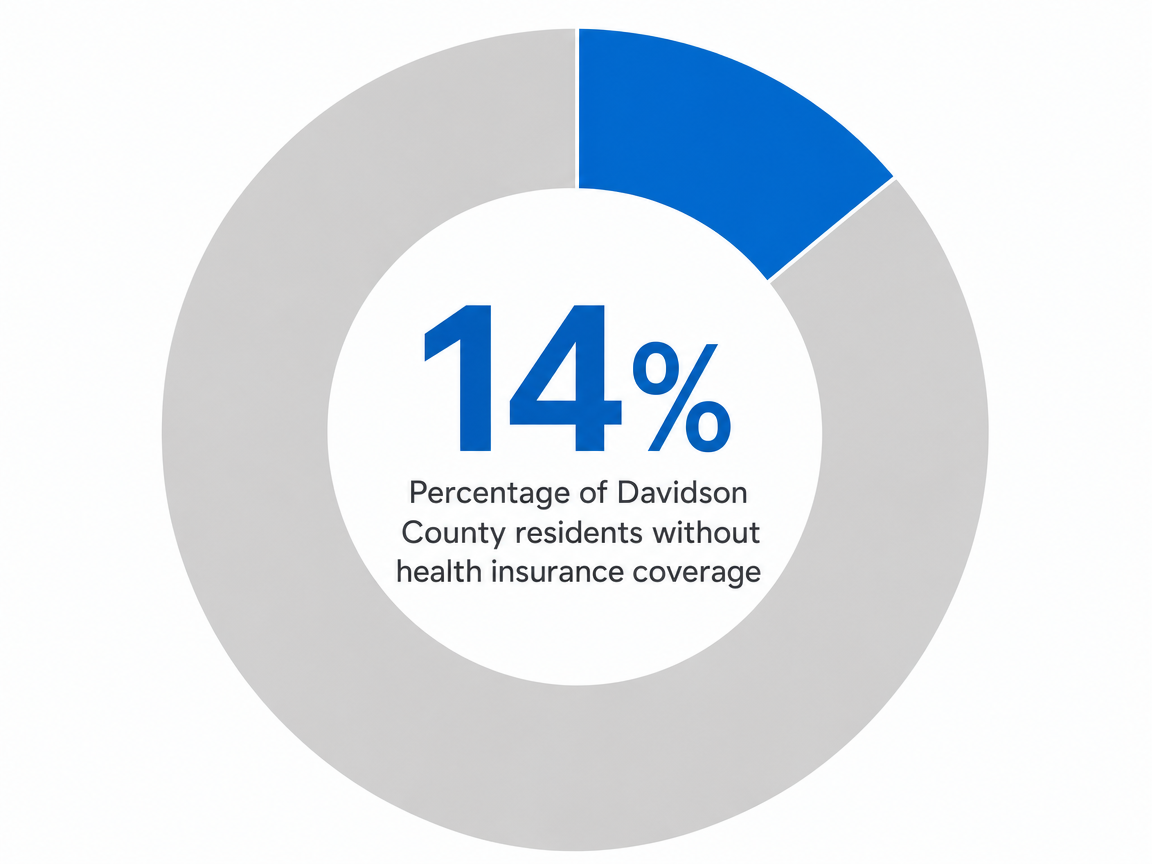
A higher local income does not erase the coverage gap. One in seven adults in Davidson County is uninsured, which means a meaningful share of men in crisis are calling without a card in their wallet, or with a high-deductible plan that feels almost as scary as the detox itself. That changes how the first conversation goes. A good Nashville treatment center will run a benefits check during intake instead of asking the family to figure it out alone.
Geography matters too. Most calls into a Spring Hill men's program come from a wider arc than the city itself, with families in Williamson, Rutherford, Sumner, Wilson, and Maury counties driving in along I-65 and I-24. A man who lives in Franklin or Murfreesboro is often calling because the Nashville metro is the closest place that runs a real medical detox, not because he wants the city. The first 24 hours, for him, also include a car ride and a goodbye at the door.
Most families hear the phrase "continuum of care" and assume it is marketing language. It is not. It is a clinical map, written by national bodies, that describes how a person moves from active crisis to stable life. SAMHSA frames behavioral health services across four areas: promotion, prevention, treatment, and recovery 3. The American Society of Addiction Medicine breaks the treatment portion into five levels, with criteria for who belongs where and when to step up or down 5. A Nashville treatment center is not one stop. It is a path with rungs, and the right entry point depends on what the body and the mind need on day one.
Detox is not treatment. It is what makes treatment possible. The body has to come off the substance safely before any therapy can land, because a man in acute alcohol or benzodiazepine withdrawal cannot sit through a CBT session, and a man in opioid withdrawal cannot think past the next hour. Medical detox at a Nashville rehab is a supervised stretch, usually three to seven days, where a physician and nursing team manage symptoms with medication, fluids, and round-the-clock monitoring.
What happens in detox depends on the substance. Alcohol withdrawal can become medically dangerous, with risks including seizures and delirium tremens, which is why a clinical setting matters more than willpower. Benzodiazepine withdrawal works on a similar timeline and often requires a slow taper rather than an abrupt stop. Opioid withdrawal is rarely fatal on its own, but it is severe enough that most people who try to detox at home end up using again within 48 hours just to make the symptoms stop.
This is where medication for opioid use disorder enters the conversation. The CDC notes that medications such as methadone, buprenorphine, and naltrexone are research-supported options, and that the right fit depends on the individual 2. A clinician decides which medication, at what dose, and for how long, after looking at the man's history, his other prescriptions, and what kind of program he is moving into next.
Detox ends when the body is stable, not when the man feels ready. Feeling ready takes longer, and that is what the next level of care is for.
Once detox clears, the question becomes how much structure a man still needs. ASAM's five-level continuum gives clinicians a way to answer that without guessing 5. The rungs run from medically managed inpatient care at the top through residential treatment, partial hospitalization, intensive outpatient, and standard outpatient at the bottom, with continuing care running alongside all of it.
Partial Hospitalization Program, or PHP, is the step most men take after detox. It looks like a full workday of treatment, typically five or six hours a day, five days a week, with the man sleeping at the facility or in a sober living environment nearby. Group therapy, individual sessions, psychiatric check-ins, and skills work fill the schedule. PHP exists because the gap between 24-hour detox and going home is too wide for most people to jump in one move.
Intensive Outpatient Program, or IOP, is the next rung down. Three days a week, three hours a session, often in the morning or evening so a man can return to work. The intensity drops, but the structure stays. Standard outpatient comes after IOP, with weekly therapy and medication management, sometimes for a year or longer.
Alumni and aftercare are not the same as outpatient. They are the recovery support layer SAMHSA describes through four core dimensions: Health, Home, Purpose, and Community 4. A man needs to be managing his substance use, living somewhere stable, doing something that matters during the day, and connected to people who know what he is working through. A Nashville treatment center that takes alumni seriously runs groups, sober events, and check-ins long after the formal program ends. The NIH chapter on this is blunt: the best outcomes show up in clients who stay engaged in continuing care, because substance use disorders often relapse and remit over years rather than weeks 5.
The five rungs are not a staircase a man climbs once. Some step back up after a hard week. Some skip rungs because their situation calls for it. The point of the continuum is that the door does not close behind anyone.
Between facility size limits, waivers, and state-by-state rules, figuring out your Medicaid or private insurance benefits can feel like its own full-time job. Our admissions team will verify your coverage in minutes and walk you through exactly what's available — no guesswork required.
Verify Insurance Benefits →No commitment required. Confidential & HIPAA-protected.
A Nashville treatment center can be co-ed, women's-only, men's-only, or specialized for adolescents. Each design choice changes what happens in the room. A men's program in Spring Hill is built around a specific idea: that a lot of men in early recovery do their best work shoulder-to-shoulder with other men, in groups that move and sweat as often as they sit and talk. That is not a knock on co-ed care. It is a different toolset for a different reader.
Most men in early recovery have spent years hiding. They have hidden bottles, hidden bank statements, hidden the real reason they were late. Walking into a room of other men who have done the same thing changes the math. There is less to perform and less to protect.
A co-ed program can do excellent clinical work, and many do. The difference in a men's-only setting is what comes up between the formal sessions. Conversations about fatherhood, about a marriage that may or may not survive, about shame around sex or money or violence, tend to land harder when the room is all men. A man who has never told anyone he was molested as a kid is often more likely to say it out loud the first time around other men who already trusted the group with something similar.
Accountability also looks different. In a brotherhood-style program like the one Trifecta Healthcare Institute runs in Spring Hill, men call each other out on the small things. Skipping breakfast. Staying on the phone too long with a chaotic relationship back home. Coasting through a group instead of working it. That kind of feedback is a feature of the design, not an accident.
None of this means a man cannot heal in a co-ed environment. It means that for the reader of this guide, often a man in real crisis or someone who loves him, a Nashville rehab built around men working alongside men removes one of the most common reasons men quietly disengage in the first two weeks.
Movement-based programming gets oversold in a lot of marketing. It is worth being honest about what the research actually shows, and what it does not.
A Harvard Health review describes a small human study in which 38 men and women who misused a variety of substances were offered an exercise program. Twenty people completed it. At a one-year check-in, five reported abstinence and ten reported decreased substance use 6. That is not a clean win. It is half of the completers showing meaningful change, with a notable drop-off between enrollment and completion. A 2024 meta-analysis on exercise in substance use disorder recovery comes to a similar place: combining cognitive behavioral therapy with structured physical activity addresses both the psychological and physical sides of addiction, but dropout rates and cultural fit are real obstacles, and voluntary participation works better than forced participation in early treatment 7.

So movement is an adjunct, not a cure. That framing matters. What it offers a man in early recovery is more practical than mystical. Boxing burns off a kind of restless energy that early sobriety produces and gives a beginner some structure to a workout. Jiu-jitsu forces a man to be fully present, because someone is actively trying to choke him and he cannot think about a craving and a triangle choke at the same time. Hiking gets him outdoors, sleeping better, and walking next to another man rather than across from him, which often opens up conversations a chair-and-table setup never would.
Ice baths and cold exposure get talked about a lot. The honest version is that they create a controlled stressor the nervous system has to regulate through, which is useful practice for a man whose nervous system has spent years using a substance to regulate everything. CrossFit, basketball, ropes courses, and outdoor programming all work on the same logic. A man learns that he can feel uncomfortable, breathe through it, and come out the other side, with other men watching him do it.
The point is not that exercise replaces therapy. It is that a Nashville rehab using movement alongside CBT, DBT, EMDR, and motivational interviewing gives men more entry points into the work.
A lot of men arriving at a Nashville treatment center are not just dealing with substance use. They are also living with depression, anxiety, post-traumatic stress, or grief that never got addressed. Treating only the drinking or only the pills, while leaving the underlying condition untouched, is one of the most common reasons relapse happens in the first six months.
This is where the language has to be precise. Trifecta's Spring Hill program treats co-occurring mental health conditions alongside substance use disorders. That means a man whose alcohol use is tangled up with depression, or whose opioid use grew out of untreated PTSD from a deployment or a car accident, gets clinical attention to both at the same time. Masters-level clinicians use evidence-based modalities like EMDR for trauma, CBT for depressive thinking patterns, and DBT for the emotional regulation pieces, while the medical team handles medication management for psychiatric needs that show up alongside the substance use.
What the program does not do is serve as primary mental healthcare. A man whose substance use is mild but whose depression or psychosis is the dominant clinical issue belongs in a different setting. The honest answer to the family asking on his behalf is that a men's addiction treatment center is the right call when substance use is the central problem and a co-occurring mental health condition is part of the picture, not the other way around. Knowing that line ahead of time saves families from a placement that will not fit.
The two questions families ask after "is he safe?" are almost always "what does this cost?" and "how do we get him there?" Both answers are more practical than they sound, and both deserve straight talk before the admissions call rather than after.
Most major commercial plans cover addiction treatment at a Nashville rehab the same way they cover any other medical care, because federal parity law requires it. That is the headline. The details are where families get tangled up.
A men's program in Spring Hill like Trifecta Healthcare Institute typically works with Aetna, Anthem, Blue Cross Blue Shield, Cigna, United Healthcare, and Tricare. What that means in practice is that a benefits coordinator at the facility runs a verification before admission, confirms what the plan covers for detox, PHP, IOP, and outpatient, and gives the family a written estimate of out-of-pocket exposure. Deductibles, coinsurance percentages, and out-of-network rules vary plan to plan, so two men with the same insurer can end up with different bills.
Self-pay is the second path. Some families choose it because the man's plan has a high deductible and they would rather pay a negotiated cash rate than fight prior authorization while he is in withdrawal. Some choose it for privacy reasons. A reputable Nashville treatment center will quote the cash rate in writing and explain payment plans before any money changes hands.
The coverage gap is the harder conversation. Roughly one in seven adults in Davidson County is uninsured, compared to about one in eight statewide 9. For a man without coverage, the path usually involves Tricare if he served, a state-funded program with a waitlist, or a facility willing to negotiate based on circumstance. Asking about that on the first call is not rude. It is the right question.
Spring Hill sits about thirty-five miles south of downtown Nashville, just off I-65 in northern Maury County. For families in Franklin, Brentwood, or Cool Springs, that drive is roughly twenty to thirty minutes. From Murfreesboro, it is closer to an hour, mostly along I-840. From Hendersonville, Gallatin, or Mount Juliet, plan on a little over an hour, depending on traffic through the metro.
That geography matters more than it looks on a map. A man being driven to detox is rarely in shape to direct anyone. Families coming from Wilson or Sumner counties usually leave early to avoid I-40 congestion. Families coming up from Columbia or Spring Hill itself sometimes make the trip in fifteen minutes. The point is that a Nashville treatment center located on the I-65 corridor pulls from a wider catchment than the city limits suggest, which is part of why men's rehab in Tennessee tends to cluster along that route.
Most programs handle transportation logistics during intake. If a man cannot safely drive himself, the admissions team will help coordinate a ride or, in some cases, arrange pickup. Families calling from the surrounding counties should ask about that on the first call rather than assuming they have to figure it out alone.
Discharge is not a finish line. It is the day a man trades a structured schedule for an empty calendar, and what fills that calendar over the next year is what determines whether the work holds.
The Tennessee data is more hopeful than most families expect. A peer-reviewed study of publicly funded treatment clients in Tennessee found post-treatment abstinence rates of around 60% each year over a three-year follow-up, alongside meaningful drops in unemployment and arrests 1. That figure comes with a clear scope: it tracked publicly funded clients, not every treatment population, and it measured outcomes across three years rather than three months. Even with those limits, it pushes back on the quiet assumption a lot of families bring to the first call, which is that nothing really works.

What keeps a man inside that 60% is rarely one big thing. SAMHSA's four recovery dimensions name what a sustainable life actually looks like after discharge: Health, Home, Purpose, and Community 4. Health means staying connected to outpatient therapy, medication management, and primary care. Home means a stable place to sleep, which the Nashville/Davidson County 2024-2025 health assessment names as one of the foundational social determinants of long-term outcomes 9. Purpose means work, school, fatherhood, or service that gives the day a shape. Community means other men who know what he is working through.
Alumni programming exists to hold that scaffolding in place. Weekly groups, sober events, and check-in calls keep a man on the radar of people who notice when he goes quiet. The NIH chapter on continuing care is direct about why that matters: substance use disorders often relapse and remit over years, and the best outcomes show up in clients who stay engaged long after formal treatment ends 5. Discharge, done well, is a handoff rather than a goodbye.
Calling a Nashville treatment center is rarely the moment a man feels strongest. It is usually the moment something gave way. The good news is that the system on the other end of the line is more organized than it looks from the outside. Medical detox makes the body safe. PHP and IOP put structure around the days that follow. Outpatient and alumni programming keep a man connected long after the formal program ends, which is where SAMHSA's four dimensions of Health, Home, Purpose, and Community do their quiet work 4.
For men in Davidson, Williamson, Rutherford, Sumner, Wilson, or Maury counties, a men's-only program in Spring Hill offers one specific version of that path: evidence-based therapy paired with movement and a room full of other men working on the same thing. It is not the only road. It is a road that has helped a lot of men find their way back.
Most Nashville rehabs can complete a phone screen, verify insurance, and admit a man on the same day, especially for medical detox. The actual timeline depends on bed availability, the substance involved, and how quickly the family can get him to the facility. A man in active alcohol or benzodiazepine withdrawal is treated as urgent, because those withdrawals can become medically dangerous. The honest answer is that calling early in the day improves the odds, but admissions teams field after-hours calls too.
Yes. A Nashville treatment center, particularly one located in Spring Hill on the I-65 corridor, draws regularly from Franklin, Brentwood, Murfreesboro, Hendersonville, Mount Juliet, and Columbia. Drive times range from twenty minutes out of Franklin to a little over an hour from parts of Sumner and Wilson counties. Insurance and licensing do not stop at county lines, so a man living in Murfreesboro can admit to a Spring Hill program the same way a man living in East Nashville can. Admissions teams typically help coordinate transportation when needed.
The first 72 hours are mostly about medical stability. Nurses take vitals every few hours, a physician adjusts medication based on withdrawal symptoms, and the man sleeps more than family might expect. Phone access is usually limited so he can rest. Withdrawal symptoms tend to peak between 24 and 72 hours, depending on the substance, then start to ease. For opioid use disorder, the medical team may begin medication like buprenorphine during this window, with the choice individualized to the patient 2. Family updates come from the clinical team, not the man directly.
A men's-only program builds the schedule, group rooms, and peer culture around men working alongside other men. Conversations about fatherhood, marriage, sexual shame, anger, and trauma tend to surface earlier when no one is performing for the other gender. Accountability is also peer-driven; men in brotherhood-style programs call each other out on small avoidances that a clinician might miss. Co-ed programs do strong clinical work too. The difference is fit. For many men in early recovery, a men's rehab in Tennessee removes a layer of self-protection that slows down the first two weeks.
Often, yes. A Nashville treatment center that runs a full continuum, from medical detox through PHP, IOP, and outpatient, can step a man down internally as he stabilizes. ASAM's five-level framework is built around exactly this kind of movement, with clinical criteria guiding when to step up or down 5. Staying inside one program means the same clinicians, the same peer group, and no gap in care during the transition. Some men do change facilities for sober living or geographic reasons, but continuity inside a single program tends to protect early progress.
It is an adjunct with real but partial evidence behind it. A 2024 meta-analysis found that pairing cognitive behavioral therapy with structured physical activity addresses both the psychological and physical sides of addiction, while flagging dropout rates and cultural fit as ongoing challenges 7. Exercise does not replace therapy or medication. What it offers a man in early recovery is nervous system regulation, structure to the day, and shoulder-to-shoulder time with peers. Boxing, jiu-jitsu, hiking, and ice exposure work alongside CBT, DBT, and EMDR, not instead of them.
Whether it's you or someone you love, our team can help you figure out the next step — what treatment looks like, what's covered, or just someone to talk to.
Talk to Our TeamConfidential. No commitment required.



July 30, 2026