
Meth & Stimulant Addiction Treatment for Men in Tennessee
No Shortcuts. No Substitutes. The Work That Actually Rebuilds a Life.
There is no FDA-approved medication that treats meth or stimulant addiction. No pill that takes the edge off. No chemical bridge between where a man is and where he wants to be.
What works — what the evidence actually supports — is therapy. Structure. Brotherhood. Movement. And the hard, honest work of rebuilding a brain that stimulants spent years dismantling.
Meth Rehab Nashville & Knoxville Locals Can Trust
At Trifecta Healthcare Institute, we provide men's-only meth and stimulant addiction treatment across Tennessee — Spring Hill (Nashville area) and Knoxville — built around the most effective behavioral approaches available: contingency management, CBT, dual diagnosis care, and a program culture designed specifically for how men recover.
If meth, cocaine, or prescription stimulants have taken hold, we know how to fight back.

The Core Values That Drive Us





.jpg)
Understanding Stimulant Addiction
Stimulants are substances that accelerate central nervous system activity — increasing heart rate, focus, energy, and mood by flooding the brain with dopamine. The category includes methamphetamine, cocaine, and prescription medications like Adderall, Ritalin, and Vyvanse.
The mechanism of addiction is the same across all of them: the brain experiences an intense, artificial dopamine surge.
Over time, it compensates by reducing its own natural dopamine production and shutting down dopamine receptors. Tolerance builds. The substance that once produced euphoria now just produces baseline function, and without it, nothing feels good at all.
The Need for Stimulant Addiction Rehab Tennessee
This is the core challenge of stimulant addiction treatment in Tennessee and everywhere else: by the time a man reaches out for help, his brain's natural reward system has been suppressed.
Joy, motivation, connection — the ordinary things that make life worth living — are blunted or absent. That's not a personal failure. It is a neurological consequence of how stimulants work.
Recovery from stimulant addiction means patiently rebuilding what was taken apart. It takes time, the right clinical support, and an environment that provides structure when the brain can't generate its own motivation yet. That's exactly what our stimulant addiction rehab in Tennessee is built to provide.
Addiction Isolates.
Recovery Reconnects.
Methamphetamine Addiction: A Tennessee Crisis
Tennessee has one of the highest rates of meth-related harm in the country. It is not a rural-only problem, a poverty-only problem, or a particular-type-of-person problem.
Meth reaches across demographics, and the men we treat for meth addiction at our Nashville and Knoxville locations reflect that reality.
Raising Awareness Surrounding Meth Addiction in Tennessee
Modern methamphetamine — most of it now manufactured using a P2P (phenyl-2-propanone) synthesis process — is pharmacologically different from the meth of previous decades. It is more potent, produces more severe psychiatric symptoms, and is associated with a higher incidence of stimulant-induced psychosis.
The men who come to us for meth addiction treatment for men in Nashville and across Tennessee are frequently dealing with psychological effects that go well beyond craving management.
The Impact of Meth Addiction — and How We Help You Recover
What meth does to the brain over sustained use is significant: dopaminergic pathways are damaged, cognitive function is impaired, emotional regulation deteriorates, and psychiatric symptoms — paranoia, hallucinations, severe depression — can emerge or worsen.
Recovery is real and documented. But it requires time, clinical expertise, and a program equipped for the psychiatric complexity meth creates.
Our approach to meth addiction treatment begins with stabilization — medically supervised management of the crash and early withdrawal period — followed by structured residential treatment, intensive behavioral therapy, and dual diagnosis care for the mental health conditions that almost always accompany sustained meth use.
.jpg)
Cocaine Addiction Treatment
Cocaine operates on the same dopamine pathway as meth, but with a shorter, more intense action profile. The high is brief — 15 to 30 minutes for powder cocaine, shorter for crack cocaine — which accelerates the cycle of use and makes cocaine addiction particularly difficult to interrupt without structured support.
Cocaine addiction treatment follows the same evidence-based behavioral framework as meth treatment: contingency management, CBT, group therapy, and dual diagnosis care.
There are notable clinical differences worth naming:
The lifestyle that often surrounds cocaine use — financial pressure, high-stakes professional environments, social circles built around use — is also addressed directly in treatment. Recovery requires more than stopping the substance. It requires rebuilding the context, and our brotherhood can help you find the support you need for lasting sobriety.

Prescription Stimulants: Adderall, Ritalin, and Vyvanse
Prescription stimulant misuse is common, underreported, and frequently minimized — because the substance came from a pharmacy and may have been legitimately prescribed.
But Adderall, Ritalin, and Vyvanse are amphetamines. They operate on the same dopamine system as methamphetamine. And Adderall addiction help is something a growing number of men need and aren't seeking because they don't think their situation qualifies.
It qualifies.
Men and Recovery: What You Need to Know
Men misuse prescription stimulants in three primary ways: taking more than prescribed, using without a prescription for performance or weight management, or using recreationally for the euphoric effects.
In all three cases, the neurological consequence is the same — tolerance, dependence, and a dopaminergic system that no longer functions normally without chemical support.
An important clinical nuance: many men with prescription stimulant use disorder have underlying ADHD that genuinely requires treatment. Our clinical team evaluates for this directly.
The goal is not to remove every tool a man needs to function; it is to address misuse while ensuring legitimate medical needs are met through appropriate, supervised care.
Signs of Stimulant Addiction in Men
Stimulant addiction can be easy to miss from the outside — especially early on, when increased energy, productivity, and confidence look like assets rather than warning signs. By the time the costs become visible, the dependence is usually well-established.
Behavioral Signs
- Extended periods without sleep, followed by extended crashes
- Dramatic weight loss and neglect of physical health
- Financial problems — stimulants are expensive habits
- Withdrawal from family, friends, and responsibilities during use cycles
- Secretiveness, irritability, and unpredictable mood swings
- Continued use despite serious consequences at work, in relationships, or legally
Physical Signs
- Dilated pupils and elevated heart rate
- Significant, rapid weight loss
- Dental deterioration — particularly with meth use
- Skin picking or sores from tactile hallucinations
- Tremors and physical restlessness
Psychological Signs
- Paranoia — a pervasive sense of being watched or followed
- Hallucinations (visual or auditory) in severe or prolonged use
- Grandiosity during use, profound depression during crashes
- Withdrawal from family, friends, and responsibilities during use cycles
- Anhedonia — the inability to feel pleasure from anything — which intensifies during withdrawal and early recovery
Stimulant-Induced Psychosis
In many cases it resolves with abstinence and time — but it requires psychiatric stabilization, not just addiction treatment in isolation. Our dual diagnosis team is trained and equipped to manage this.
Stimulant Withdrawal: The Crash
Unlike opioids and benzodiazepines, stimulant withdrawal is not medically dangerous in the physical sense.
There are no seizures, no life-threatening cardiovascular events associated with stopping. What stimulant withdrawal does produce — particularly after heavy, sustained use — is psychologically devastating.
Symptoms of Stimulant Withdrawal
The crash hits fast and hard:
- Profound depression and emotional flatness
- Extreme fatigue and hypersomnia — sleeping 12 to 18 hours becomes common
- Intense, persistent cravings
- Cognitive fog — difficulty thinking, concentrating, or making decisions
- In some men, suicidal ideation — which must be assessed and monitored clinically
This phase is when relapse is most likely.
The brain's dopamine system is running on empty. Nothing feels good, everything feels hard, and the one thing that is guaranteed to make it stop — at least temporarily — is right there in memory.
The Need for Structured Support in Recovery
Residential treatment during this window provides the structure, supervision, and psychiatric support that makes getting through the crash survivable without going back.
The acute crash typically lasts 1 to 2 weeks. The longer-tail symptoms — depression, anhedonia, sleep disruption, and cravings — can persist for weeks to months as the dopaminergic system gradually recovers.
We are honest with every man about this timeline from day one, because understanding what's coming is part of being prepared for it.
Evidence-Based Treatment for Stimulant Addiction
Because there is no MAT for stimulant use disorder, the quality of the behavioral treatment program matters more than in any other addiction category. This is where Trifecta's clinical model is built to compete.
Contingency Management
It works because it provides external dopamine-associated reward at the exact moment the brain's internal reward system is least capable of generating its own. It is not a gimmick. It is neuroscience applied practically.
Cognitive Behavioral Therapy (CBT)
The Matrix Model
Group Therapy and Brotherhood
Physical Programming
Meth dismantles the dopamine system in measurable, documented ways. And exercise rebuilds it in measurable, documented ways.
A study published in Neuropsychopharmacology — using PET imaging to directly measure dopamine receptor function in meth users — found that 8 weeks of supervised exercise training produced a significant increase in striatal dopamine D2/D3 receptor availability. The control group, which received health education instead of exercise, showed no such change.
This is not theoretical. It is a biological measurement of the dopamine system recovering in response to structured physical activity.
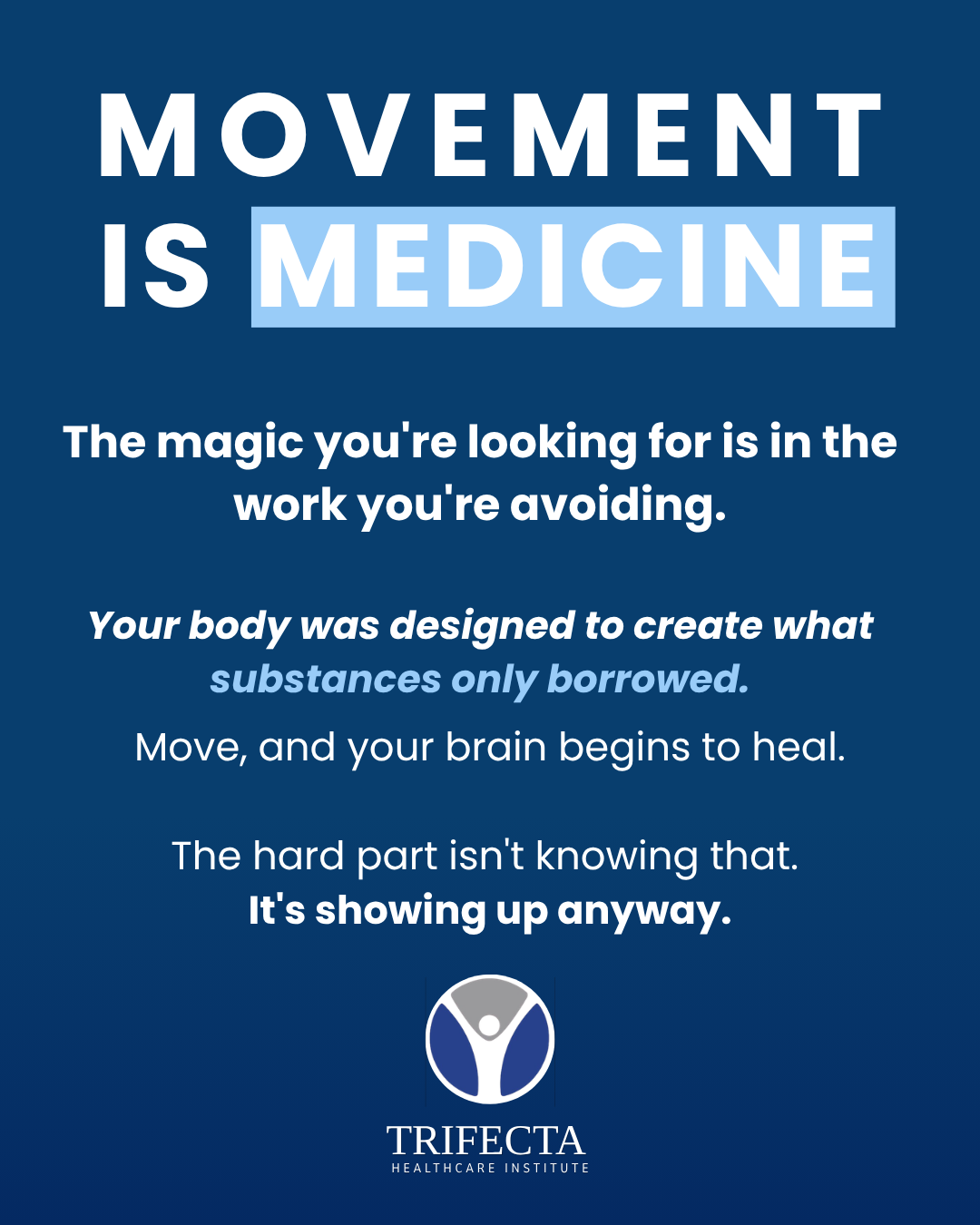
Movement is medicine. At Trifecta, we mean that with clinical precision.
A Program Built for the Brain Meth Left Behind
There is no medication for meth addiction. That means the quality of the behavioral and physical program isn't one variable among many; it is the treatment. What happens in this building, in the gym, on the trail, and in group is what rebuilds what meth took apart.
Here's what that looks like in practice, and why it works.
.png)
What the Research Actually Shows
Methamphetamine depletes dopamine at the receptor level, physically reducing the number of dopamine receptors available in the brain's reward circuitry. That's not a metaphor for feeling bad. It is a structural change that imaging technology can measure. It's why early recovery from meth often feels like the absence of everything — joy, motivation, connection, purpose — all of them running through a system that has been chemically stripped.
The same imaging technology that documents that damage has now documented the reversal. A UCLA/VA study published in Neuropsychopharmacology used PET scanning to directly measure dopamine receptor function in meth-dependent men and women during residential treatment.
Those who completed 8 weeks of supervised exercise training showed a significant increase in striatal dopamine D2/D3 receptor availability. Those who received health education instead showed no change.
Exercise physically rebuilt the dopamine receptors that meth damaged. In real human brains. Measured with PET imaging. This is the science behind what we do.
A 2025 synthesis of 84 studies on exercise and meth use disorder further confirmed that aerobic exercise upregulates BDNF in prefrontal-striatal pathways — supporting cognitive recovery and control — while resistance training modulates the amygdala-striatal dopamine system to improve emotional stability. Different modalities target different circuits. Our program uses both.
12 weeks of moderate-intensity aerobic exercise added to standard residential treatment has been shown to significantly promote recovery of the blood-brain barrier, brain neurons, and inhibitory control in meth-dependent patients.
Our programming is built around this evidence.
You Deserve More Than the Bare Minimum
We refuse to settle when it comes to recovery. We’re here to help you rebuild a life you love, from the ground up. Here’s how we do it:
- Boxing and high-intensity gym training — aerobic exercise is the modality most directly linked to dopamine receptor restoration and craving reduction in stimulant recovery. High-intensity work produces the largest neurochemical response. This is where the recovery begins at a biological level.
- Resistance training — specifically shown to modulate the amygdala-striatal dopamine system, improving the emotional stability and impulse regulation that meth chronically impairs.
- Jiu-jitsu — cognitive and physical engagement simultaneously. Rebuilds the executive function and attentional control that sustained meth use degrades, through a discipline that demands presence, strategy, and earned skill.
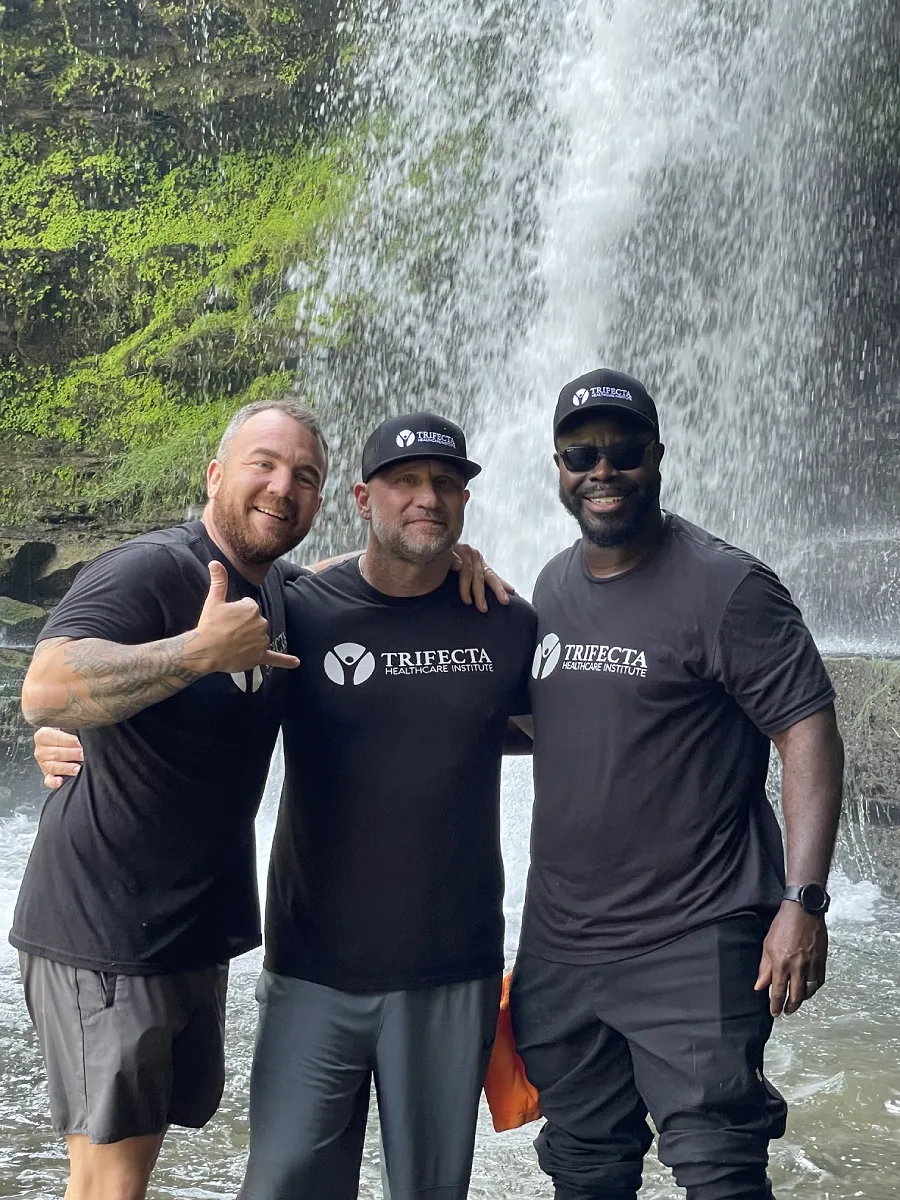
- Hiking and outdoor programming — sustained moderate aerobic activity that supports serotonin restoration and provides an experience of physical capability men can own independently of any substance.
- Ice baths — controlled stress response training that builds norepinephrine and stress tolerance — critical for men whose nervous systems have been dysregulated by the meth use-crash cycle.
- Team and group activities — peer accountability and social bonding that begins to replace the social environment meth use occupied. Exercise reduces sensitivity to drug-related cues; doing it alongside other men in recovery compounds the effect.


Brotherhood Is Not a Program Feature
Stimulant addiction, meth especially, hollows out a man's relationships while he's in it. The secrecy, the paranoia, the lifestyle built around use: by the time most men reach treatment, the social world they had is gone or badly damaged.
The brotherhood at Trifecta is not a therapeutic metaphor. It is the deliberate rebuilding of genuine connection — the kind forged through shared struggle, physical challenge, and the mutual accountability of men choosing the same hard thing together.
The research on social recovery capital is consistent: connection is one of the strongest protective factors against relapse. We built the entire culture of this program around making that connection real.
What Gets Built Here
Recovery from meth is not just abstinence from a substance. It is the gradual return of a brain that can generate its own dopamine — its own motivation, reward, and capacity for joy — without chemical assistance.
That takes time. It takes the right clinical structure. And it takes a program that understands what meth actually did and builds recovery around reversing it.
What gets built here is a life the dopamine system can sustain on its own.
Dual Diagnosis: Stimulants, Depression, and Psychosis
Stimulant addiction and mental health rarely travel separately.
Depression is almost universal in stimulant withdrawal and early recovery — not because a man is broken, but because the brain's dopamine system cannot produce a normal emotional baseline while it's recovering.
Understanding this clinically changes how it's experienced. It is not a permanent state. It is a phase with a trajectory.
ADHD and Stimulant Use: The Connection
The relationship runs in both directions: men with untreated ADHD are at elevated risk for stimulant misuse, and stimulant use disorders are easier to sustain when the underlying attention dysregulation is unaddressed.
Our clinical team assesses for this at admission and incorporates ADHD management into the treatment plan where indicated.
Stimulant-induced psychosis — paranoia, hallucinations, disorganized thinking — requires psychiatric stabilization before meaningful addiction work can begin. Our dual diagnosis team coordinates psychiatric and addiction treatment as a single program, not parallel services.
Healing that Goes Beneath the Surface
- Depression and major depressive disorder
- ADHD
- Anxiety disorders
- Stimulant-induced psychosis
- PTSD and trauma
- Bipolar disorder
Insurance & Admissions
Stimulant addiction treatment is covered by most major insurance plans under the Mental Health Parity and Addiction Equity Act. Our admissions team verifies benefits quickly, clearly, and at no cost — before you make any decisions.
In-network insurance providers include:
- Blue Cross Blue Shield
- Aetna
- Cigna / Evernorth
- United Healthcare
- Humana
- Ambetter
- Magellan Healthcare
- Tricare East (Humana Military)
- And others — contact us to verify your specific plan

Begin Stimulant Addiction Treatment in Nashville or Knoxville
Trifecta Healthcare Institute provides men's-only stimulant addiction rehab in Tennessee at two locations — both delivering medical stabilization, residential treatment, and integrated dual diagnosis care.
Nashville / Spring Hill [1025 Nashville Hwy Columbia TN 38401]
Knoxville [2017 Ailor Ave, Knoxville, TN 37921]
Admissions are available 24 hours a day. Our team is straightforward — we'll tell you exactly what we can offer, what the process looks like, and what the next step is. No pressure. No judgment.
Frequently Asked Questions About Meth & Stimulant Addiction Treatment
Is there a medication for meth addiction?
There is currently no FDA-approved medication specifically for methamphetamine or stimulant use disorder. Treatment is built on evidence-based behavioral approaches — contingency management, CBT, and structured residential programming — which the research consistently shows to be effective.
Some emerging pharmacological combinations show early promise as adjunctive options, and our clinical team stays current with the evidence as it develops.
How long does meth withdrawal last?
The acute crash — characterized by depression, exhaustion, and intense cravings — typically peaks in the first week and begins to lift over 1 to 2 weeks. The longer recovery arc, including mood instability, anhedonia, cognitive fog, and intermittent cravings, can persist for weeks to months as dopaminergic systems gradually recover.
This timeline is survivable, and it gets progressively easier. Residential treatment during the acute phase provides the structure and support that makes getting through it possible.
Can meth use cause permanent brain damage?
Long-term meth use causes measurable changes in brain structure and function — particularly in dopaminergic pathways, cognitive processing, and emotional regulation.
For most men, sustained abstinence leads to significant neurological recovery over months to years. The brain's capacity to adapt and rebuild — neuroplasticity — is real, and our program is specifically designed to accelerate it through structured activity, therapy, and time.
How is cocaine addiction treated differently from meth?
Both are stimulant use disorders treated primarily through behavioral therapy — the clinical framework is similar. The key differences are in withdrawal timeline (cocaine's crash is shorter and more intense), common co-occurring patterns, and the cardiovascular medical risks associated with cocaine that require screening at intake. For most men, the residential treatment experience is comparable across both substances.
Can Adderall misuse turn to addiction?
Yes. Adderall is an amphetamine — pharmacologically in the same class as methamphetamine. Misuse produces the same dopaminergic changes, the same tolerance cycle, and the same substance use disorder that any other stimulant does.
Men who hesitate to seek help for prescription stimulant misuse because they don't think it "counts" deserve the same clinical care and the same respect as anyone else who walks through our doors.
Does insurance cover stimulant addiction treatment?
Most major insurance plans cover stimulant addiction treatment under the Mental Health Parity and Addiction Equity Act. We are in-network with Blue Cross Blue Shield, Aetna, Cigna, United Healthcare, Humana, and other major carriers. Contact our admissions team for a free, same-day benefits check — no commitment required.