


How to Choose a Dual Diagnosis Partial Hospitalization Program
Use this checklist to assess a dual diagnosis partial hospitalization program, including integrated care, medication support, Tennessee licensure, PHP fit, a...
Read More
Learn what supervised adderall detox tennessee involves, how care levels are chosen, what TennCare may cover, and where to begin an assessment.
Start Your Journey NowWritten and reviewed by the clinical team at Trifecta Healthcare Institute, a men’s-only treatment center in Tennessee specializing in substance use, mental health, and dual diagnosis care.
Stopping Adderall after months or years of daily use rarely feels like a clean break. In the first 24 to 72 hours, most men hit what clinicians call the crash: heavy fatigue, flat or dark mood, long stretches of sleep, a hunger that comes back all at once, and a brain that will not focus on anything that used to be easy.1, 3
By day four to seven, the sharpest discomfort usually starts to ease, but sleep stays strange, motivation runs low, and cravings arrive in waves, often triggered by a deadline, a workout, or an early morning.3 Some men also notice depressed thinking that feels heavier than a normal bad week, which is why MedlinePlus warns against stopping amphetamine abruptly after heavy use without a clinician involved.2
None of this means you are weak. It means your nervous system is recalibrating, and that first week is far easier to get through with someone watching the symptoms that actually matter.
The FDA-approved prescribing information for Adderall spells out what can happen after abrupt cessation or dose reduction following prolonged use:
That list reads clinical, but in real life it looks like a man who cannot get out of bed, snaps at his kids, sleeps 14 hours and still feels wrecked, or stares at a screen for an hour without reading a line.
MedlinePlus adds a direct warning for anyone who has been using more than prescribed: do not stop amphetamine on your own, because sudden discontinuation after overuse can cause depression and extreme tiredness that need a clinician's eyes.2 The symptoms are not dramatic enough to look like an emergency from the outside, which is exactly why they get missed.
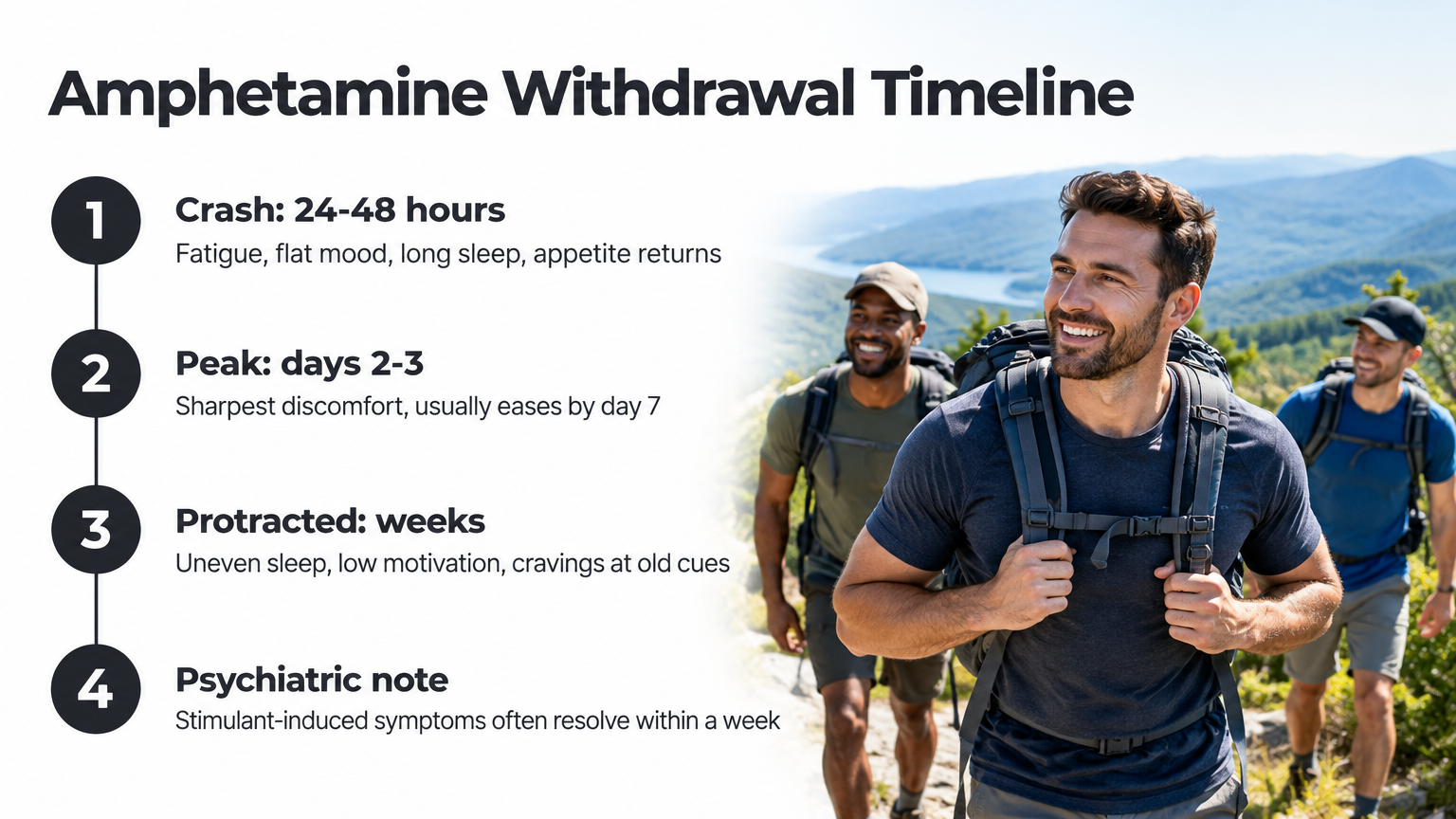
Psychostimulant withdrawal follows a reasonably predictable arc. In the first 24 to 48 hours, the crash sets in: deep fatigue, flattened mood, long sleep, and a sudden return of appetite. Symptoms commonly peak 2 to 3 days after abrupt discontinuation, with the sharpest discomfort typically resolving within 4 to 7 days.3
After that first week, something many men do not expect takes over. A protracted phase can persist for several weeks, bringing uneven sleep, low motivation, mood dips, and cravings that spike around the places and times Adderall used to show up: 6 a.m. before a shift, Sunday night before a work week, the middle of a hard workout.3 This is not relapse. It is a nervous system still finding its baseline.
Psychiatric symptoms deserve a separate note. Stimulant-induced psychotic symptoms, when they occur, commonly resolve with abstinence by about one week, while primary psychotic disorders require ongoing psychiatric care.3 A clinician watching the week unfold can tell the difference. A man alone in an apartment usually cannot.
Here is the honest part that most detox marketing skips: no medication has been shown to reliably treat amphetamine withdrawal. A Cochrane review of the available studies concluded that no medication demonstrated effectiveness for the withdrawal syndrome itself.4 The ASAM/AAAP clinical practice guideline on stimulant use disorder reaches the same conclusion, noting that most studies of withdrawal medications were small and low quality.7
That does not make supervised detox pointless. It changes what detox actually is. Instead of a pill that fixes the crash, supervised care offers an assessment of dose and duration, monitoring for depression and suicidal thinking, support for sleep and nutrition, symptom-targeted medications where appropriate, and a planned handoff into treatment.3, 7 Framing matters here. Men who expect a magic protocol feel let down and quit. Men who understand detox as a monitored on-ramp tend to stay long enough to let the second week do its work.
A good detox starts with a real conversation, not a wristband. A clinician works through how much Adderall you have been taking, how long, whether it was prescribed, how it was taken, what else is in your system (alcohol, cannabis, benzodiazepines, nicotine), and what your sleep, eating, and mood have looked like for the past month. Physical health, psychiatric history, and suicide risk come up on day one, not day five.3, 5
From there, monitoring is the quiet work. Vital signs, hydration, sleep, appetite, and mood check-ins are tracked across the week so the crash does not drift into something worse unnoticed.3 Symptom relief is targeted, not formulaic: short-term support for sleep, help with anxiety or agitation, hydration and nutrition, and a steady schedule so your body has something to pattern around.5 No single medication treats amphetamine withdrawal, so the plan is built around the symptoms actually showing up in front of the team.4
The symptoms that matter most are the ones that look quiet from the outside. MedlinePlus is explicit that stopping amphetamine after overuse can bring on depression and extreme tiredness, which is why clinicians watch mood closely during the first week.2 The FDA label flags dysphoric mood and depression among withdrawal signs, and a supervised team is trained to screen for suicidal thoughts rather than wait for a man to volunteer them.1
Psychosis is a separate flag. Stimulant-induced psychotic symptoms, when they appear, commonly resolve with abstinence by about one week, while a primary psychotic disorder needs ongoing psychiatric care.3 Sorting those two apart in real time is a clinical judgment, not a guess made alone at home.
Tennessee's Department of Mental Health and Substance Abuse Services licenses detox under distinct categories, and knowing which one a program carries matters. Outpatient detoxification facilities are defined as providing organized outpatient services to systematically reduce or eliminate a toxic agent until withdrawal signs and symptoms resolve. Residential detoxification facilities provide intensive 24-hour residential treatment for withdrawal management.10
The state's continuum-of-care page adds a third category you will see in placement conversations: clinically managed withdrawal management, a 24/7 residential social-withdrawal service that may include limited medication and individual, group, or family therapy. Tennessee says placement decisions are guided by evidence-based multidimensional assessment criteria rather than a one-size setting.11
Translation: a license tells you what a facility is authorized to do, not whether it is the right fit for your situation. For Adderall specifically, that assessment weighs how long you have been using, dose, other substances in the mix, sleep and mood status, suicide risk, and whether medical or psychiatric complications are expected.11
The levels of care read like a ladder, each step offering more structure, supervision, and hours per week. For Adderall withdrawal, the right rung depends on what the assessment surfaces, not on preference alone.11
| Level of care | Setting and intensity | When it may fit |
|---|---|---|
| Outpatient detoxification | Organized outpatient services to systematically reduce or eliminate a toxic agent until withdrawal signs and symptoms resolve.10 | Shorter or lower-dose use, stable home, no significant psychiatric or medical complications expected, reliable support at home. |
| Residential detox / clinically managed withdrawal management | Intensive 24-hour residential withdrawal management, or a 24/7 residential social-withdrawal service that may include limited medication and individual, group, or family therapy.10, 11 | Longer or higher-dose use, concerning mood or sleep, suicide risk flags, prior failed attempts to stop, unstable or triggering home environment. |
| Partial hospitalization (PHP) | Daytime clinical programming, typically five days per week, returning home or to supportive housing at night. | After the acute crash, when symptoms are easing but structure and therapy intensity are still needed. |
| Intensive outpatient (IOP) | Several hours of group and individual therapy, three to five days per week, around work or school. | Stepping down from PHP, or starting here when the crash is manageable with daily support. |
| Outpatient | Weekly or twice-weekly therapy and medical check-ins. | Longer-term continuing care after more intensive levels, with cravings and triggers now manageable. |

Adderall is not a fringe medication in Tennessee. The state's 2025 Controlled Substance Monitoring Database annual report found that stimulant prescriptions dispensed to Tennessee patients increased 20.8% from 2017 to 2024.14 That category covers all prescription stimulants, not Adderall alone, but amphetamine products sit squarely inside it.
More prescriptions in circulation also means more men ending up on stimulants without a clear plan for how, or when, to come off. Some started with a legitimate prescription for ADHD and slowly climbed the dose. Others picked up pills from a roommate during finals week and never really stopped. For broader national context, the CDC reports that approximately 3.9 million people aged 12 or older misused prescription stimulants in 2023, a national figure that includes amphetamines like Adderall and is not specific to Tennessee.17
The same Tennessee report documents a 143% increase in deaths involving any stimulants from 2019 to 2023.14 That category is broader than Adderall and includes illicit stimulants like methamphetamine, so it does not translate to prescription-amphetamine mortality on its own. It does mean the clinical landscape around stimulants in Tennessee has gotten heavier, and that assessing stimulant use carefully, rather than quietly, is the move that matches the moment.

If you have TennCare, Tennessee Medicaid covers withdrawal management and substance use treatment at inpatient, residential, and outpatient levels for eligible children, adolescents, and adults.12 That is the headline. The practical version is less tidy.
Coverage is not the same as automatic admission. For certain residential and inpatient services in institutions for mental diseases, Tennessee's state-plan option requires prior authorization and a comprehensive diagnostic assessment before covered care begins, and provides up to 30 days per 12-month period for qualifying Medicaid beneficiaries ages 21 to 64 in eligible settings.13 Translation: a program's admissions team runs an assessment, documents medical necessity, and submits authorization to your plan before you walk in the door.
What this means on a Tuesday morning: call the program, give them your TennCare member ID, and let them do the paperwork while you focus on getting through the week. Ask whether the facility is in-network with your specific TennCare managed care plan, what the authorization timeline looks like, and what happens if you need to step down from residential detox to PHP or IOP afterward.
If you carry commercial insurance through an employer or the marketplace, most major plans in Tennessee cover medically supervised detox and the levels of care that follow, but the specifics vary by plan, network, and benefit design. A quick verification call clarifies four things:
Most programs will run that verification for you confidentially in under an hour. You do not have to decode an EOB alone to know what the first week will cost.
[Verify your insurance]
Detox gets you through the week. What comes next is what actually changes the pattern. For stimulant use disorder, the therapy with the strongest evidence base is contingency management, which reinforces concrete recovery goals like attendance or stimulant-negative tests with structured incentives.6, 8 A systematic review of 29 reviews found it remained the strongest evidence-based approach for stimulant use disorder at the time of publication.8
SAMHSA's Treatment Improvement Protocol on stimulant use disorders names four behavioral approaches that belong in a post-detox plan:
None of these are quick fixes. Together, they are what the research actually supports, and they are what should fill the weeks after the crash eases.
The second week off Adderall is where small daily inputs start carrying real weight. SAMHSA's stimulant treatment guide recommends rest, mild or moderate exercise, and a healthy diet as supportive measures during withdrawal, and those same inputs continue to matter well past day seven.5 Sleep that stabilizes, meals that happen on a schedule, and a 30-minute walk or lift most days give a recovering nervous system something to pattern around.
Movement is not a replacement for therapy, and research-supported benefits for mood and energy are not guarantees for any one man. What movement does reliably offer is structure, a reason to be somewhere, and a body that is tired for the right reasons at night. Pair that with peer connection, whether in a group room, a gym floor, or a weekly check-in with other men in recovery, and the isolation that fed the Adderall pattern starts to lose its grip.
A lot of Adderall use starts somewhere other than a party. Men pick it up for focus they could not find, energy they ran out of, or a mood they could not shake. When the pills come out, what is often left underneath is undiagnosed or undertreated ADHD, anxiety, depression, grief, or trauma, and withdrawal tends to make all of those louder.1, 3
That is why Tennessee's behavioral health system frames mental health care as part of integrated substance use treatment rather than a separate track.16 Co-occurring care after detox means a real psychiatric assessment, honest conversations about ADHD and whether non-stimulant treatment options fit, and therapy that addresses the trauma or anxiety that made Adderall feel useful in the first place. Treating only the substance leaves the reason intact.
Knoxville sits at the edge of the Smoky Mountains, and that geography is not a brochure line. For a lot of men coming off Adderall in East Tennessee, the second week of recovery is where a trail, a river, or a quiet overlook starts doing real work alongside therapy. SAMHSA's stimulant treatment guide names rest, mild to moderate exercise, and a healthy diet as supportive measures during withdrawal, and Knoxville programming can lean on the surrounding terrain to make those inputs feel earned rather than prescribed.5
Practically, a Knoxville-based program means local assessment, local admissions, and continuing care within driving distance of home, work, and family. Trifecta Healthcare Institute operates a Knoxville location in East Tennessee for men seeking care without having to leave the region.
The Nashville-area option sits in Columbia, about 45 minutes south of downtown Nashville in Maury County. That distance matters. Columbia offers enough separation from the bars, offices, and social patterns that fed the Adderall habit without putting a man hours away from the people he is trying to come back to.
For Middle Tennessee readers, a Columbia-based program means in-state admissions and in-network conversations with major Tennessee insurers, with placement decisions guided by the kind of multidimensional assessment Tennessee uses across its continuum of care.11 Close enough to stay connected, far enough to actually change the pattern.
If you are reading this on behalf of a man you love, the thing to know is that the first call is shorter and simpler than it sounds. You do not need a diagnosis, a list of pills, or his permission to ask questions. A good admissions line will talk with family members, explain what assessment looks like, and walk you through options confidentially.
A workable script: "My husband (or son, or brother) has been taking Adderall outside how it was prescribed for about ___ months. He is talking about stopping and I am worried about his mood and sleep. Can you tell me what an assessment would involve and what levels of care you offer?" Ask whether they accept your insurance, what the first 24 hours look like, and how they handle a man who is scared or ambivalent on arrival.
Two numbers worth saving before you close this tab. For non-emergency help finding Adderall detox or treatment anywhere in the state, the Tennessee REDLINE is free, confidential, and open 24/7. Call or text 800-889-9789 to get connected to referrals, including for co-occurring mental health concerns.15, 16
For emergencies, call 911 or go to the nearest emergency department. During Adderall withdrawal, the clinical warning signs that call for immediate evaluation include:
For a mental health crisis short of medical emergency, 988 reaches the Suicide and Crisis Lifeline any time, day or night.
If you have been thinking about stopping Adderall for a while and keep putting it off until the next deadline passes, the next step is smaller than it feels: a phone call for an assessment. Not a commitment to residential care, not a promise to tell your boss, not a decision about the next six months. One conversation about what you have been taking, how your sleep and mood are holding up, and which level of Tennessee care actually matches your situation.
The first week off Adderall is harder alone than it needs to be. Walk into it with a clinician who knows what to watch for, and the week leads somewhere.
MedlinePlus advises not stopping amphetamine on your own after overuse because sudden discontinuation can cause depression and extreme tiredness that need a clinician's attention.2Supervised detox adds assessment, monitoring for suicidal thoughts and psychosis, symptom relief, and a planned handoff into treatment, which is harder to pull off alone.3
No medication has demonstrated effectiveness for treating amphetamine withdrawal, according to a Cochrane review and the ASAM/AAAP clinical practice guideline on stimulant use disorder.4, 7Clinicians may use symptom-targeted medications for sleep, anxiety, or agitation during detox, but these support the week rather than cure the withdrawal syndrome itself.3
Yes. TennCare covers withdrawal management and substance use treatment at inpatient, residential, and outpatient levels for eligible children, adolescents, and adults.12Certain residential services require prior authorization and a comprehensive diagnostic assessment, and the state-plan option provides up to 30 days per 12-month period for qualifying beneficiaries ages 21 to 64 in eligible settings.13
Detox is the on-ramp, not the destination. The strongest evidence for stimulant use disorder supports contingency management, with motivational interviewing, community reinforcement, and cognitive behavioral therapy rounding out a post-detox plan.5, 8Most men step down from residential or PHP into IOP and outpatient, with co-occurring mental health care built in.11, 16
Start with a confidential call to a treatment program or to the Tennessee REDLINE, the state's 24/7 referral line, by calling or texting 800-889-9789.15You can ask about assessment, levels of care, and insurance without his permission. If he mentions suicide, severe agitation, or psychosis that is not easing, call 911 or go to an emergency department for immediate evaluation.
Between facility size limits, waivers, and state-by-state rules, figuring out your Medicaid or private insurance benefits can feel like its own full-time job. Our admissions team will verify your coverage in minutes and walk you through exactly what's available — no guesswork required.
Verify Insurance Benefits →No commitment required. Confidential & HIPAA-protected.
Whether it's you or someone you love, our team can help you figure out the next step — what treatment looks like, what's covered, or just someone to talk to.
Talk to Our TeamConfidential. No commitment required.


