


How to Choose a Dual Diagnosis Partial Hospitalization Program
Use this checklist to assess a dual diagnosis partial hospitalization program, including integrated care, medication support, Tennessee licensure, PHP fit, a...
Read More
Compare credentials, treatment approaches, and personal fit to choose addiction specialists who address co-occurring concerns and support lasting recovery.
Start Your Journey NowWritten and reviewed by the clinical team at Trifecta Healthcare Institute, a men’s-only treatment center in Tennessee specializing in substance use, mental health, and dual diagnosis care.
Finding the right addiction specialist comes down to two checks run in parallel: a credential check (active license, addiction-specific training, evidence-based methods) and a fit check (does this clinician assess the whole person, including mental health, and will the first conversation feel honest rather than scripted). Both matter. A board-certified name on a website does not guarantee the care underneath it, and a warm first call does not substitute for actual addiction training.
Most men searching this topic are not shopping for a philosophy. They want to know who qualifies, how to verify it in Tennessee, what to ask before the first appointment, and how to tell whether a specialist can handle anxiety, depression, trauma, or grief alongside alcohol or drug use. Families searching on behalf of a husband, partner, or adult son need the same information in language they can use on the phone.
The sections ahead walk through both checks in order, with Tennessee-specific verification steps and a first-call script built from NIAAA and NIDA guidance 1, 5.
The phrase "addiction specialist" covers five distinct clinician types, each with different training and scope. Knowing which type a provider belongs to is the first step in deciding whether their expertise matches the problem on the table.
Addiction medicine physicians are MDs or DOs who hold board certification in addiction medicine. They can diagnose substance use disorders, manage withdrawal, prescribe medications, and treat the medical complications that come with heavy drinking or drug use 3.
Addiction psychiatrists are physicians board-certified in addiction psychiatry. NIAAA describes this group as having the highest level of training in both addiction and mental health care, which matters when depression, anxiety, PTSD, or bipolar disorder sit alongside substance use 3.
Both physician groups are scarce. A 2024 Senate Finance Committee letter to CMS reported fewer than 4,600 physicians nationally board-certified in addiction medicine and roughly 1,500 in addiction psychiatry 13. Translation: outside major metro areas, patients often see these physicians through a team, not as the sole provider.
Licensed alcohol and drug counselors (in Tennessee, LADACs) hold state-regulated credentials specifically for substance use counseling. They deliver much of the day-to-day therapy work in treatment programs 9.
LCSWs and LMFTs with addiction training bring mental health licensure plus additional coursework or supervised hours in addiction care. Their presence on a team usually signals capacity to address co-occurring concerns in session.
APRNs and PAs with addiction experience round out the group, often prescribing medications for alcohol or opioid use disorder as part of multidisciplinary addiction care 12.
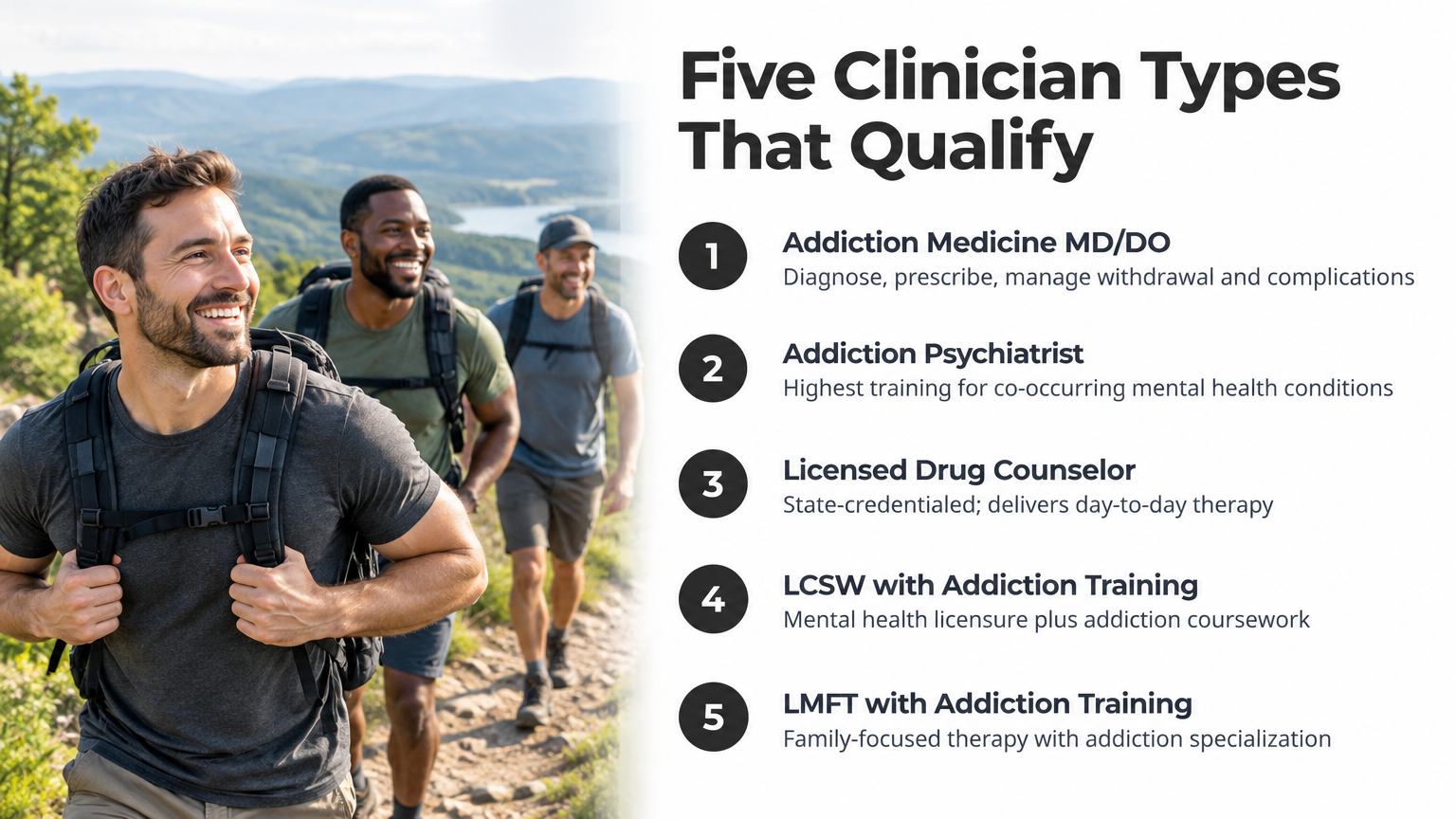
The table below sorts the five clinician types by what they can do, where they typically practice, and where their scope ends. Use it as a starting map, not a hierarchy: the right specialist depends on the specific clinical picture, not on who sits at the top of the chart.
| Specialist Type | Core Scope | Typical Settings | Scope Limits |
|---|---|---|---|
| Addiction medicine physician | Diagnosis, withdrawal management, medication prescribing, medical complications of substance use | Detox units, PHP/IOP programs, hospital consult services, outpatient clinics | May not provide primary psychiatric medication management for complex mental health conditions |
| Addiction psychiatrist | Combined addiction and psychiatric care, medication management for co-occurring mental health conditions | Dual-diagnosis programs, outpatient psychiatry, academic medical centers | Lowest supply of the five groups; often accessed through a team 13 |
| LADAC (TN licensed counselor) | Individual and group substance use counseling, relapse prevention, recovery planning | Treatment programs, outpatient clinics, community agencies | Practices within state-defined counseling scope under the Tennessee Board of Alcohol and Drug Abuse Counselors 9 |
| LCSW or LMFT with addiction training | Therapy for substance use plus co-occurring mental health concerns, family work | Treatment programs, private practice, integrated clinics | Cannot prescribe; depth of addiction training varies by clinician |
| APRN or PA with addiction experience | Medication for alcohol and opioid use disorder, routine medical follow-up | Outpatient treatment, primary care, office-based opioid treatment | Often cite limited addiction expertise as a barrier without formal addiction training 12 |
Most men do not pick a single clinician in isolation. They enter a program where a physician, a counselor, and a therapist share the case. The question becomes whether that team covers the full picture, which is where the credential checks in Section 4 come in.
Men who call three clinics and hear "the next intake slot is in six weeks" usually assume something is wrong with the clinics. The problem is bigger than any single provider. Addiction medicine and addiction psychiatry are among the smallest physician specialties in the country, and the pipeline is not keeping pace with demand.
A 2024 Senate Finance Committee letter to CMS reported that addiction medicine fellowships filled roughly 60% of their training positions that year, while addiction psychiatry fellowships filled about 51% 13. Nearly half of addiction psychiatry training slots sat empty. Those unfilled seats become unfilled jobs two or three years later, which becomes a waitlist on a Tuesday morning for a man in Knoxville trying to get an evaluation.
A federal report on addiction medicine fellowship funding adds the other half of the picture: primary care physicians, nurse practitioners, and physician assistants frequently cite limited addiction expertise as a barrier when patients bring up alcohol or drug use in a routine visit 12. The specialist bench is thin, and the generalist bench is undertrained.
NIAAA's quality framework boils down to five signals: credentials, comprehensive assessment, customized treatment, evidence-based methods, and continuing recovery support 1, 3. A specialist who checks only one or two of those boxes is not necessarily unqualified, but a program that checks all five is doing the work most research says matters.
Credentials means an active state license plus addiction-specific training, not a general healthcare degree with a weekend course added on. For physicians, that typically means board certification in addiction medicine or addiction psychiatry 3. For counselors and therapists, it means documented coursework and supervised hours in substance use care, not just a mental health license.
Comprehensive assessment is the other signal men should listen for during a first call. NIAAA defines a full assessment as covering substance use, medical history, mental health, employment, housing, transportation, and family or social support 1. If the intake form only asks about drinking or drug use, the plan built from it will be just as narrow.
Evidence-based methods include behavioral therapies like cognitive behavioral therapy and motivational interviewing, medications when clinically appropriate, and a written continuing care plan that extends past the end of a program 2, 5. Ask whether the specialist can name their methods. Vague answers are a signal.
A credential someone claims on a website is not the same as a credential a state board can confirm. In Tennessee, verification runs through two separate paths depending on the clinician type.
For licensed alcohol and drug counselors, the Tennessee Department of Health's Board of Alcohol and Drug Abuse Counselors handles licensure and public verification. The board's stated mission is to require anyone practicing as an alcohol and drug abuse counselor in Tennessee to be qualified, and its page provides access to license-verification tools 9. A quick lookup confirms the license is active and in good standing.
Physicians, psychiatrists, nurse practitioners, physician assistants, and social workers each have their own Department of Health boards. The lookup process is similar: search by name, confirm the license type matches the role, and note any disciplinary actions on the record.
Men who are not sure where to start, or who want help identifying programs that match their situation, can contact Tennessee REDLINE. The service has operated since 1989 through the Tennessee Department of Mental Health and Substance Abuse Services and offers 24/7/365 confidential referrals by call or text at 800-889-9789 10. REDLINE does not replace a direct credential check, but it narrows the list before the verification step.
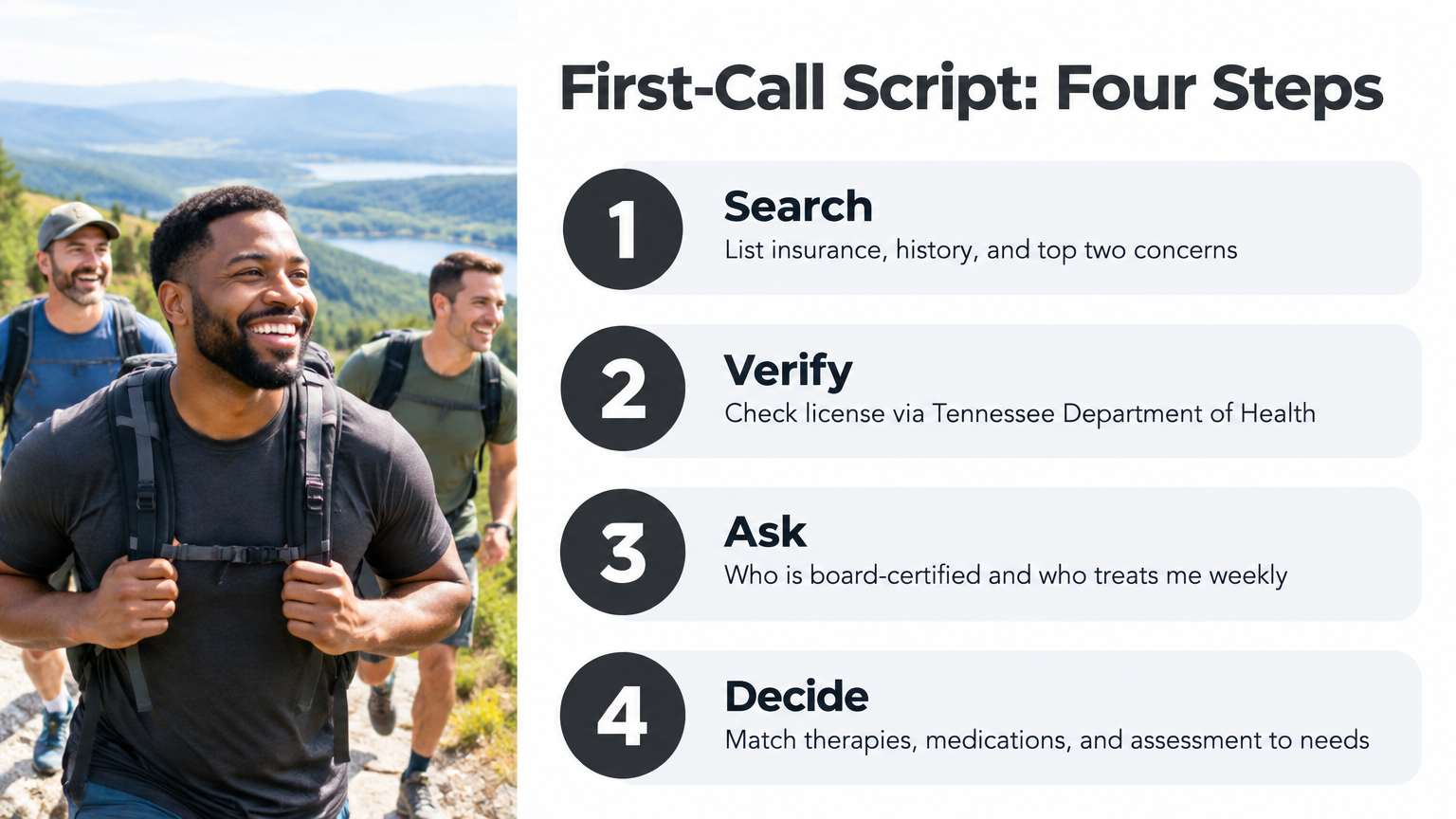
A first call with an addiction specialist or an intake coordinator usually lasts fifteen to thirty minutes. That is enough time to answer the questions that matter, if the caller knows which ones to ask. NIAAA's Navigator Toolkit recommends writing down insurance information, treatment history, personal needs, and preferences before dialing, and provides a comparison chart and worksheets for evaluating signs of quality across options 4.
The sequence below follows that Search → Verify → Ask → Decide structure, with Tennessee verification layered in. It works whether the man is calling for himself or a family member is calling on his behalf.
Before the call (Search and Verify):
During the call (Ask):
After the call (Decide): If the answers are specific, the clinician names roles rather than deflecting, and the plan sounds built around the person rather than a template, that is a good signal. Vague answers on any of the five questions above are worth a second call to a second program.
Alcohol or drug use rarely shows up alone. Anxiety, depression, PTSD, grief, chronic pain, and anger problems routinely sit underneath the drinking or the pills, and the Tennessee Department of Mental Health and Substance Abuse Services defines a co-occurring disorder as at least one mental health condition present alongside a substance use disorder. The state calls proper diagnosis and treatment of both critical to recovery 11.
That matters for specialist selection because a clinician who treats only the substance use is treating half the problem. NIAAA directs patients to ask prospective providers whether they offer medication when appropriate and whether they address mental health alongside alcohol treatment 2. NIDA says the same thing in different language: when substance use and mental disorders co-occur, treatment should address both as appropriate, not sequentially and not in different buildings 5.
Three questions sort capable programs from the rest. First, who performs the mental health assessment, and when in the process does it happen? A real integrated program screens for depression, anxiety, trauma, and other conditions during intake, not after thirty days of counseling. Second, if a mental health condition is identified, who manages it week to week, a prescriber on the team or an outside referral? SAMHSA's advisory on co-occurring disorders recommends that pharmacotherapy decisions happen inside a multidisciplinary team that monitors safety, adherence, and response 7. Third, what therapy formats are available? SAMHSA calls for a mix of individual, group, family, and peer support, because co-occurring work usually needs more than one setting to land 7.
A note on scope: some programs treat co-occurring mental health concerns as part of substance use care without offering primary psychiatric services for conditions unrelated to the substance use. That is a legitimate model, and it is worth asking directly so expectations match reality.
Medication is one of the sharpest tests of whether a specialist is working from current evidence or an older abstinence-only script. For opioid use disorder, the CDC identifies medications (methadone, buprenorphine, and naltrexone), with or without behavioral therapy, as evidence-based treatment, and notes that each one has different access pathways: methadone is dispensed through certified opioid treatment programs, while buprenorphine and naltrexone can be prescribed in other outpatient settings 8. A specialist who can only discuss one of the three, or who dismisses medication altogether, is not working from the current standard of care.
For alcohol use disorder, NIAAA directs patients to ask directly whether the provider offers medication when clinically appropriate, alongside behavioral treatment 2. NIDA frames the broader point: effective care often combines counseling with medication, and the specific choice depends on the substance involved, medical history, and patient preference 6.
Three questions keep a medication conversation honest. Which medications do you prescribe or coordinate, and for which substances? How is the decision made, and who on the team monitors safety, side effects, and response over time 7? If a medication is not offered on-site, how do you refer and stay involved in the plan?
Credentials and evidence-based methods set the floor. Above that floor, fit criteria vary by person, and for many men they include how a program handles the body, the peer group, and the daily structure around therapy. These are legitimate selection factors, not add-ons, as long as they sit alongside the clinical basics rather than replacing them.
NIDA's framework for effective treatment is clear that care should address medical, psychological, social, and vocational needs together, not substance use alone 6. SAMHSA's co-occurring advisory reinforces the point by recommending multiple treatment formats, including individual, group, family, and peer support, because different formats reach different parts of the problem 7. A program that pairs cognitive behavioral therapy or motivational interviewing with structured physical activity, peer accountability, and family work is operating inside that framework, not outside it.
For a man weighing options in Knoxville, Nashville, or Columbia, three questions sharpen the fit check. Does the program use physical activity as part of the clinical day, with licensed staff involved, or is it listed as recreation on the website? Does the peer group function as structured accountability, with group therapy and documented formats, or is it informal only 7? And does the schedule address work, housing, and family alongside the substance use, the way NIDA describes effective care 6? Direct answers to those questions tell a man whether a brotherhood-centered, movement-based model is a real clinical fit or marketing language.
This section speaks to the family member doing the research: a wife, partner, mother, or father making calls because the man in their life has not made them yet. The goal is to equip that caller with language that gets honest answers, without crossing into decisions only the man himself can make.
Families often get further on the phone when they ask structural questions rather than clinical ones. Does the program conduct a comprehensive assessment that covers mental health, medical history, work, and family alongside substance use 1? Which clinicians on the team are board-certified in addiction medicine or addiction psychiatry, and who holds Tennessee counselor licensure 3, 9? What behavioral therapies and medications are offered, and how does the team decide 5? Those questions move intake coordinators off the script.
When the list of options feels overwhelming, Tennessee REDLINE offers 24/7/365 confidential referrals by call or text at 800-889-9789, including for family members looking into options for an adult relative 10. A referral narrows the field; the credential and fit checks in the earlier sections still apply before a decision is made.
Where a man lives in Tennessee shapes which specialists he can realistically reach, whether that is Knoxville in East Tennessee or the Nashville area, including Columbia to the south. Travel time matters for intensive outpatient and partial hospitalization schedules, which usually meet three to five days a week.
The verification path is the same in every county. Confirm counselor licensure through the Tennessee Department of Health's Board of Alcohol and Drug Abuse Counselors, and check physician, psychiatrist, nurse practitioner, PA, and social work licenses through their respective state boards 9. For a shortlist of programs that match insurance, geography, and clinical needs, Tennessee REDLINE offers 24/7/365 confidential referrals by call or text at 800-889-9789, including referrals that fit a specific city or region 10. Pair the referral with the credential and fit checks already covered before committing.
After the credential check and the first-call script, the decision usually comes down to one question: does the plan this specialist described sound built for the man in front of them, or built for the average patient? A specific answer about assessment, methods, medication, and continuing care is the sign of a program ready to work 1. A general answer is a sign to call one more place.
Waiting for certainty rarely helps. NIAAA's Navigator Toolkit offers a comparison chart and worksheets to work through the Search–Ask–Choose process, so options can be compared directly rather than agonized over 4. Starting with a program that covers the five quality signals, then changing course if the fit is wrong, beats staying stuck while the problem grows.
For Tennessee men looking at a program that pairs clinical rigor with movement and peer connection, Trifecta Healthcare Institute is one option worth a direct conversation. [Call Trifecta] or [Verify your insurance] to start.
Five clinician types typically qualify: addiction medicine physicians, addiction psychiatrists, licensed alcohol and drug counselors (LADACs in Tennessee), LCSWs or LMFTs with addiction training, and APRNs or PAs with addiction experience. NIAAA identifies board certification in addiction medicine or addiction psychiatry as the highest physician credential, with addiction psychiatrists trained in both substance use and mental health care 3.
Counselor credentials run through the Tennessee Department of Health's Board of Alcohol and Drug Abuse Counselors, which provides public license-verification tools 9. Physicians, psychiatrists, nurse practitioners, PAs, and social workers are verified through their respective Department of Health boards. For help building a shortlist before verification, Tennessee REDLINE offers 24/7 confidential referrals by call or text at 800-889-9789 10.
Ask who on the team is board-certified in addiction medicine or psychiatry and who you will see weekly 3. Ask whether intake includes a full assessment covering mental health, medical history, work, and family alongside substance use 1. Ask what behavioral therapies and medications are offered and how continuing care works after the program ends 5, 1.
Many can, and NIAAA directs patients to ask directly whether providers address mental health alongside alcohol or drug treatment 2. Tennessee defines co-occurring disorders as at least one mental health condition alongside substance use, and calls proper diagnosis of both critical 11. SAMHSA recommends medication decisions happen within a multidisciplinary team that monitors safety and response 7. Confirm scope before enrolling.
The specialty is small. A 2024 Senate Finance Committee letter to CMS reported fewer than 4,600 physicians nationally board-certified in addiction medicine 13. A federal report notes that primary care clinicians often cite limited addiction expertise as a barrier, which pushes more cases toward a shrinking specialist bench 12. Waitlists are common, and team-based programs are usually the realistic path.
Families often get further asking structural questions: does intake cover mental health, medical history, work, and family 1; which clinicians are board-certified or hold Tennessee counselor licensure 3, 9; and what therapies and medications are offered 5. Tennessee REDLINE provides 24/7 confidential referrals, including for family members researching options for an adult relative, by call or text at 800-889-9789 10.
Between facility size limits, waivers, and state-by-state rules, figuring out your Medicaid or private insurance benefits can feel like its own full-time job. Our admissions team will verify your coverage in minutes and walk you through exactly what's available — no guesswork required.
Verify Insurance Benefits →No commitment required. Confidential & HIPAA-protected.
Whether it's you or someone you love, our team can help you figure out the next step — what treatment looks like, what's covered, or just someone to talk to.
Talk to Our TeamConfidential. No commitment required.


