


How to Choose a Dual Diagnosis Partial Hospitalization Program
Use this checklist to assess a dual diagnosis partial hospitalization program, including integrated care, medication support, Tennessee licensure, PHP fit, a...
Read More
Learn when withdrawal symptoms begin, peak, and ease, plus warning signs that require medical care and how to choose a safer detox setting.
Start Your Journey NowWritten and reviewed by the clinical team at Trifecta Healthcare Institute, a men’s-only treatment center in Tennessee specializing in substance use, mental health, and dual diagnosis care.
The alcohol detox timeline follows a predictable arc for most men: symptoms usually begin 6 to 24 hours after the last drink, peak between 24 and 72 hours, and resolve over roughly 2 to 10 days 3. That middle window is where the real danger lives. Seizures, hallucinations, and delirium tremens almost always surface during the first three days, which is why clinicians treat the opening 72 hours as the decisive stretch of any alcohol withdrawal timeline 2.
The next sections map what the body does hour by hour, which warning signs demand medical help, and how men in Knoxville and the Nashville area decide between detoxing at home and entering a supervised program.
Here's something most men don't expect: the shakes, sweating, and anxiety can hit while there's still alcohol in the bloodstream. Early withdrawal symptoms often begin 3 to 6 hours after the last drink and can appear before blood alcohol concentration falls to zero 6. If a man finishes drinking at midnight, he may wake at 5 or 6 a.m. with a racing heart and shaky hands and assume it's a bad hangover. It isn't. It's the nervous system reacting to the drop from peak intoxication 5.
The reason sits in the brain's chemistry. Heavy, prolonged drinking pushes the brain to compensate: it dampens the calming GABA system and ramps up excitatory glutamate activity to stay balanced against the alcohol. When alcohol leaves, that compensation keeps running without anything to offset it. The result is an overactive, overexcited nervous system — tremor, sweating, elevated heart rate, anxiety, and insomnia — showing up before sobriety does 6.
This matters for one practical reason. Many men try to "ride out" the morning after and expect to feel better by lunch. For someone with months or years of heavy daily drinking, those early hours are not the end of a hangover. They're the start of a withdrawal timeline that may still have 48 to 72 hours of escalation ahead 3.
Somewhere between hour 6 and hour 12 after the last drink, the body starts sending its first clear signals. For a man who has been drinking heavily for months or years, this stretch usually brings a fine tremor in the hands, a damp sweat on the forehead and chest, a stomach that doesn't want food, and a jittery, keyed-up feeling that no amount of coffee or distraction will quiet 3, 6.
Sleep tends to fall apart first. Many men describe waking in the early morning hours with a pounding heart, light sensitivity, and a sense that something is off in a way they can't name. Mild headache and nausea are common. Blood pressure and pulse often climb modestly, even if nothing feels dramatic yet 6.
At this stage, most symptoms stay mild and feel survivable. The risk is misreading them as a rough hangover and underestimating what the next 24 to 48 hours may bring 1.
Between hour 12 and hour 24, the same symptoms start stacking. The tremor becomes harder to hide. Sweating gets heavier. Anxiety sharpens into something closer to dread, and sleep becomes nearly impossible even when exhaustion is total 3. Appetite often disappears. Vomiting can set in, which makes it harder to keep down water, food, or any medication that might help.
Heart rate and blood pressure tend to drift upward through this window. Some men run a low-grade fever. A smaller number begin seeing or hearing things that aren't there — brief visual flickers, shadows at the edge of the room, or a sense of being watched. These early perceptual disturbances, known as alcoholic hallucinosis, can appear within the first 24 hours and signal that withdrawal is tracking toward the more severe end of the spectrum 6.
If symptoms are escalating this fast, the next day is not the time to white-knuckle it.
The 24-to-72-hour window is the hinge of the alcohol withdrawal timeline. Symptoms are typically most severe between hours 36 and 72, and nearly every serious complication clusters in this stretch 3. Tremor can become coarse enough that a man can't hold a glass. Blood pressure, heart rate, and body temperature can run high. Confusion, agitation, and disorientation may surface in waves.
Two dangers define this window. The first is withdrawal seizures, which usually appear within the first 48 hours after the last drink 5. These are often generalized tonic-clonic seizures — sudden, with loss of consciousness — and they can happen in men who have never had a seizure before. The second is delirium tremens, the most severe form of alcohol withdrawal delirium, which typically begins 48 to 72 hours after the last drink and brings profound confusion, vivid hallucinations, severe autonomic instability, and a real risk of death without treatment 4.
Not everyone reaches this point. For men with a long history of daily heavy drinking, prior withdrawal episodes, or significant medical illness, though, this is the stretch where a detox at the kitchen table can turn into an ambulance call. It's also the window where medically supervised care does the most to lower risk.
If the first 72 hours pass without serious complications, the worst is usually behind. Severe symptoms often peak around day three or four and then start easing, with most men feeling meaningfully better by day five 6. Tremor softens. Vital signs settle. Appetite begins to return in small amounts.
That doesn't mean day four feels good. Many men describe this stretch as flat and raw — poor sleep, waves of anxiety, low energy, irritability, and a kind of emotional thin skin that can catch them off guard. Cravings may spike at odd hours, especially around old drinking cues. Uncomplicated alcohol withdrawal generally resolves within 2 to 10 days, with lingering symptoms tapering across the back half of that window 3.
What recovery really feels like at this stage is the slow return of a baseline most men haven't felt in months or years: the ability to sleep without alcohol, eat a real meal, and sit with a quiet nervous system. That's the opening ongoing treatment is built to use.
Most men who stop drinking after heavy, prolonged use fall into what clinicians call uncomplicated withdrawal. The symptoms are rough but stay within a predictable range: tremor, sweating, anxiety, insomnia, nausea, mild headache, and a modest bump in heart rate and blood pressure 6. Nothing in that list is pleasant. None of it is immediately life-threatening in an otherwise healthy adult.
Uncomplicated withdrawal typically starts within 6 to 24 hours of the last drink, climbs over the first day or two, and resolves within 2 to 10 days with supportive care 3. A man may feel wrung out and raw, but he stays oriented. He knows where he is, what day it is, and who's in the room. His thinking is slow and his nerves are frayed, but reality stays intact 1.
That's the baseline. The line between uncomplicated and complicated withdrawal is where decisions about medical supervision get made.
Complicated withdrawal is defined by three things: seizures, hallucinations, or delirium tremens 7. Any one of them changes the situation from uncomfortable to medically urgent.
Withdrawal seizures usually hit early. More than 90% of alcohol-withdrawal seizures occur within 48 hours of the last drink, according to a peer-reviewed review of alcohol-withdrawal complications 5. They tend to be generalized tonic-clonic seizures — a sudden loss of consciousness, full-body convulsions, and a confused, exhausted recovery afterward. They can happen in a man who has never had a seizure in his life, and a single seizure sharply raises the risk of a second one in the same episode.
Alcoholic hallucinosis is different from the hallucinations that come with delirium. It can start within the first 24 hours and typically involves hearing voices, seeing shapes, or feeling things crawling on the skin while the man remains otherwise alert and oriented 6. It's unsettling, and it's a signal that withdrawal is tracking severe.
Delirium tremens is the most dangerous form. It usually appears 48 to 72 hours after the last drink and can last anywhere from one to eight days 4. The hallmarks are deep confusion, vivid hallucinations, severe tremor, racing heart, high blood pressure, fever, and heavy sweating. Without treatment, delirium tremens can be fatal. With prompt medical care — benzodiazepines, close monitoring, and support for vital signs — outcomes are far better 7.
How often do these complications actually show up? Across clinical populations, hallucinations occur in roughly 2 to 8% of patients going through alcohol withdrawal, withdrawal seizures in up to about 15%, and delirium tremens in roughly 3 to 5% 2. Those are ranges drawn from studies in different settings, not predictions for any one person.
Two things matter when reading those numbers. First, they describe populations, not individuals. A man with no prior seizures, no history of delirium tremens, no serious medical illness, and a shorter drinking history is at the lower end of risk. A man with any of those factors is not. Second, the stakes of being in the smaller percentage are high enough that risk screening — not just symptom counting — drives how clinicians recommend where to detox 7.
The honest answer isn't the same for every man, and it shouldn't be. Clinicians don't guess — they screen. One validated tool, the Prediction of Alcohol Withdrawal Severity Scale (PAWSS), was built to flag the people most likely to develop seizures, hallucinations, or delirium tremens before those symptoms ever show up. In its prospective validation study of medically ill hospitalized patients, a PAWSS score of 4 or higher identified complicated withdrawal with 93.1% sensitivity and 99.5% specificity 9. That performance was measured in hospitalized patients with other medical illness, so the exact numbers don't transfer cleanly to every setting — but the risk factors behind the score do.
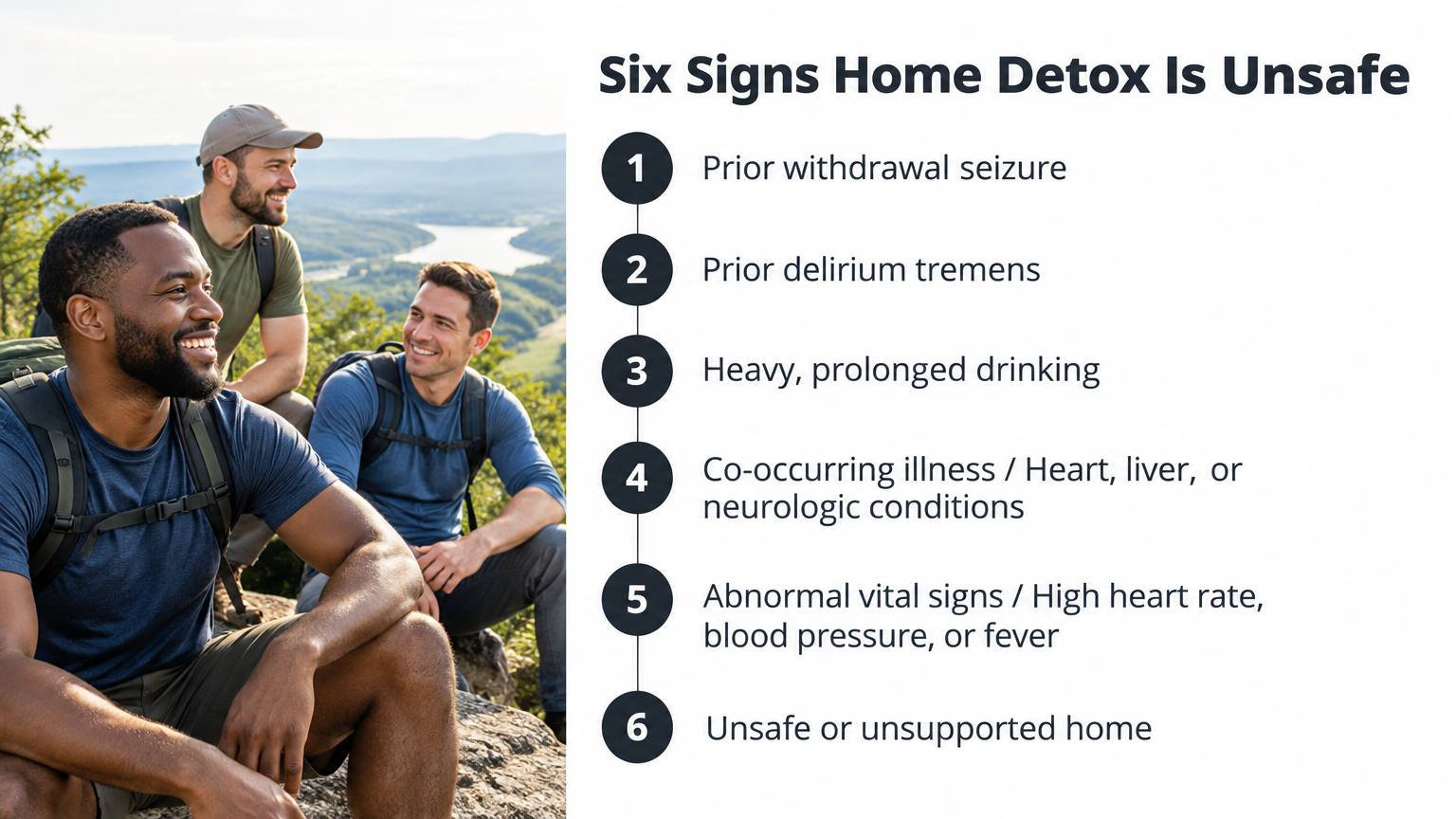
Six factors tend to tip the answer toward medical supervision:
If any of these apply, home detox is not the setting that matches the risk 7.
Outpatient detox can be a reasonable option for a specific, narrow group: men with mild symptoms, no history of complicated withdrawal, no serious medical illness, a sober person at home to watch for changes, and a clinician they can see daily. In that setup, benzodiazepines are generally first-line when medication is needed for moderate symptoms, and carbamazepine or gabapentin may be considered in selected mild cases 10. Patients should be checked daily for up to five days after the last drink to confirm symptoms are improving rather than escalating 10.
Outpatient detox isn't reasonable for a man drinking a fifth a day for years, a man who had a seizure during his last attempt to stop, a man with poorly controlled diabetes or heart disease, or a man alone in an apartment with no one to call if things change at 2 a.m. The same guidance that supports outpatient care for lower-risk patients is clear that it isn't appropriate for high-risk ones 10. Picking the wrong setting is the mistake. Picking the right one is how a safe detox actually happens.
There's a particular instinct that shows up in a lot of men here: handle it quietly, don't make it anyone else's problem, prove you can grind through 72 hours of misery. That instinct has carried men through plenty of hard things. Alcohol withdrawal is one of the few where it can get them killed.
Unlike withdrawal from most other substances, alcohol withdrawal can be fatal when it turns severe — through seizures, through delirium tremens, through the strain untreated autonomic surges put on an already stressed heart 7. The man most at risk is often the one least likely to ask for help: a steady, high-functioning drinker who has quietly handled everything else himself.
Choosing supervision isn't a referendum on toughness. It's recognizing that the nervous system doesn't care how disciplined you are. For a man who has been drinking heavily for years, medical detox isn't the hard option — it's the one that actually gives the next chapter a chance to start.
A supervised detox starts before the first dose of any medication. On arrival, a clinician takes a careful history: how much a man has been drinking, for how long, when the last drink was, any prior seizures or episodes of delirium tremens, other medical conditions, current medications, and whether other substances are in the picture. That history, together with vital signs and lab work, drives the plan 7.
From there, monitoring runs on a schedule, not on how someone says they feel. Nurses track heart rate, blood pressure, temperature, and withdrawal symptoms using a structured scale — most often the CIWA-Ar — repeated through the first several days to catch changes early rather than late 3. Repeat assessments continue for at least three days, longer if symptoms persist.
Medication is matched to severity. Benzodiazepines carry the strongest evidence base for alcohol withdrawal and are first-line for moderate-to-severe symptoms, often delivered on a symptom-triggered basis so dosing follows what the body is actually doing rather than a fixed clock 7, 11. In selected mild cases, carbamazepine or gabapentin may be used as alternatives 10. The point of the structure is simple: catch escalation before it becomes an emergency, and treat the nervous system aggressively enough that the first 72 hours stay survivable.
Heavy, prolonged drinking tends to leave the body short on key nutrients, and thiamine (vitamin B1) is the one that matters most during detox. A severe thiamine deficit can trigger Wernicke encephalopathy — a serious neurologic condition marked by confusion, eye-movement problems, and unsteady gait that can become permanent if missed.
Standard inpatient protocols start thiamine, folic acid, and a multivitamin at the beginning of treatment and typically continue vitamin support for 7 to 14 days 8. In patients at risk of deficiency, clinicians give thiamine before any glucose-containing fluids, because glucose without thiamine can push a borderline deficiency into a crisis 8. Hydration, electrolyte correction, and real meals once nausea eases round out the supportive piece. None of it is dramatic. All of it protects the brain while withdrawal runs its course.
Detox clears the alcohol. It doesn't address the reasons a man was drinking a fifth a day in the first place — the sleep that fell apart years ago, the anxiety that only quieted at the bottom of a glass, the pressure of providing, the grief no one talked about. That work starts in the days after the acute withdrawal window closes, which is why detox is the opening chapter rather than the whole book.
At Trifecta Healthcare Institute, men step down from medical detox into a continuum of care at the Knoxville facility in East Tennessee or the Nashville-area program in Columbia, TN. The handoff is deliberate: ongoing therapy and movement-based programming support a nervous system that is still relearning how to settle, and co-occurring anxiety, depression, trauma, and PTSD are addressed in the same plan rather than treated as separate problems. [Verify your insurance] to see what a continuum of care would look like for you.
This section speaks to the people around him — wives, partners, parents, brothers — who are watching and trying to figure out how worried to be. The short version: the first three days after his last drink are when things can turn fast, so knowing what's normal and what's an emergency matters more than knowing the full timeline.
Short of that, call a detox facility if his tremor is worsening by the hour, his heart is pounding at rest, he's vomiting and can't keep water down, he hasn't slept, or he had a prior seizure or episode of delirium tremens during a past attempt to stop 7. Those aren't signs to wait out. They're signs the setting needs to change today.
The alcohol detox timeline is predictable in its shape and unpredictable in its severity. Onset in the first day, peak between 24 and 72 hours, resolution across 2 to 10 days for men who come through it uncomplicated 3. What determines which category a man lands in is rarely willpower. It's the drinking history, the medical picture, the support around him, and whether the setting matches the risk before symptoms start.
If the picture here matches your last few months — or the last few months of a man you love — the next step isn't waiting to see how bad it gets. It's a conversation about what a safe detox looks like, and what comes after. [Call Trifecta] to talk through it. The first 72 hours decide a lot. The next chapter is still yours to write.
For most men, acute alcohol withdrawal runs about 2 to 10 days from the last drink. Symptoms usually begin within 6 to 24 hours, peak somewhere between 24 and 72 hours, and ease across the back half of the first week 3. Sleep, mood, and energy often take longer to settle than the physical signs.
Symptoms are typically most severe between hours 36 and 72 after the last drink 3. Severe cases can peak around day three or four and generally start improving by day five 6. The 24-to-72-hour window is also when seizures and delirium tremens are most likely to appear, which is why those three days matter most.
Only for a narrow group: men with mild symptoms, no history of withdrawal seizures or delirium tremens, no serious medical illness, a sober person at home, and a clinician checking in daily for up to five days 10. Anyone with heavy daily use, prior complicated withdrawal, or significant medical conditions should detox under medical supervision 7.
Call 911 or go to the nearest emergency room for a seizure, confusion about where he is or who people are, hallucinations, high fever, chest pain, or inability to stay awake 7. Worsening tremor by the hour, a racing heart at rest, repeated vomiting, or no sleep across two days are signs the setting needs to change today 3.
Delirium tremens typically begins 48 to 72 hours after the last drink and can last anywhere from one to eight days 4. It involves deep confusion, vivid hallucinations, severe tremor, racing heart, high blood pressure, and heavy sweating. Without treatment it can be fatal; with prompt medical care, including benzodiazepines and monitoring, outcomes are far better 7.
After the acute withdrawal window closes, men step down into a continuum of care at Trifecta Healthcare Institute in Knoxville or at the Nashville-area program in Columbia, TN. The continuum includes therapy and movement-based programming, with co-occurring anxiety, depression, and trauma addressed in the same plan.
Between facility size limits, waivers, and state-by-state rules, figuring out your Medicaid or private insurance benefits can feel like its own full-time job. Our admissions team will verify your coverage in minutes and walk you through exactly what's available — no guesswork required.
Verify Insurance Benefits →No commitment required. Confidential & HIPAA-protected.
Whether it's you or someone you love, our team can help you figure out the next step — what treatment looks like, what's covered, or just someone to talk to.
Talk to Our TeamConfidential. No commitment required.


