


How to Choose a Dual Diagnosis Partial Hospitalization Program
Use this checklist to assess a dual diagnosis partial hospitalization program, including integrated care, medication support, Tennessee licensure, PHP fit, a...
Read More
Learn the five stages of the alcohol detoxification process, how clinicians manage withdrawal risks, when inpatient care may be needed, and why ongoing suppo...
Start Your Journey NowWritten and reviewed by the clinical team at Trifecta Healthcare Institute, a men’s-only treatment center in Tennessee specializing in substance use, mental health, and dual diagnosis care.
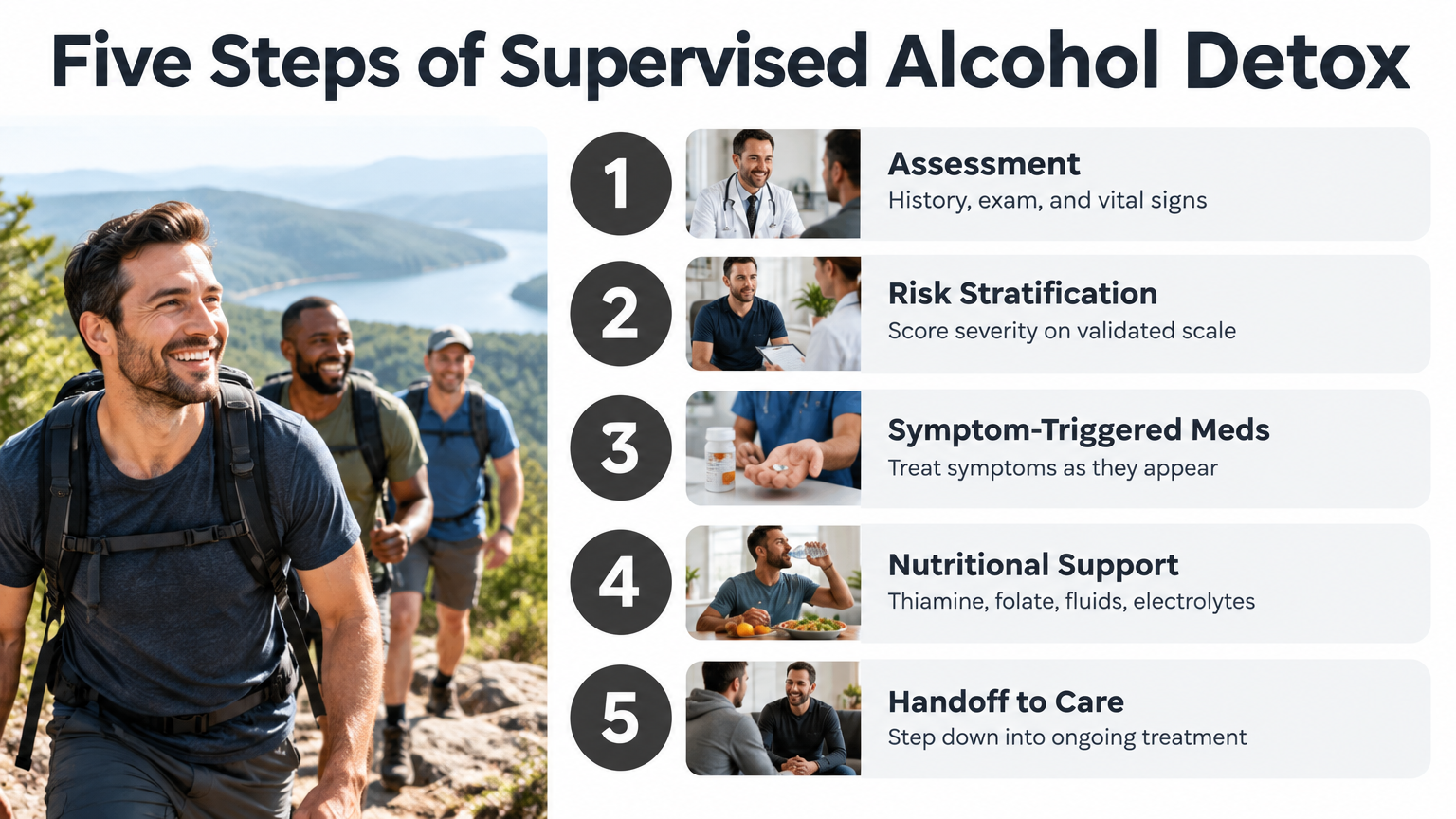
Medically supervised alcohol detox is a structured clinical process with five moving parts: assessment, risk stratification, symptom-triggered medication, nutritional support, and a handoff into ongoing treatment. A clinical team takes a history and physical exam, checks vital signs, scores withdrawal severity on a validated scale, and treats symptoms as they appear 4, 6. It is not a willpower test, and it is not something you white-knuckle on the couch.
For most men who have been drinking heavily for months or years, withdrawal typically begins within 24 to 48 hours after blood alcohol drops and can last 5 to 7 days 7. Early symptoms often include tremor, sweating, fast heart rate, anxiety, nausea, and insomnia, and a smaller share of patients progress to seizures or delirium tremens 1. That is why the setting matters. A clinician will decide whether outpatient care is safe or whether round-the-clock monitoring is needed based on your symptoms, drinking history, prior withdrawal episodes, medical and psychiatric conditions, and the people available to help 5. Detox is the opening phase of recovery, not the whole of it 7.
If you have been drinking heavily for months or years, your brain and body have adapted to the presence of alcohol. Pull it out suddenly and the nervous system rebounds in the opposite direction: racing heart, rising blood pressure, tremor, agitation, and in some cases seizures or delirium. The National Institute on Alcohol Abuse and Alcoholism (NIAAA) states that alcohol withdrawal can be life threatening when people who chronically drink heavily stop suddenly, and up to half of people with alcohol use disorder may experience withdrawal symptoms. NIAAA estimates roughly 260,000 emergency-department visits and 850 deaths each year in the United States tied to withdrawal 2.
These numbers are not meant to frighten you. They are meant to reframe the question. The risk is not about character or discipline. It is about neurobiology. Chronic drinking shifts the balance between the brain's calming and excitatory signals, and when alcohol leaves the system, that balance snaps back without a brake 10.
The first signs usually show up in the first morning after a last drink. Uncomplicated withdrawal symptoms can begin as early as six hours after blood alcohol starts to fall and typically last 24 to 48 hours in milder cases 8. You may notice your hands shaking when you reach for a cup, a thin sheen of sweat on your forehead, a pulse that feels faster than it should, and a creeping anxiety that has no obvious trigger.
Other early signs include nausea, loss of appetite, a mild headache, and insomnia that will not break even when you are exhausted. Blood pressure often climbs a little. None of this is proof that things will get worse, but it is the body telling a clinician that the nervous system has lost its chemical ballast and needs watching 6. This is the window where a careful assessment changes what the next two days look like.
Somewhere between 12 and 24 hours after the last drink, a smaller group of people develops what clinicians call alcoholic hallucinosis. You may see shadows that are not there, hear voices or sounds in a quiet room, or feel sensations on your skin that do not match anything in the environment. Unlike delirium tremens, which comes later, hallucinosis usually leaves your sense of time, place, and self intact. You know the hallucination is strange, even unsettling 15.
At the same time, the tremor often worsens, sleep is nearly impossible, and anxiety can shade into agitation. This is the point in the timeline where a clinical team tightens the monitoring interval, rechecks the withdrawal score, and often adjusts medication. Symptoms rarely stall out on their own at this stage. They either settle under treatment or progress 6.
Withdrawal seizures sit in their own band of risk. They can occur between roughly 12 and 48 hours after the last drink in up to 15% of patients, with the peak often falling in the first day 1. A broader clinical review notes the window can extend from 6 to 48 hours after the last drink 10. These are typically generalized tonic-clonic seizures, meaning the whole body stiffens and jerks, and they often happen without the warning signs that people associate with epilepsy. A single seizure can arrive out of a clear stretch of mild symptoms.
Two things make this window matter. First, a seizure during withdrawal raises the risk of another seizure and of progression to delirium tremens, which is why clinical reviews recommend inpatient monitoring after a withdrawal seizure 9. Second, actively seizing patients need immediate benzodiazepine treatment, something a kitchen or spare bedroom cannot provide 8. If you or a man you love has ever had a withdrawal seizure, that history alone changes the setting conversation.
Delirium tremens, usually shortened to DT, is the most dangerous phase of alcohol withdrawal. It generally begins 48 to 72 hours after the last drink 1, 10 and occurs in about 3 to 5% of people in withdrawal 1. DT is more than bad hallucinations. It is a sudden collapse of orientation: you may not know where you are, what day it is, or who is in the room. Hallucinations become vivid and persistent, agitation runs high, and the body's autonomic system swings hard, with fever, drenching sweats, a racing heart, and spikes in blood pressure 15.
Left unmanaged, DT can be fatal. Managed in a hospital setting with proper sedation, hydration, and monitoring, most people come through it. That is the clinical case for not guessing on setting when a man has risk factors for severe withdrawal. By the time DT is unfolding at the kitchen table, the window for a controlled start is already closed.
The first hour of a well-run detox is mostly questions. A clinician wants to know how much you have been drinking, for how long, when your last drink was, and whether you have gone through withdrawal before. Prior withdrawal seizures, a past episode of delirium tremens, concurrent use of benzodiazepines or opioids, and major medical or psychiatric conditions all change the plan 5, 11.
Then comes the physical exam and the vitals: pulse, blood pressure, temperature, respiratory rate, tremor, and orientation. Lab work often follows, with attention to electrolytes, liver function, and nutritional status 4. Each answer narrows the question of what you need and where you need to be, so the team can build a plan matched to your body rather than to a generic schedule.
Two tools come up constantly in alcohol detox, and knowing what they mean helps you evaluate any program you call. The first is the Clinical Institute Withdrawal Assessment for Alcohol, Revised, usually shortened to CIWA-Ar. A nurse scores ten items such as tremor, sweating, anxiety, nausea, agitation, and orientation, and the total guides treatment. Scores of 8 or less are generally mild, 8 to 15 moderate, and above 15 severe 4. The score gets rechecked on a schedule, often every one to two hours during the acute phase, so medication can be adjusted as symptoms rise or fall 6.
The second is the Prediction of Alcohol Withdrawal Severity Scale, or PAWSS. It is a 10-item scale, scored 0 to 10, that asks about prior withdrawal seizures, prior delirium tremens, blackouts, prior detox episodes, and recent use of other sedatives. A score of four or more flags high risk for severe withdrawal 11. One honest caveat: PAWSS was validated mostly in hospitalized medical patients, and a 2025 community-detox study found its cutoffs did not transfer cleanly to that setting 12. Good programs use these tools as guides, not verdicts.
Benzodiazepines are the backbone of alcohol withdrawal treatment. They work on the same calming receptors that chronic alcohol has been pushing on for months or years, which is why they quiet the tremor, drop the heart rate, lower seizure risk, and let a shaking nervous system settle 4, 8. Common choices include diazepam, lorazepam, and chlordiazepoxide, with the specific drug chosen based on your liver function, age, and overall medical picture.
How the medication is dosed matters as much as which one you get. Symptom-triggered dosing uses the CIWA-Ar score to drive each dose, so you receive medication when your symptoms call for it. Fixed-schedule dosing gives set doses at set intervals, which can be the safer default when a patient has significant medical or psychiatric comorbidity or cannot be monitored closely 6, 8.
Phenobarbital is used in some protocols, particularly for severe withdrawal or when benzodiazepines are not controlling symptoms. Carbamazepine and gabapentin have a role in selected mild-to-moderate cases, especially when a patient also needs opioid withdrawal management or should avoid sedatives 13. Clinicians pick from this menu with your history in mind, not from a one-size template.
Heavy drinking depletes thiamine, a B vitamin the brain needs to function. Low thiamine can trigger Wernicke encephalopathy, a serious neurologic complication involving confusion, abnormal eye movements, and problems with coordination. The fix is simple and nearly universal in detox: give thiamine early, often by injection in higher-risk patients, along with folate 4, 9, 10.
Hydration gets the same careful attention. Sweating, vomiting, and poor intake drain fluids and electrolytes, so a detox team watches sodium, potassium, and magnesium and replaces what the labs show is missing. Small moves done well, repeated hour after hour, are what keep an uncomplicated detox uncomplicated.
Not everyone needs a hospital bed to stop drinking safely. Many men with mild-to-moderate symptoms, no history of complicated withdrawal, and a stable medical picture can be managed as outpatients with scheduled clinic visits, daily check-ins, and a clear plan for escalating care if symptoms climb 5.
A reasonable outpatient candidate usually looks like this:
The outpatient model still involves clinicians. It is not detox at home alone. It is detox at home with a team on the other end of the phone and in the clinic the next morning.
Some histories move the setting decision out of the gray zone. If you have ever had a withdrawal seizure or an episode of delirium tremens, routine outpatient detox is not the right choice. Both predict a higher risk of severe, complicated withdrawal the next time around, and clinical reviews are explicit that these histories call for closer, usually inpatient, monitoring 5, 9.
Other disqualifiers stack up quickly. Severe current symptoms, including a CIWA-Ar above 15, agitation, or vomiting that prevents keeping down medication, point toward hospital care 4, 5. Major medical conditions such as significant heart disease, advanced liver disease, uncontrolled diabetes, or recent head injury raise the stakes of a seizure or an autonomic swing. Severe psychiatric disorders, active suicidality, or psychosis push the same direction 5. Concurrent use of other sedatives, benzodiazepines bought outside a prescription, or opioids complicates both the risk picture and the medication plan, and often warrants structured inpatient management 11, 13.
Social factors matter too. If there is no sober adult who can monitor you, no safe place to rest, or no way to get to a clinic for daily rechecks, the outpatient model loses its safety net 5. None of this is about judgment. It is about matching the setting to the risk you actually carry.
Severe confusion about where you are or what day it is, hallucinations that will not stop, a fever, a pounding heart that will not settle, drenching sweats, chest pain, repeated vomiting, or thoughts of harming yourself all count as emergencies 14, 15. These are the signs that withdrawal has outgrown a home plan. Getting evaluated fast is not an overreaction. It is the move that keeps a hard night from becoming something worse.
If you are the one making the call for a man who will not make it himself, a few things are worth knowing. His fear of withdrawal is usually bigger than his fear of treatment, and that fear is reasonable. Chronic heavy drinking changes the nervous system, which is why sudden cessation can trigger seizures or delirium tremens rather than just a rough weekend 2, 10. Framing a medical plan as a safer way to stop, rather than as proof he has failed, often lands better.
You do not need to diagnose him. A detox team will do the history, the exam, and the risk scoring 4. What you can do is gather useful information before the call:
If he has a history of withdrawal seizures or delirium tremens, say so early. That history alone usually moves the recommendation toward inpatient care 5, 9.
Watch for the emergency signs during any attempt to stop at home: a seizure, severe confusion, hallucinations that will not stop, fever, chest pain, or thoughts of self-harm. Call 911 14, 15. Your calm presence matters more than the right words.
When the tremor settles and the vital signs come back toward normal, something else often surfaces. Anxiety that drinking used to blunt. Depression that the bottle used to mask. Memories or anger tied to things you have not talked about in years. NIAAA is clear that alcohol use disorder frequently coexists with anxiety, depression, trauma-related symptoms, and suicidality, and that these conditions need to be assessed and treated alongside the drinking rather than brushed past once withdrawal ends 14.
One honest caution matters here. Benzodiazepines are the standard for acute alcohol withdrawal under medical supervision, but they are not a long-term fix for anxiety, mood, or sleep problems that outlast detox 14. Those symptoms call for therapy, psychiatric evaluation, and in many cases non-addictive medication, built into a continuing-care plan rather than left to improvise after discharge.
Detox typically runs 5 to 7 days 7. What happens on day eight is what decides whether the hard work holds. SAMHSA's clinical guidance treats withdrawal management as an initial phase and directs clinicians to refer patients to more intensive services when office-based follow-up cannot safely meet their needs 7. In practice, that means a step-down into a structured program: partial hospitalization, intensive outpatient, or outpatient care, paired with therapy, medication management when appropriate, and a peer community that keeps you accountable when the week gets long.
For men in Tennessee, that continuing-care phase is where the day-to-day shape of recovery gets built. Trifecta Healthcare Institute runs men's programs in Knoxville, in East Tennessee near the Smoky Mountains, and in Columbia in the Nashville area. Movement-based programming is used as part of care alongside clinical therapy, not in place of it. A band of brothers who understand what the first week felt like tends to make the second month easier.
If you have been drinking heavily for months or years and you are thinking about stopping, the smartest first move is a phone call, not a pour-out. A clinician can take your history, score your risk, and tell you plainly whether outpatient detox is reasonable or whether you need a bed and a monitor. That one conversation changes what the next 72 hours look like.
Trifecta Healthcare Institute admits men in Knoxville and in Columbia, Tennessee, in the Nashville area, and the intake team can help you coordinate detox and walk you through what continuing care looks like after. [Call Trifecta] or [Verify your insurance] to start. You do not have to be ready for everything today. You only have to be ready for the next step.
Acute alcohol withdrawal generally begins within 24 to 48 hours after blood alcohol levels fall and can persist for about 5 to 7 days in a medically supervised setting 7. The hardest stretch is usually the first 72 hours, when seizure and delirium tremens risk peaks. Individual timelines vary with drinking history, prior withdrawal episodes, and medical health.
Withdrawal is uncomfortable, but a well-run detox is built to blunt the worst of it. Clinicians use benzodiazepines or similar medications to quiet tremor, racing heart, anxiety, and insomnia, with doses adjusted to your symptom score 4, 6. You will not feel great on day two, but you should not be left white-knuckling it. Honest reporting of symptoms helps the team dose correctly.
Benzodiazepines such as diazepam, lorazepam, or chlordiazepoxide are the evidence-based mainstay because they calm the same receptors chronic alcohol has been pushing on 4, 8. Phenobarbital is used in some protocols, particularly for severe cases or when benzodiazepines are not controlling symptoms. Carbamazepine and gabapentin can fit selected mild-to-moderate cases 13. Thiamine, folate, and electrolyte replacement are standard alongside medication 4, 9.
Some men with mild symptoms, no history of complicated withdrawal, and a stable medical picture can be managed as outpatients with daily clinician check-ins 5. Home detox is not safe if you have ever had a withdrawal seizure or delirium tremens, carry major medical or psychiatric conditions, use other sedatives or opioids, have severe current symptoms, or lack a sober adult to monitor you 5, 9, 11. When in doubt, call a clinician before you stop.
Detox stabilizes the body. It does not treat the alcohol use disorder underneath. SAMHSA's clinical guidance directs clinicians to refer patients into more intensive services when office-based follow-up cannot safely meet their needs 7. In practice, that usually means a step-down into partial hospitalization, intensive outpatient, or outpatient care, with therapy, medication management when appropriate, and attention to any co-occurring anxiety, depression, or trauma 14.
Coverage for alcohol detox and continuing-care programs varies by plan, and specific benefits, authorization requirements, and out-of-pocket costs depend on your insurer. An intake team can run a benefits check in a few minutes, confirm what detox and step-down services are covered at a Tennessee program, and walk through any gaps before you commit to admission.
Between facility size limits, waivers, and state-by-state rules, figuring out your Medicaid or private insurance benefits can feel like its own full-time job. Our admissions team will verify your coverage in minutes and walk you through exactly what's available — no guesswork required.
Verify Insurance Benefits →No commitment required. Confidential & HIPAA-protected.
Whether it's you or someone you love, our team can help you figure out the next step — what treatment looks like, what's covered, or just someone to talk to.
Talk to Our TeamConfidential. No commitment required.


