


How to Choose a Dual Diagnosis Partial Hospitalization Program
Use this checklist to assess a dual diagnosis partial hospitalization program, including integrated care, medication support, Tennessee licensure, PHP fit, a...
Read More
An asam assessment reviews withdrawal, health, mental well-being, and other factors to guide a safe level of care. Learn what to expect and why honest answer...
Start Your Journey NowWritten and reviewed by the clinical team at Trifecta Healthcare Institute, a men’s-only treatment center in Tennessee specializing in substance use, mental health, and dual diagnosis care.
An ASAM assessment is a structured clinical conversation that looks at six areas of a person's life — withdrawal risk, physical health, mental and emotional health, readiness to change, relapse risk, and the home environment — to recommend a level of care that can safely meet the need1. It is not a test with right or wrong answers. It is the moment a clinician starts to see the full picture instead of six separate problems.
Most assessments take about 60 to 90 minutes and are conducted by a licensed clinician, often a counselor, social worker, or nurse trained in addiction care3. The findings guide placement across outpatient, intensive outpatient, partial hospitalization, residential, or medically managed withdrawal services2.
For a man in Tennessee weighing a call to a rehab in Knoxville or the Nashville area, that first conversation sets the tone for everything that follows. The clearer the picture a clinician gets, the better the match — and honest answers almost always lead to a better fit than impressive ones.
The ASAM assessment is the standard tool clinicians use to decide what kind of substance use care fits a person's actual situation. Developed by the American Society of Addiction Medicine, it looks at six dimensions of a person's life and health, then points toward one of five broad levels of care, from early intervention at Level 0.5 through medically managed inpatient treatment at Level 42. The current edition incorporates updated terminology on psychiatric and cognitive conditions, substance-use-related risks, recovery-environment interactions, and person-centered considerations1.
It matters because placement decisions used to lean heavily on what a program had available, not on what the person in front of the clinician actually needed. A multidimensional assessment flips that order. Someone with mild alcohol use, a stable home, and no withdrawal risk should not land in the same program as someone detoxing from benzodiazepines with untreated PTSD and nowhere safe to sleep.
Tennessee treatment providers rely on this framework to document the clinical reasoning behind a recommendation and to connect that reasoning to outpatient, residential, or medical detox services3. The assessment is also the record that payers review when authorizing care4, which is why thorough, honest answers protect access to the right level of treatment later on.
A screening and an assessment are not the same thing, and confusing the two is one of the most common sources of anxiety before an intake call. A screening is short. It usually involves a handful of questions designed to flag whether a problem might exist and whether a deeper look is warranted8. Think of it as a yes-or-no gate: does this person need a fuller conversation?
An ASAM assessment is the fuller conversation. It typically runs 60 to 90 minutes and covers substance use history, withdrawal history, physical and mental health, safety risks, home environment, and the clinician's reasoning behind a recommendation3. The goal is not to label someone — it is to build enough of a picture to place them in the right level of care, from outpatient through medically managed withdrawal2.
A positive screen for alcohol use, for example, should lead to a broader assessment that looks at withdrawal risk and other health factors before any level of care is recommended8. The screen opens the door. The assessment decides which room to walk into.
The current ASAM Criteria organizes a person's situation into six connected dimensions, each one a different angle on the same life1. Together they give the clinician a working map before any level of care is suggested.
Here is the shape of that map:
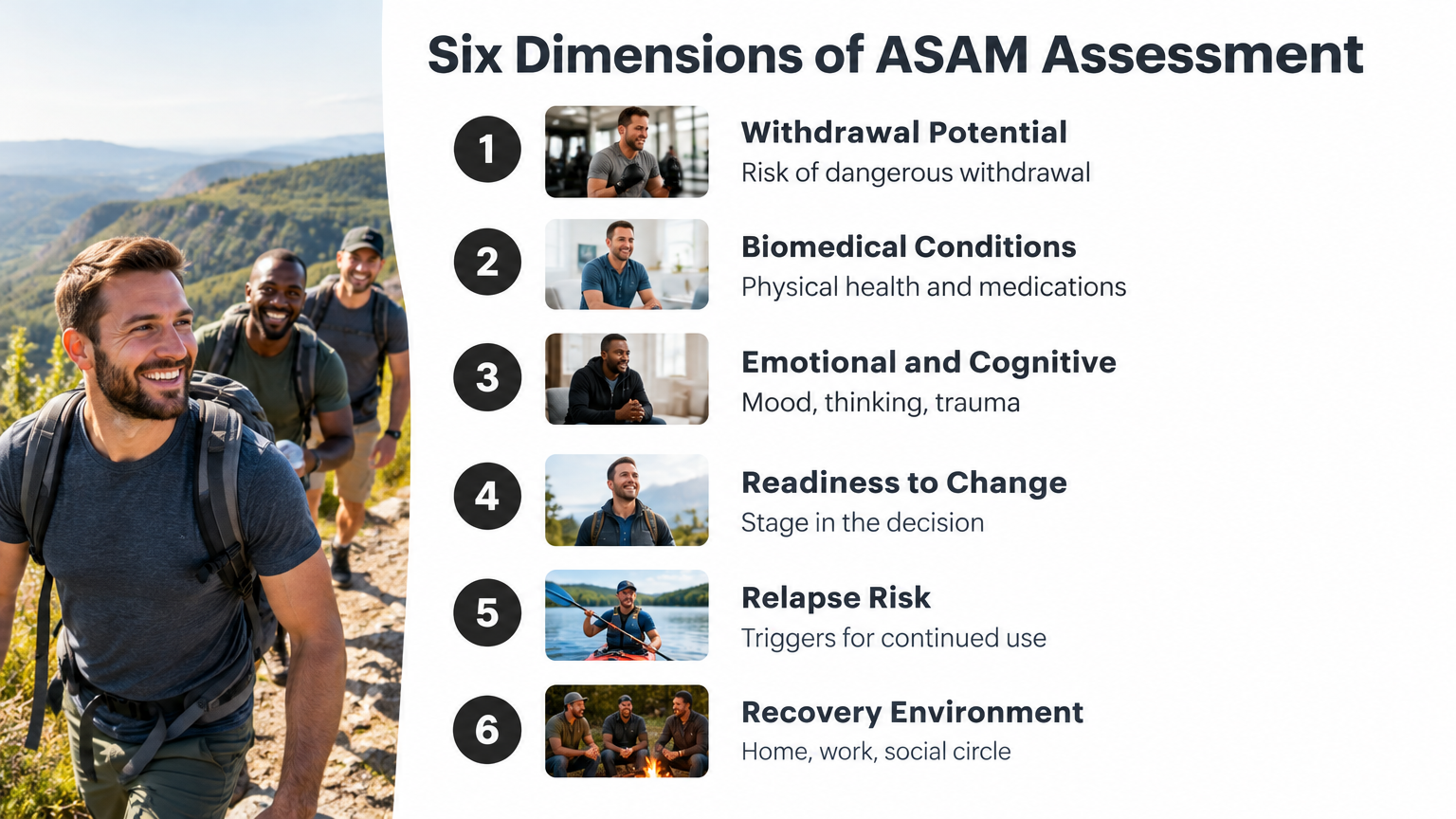
The first dimension looks at what the body is likely to do when the substance stops. The clinician asks about the last use, the typical daily amount, any past withdrawal episodes, seizures, DTs, or hospital visits, and whether other substances are in the mix7.
Alcohol and sedatives sit at the top of the caution list. Suddenly stopping heavy alcohol use can trigger life-threatening withdrawal, which is why NIAAA recommends matching the setting to the risk — outpatient support for lower-risk cases and medically supported withdrawal for people with a history of severe symptoms or complicating medical issues9.
Honest answers in this dimension are not about judgment. They are about safety. A man who downplays how much he drinks or forgets to mention the benzodiazepine prescription from a previous doctor may end up in a setting that cannot handle what his body is about to do. The point of Dimension 1 is to make sure the first 72 hours are survivable and stable.
Dimension 2 covers the body outside of withdrawal. The clinician asks about biomedical conditions, such as chronic illnesses, recent injuries, and current medications, and how those issues interact with substance use4.
A man who works construction with an untreated back injury and a prescription painkiller history has a different clinical picture than a man with no active medical issues, even if their drinking looks identical on paper. Nutrition, sleep, and dental problems also come up here, because they shape how the body tolerates both withdrawal and the demands of a treatment schedule.
The question behind this dimension is simple: what does the body need in order to participate in recovery, and does any of it require medical oversight that outpatient care cannot provide?
This is often the dimension men brace for the most. Dimension 3 looks at mood, anxiety, trauma history, anger, grief, sleep, concentration, and any thoughts of harming self or others6. The current edition incorporates updated terminology for psychiatric and cognitive conditions to better reflect how those concerns actually show up in substance use care1.
A clinician might ask about panic attacks, flashbacks, long stretches of low mood, or periods where it felt impossible to focus at work. They are not trying to diagnose a separate mental illness in a single sitting. They are trying to understand whether something underneath the substance use needs to be addressed at the same time, since integrated treatment is the preferred model for people with co-occurring concerns5.
For many men, this is also the first time anyone has asked these questions directly. Short, honest answers — even "I don't know, but it's been rough" — give the clinician enough to work with.
Readiness is not a yes-or-no switch. Dimension 4 looks at where someone actually stands with the idea of change: ambivalent, pressured by family or court, exhausted and ready, or somewhere in between5.
A clinician might ask what finally prompted the call, what the person hopes will be different in six months, and what parts of life they are not ready to give up yet. The answers do not disqualify anyone from treatment. They shape how a plan is built — more motivational work for someone who is still weighing it, more structure for someone who feels committed but has tried and relapsed before.
Saying "I'm here because my wife asked me to come" is a legitimate starting point. It tells the clinician where to begin, not where the conversation has to end.
Dimension 5 looks at what makes staying stopped hard. The clinician asks about past attempts at cutting back or quitting, how long those stretches lasted, what pulled the person back, and what cravings tend to feel like day to day7.
Someone with several short periods of abstinence followed by return to use has a different relapse profile than someone who has never tried to stop. Prior patterns matter, and so do current triggers — a job site where coworkers drink after shifts, a chronic pain flare, a specific person, a specific hour of the night.
This dimension is where strengths get named too. A man who has stayed sober through two deployments, or who stopped smoking cold turkey a decade ago, has coping skills worth building on. The assessment captures both the risks and the proof that change is possible.
The last dimension steps back and looks at the world the person goes home to. Dimension 6 covers the person's living situation and housing needs, along with the broader environment that shapes recovery4.
A clinician might ask whether there is alcohol in the house, whether a roommate uses, how far the commute is to an outpatient program, and who the person would call at 2 a.m. on a hard night. Supports count — a sober brother across town, a steady employer, a faith community — and so do the pressure points that keep showing up5.
In Tennessee, that environment varies widely. A man in East Tennessee near the Smokies has different daily rhythms than a man in Columbia commuting into the Nashville area. Both pictures are legitimate; the assessment just needs to see them clearly so the plan fits the life, not an idealized version of it.
Once the six dimensions are documented, the clinician looks for a level of care that can safely address what the assessment turned up2. A man with mild use, no withdrawal risk, a stable job, and a supportive partner at home does not need the same program as a man detoxing from alcohol with untreated depression and no reliable place to sleep. The findings do the sorting.
The ASAM continuum is described as five broad levels of care, Levels 0.5 through 4, varying in intensity according to patient needs, with options including outpatient treatment, intensive outpatient care, partial hospitalization, residential services, and inpatient care2. Each level is defined by the services available and the medical and clinical oversight required, so the match is really about which setting can hold the weight of the combined findings4.
| ASAM level | What it is | Findings that typically point here |
|---|---|---|
| 0.5 | Early intervention | Risky use without a diagnosed disorder; stable health and environment |
| 1 | Outpatient | Mild severity, low withdrawal and relapse risk, supportive home |
| 2 | Intensive outpatient / Partial hospitalization | Moderate severity, some psychiatric or environmental pressure, able to live at home |
| 3 | Residential | Unstable environment, higher relapse risk, moderate biomedical or psychiatric needs |
| 4 | Medically managed inpatient | Severe withdrawal risk or acute medical/psychiatric instability |
The recommendation is not permanent. As withdrawal resolves, mental health stabilizes, or home circumstances change, the plan is reassessed and the level of care steps down or up to match1.

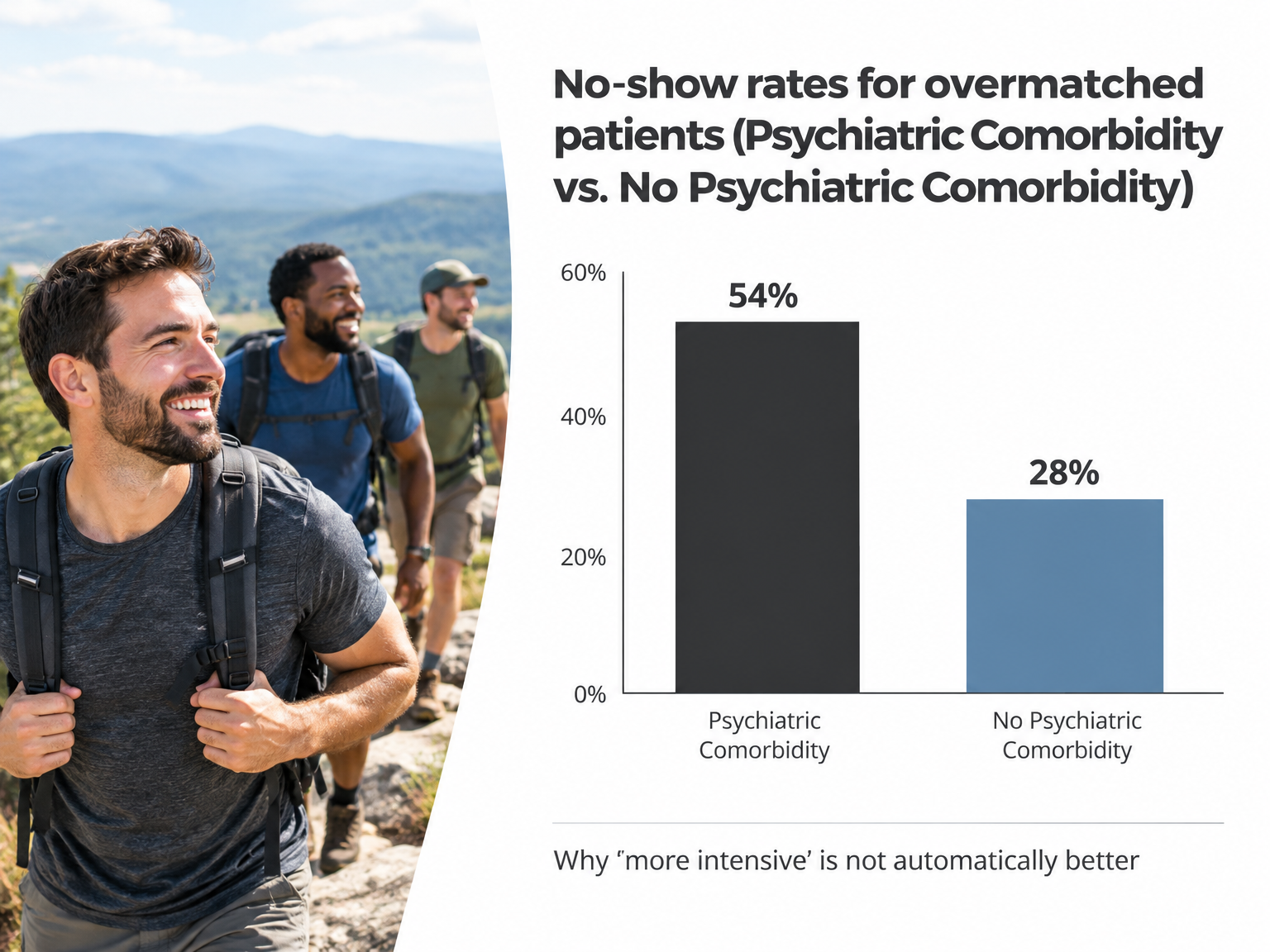
A common assumption at the start of recovery is that the longest, most intensive program must be the safest bet. The data pushes back on that instinct. When clinicians overmatch a person — placing them in a setting more intensive than the criteria indicated — attendance tends to suffer, especially when psychiatric symptoms are part of the picture.
What the finding does say is that fit matters. A program a man will actually show up to beats a more intensive one he quietly backs away from after week one. That is why the ASAM assessment aims for a level of care that can safely meet the need1 — not the most impressive one on the brochure. Honest answers about work, home, mental health, and readiness help the clinician build toward a plan that holds.
For many men, substance use and mental health have been tangled together for a long time before anyone named it that way. The ASAM assessment is designed to see both at once. Dimension 3 asks about mood, anxiety, trauma, anger, sleep, and concentration, while Dimensions 5 and 6 look at what tends to pull a return to use and what the home environment actually looks like day to day6. The clinician is listening for how those pieces move together, not scoring them separately.
SAMHSA treats integrated care — addressing substance use and co-occurring mental health symptoms in the same plan — as the preferred model, because splitting them tends to leave one side untreated5. In practice, that means a man describing panic attacks before job sites, flashbacks that get quieter after a few drinks, or long stretches of low mood after a loss will have those details written into the recommendation, not filed away for later.
Work pressure, provider identity, and the habit of handling things alone often show up here too. A clinician trained in co-occurring care expects that, and asks about it directly rather than waiting for a man to volunteer it. Short, honest answers — even partial ones — give the assessment enough to point toward a program equipped to treat both sides at once instead of one at a time.
Most ASAM assessments run about 60 to 90 minutes, though a complicated history — polysubstance use, multiple hospitalizations, a long trauma timeline — can push the conversation longer or split it across two visits3. The person asking the questions is almost always a licensed clinician: a counselor, social worker, or nurse with specific training in addiction care, sometimes supported by a physician or addiction medicine specialist when withdrawal risk or medical complexity is in the picture.
The format is a structured interview, not a quiz. Expect open questions about substance use history, withdrawal history, physical and mental health, safety, and home life, often paired with standardized tools the clinician scores alongside the conversation3. Nothing in the assessment is designed to catch anyone out.
Honesty is the part that actually changes the outcome. The assessment is also the clinical record a payer reviews when authorizing care, so understating use, minimizing past withdrawal, or leaving out a medication can quietly steer the recommendation — and the authorization — toward a setting that cannot hold what is really going on4.
The recommendation itself is a starting point, not a verdict. The clinician explains which level of care the six-dimension findings point to, walks through what that setting would actually look like day to day, and asks what the person thinks of the plan1. Nothing is locked in during a single conversation.
From there, the written assessment moves into two parallel tracks. One is clinical: the recommendation becomes the backbone of an initial treatment plan, with specific goals tied to the dimensions that drove the placement3. The other is administrative: the same documentation is what a payer reviews when authorizing coverage for the recommended level of care4. Thorough notes protect access; thin ones can slow it down.
Acceptance is not automatic. In a 2025 study of 1,399 completed intakes at a single substance use program, 42% of patients declined all offered ASAM levels of care when offered alongside medication and in-clinic recovery support11. That number comes from one program and one population, not every rehab in the country, but it makes a real point: a recommendation is an offer. Reassessment is built in, and the plan can shift as withdrawal clears, mental health stabilizes, or home circumstances change1.
This section is for the wife, partner, parent, or sibling making the call on someone else's behalf. During an ASAM assessment, the clinician may ask whether they can speak with you — that is called collateral information, and Tennessee assessment guidelines list it as a standard part of a thorough evaluation3.
What that usually looks like: a short conversation about what you have observed at home, how long the pattern has been going on, past treatment attempts, any medical or mental health history he may not remember or minimize, and safety concerns. Nothing you share overrides his account. It fills in gaps so the recommendation reflects the whole picture, not just the version shared on a hard day5.
Permission is required. He has to consent before the clinician can speak with you or share anything back. Offering to be available — by phone, in a follow-up call, or at a family session — is one of the most useful things a loved one can do early on.
If you have read this far, the hardest part — admitting the question is on your mind — is already behind you. An ASAM assessment is just the next conversation, not a verdict on who you are. A clinician asks about your drinking or drug use, your health, your sleep, what home looks like, and what you want to be different. You answer honestly. Together you land on a level of care that fits the actual life you are living1.
Trifecta Healthcare Institute offers that conversation at both the Knoxville location in East Tennessee and the Nashville-area facility in Columbia, with care matched to what the assessment turns up along the ASAM continuum2. Co-occurring mental health symptoms are treated alongside substance use, not after it.
[Verify your insurance] or [Call Trifecta] when you are ready. Men do not have to figure this out alone — a band of brothers starts with one call.
No. An ASAM assessment is not a pass-or-fail test. It is a structured conversation a clinician uses to figure out which level of care safely fits a person's situation1. There is no score that disqualifies anyone from treatment. The point is to match the plan to the real picture — honest answers help the clinician build toward a program that actually holds.
Most ASAM assessments run about 60 to 90 minutes3. A complicated history — polysubstance use, past hospitalizations, a long trauma timeline, or multiple medications — can push the conversation longer or split it across two visits. The clinician works through substance use history, physical and mental health, safety, and home environment, pairing open questions with standardized tools scored alongside the interview.
A licensed clinician trained in addiction care usually leads the assessment — often a counselor, social worker, or nurse, with a physician or addiction medicine specialist involved when withdrawal risk or medical complexity is in play3. In Tennessee, assessment documentation is expected to include substance use history, withdrawal history, safety risks, collateral information, and clinical reasoning behind the level-of-care recommendation.
Yes, indirectly. The written ASAM assessment is the clinical record a payer reviews when authorizing coverage for a specific level of care4. Thorough documentation of withdrawal risk, biomedical conditions, mental health, and home environment supports access to the recommended setting. Minimizing use or leaving out details can quietly steer both the recommendation and the authorization toward a program that cannot hold what is actually happening.
Dimension 3 covers mood, anxiety, trauma, anger, sleep, concentration, and any thoughts of harming self or others6. Dimensions 5 and 6 look at how those symptoms interact with relapse risk and home environment. SAMHSA treats integrated care — addressing substance use and co-occurring mental health symptoms together — as the preferred model, so those findings shape the recommendation rather than getting filed away for later5.
The recommendation is a starting point, not a verdict. A clinician walks through the reasoning and the day-to-day shape of the suggested setting, then asks what you think1. If something does not fit — work schedule, caregiving, concerns about residential care — say so. The plan can be adjusted, and reassessment is built in as withdrawal clears, mental health stabilizes, or home circumstances change.
Between facility size limits, waivers, and state-by-state rules, figuring out your Medicaid or private insurance benefits can feel like its own full-time job. Our admissions team will verify your coverage in minutes and walk you through exactly what's available — no guesswork required.
Verify Insurance Benefits →No commitment required. Confidential & HIPAA-protected.
Whether it's you or someone you love, our team can help you figure out the next step — what treatment looks like, what's covered, or just someone to talk to.
Talk to Our TeamConfidential. No commitment required.


