


How to Choose a Dual Diagnosis Partial Hospitalization Program
Use this checklist to assess a dual diagnosis partial hospitalization program, including integrated care, medication support, Tennessee licensure, PHP fit, a...
Read More
Learn how the asam criteria assess six dimensions to guide treatment placement, level-of-care changes, and discharge planning for people with substance use d...
Start Your Journey NowWritten and reviewed by the clinical team at Trifecta Healthcare Institute, a men’s-only treatment center in Tennessee specializing in substance use, mental health, and dual diagnosis care.
The ASAM Criteria are a clinical framework used across the United States to assess men and women with substance use disorders and match them to the right level of treatment, from brief outpatient support through medically managed inpatient care. Instead of ranking you by how much you drink or use, the asam criteria look at six areas of your life at once and ask what kind of setting can actually keep you safe and moving forward 3.
If you have been told you need rehab and someone mentioned an ASAM assessment, that first meeting is not a quiz you can fail. It is a structured conversation about your withdrawal risk, your physical health, what is happening emotionally, how ready you feel, how your last attempts went, and what you are walking back into when you leave the room 4.
For a man weighing treatment in Knoxville or at the Nashville-area facility in Columbia, TN, understanding how this works turns a confusing intake into the first honest conversation of recovery, not a verdict handed down about you.
The ASAM Criteria are a consensus-based clinical tool used to match a person with substance use disorder to the setting and intensity of care that fits their actual needs 3. They are not a scoring quiz, and they are not a label pinned to you at the door. They are a shared language that clinicians, state Medicaid programs, and insurers use to decide where treatment should start, how long it should continue, and when it should step up or down 2.
Three things make the framework distinct:
In practice, that means the asam criteria work less like a diagnosis and more like a map updated as your situation changes.
The first dimension looks at what your body is doing, or about to do, as substances leave your system. A clinician asks what you have been using, how much, how recently, and what happened the last time you tried to stop. The point is not to judge the pattern. It is to figure out whether you can safely detox at home with support, whether you need daily medical check-ins, or whether you need 24-hour medical monitoring because of risks like seizures, severe alcohol withdrawal, or benzodiazepine complications 4.
Your honest answers here directly shape whether treatment begins with medical detox or starts further down the continuum.
Dimension 2 covers the rest of your body: anything medical that is going on alongside the substance use. Blood pressure, liver function, chronic pain, diabetes, a healing injury, hepatitis, heart issues, sleep apnea, medications you are already taking. A man who is managing an opioid use disorder plus untreated hypertension is a different clinical picture than a man with the same substance use and no other health concerns 4.
This dimension decides how much medical oversight your setting needs, and whether a primary care handoff or psychiatric medication review has to be built into the plan from day one.
This is the dimension most men brace for and most explainers skim past. Dimension 3 asks what is happening in your head and in your mood. Are you depressed? Anxious? Carrying trauma from combat, a childhood you do not talk about, a loss you buried under work? Do you have trouble controlling anger? Are you having thoughts of hurting yourself or anyone else? Have you been diagnosed with ADHD, PTSD, bipolar disorder, or another condition, treated or untreated 4?
The reason this dimension matters so much for men is that substances are often an unhealthy solution to something underneath. If a clinician only addresses the drinking or the pills and misses the trauma, grief, or chronic anxiety fueling it, the plan is incomplete. ASAM-aligned programs are built to assess co-occurring mental health conditions alongside substance use so both get treated in the same episode of care rather than handed off separately 10.
Dimension 4 is a straight question dressed in clinical language: how ready do you feel to change this right now? Not how ready your wife wants you to be, or how ready your boss expects you to be. How ready are you 4?
Ambivalence is not disqualifying. Most men who walk into an assessment are somewhere between "I know I need to stop" and "I am not sure I can." That honest middle is exactly what the clinician needs to hear. A low readiness score does not block you from treatment; it usually points toward a setting with more structure, motivational interviewing, and daily contact to help readiness grow.
Dimension 5 is about pattern and pull. How many times have you tried to stop before? What happened? How quickly did cravings return, and what triggered them? Do you have strategies that have actually worked, even briefly? Are there people, places, or situations that reliably put you back where you started 4?
A man with a long history of short-lived sobriety followed by rapid return to use needs a different intensity than a man in his first serious attempt. This dimension helps the clinician gauge how much structure, peer support, and relapse-prevention work needs to be stacked around you to make this attempt stick.
The last dimension looks past the assessment room at what you walk back into. Who lives in your house? Is anyone there using? Do you have a job, and is that job part of the stress or part of the stability? Transportation, childcare, legal issues, financial pressure, a supportive partner, an isolating one. Housing you can count on, or housing that is uncertain 4.
Dimension 6 is why two men with nearly identical substance use histories can land in very different levels of care. Placement should account for individual characteristics rather than diagnosis alone 6. If your home environment is stable and your people support recovery, outpatient options are more realistic. If you are returning to active use at home or sleeping somewhere unsafe, a residential setting may be what keeps the plan from unraveling in week one. Providers have noted that standardized assessments can underweight housing instability and social needs if the clinician does not probe here carefully 1.
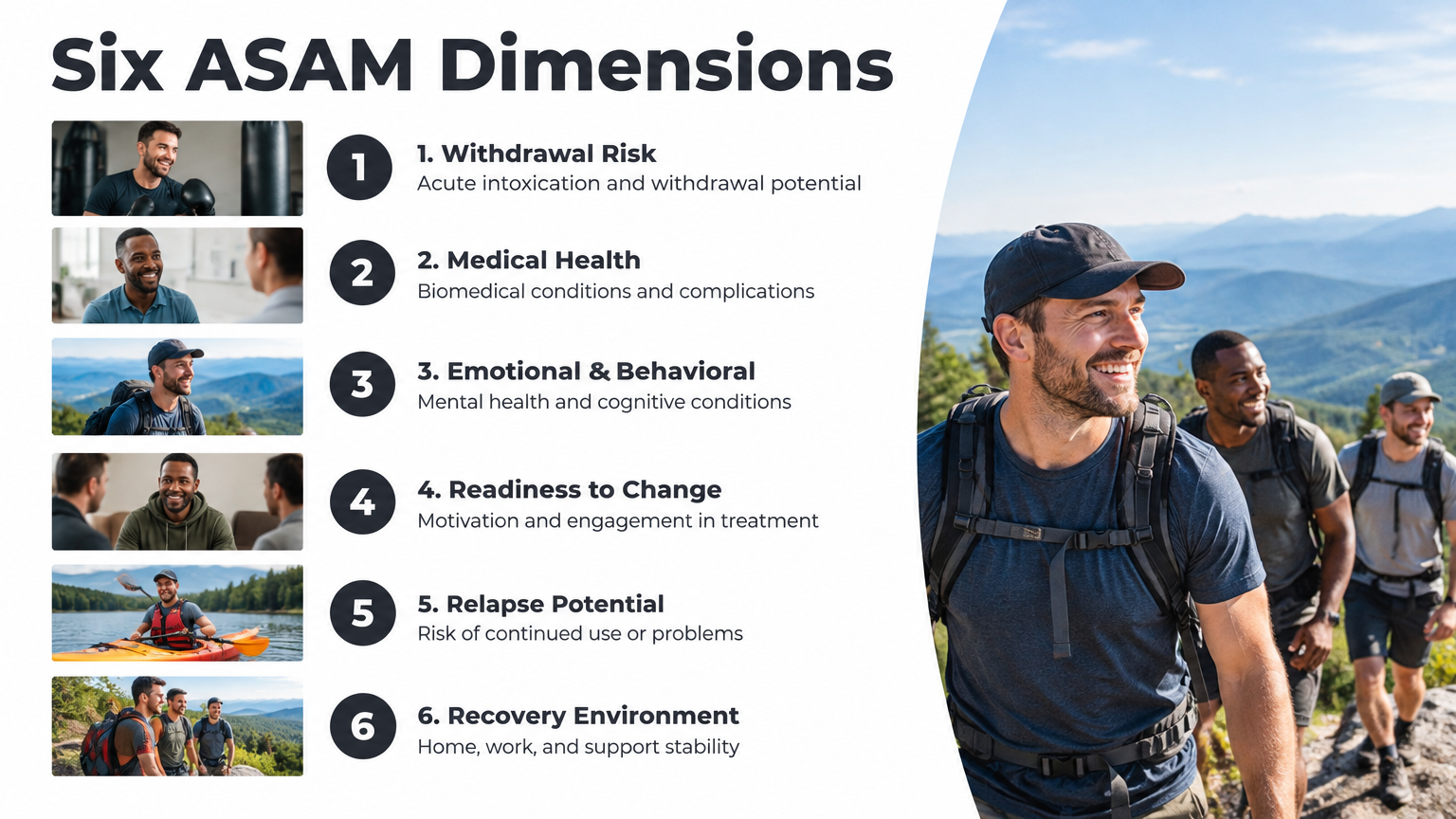
Once a clinician has notes across all six dimensions, the question becomes which setting can actually hold what you need. The ASAM framework organizes care into five broad levels, from Level 0.5 early intervention through Level 4 medically managed inpatient services, with sublevels and provider requirements tied to the intensity of clinical services and the degree of medical supervision required 2.
The guiding principle is the least restrictive setting that can still keep you safe and moving forward. In plain terms, that usually sorts out like this:
Diagnosis alone does not decide the level. Two men with the same substance use history can land in different settings because their dimension profiles differ 4.
Picture a conversation that runs 60 to 90 minutes, usually in a quiet office or over a secure video call. A licensed clinician, often a masters-level counselor or an LCSW, sits across from you with an intake packet and a set of structured questions tied to each of the six dimensions 4. You will be asked about your substance use history, your last drink or dose, your medical history, your mental health history, and what your week actually looks like at home and at work.
Expect three practical steps:
A common assumption is that the ASAM Criteria decide which door you walk through on day one and then step aside. They don't. California's behavioral-health guidance frames the asam criteria as a multidimensional assessment framework that directs medical management and the structure, safety, security, and intensity of treatment services 10. In plain terms, the same six dimensions that got you placed also decide what happens next.
That lifecycle moves through four checkpoints: Assessment, Placement, Continued Stay, and Transfer or Discharge. After the initial match to a level of care, your clinician keeps rating the same six dimensions on a schedule. If your withdrawal has stabilized and your home environment has steadied, continued stay at a high intensity may no longer be justified, and you step down. If a co-occurring mental health concern flares in Dimension 3, or your recovery environment destabilizes in Dimension 6, you may step up 4.
This is why honesty during weekly check-ins matters as much as it did at intake. The dimensions are the language your treatment team uses to defend a longer stay to an insurer, justify a transfer to residential, or sign off on a step-down to IOP when you are ready. Discharge planning begins with that same vocabulary, which is why aftercare recommendations usually trace directly back to Dimensions 5 and 6: what put you at risk before, and what you are walking back into now.

The framework is cleaner on paper than it is in practice. Three honest tensions are worth knowing before you sit down for an assessment.
Payer rules can override clinical recommendations. A May 2025 CMS-sponsored report from RTI, based on 70 interviews with Medicaid managed-care and SUD provider representatives across 10 states, found that clinicians regularly recommend a level of care that insurers then delay, modify, or deny through prior authorization. Providers in that report described useful clinical conversations undermined by inconsistent payer interpretation, authorization lags, and documentation burden that pulled time away from care 1. If your treatment team recommends residential and your insurer authorizes PHP, that is not your clinician being wrong. It is the gap between clinical judgment and utilization management.
Which edition of ASAM applies depends on where you are. States are not synchronized in their adoption of newer editions. Oregon plans to transition to Fourth Edition rules on July 1, 2027 8. Washington delayed Fourth Edition adoption to January 2028 under 2025 legislation 9. State editions vary, and the edition shapes how dimensions are weighted and documented. Ask your provider which edition they are using so the vocabulary matches your records.
The matching evidence is still debated. The criteria were widely adopted on face validity, and outcome validation remains limited; at least one study found no significant outcome difference between matched and mismatched groups at follow-up 5. That does not make the framework useless. It means ASAM is best understood as a structured, honest way to organize placement decisions, not a guarantee that a given level will produce a given outcome.
The last three dimensions are where a program's design starts to matter as much as its paperwork. Readiness (Dimension 4), relapse potential (Dimension 5), and recovery environment (Dimension 6) are not solved by a worksheet. They are built, slowly, through what you do every day and who you do it with 4.
Movement is one way that work happens. Boxing, jiu-jitsu, CrossFit, hiking in East Tennessee, ice baths, basketball — these are not amenities bolted onto therapy. Structured physical activity gives a man a concrete place to practice showing up when he does not feel like it, which is readiness in action. It also builds a tolerance for discomfort that transfers directly to craving work in Dimension 5. You learn that hard sensations pass without you having to numb them.
Brotherhood maps onto Dimension 6. The recovery environment is not only the house you sleep in. It is the people you call at 9 p.m. on a bad Tuesday. A group of men moving through treatment together becomes a second environment, one that often holds steadier than the one waiting at home while that one gets rebuilt.
You do not need to prepare like it's a job interview. The clinician's job is to pull the picture together even if you arrive tired, nervous, or unsure what to say. A few practical things make the hour more useful.
Bring a current medication list, including anything you take for blood pressure, pain, anxiety, sleep, or ADHD, plus doses if you know them. Bring your insurance card and a photo ID. If you have had prior treatment, jot down the program name, roughly when, and what level of care, residential or outpatient. If you have a primary care doctor or a therapist, have their names handy so the clinician can coordinate on Dimensions 2 and 3.
Be ready to answer honestly about your last use, not your best week. As a general clinical principle, underreporting can push the placement toward a setting that may not hold you 4. Expect questions about your home, work, legal situation, and the people around you — that is Dimension 6 doing its work.
Men coming to Knoxville or to the Nashville-area facility in Columbia, TN can also ask up front which edition of the ASAM Criteria the program is using and how insurance verification will run alongside the clinical recommendation. Both answers belong to you.
A quick shift in audience: this section speaks to the people around him. If you are the one who found this article at midnight, you are not reading it wrong. Understanding how placement actually works will help you be useful without taking over.
A few things worth knowing. The ASAM assessment is not something you can prepare him into passing. The clinician needs his honest answers, not the version he thinks will get him home faster. As a general clinical principle, if he underreports withdrawal risk or minimizes prior relapses, the recommended level may not match what he actually needs 4.
You can help in concrete ways. Gather his medication list, insurance card, and any records from prior treatment. Offer to drive him and sit in the waiting room, not the assessment itself unless he asks. If you have observed withdrawal symptoms, mood changes, or safety concerns he may downplay, write them down and ask the clinician how to share them. Providers have noted that family-reported context often fills gaps the assessment alone misses, particularly around the recovery environment he will return to 1.
And ask the program directly how family involvement works after admission. His recovery is his, but the home he comes back to is yours together.
The ASAM Criteria give your treatment team a shared language for a decision that used to get made on gut and bed availability. Six dimensions, one honest conversation, a level of care that can actually hold what you brought in. That's the whole frame 3.
What the assessment cannot do is finish the work for you. Placement sets the stage. Showing up, telling the truth at the weekly check-ins, and building something steadier than the pattern that got you here — that part is yours. If you're ready to start that conversation with Trifecta Healthcare Institute in Knoxville or Columbia, TN, the first step is a phone call. [Verify your insurance] or [Call Trifecta] when you're ready. The next right move is usually smaller than it looks from here.
No. The ASAM Criteria are a clinical framework for matching you to the right setting, not a quiz with right or wrong answers 3. The clinician is listening for an honest picture across six areas of your life so the recommended level of care can actually hold what you brought in. Shading the truth doesn't help you "win" — it usually points you toward a setting that won't fit.
Plan for 60 to 90 minutes with a licensed clinician, either in person or over secure video. That window covers a safety screen on withdrawal and physical health, a longer biopsychosocial conversation about mental health, readiness, prior attempts, and home environment, and a shared discussion of the recommended level of care 4. Some programs now use shorter structured tools like the GAIN-Q4 to generate dimension ratings more efficiently 7.
It happens. A May 2025 CMS-sponsored RTI report, based on 70 interviews with Medicaid managed-care and SUD provider representatives across 10 states, documented regular gaps between clinical recommendations and payer authorization, including delays, modifications, and inconsistent interpretation 1. If your clinician recommends residential and your insurer authorizes PHP, ask the program about appeals, peer-to-peer reviews, and whether the clinical team can document the dimension ratings supporting the higher level.
Yes, and it usually does. The same six dimensions that drive admission also drive continued stay, transfer, and discharge decisions 4. California's behavioral-health guidance describes ASAM as directing the structure, safety, and intensity of treatment across the whole episode 10. If your withdrawal stabilizes and your home steadies, you step down. If a co-occurring symptom flares or your environment destabilizes, you may step up.
Not beforehand. Placement is based on a substance use disorder diagnosis plus ratings across the six dimensions, and the clinician doing the assessment typically establishes or confirms the diagnosis during that same conversation 7. If you already have records from a prior provider — a primary care doctor, a therapist, a previous treatment program — bring them. They give the clinician a fuller picture of Dimensions 2 and 3.
That's your call. Most programs will let a family member join part of the conversation or share observations in writing, especially around withdrawal symptoms, mood changes, or home environment he may downplay. Provider interviews in the 2025 CMS/RTI report noted that family-reported context often fills gaps that a standardized assessment alone misses, particularly around recovery environment 1. Ask the program directly how they handle family input at intake.
Between facility size limits, waivers, and state-by-state rules, figuring out your Medicaid or private insurance benefits can feel like its own full-time job. Our admissions team will verify your coverage in minutes and walk you through exactly what's available — no guesswork required.
Verify Insurance Benefits →No commitment required. Confidential & HIPAA-protected.
Whether it's you or someone you love, our team can help you figure out the next step — what treatment looks like, what's covered, or just someone to talk to.
Talk to Our TeamConfidential. No commitment required.


