


How to Choose a Dual Diagnosis Partial Hospitalization Program
Use this checklist to assess a dual diagnosis partial hospitalization program, including integrated care, medication support, Tennessee licensure, PHP fit, a...
Read More
Explore the benefits of drug rehabilitation, from medical stabilization and tailored therapy to peer support and continuing care that help build lasting reco...
Start Your Journey NowWritten and reviewed by the clinical team at Trifecta Healthcare Institute, a men’s-only treatment center in Tennessee specializing in substance use, mental health, and dual diagnosis care.
The benefits of drug rehabilitation come down to one thing: a stacked set of medical, psychological, and social supports that are hard to put together on your own. A good program handles the body first, then the mind, then the people and routines you go home to. That stack is what separates treatment from willpower.
If you are reading this at a kitchen table in Knoxville or in a parked truck outside a job site in Columbia, you are not alone in weighing it, and you are not late. SAMHSA's 2024 National Survey on Drug Use and Health provides national estimates on substance use, substance-use disorders, and treatment receipt, and it consistently shows that most people who could benefit from substance use treatment do not receive it in a given year.20That gap is not a verdict on the people who did not get care. It reflects cost, stigma, scheduling, and the fact that most men wait until something breaks before they pick up the phone.
Here is the honest frame for what follows. Rehabilitation is not a cure, and recurrence of use is not failure. The National Institute on Drug Abuse is clear that detox alone is not treatment and is not enough for recovery on its own.1What structured programs do add is medical stabilization, a plan built around your situation, therapy that targets real triggers, co-occurring mental health support, peer connection, family work, movement as a clinical tool, and continuing care after discharge. The next seven sections unpack each one.
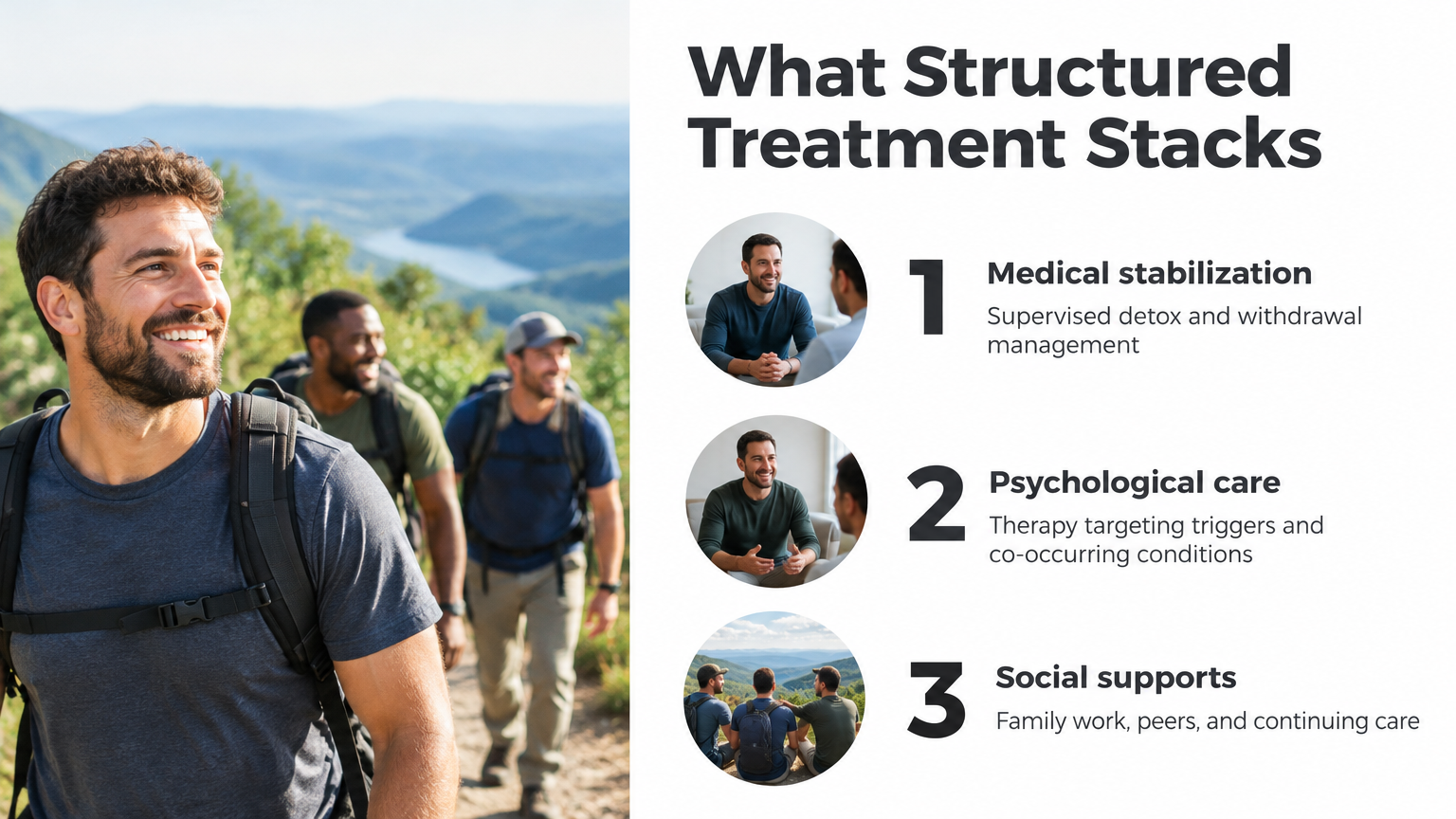
The first benefit of a structured program is the one most men underestimate: a medical team watching over your body while it comes off the substance. Withdrawal is not just uncomfortable. Depending on the substance, how much you have been using, and for how long, it can carry real medical risk, and in opioid cases, a crash in tolerance that makes a return to use far more lethal than the use that came before it.
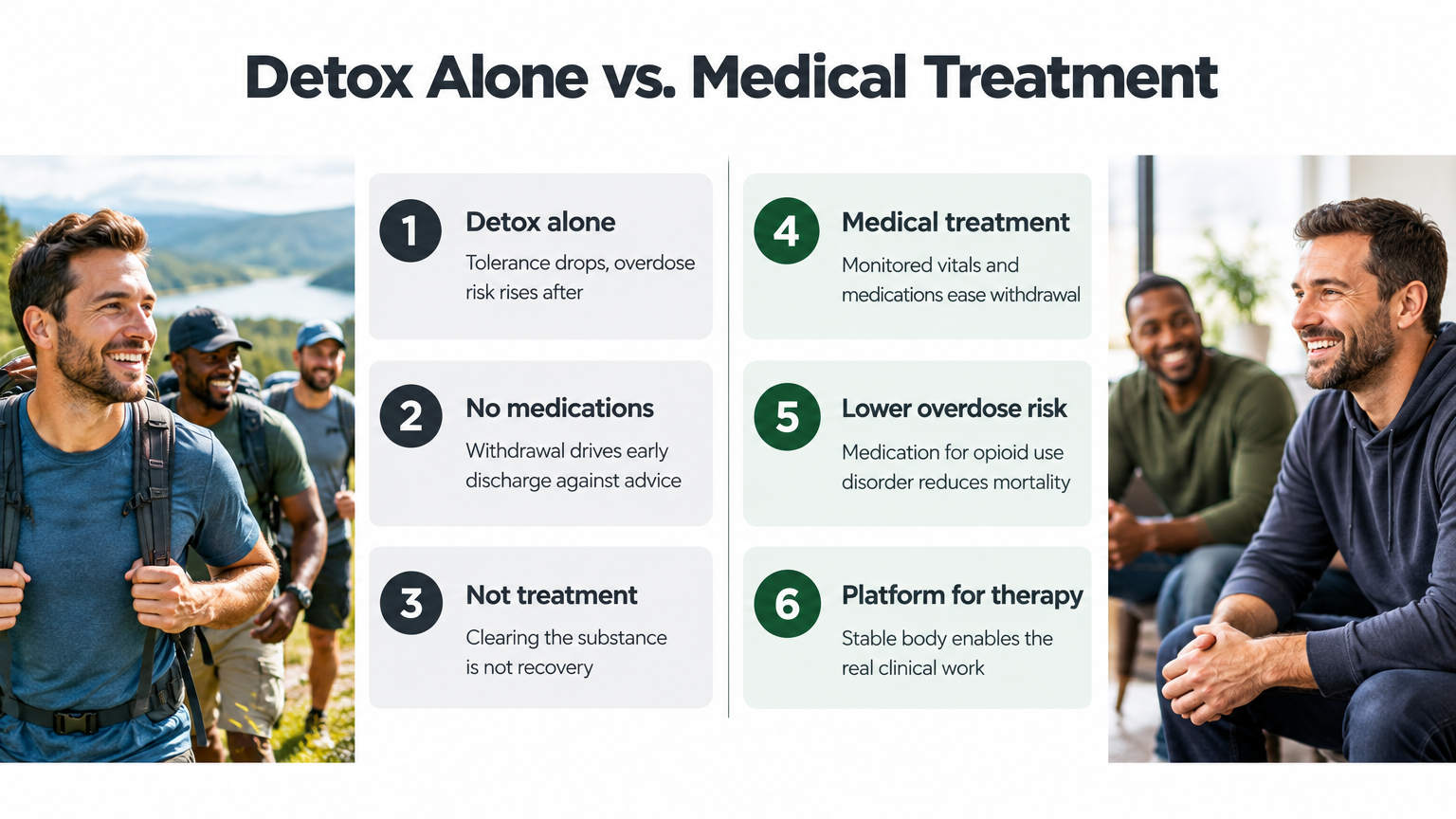
Medical detox puts clinicians between you and that risk. Vitals get monitored. Medications are used to blunt withdrawal symptoms and reduce the odds that you leave against medical advice because the discomfort is too much. The CDC is explicit on the opioid side: medication treatment for opioid use disorder is associated with reduced risk of overdose and overall mortality, while detoxification alone, without medication, is not recommended for opioid use disorder because the risk of overdose actually rises after a short detox when tolerance has dropped but the drive to use has not.3
NIDA frames the broader point this way: detoxification is not the same as treatment, and getting the substance out of your system is not enough on its own to produce recovery.1The body has to be stabilized before the real work can begin, and then the real work has to begin.
Trying to white-knuckle this at home, on a cot in a spare bedroom in Knoxville or a basement in Columbia, is where a lot of good intentions end. A supervised detox gives you the one thing self-detox can't: people who know what to watch for and what to do when something turns. That is not a weakness to accept help with. It is a clinical reality worth respecting.
No two men walk into treatment carrying the same situation. One is a 32-year-old welder whose drinking escalated after a back injury and a divorce. Another is a 48-year-old father of three who started on prescribed opioids after surgery and never came back down. A third is a 26-year-old whose stimulant use is tangled up with untreated anxiety he has had since high school. The substance may look similar on paper. What is driving it, and what will hold recovery together, almost never does.
That is why NIDA's foundational treatment principles state plainly that no single treatment is appropriate for everyone, and that matching the setting, interventions, and services to a person's specific problems and needs is critical to success.2A good program treats intake as a real assessment, not paperwork. Clinicians look at the substance and the pattern of use, medical history, mental health history, trauma, family dynamics, work and legal pressures, housing, and what has already been tried.
From that assessment, a plan gets built. For alcohol use disorder, NIAAA describes a menu that can include behavioral care, FDA-approved medications, and residential or outpatient treatment, often in combination.4For opioid use disorder, medication is a central piece, not an add-on. For a man whose use is tied up with panic attacks or unprocessed grief, therapy choices get prioritized differently than for someone whose main driver is social and situational.
Level of care matters, too. A Partial Hospitalization Program (PHP) runs most of the day and is closer to the intensity of inpatient care without the overnight stay. An Intensive Outpatient Program (IOP) meets several times a week and lets a man keep working or attending to family. Outpatient steps down further. The right starting point depends on withdrawal risk, home environment, co-occurring conditions, and prior treatment history, which is exactly why a one-size protocol tends to misfire.
A plan should also change as you do. NIAAA frames recovery as an ongoing process rather than a single event, with treatment adjusted over time as needs shift.5That means the plan you start with in week one is not the plan you leave with. It is the first version of something that gets refined as the clinical team learns what is actually working for you.
Getting the substance out is one thing. Learning to get through a Tuesday without it is another. Behavioral therapy is where that second part gets built, session by session, with a clinician who is paid to pay attention to the exact places your recovery is most likely to crack.
NIDA describes behavioral therapies as helping people recognize and cope with triggers, improve the effectiveness of any medications involved, and stay in treatment longer.1That is the plain version of what happens in the room. You name the moments where the pull is strongest. You and your therapist pull them apart and figure out what the craving is actually asking for.
Picture the 2 a.m. craving after a fight with your wife. The Monday morning after a weekend you told yourself you would skip. The first work happy hour where everyone is ordering and you have to decide, in about four seconds, what you are drinking. In a program, you do not meet those moments cold. You rehearse them. At Trifecta Healthcare Institute, that work draws on modalities offered by the clinical team including CBT, DBT, MI, and EMDR, chosen based on what each man actually needs.
Behavioral therapy also reaches beyond the substance itself. NIDA's foundational principles note that these therapies can improve communication, relationships, parenting, and family dynamics, because substance use rarely damages only one area of a life.2The skills you build for a craving are the same skills that let you stay at the dinner table instead of walking out, or ask for help at work instead of calling in.
None of this is magic, and no therapist will promise it is. NIAAA frames recovery as a process rather than an event, with coping skills, support, and treatment adjustments carrying it over time.5The benefit of a structured program is that you get to practice those skills on the real triggers that are waiting for you back home, with someone in the room who can tell you when your plan is working and when it needs a rewrite.
A lot of men do not walk in with a clean substance use problem. They walk in with anxiety that has been running the show since their twenties, depression that got heavier after a layoff, PTSD from a deployment or a car wreck, grief they never processed, or anger they have learned to blunt with alcohol or pills. The substance is the loudest part of the picture. It is usually not the only part.
That is what co-occurring disorder treatment, sometimes called dual diagnosis, is built to address. SAMHSA's advisory based on Treatment Improvement Protocol 42 lays out why: substance use programs need to screen, assess, diagnose, and manage mental health conditions as part of care rather than send a man down the hall for one problem and refer him somewhere else for the other.7When those two tracks run in separate buildings with separate charts, things get missed. Medications collide. Trauma work stalls because the drinking is not addressed. Sobriety wobbles because the panic attacks never got a plan.
Integrated care means one clinical team working on both at once. Assessment covers mental health history alongside substance use. Treatment planning is built together. Therapy sessions can target a trauma memory one week and a craving pattern the next, with the clinician tracking how one is feeding the other. SAMHSA's integrated-treatment guidance frames this as coordinated assessment, planning, and continuity rather than parallel services that never talk.8
The evidence here is strong but honest about its limits. A 2025 umbrella review of 28 systematic reviews on psychosocial interventions for adults with substance use disorders and common co-occurring mental health conditions found that integrated or coordinated treatment was usually better than treating one condition alone, and sometimes better than parallel, uncoordinated services.17At the same time, a 2023 systematic review of dual-disorder studies found integrated treatment improved psychiatric symptoms but did not show a clear advantage over non-integrated care for substance use outcomes or treatment retention.16Translation: pulling both conditions into one plan tends to help the mental health side, and often helps the substance side, but it is not a guaranteed upgrade on every measure.
For a man weighing treatment, that is still a meaningful benefit. If anxiety or depression or trauma has been part of why using felt necessary, a program that treats only the substance is leaving the real driver on the table. Co-occurring care is not primary mental health care, and it is not a replacement for a long-term psychiatrist. It is the piece of rehabilitation that makes sure the thing underneath the drinking or the pills gets looked at, named, and worked on while you are already in the room.
One of the quieter benefits of a structured program is also one of the most durable: you stop recovering alone. For a lot of men, that is the piece that has been missing for years. Drinking happened with other guys. Using happened in private. Recovery, until now, has been a thing you tried to white-knuckle through on your own, and it has not held.
Group work in rehab changes the math. You sit in a room with other men who have been where you are, and the usual shame scripts stop working. Someone else names the exact thing you were planning not to say. Someone calls out the half-truth you did not realize you were telling. That kind of peer accountability is harder to fake than a one-on-one session, and it is harder to walk away from than a solo plan.
The research on peer recovery support is still developing, but it points in a consistent direction. A systematic review of peer recovery support services, delivered by people with lived experience of recovery, reported tentative positive evidence across several outcomes:
The authors called the findings tentative because study designs varied, but the pattern across outcomes is worth taking seriously.
For men specifically, a program built around brotherhood tends to make this work easier to lean into. Talking honestly about fear, grief, or the way your drinking affected your kids is not something most men have practiced. Doing it next to other guys who are practicing the same thing makes it survivable, and then useful. That shared experience is also what tends to carry forward: the men you detox with, group with, and train with are often the ones you text at 10 p.m. a year later when the pull comes back.
Of all the benefits of drug rehabilitation, this one tends to get written off as a perk. It is not. Movement in a well-run program is clinical programming, scheduled on purpose, tracked like other interventions, and built around what the research actually shows exercise can do for a man in early recovery.
Start with cravings, which is where most relapses begin. A 2023 systematic review and meta-analysis of 22 randomized controlled trials involving 1,537 participants with substance use disorders reported a significant reduction in cravings after light-, moderate-, and high-intensity exercise, with a reported standardized mean difference of −0.71 in the review's analysis.11That is a sizable effect for a non-pharmacological intervention. It does not mean a workout erases the pull. It means that for the window around and after exercise, cravings tend to come down measurably, which gives you breathing room to use the coping skills you have been building in session.
Broader reviews point the same direction. A systematic literature review of exercise as an adjunct to addiction treatment reported that nearly three-quarters of included studies documented significant changes in addiction-related outcomes, such as abstinent days or craving reductions, particularly during inpatient or outpatient care.10A separate review of 14 randomized controlled studies in people with opioid or amphetamine use disorder concluded that exercise can function as an auxiliary intervention, and emphasized low-intensity, high-frequency, long-term activity rather than occasional hard sessions.12
In practice, that is why serious programs put structured movement on the daily schedule rather than leaving it to willpower. Boxing, jiu-jitsu, strength work, hiking, basketball, ropes courses, cold exposure. The specific activity matters less than the fact that it is happening regularly, with other men, and tied to the rest of your clinical plan. In Knoxville, that often looks like time in the Smoky Mountains and outdoor work built into the week. The point is the same either way: give the body something hard to do that is not using, and let the nervous system start learning a different pattern.
Substance use rarely stays in one lane. By the time a man walks into treatment, his wife, parents, or kids have usually been living with the fallout for a while. Trust is thin. Conversations have patterns. Everyone has a role they have been playing, and most of those roles have calcified around managing the drinking or the pills.
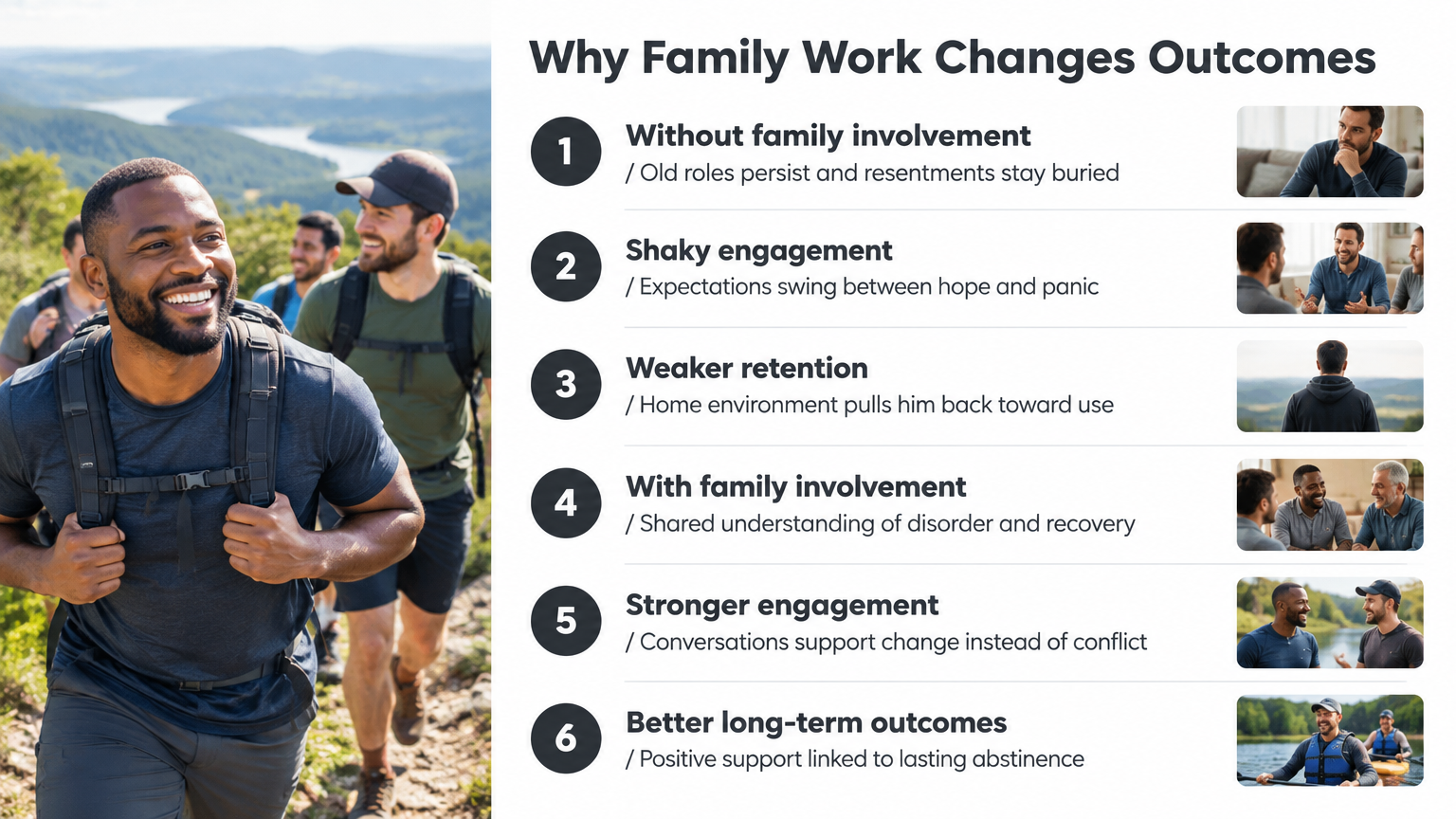
Family work in a structured program is where those patterns get interrupted. SAMHSA's advisory on family therapy in substance use treatment is direct about the benefit: involving family members can positively affect a man's engagement in care, how long he stays in treatment, and his outcomes, and positive social and family support is linked with longer-term abstinence and recovery.9That is a clinical finding, not a sentiment. The people he goes home to shape whether the work holds.
In practice, family sessions do a few specific things. They give his partner or parents accurate information about what the disorder is and what recovery looks like, so expectations stop whipsawing between hope and panic. They teach the kinds of conversations that support change instead of pushing him back toward using. They surface resentments that would otherwise sit under the dinner table for the next five years. For men whose kids are old enough to notice, age-appropriate family work can start to repair what the last few years took.
The discharge day photo is misleading. It looks like a finish line. It is not. The weeks and months after a program ends are when most of what you learned either becomes a habit or quietly erodes. Continuing care is the structure that keeps the first version going.
NIAAA puts it plainly: continued care in residential or outpatient settings, or both, is often needed to sustain abstinence and promote long-term recovery.4This can take different forms depending on where you are stepping down from. A man finishing PHP may move into IOP, then into outpatient, then into an alumni group that meets weekly. Someone else may stay on medication for opioid or alcohol use disorder, with regular check-ins, while attending a mutual-support group on the side. The point is that something continues on the calendar.
The research supports this as a real, if modest, benefit. A review of continuing-care models for adults and adolescents reported a small but significant benefit at the end of continuing care and at post-treatment follow-up, with the most consistent gains showing up in longer-duration programs that actively worked to keep people engaged.14A meta-analysis of 33 controlled trials found continuing care outperformed minimal or no continuing care, with effect sizes of g = 0.187 at end of care and g = 0.271 at follow-up.15These are not huge numbers. They are honest ones, and they point in a consistent direction: staying connected to care longer helps more than stopping cold.
In practical terms, that means picking a program that treats aftercare as part of the plan, not an afterthought. Alumni groups, recovery coaching, scheduled check-ins, and a clear plan for the first high-risk weekend home are not frills. They are what carries the work past the discharge door.
This section is for the wives, parents, partners, and siblings reading at midnight because the man in your life has not asked for help yet, or has asked and then backed off, or is in the middle of something that scares you. The question underneath most of these searches is the same: will a program actually help him, and what should you do in the meantime?
A few things that are worth knowing. Family involvement is not a bystander role. SAMHSA's advisory on family therapy in substance use treatment reports that involving family members can positively affect engagement, retention, and treatment outcomes, and that positive social and family support is linked with longer-term recovery.9That means the conversations you have, and the ones a clinician helps you have, carry real clinical weight.
Two other things worth holding onto. NIAAA frames recovery as an ongoing process that often includes improvements in physical health, mental health, relationships, and daily functioning, not a single finish line.6And a recurrence of use after treatment is not proof that treatment did not work. It is information the clinical team can use to adjust the plan.
If you have read this far, something in your life is probably asking you to. Maybe it is your own tiredness. Maybe it is the look on your wife's face. Maybe it is a quiet count of how many Mondays you have promised yourself this was the last weekend.
The benefits of drug rehabilitation stack because they are built to. Medical stabilization, an individualized plan, behavioral therapy, co-occurring care, peer connection, movement, family work, and continuing care each do a different job, and together they do what willpower on its own usually can't.
You do not have to have it figured out before you make a call. Trifecta Healthcare Institute's admissions team in Knoxville and the Nashville-area facility in Columbia can walk through options, insurance, and timing in one conversation. [Call Trifecta] or [Verify your insurance] when you are ready. The next version of your life is still yours to write.
Research supports real benefits, but the honest answer is that outcomes vary. NIDA frames behavioral therapies as helping people cope with triggers, stay in treatment longer, and improve relationships and functioning.1NIAAA describes recovery as an ongoing process that often includes gains in physical health, mental health, relationships, and daily functioning rather than a single pass-fail result.6A good program improves the odds; it does not guarantee an outcome.
Quitting alone usually means managing withdrawal, cravings, triggers, and mental health concerns without medical or clinical support. A structured program adds medical stabilization, individualized treatment matching, and behavioral therapy for coping skills. NIDA states plainly that detoxification is not the same as treatment and is not enough for recovery on its own.1For opioid use disorder, the CDC notes that detox alone, without medication, is not recommended because overdose risk rises afterward.3
Yes. Co-occurring or dual-diagnosis care is designed to address both at once. SAMHSA's advisory based on TIP 42 calls for screening, assessing, diagnosing, and managing mental health conditions inside substance use treatment rather than referring them out.7A 2025 umbrella review found integrated treatment was usually better than treating one condition alone for adults with co-occurring conditions.17Note that co-occurring care is not a substitute for long-term primary mental health care.
A recurrence of use is not proof that treatment failed. NIAAA frames recovery as a process rather than a single event, with plans adjusted over time as needs shift.5Clinically, a return to use is information the team uses to revise the plan, which might mean a higher level of care, medication changes, new therapy focus, or stronger continuing care. The next step is usually a call back to the clinical team, not starting over from zero.
There is no single length that fits everyone. NIDA's foundational principles emphasize matching treatment setting, intensity, and services to the person rather than a fixed timeline.2In practice, a man may move through medical detox, then PHP, then IOP, then outpatient and alumni support over months. NIAAA notes that continued care in residential or outpatient settings, or both, is often needed to sustain long-term recovery.4Longer engagement with care tends to help more.
Families should expect to be involved, not sidelined. SAMHSA's advisory on family therapy reports that involving family members can positively affect engagement, retention, and treatment outcomes, and that positive social and family support is linked with longer-term recovery.9Expect education about the disorder, structured family sessions, and guidance on how to communicate in ways that support change. In Knoxville or the Nashville-area facility in Columbia, a clinical team will tailor family involvement case by case.
Between facility size limits, waivers, and state-by-state rules, figuring out your Medicaid or private insurance benefits can feel like its own full-time job. Our admissions team will verify your coverage in minutes and walk you through exactly what's available — no guesswork required.
Verify Insurance Benefits →No commitment required. Confidential & HIPAA-protected.
Whether it's you or someone you love, our team can help you figure out the next step — what treatment looks like, what's covered, or just someone to talk to.
Talk to Our TeamConfidential. No commitment required.


