


How to Choose a Dual Diagnosis Partial Hospitalization Program
Use this checklist to assess a dual diagnosis partial hospitalization program, including integrated care, medication support, Tennessee licensure, PHP fit, a...
Read More
Learn how the clinical opioid withdrawal scale scores 11 symptoms, interpret severity ranges, and understand how clinicians use scores to guide buprenorphine...
Start Your Journey NowWritten and reviewed by the clinical team at Trifecta Healthcare Institute, a men’s-only treatment center in Tennessee specializing in substance use, mental health, and dual diagnosis care.
The clinical opioid withdrawal scale, almost always called COWS, is an 11-item checklist a clinician uses to measure how severe your opioid withdrawal is right now. Scores run from 0 to 48, and higher numbers mean more intense withdrawal.1, 2
Think of the COWS score as a shared language between you, your nurse, and your doctor. Instead of guessing whether your sweating, racing pulse, or restlessness count as "a little" or "a lot," the team puts a number on each sign and adds them up. That total gives everyone the same picture of what your body is doing in the moment.
The score is not a grade or a pass/fail test. It is a snapshot, taken again and again across a detox day, so the care team can match the next step to how you actually feel. If your pulse climbs, your pupils widen, and goosebumps appear on your arms, the number goes up and the response changes. If comfort medications ease the shakes and your gut settles, the number comes down and the plan adapts.8
For a man walking into medical detox in Knoxville or Nashville, that matters. The COWS score is how the team hears what your body is saying when words feel like too much work.
COWS breaks withdrawal into 11 observable pieces. Some the clinician watches and measures. Some they ask you to describe. Each item gets a point value, and the whole assessment usually takes about two minutes at the bedside.5 The maximum possible total is 48.1
Here is what the care team is actually scoring.1
| COWS item | What is being measured |
|---|---|
| Resting pulse rate | Heart rate taken after one minute of sitting or lying still |
| Sweating | Flushing, moist face, or beads of sweat over the past half hour, not from room temperature or activity |
| Restlessness | Ability to sit still during the exam, from calm to constantly shifting |
| Pupil size | How dilated the pupils look in normal room light |
| Bone or joint aches | Reported aching in muscles, back, or joints attributable to withdrawal |
| Runny nose or tearing | Nasal stuffiness, runny nose, or watery eyes not caused by a cold or allergies |
| GI upset | Stomach cramps, loose stool, vomiting over the past half hour |
| Tremor | Shaking observed when hands are held out |
| Yawning | Number of yawns during the exam |
| Anxiety or irritability | Reported nervousness, agitation, or edge during the visit |
| Gooseflesh skin | Visible piloerection, or goosebumps, on the arms or back |
A few of these need a plain-language note. Piloerection just means goosebumps standing up on your skin, often across the forearms, when nothing in the room should be causing them. Pupil size is checked in normal light because withdrawal tends to widen the pupils, the opposite of what opioids themselves do. Resting pulse is taken after you have been still for a minute so a walk down the hall or a flight of stairs does not inflate the number.1
Add every line together and you get a single number that lives somewhere on the 0 to 48 range, ready to be compared to the one taken an hour before or an hour from now.1, 10
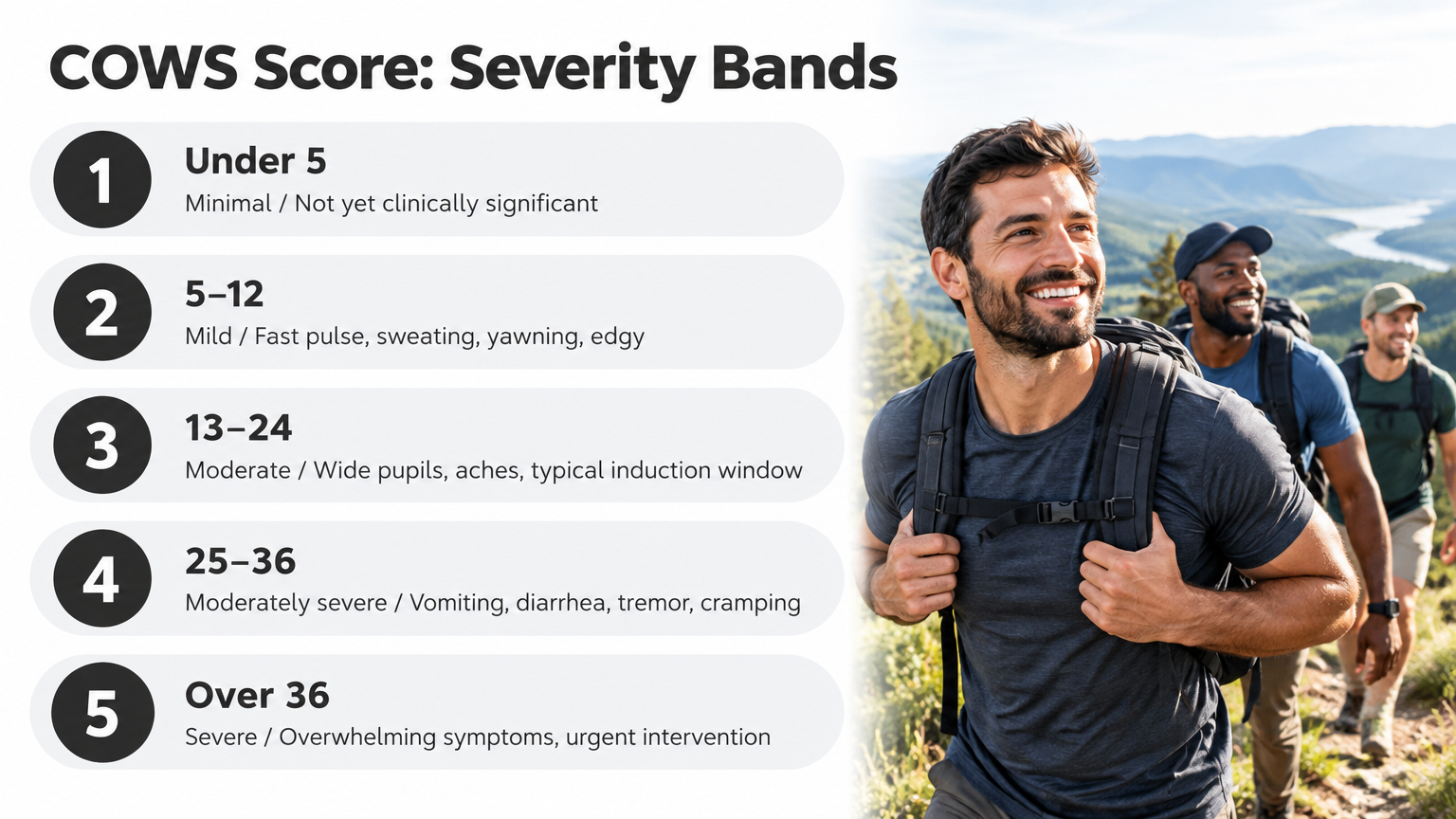
Once the 11 items are added together, the total lands in one of four severity bands that have been used in COWS-based care for years. The Veterans Health Administration provider fact sheet lays them out plainly: 5 to 12 is mild withdrawal, 13 to 24 is moderate, 25 to 36 is moderately severe, and anything above 36 is severe withdrawal.12 A total under 5 generally means withdrawal is not yet clinically significant.1
Here is what each band tends to feel like in your body, and what the care team is usually doing at that level.
A rising score is not a verdict on you. It is a signal that your body is in the hardest stretch of the climb, and the team now has a clearer target for the next intervention.
Before COWS existed, nurses and doctors often described withdrawal in words like "mild," "pretty bad," or "the worst I've ever seen." Those phrases mean different things to different people on different shifts. A standardized score fixes that drift. Everyone looks at the same 11 items, uses the same point values, and ends up with the same number, which makes handoffs between the night nurse and the morning physician honest instead of improvised.
The clearest evidence that this shift matters comes from a quality-improvement project at a single hospital that trained 45 nurses on a COWS-based assessment tool. Before implementation, correct nursing evaluation of opioid withdrawal was documented in only 25% of cases. After the COWS process was in place, that rate climbed to 96%.9 That is a single-site number from one training cohort, not a nationwide benchmark, and the study did not claim COWS alone changes patient outcomes. What it did show is that when a care team shares a scoring vocabulary, their reads on the same body stop disagreeing.
That accuracy has downstream consequences. In a 24-month inpatient pathway at another health system, 2,178 of 2,347 at-risk patients — about 92.8% — received a COWS assessment, and 29.6% of those assessed met the active-withdrawal threshold the pathway used for treatment.7 Without a standardized score, those patients might have been missed, over-medicated, or sent home with symptoms the team never named out loud.
For a man in a Knoxville or Nashville detox bed, the practical upside is simple. The nurse who checks on you at 2 a.m. and the physician who rounds at 7 a.m. are reading the same chart in the same language. The number does the translating so you do not have to.
Buprenorphine is one of the main medications used to ease opioid withdrawal and anchor longer-term recovery, but timing matters. Giving the first dose too early can be followed by a sharp spike in symptoms known as precipitated withdrawal, and clinicians use the COWS score to help avoid that reaction by waiting until withdrawal is clearly underway.10
The score answers one practical question at the bedside: is enough withdrawal already underway that buprenorphine will help instead of hurt? A national review of 31 emergency-department buprenorphine protocols from sites in 22 states found that 87% required a documented COWS score before the first dose, and 87% set a minimum COWS of 8 as the induction threshold. Other protocols in that same review used cutoffs of 5, 11, or 12, which shows there is no single universal number.6 New York State's buprenorphine guidance illustrates the same range in a different way: some clinicians recommend waiting for a COWS score of 6 to 10 or higher before the first dose, while others prefer 11 to 12 or higher to further reduce the chance of a bad reaction.13
Why the spread? A score of 8 is enough objective evidence that opioids are leaving the system — pulse up, pupils wider, some sweating or restlessness — without forcing you to wait through hours of avoidable misery. A higher threshold like 11 or 12 adds a margin of safety when the clinician suspects longer-acting opioids or uncertain timing of last use. The Veterans Health Administration's provider fact sheet frames it the same way: a COWS of at least 8 is commonly used, but the number is a guide, not a verdict, and clinical judgment still drives the final call.12
Inpatient settings use the score the same way, just stretched over a longer timeline. One standard inpatient protocol recommends starting buprenorphine once a patient is in moderate withdrawal and then correlating subsequent doses with repeat COWS scores documented in an electronic flowsheet.8 The number becomes a running conversation: the team dosed when the score hit the threshold, reassessed in 60 to 90 minutes, and adjusted based on where the next total landed.
For you, that means the wait is not arbitrary. If the care team asks you to hold on another hour before the first dose, they are watching for the specific signs that make the medication work the way it should.
Fentanyl changed the math on buprenorphine timing. Clinicians treating patients with fentanyl exposure often wait longer before giving the first dose, because starting too early is the setup for precipitated withdrawal — when symptoms spike within minutes of the medication.10
A 2025 urban emergency-department study offers one of the clearest looks at how this plays out in practice. Among 113 patients reporting fentanyl use who received buprenorphine, 51 had an initial COWS documented, and the median starting score was 11 — notably higher than the threshold of 8 that most emergency-department protocols set as a floor. Three patients, or 2.6% of the group, experienced precipitated withdrawal.11 That is a single-site retrospective number, and only 45% of the cohort had an initial COWS documented, so it should not be read as a national rate. What it does suggest is that clinicians treating fentanyl exposure are often waiting past the old minimums before giving the first dose.
The practical takeaway for a man heading into detox in Knoxville or Nashville is that the wait may feel longer than you expected, especially if fentanyl is in the picture. The care team is not stalling. They are reading the COWS score and your history together, giving comfort medications in the meantime, and holding until the number says the first dose will actually land the way it should.
COWS is a strong tool, not a perfect one. The research that validated it was clear-eyed about that from the start. In the original concurrent validation study, peak COWS and CINA scores correlated at r = 0.85 and internal consistency came in at a Cronbach's alpha of 0.78 — solid numbers for detecting and tracking acute withdrawal, especially on the milder end of the range.3 Those findings came from 46 opioid-dependent volunteers during naloxone challenges, which produced mostly mild withdrawal, so the strongest evidence sits closest to the lower bands.
A later secondary analysis of 516 participants, including 347 men and 169 women, dug into whether all 11 items measure the same underlying thing. A one-factor model did not fit the data well for either group. The authors concluded that COWS may not reflect a single construct of withdrawal, and that more research is needed in samples with more severe symptoms.4 In plain terms, the total is a useful summary, but the items are not interchangeable, and the same score can be built from different combinations of signs.
There are things the number simply does not capture: how long you have been using, how much sleep you have lost in the past week, how afraid you are of what comes next, and what you need from the people in the room. A good care team reads the score and keeps asking.
Walk through the door of a medical detox unit and the first COWS check usually happens within the first hour. A nurse takes your pulse after you have been sitting for a minute, looks at your pupils in normal room light, asks how your stomach feels, and watches whether your hands shake when you hold them out. The whole assessment takes about two minutes at the bedside.5 That first number anchors everything that follows.
From there, the rhythm is predictable. Expect another COWS roughly every one to two hours during the active stretch, and sometimes more often if the number is climbing fast or a dose was just given. The team charts each total in an electronic flowsheet so the whole shift can see the trend without hunting for notes.8 A score that jumps from 7 to 14 in ninety minutes tells a different story than a score that holds steady at 12, and the response changes accordingly.
Between assessments, you are not left alone with the symptoms. Comfort medications for nausea, muscle aches, anxiety, and sleep are layered in based on what the score and your own words are describing. When the total crosses the induction threshold the team has set for you, the first buprenorphine dose follows, and the next COWS 60 to 90 minutes later checks whether it did the work it was supposed to do.8
A few things are worth knowing before you arrive. You can tell the nurse what you are feeling even if it is hard to put into words — the score is better when it includes your report, not just what the clinician observes. You can ask what your current number is. Most teams will tell you, and watching it drop over a day is one of the few concrete signs of progress available in the thick of withdrawal. By the end of a well-run detox day, the number is lower than it was that morning, and your body has started the work of coming back online.
If you are the person sitting in the waiting room or holding a phone that has not rung in six hours, this section is for you. The COWS score you may hear nurses mention is not a punishment or a report card on the man you love. It is the number the care team uses to decide what he needs next, and it changes hour by hour.
A few things help families stay grounded. The score is expected to rise before it falls, often climbing into the moderate range of 13 to 24 before buprenorphine is started.8 A higher number early in the day does not mean something has gone wrong. It usually means the body is doing exactly what it has to do before the first dose can land safely.
Ask the nurse what his current number is and what band it falls into. Most teams will share it. If the staff are waiting longer than you expected before giving medication, especially when fentanyl is part of the history, that patience is protective, not neglect.11 Your job right now is not to fix the number. It is to be the familiar voice on the other side of the hardest hours.
A COWS score that trends from 18 down to 6 over a day is not the end of the story. It is the point where your body quiets enough that the rest of recovery can start showing up. Detox is the medical floor. What gets built on top of it is where men tend to find their footing again.
Once withdrawal is under control, care usually steps down from medical detox into a structured program like a partial hospitalization program or an intensive outpatient program. In Tennessee, that often means a run of therapy that treats substance use alongside the anxiety, depression, trauma, or grief that may have been riding underneath — the co-occurring concerns that rarely get addressed when a man is just trying to get through the night. Trifecta uses evidence-based approaches like CBT, DBT, EMDR, and motivational interviewing as part of that clinical work.
Movement does a different kind of work. Boxing, jiu-jitsu, hiking in the Smokies outside Knoxville, ice baths, a weight room with other men in it — at Trifecta these are not extras tacked onto a treatment schedule. They are part of how care helps the body relearn what calm, effort, and sleep feel like after months or years of being hijacked.
And none of it happens alone. The men who stabilize and stay stabilized tend to be the ones who found other men in the same fight and stood together through it. That is what comes after the number drops. The score gave the care team a way to listen. What you build next is yours.
A total under 5 generally means withdrawal is not yet clinically significant. From there, 5 to 12 is mild, 13 to 24 is moderate, 25 to 36 is moderately severe, and anything above 36 is severe withdrawal.12These bands are a guide for the care team, not a verdict on the person. Clinical judgment and your own report of how you feel still shape the plan.
There is no single universal number. A national review of 31 emergency-department buprenorphine protocols found that 87% used a minimum COWS of 8 before the first dose, while others used 5, 11, or 12.6New York State guidance notes that some clinicians wait for a COWS of 6 to 10 or higher, and others prefer 11 to 12 or higher, to lower the risk of precipitated withdrawal.13
A COWS assessment usually takes about two minutes at the bedside.5The clinician checks your pulse, looks at your pupils, watches for sweating, tremor, yawning, and goosebumps, and asks about aches, nausea, and anxiety. Expect repeated checks every one to two hours during the active stretch of detox so the team can track whether the number is rising or falling.
Clinicians often wait longer before giving the first dose of buprenorphine when fentanyl is in the picture, because starting too early can trigger precipitated withdrawal, when symptoms spike sharply.10In one 2025 urban emergency-department cohort, the median initial COWS before buprenorphine was 11 among 51 patients with documented scores reporting fentanyl use.11Waiting is protective, not neglect.
COWS was designed to be administered by a trained clinician, not scored from a kitchen table.1Several items — pulse rate, pupil size, visible tremor, piloerection — need an outside observer, and symptoms must be attributable to opioid withdrawal rather than a cold, caffeine, or anxiety from an unrelated source. If you or someone you love is in withdrawal, the safer move is to call a medical detox program and let a clinician take the number.
Between facility size limits, waivers, and state-by-state rules, figuring out your Medicaid or private insurance benefits can feel like its own full-time job. Our admissions team will verify your coverage in minutes and walk you through exactly what's available — no guesswork required.
Verify Insurance Benefits →No commitment required. Confidential & HIPAA-protected.
Whether it's you or someone you love, our team can help you figure out the next step — what treatment looks like, what's covered, or just someone to talk to.
Talk to Our TeamConfidential. No commitment required.


