


How to Choose a Dual Diagnosis Partial Hospitalization Program
Use this checklist to assess a dual diagnosis partial hospitalization program, including integrated care, medication support, Tennessee licensure, PHP fit, a...
Read More
Understand the difference between short-term and long-term rehab nashville, compare care durations, and learn how withdrawal risk, home support, and follow-u...
Start Your Journey NowWritten and reviewed by the clinical team at Trifecta Healthcare Institute, a men’s-only treatment center in Tennessee specializing in substance use, mental health, and dual diagnosis care.
The real difference between short-term and long-term rehab in Nashville comes down to one line, drawn from SAMHSA's Tennessee statewide facility definitions: short-term residential care runs 30 days or fewer, while long-term residential care runs longer than 30 days 2. That is the technical answer. The more useful answer is that the number of nights in a bed is only one piece of a care pathway that usually includes withdrawal management, residential treatment, partial hospitalization, intensive outpatient, standard outpatient, medication treatment where appropriate, and peer support 4.
The 30-day figure most people have heard is a common default rather than a research-derived prescription for every man walking in the door. A pilot analysis of residential treatment found that stays of roughly 30 to 90 days were associated with improved substance-use outcomes, while stays beyond 90 days did not consistently show added benefit in the cited studies 10. That is a far cry from "30 days fixes it" or "longer is always better."
For a man weighing Nashville rehab, the sharper question is not how many days but what sequence of care fits his withdrawal risk, co-occurring conditions, home environment, prior treatment history, and ability to stay connected after discharge. The sections ahead walk through how short-term and long-term options actually differ in Tennessee, what the research says about length of stay, and a decision framework that treats duration as a clinical choice rather than a slogan.
The cleanest line between the two categories is calendar-based. Short-term residential treatment runs 30 days or fewer. Long-term residential treatment runs more than 30 days, and in some therapeutic-community models historically stretched to six or twelve months, though stays have shortened under managed-care pressures 2, 5.
Inside that calendar, both options share the same basic architecture: 24-hour staffing, structured programming, medical oversight, individual and group therapy, and a sober living environment. What changes with length is the depth of certain work. A short-term stay in Nashville typically focuses on stabilization after withdrawal, early relapse-prevention skills, and a clear handoff to the next level of care. A long-term stay has more time to work through trauma, co-occurring symptoms, relationship patterns, and the day-to-day habits that drove substance use in the first place.
One point worth stating plainly: residential care is a level of care, not the whole treatment. Tennessee's state-plan framework requires evidence-based screening and periodic reassessment to decide the appropriate setting and length, then names step-down services like intensive outpatient and medication treatment as part of the plan 4. The number of nights is a clinical decision that gets revisited, not a fixed sentence handed out at intake.
Availability in Tennessee does not push you toward one duration or the other. SAMHSA's 2023 state profile counted 319 substance-use treatment facilities statewide, with 34,244 clients in treatment on the March 31, 2023 census day. Among those facilities, 54 offered short-term residential treatment of 30 days or fewer and 53 offered long-term residential treatment of more than 30 days 2.
That near-even split matters for how a man in Nashville should think about this choice. The decision is not driven by scarcity of either option; it is driven by clinical fit. If one duration were dramatically harder to access, length of stay would partly become a logistics problem. In Tennessee, it is closer to a true clinical and personal question: which setting matches your withdrawal risk, your co-occurring symptoms, your home environment, and the realistic plan for what happens on day 31 or day 61.
Capacity numbers also do not tell you about quality, specialization, or whether a program treats men specifically. Two short-term programs can look identical on a facility count and still differ in how they handle trauma, how they coordinate medication treatment, or whether their aftercare actually connects before discharge day. Treat the state totals as a reminder that both doors exist, then ask harder questions about what happens behind each one.

The honest answer: sometimes yes, often not in the way the question assumes. The research does not identify a single magic number of residential nights that produces recovery for every man. A pilot analysis of residential treatment found that stays of roughly 30 to 90 days were associated with improved substance-use outcomes, while stays extending beyond 90 days did not consistently add benefit in the cited studies 10. So "more than 30 days" can help, but "more and more" is not a clean upgrade.
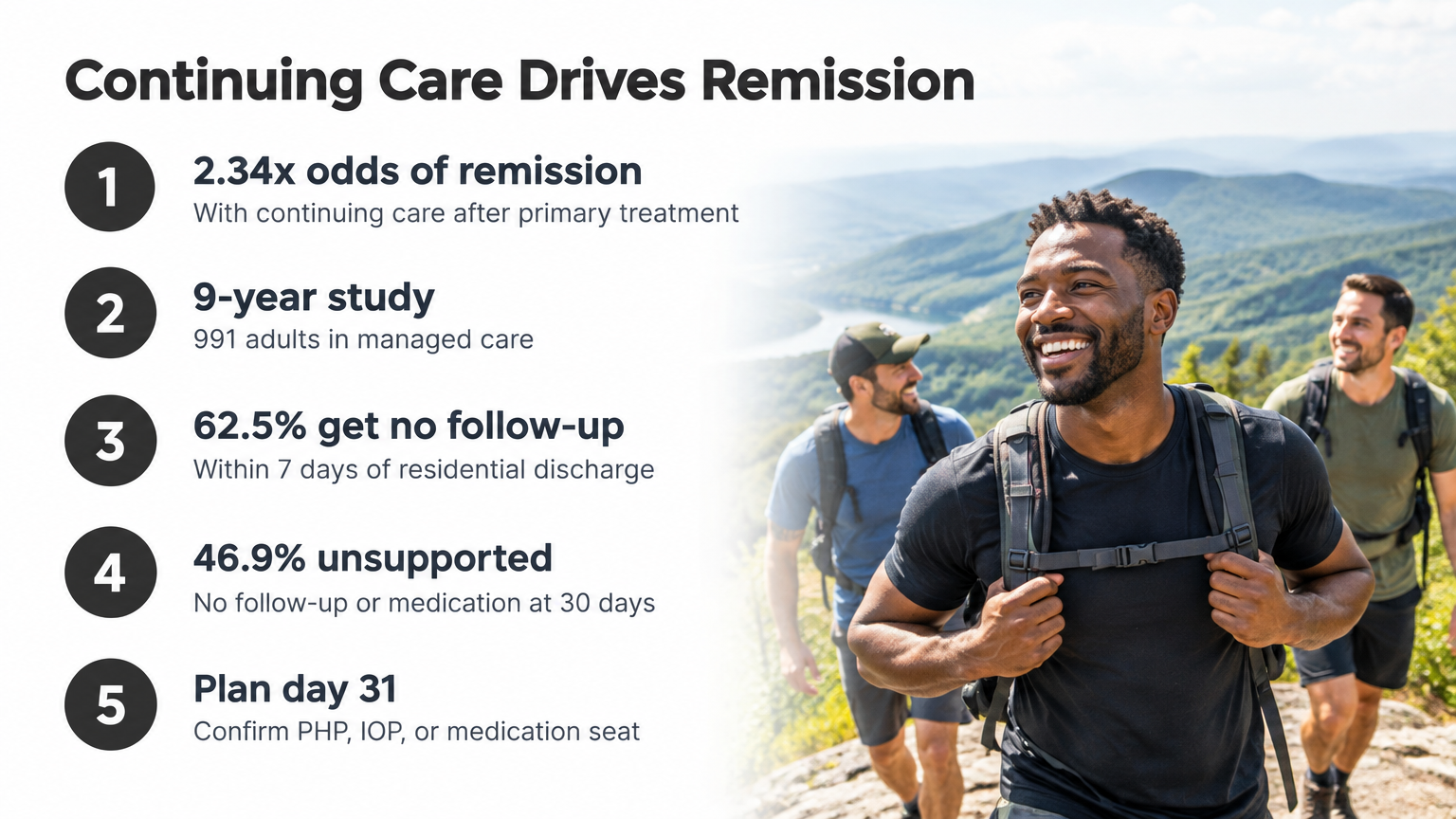
What the research does say clearly is that the full arc of care matters more than any single stay. A peer-reviewed review of continuing-care models reported that three months or more of combined treatment across long-term residential and outpatient settings was associated with better 12-month outcomes than treatment lasting less than three months 7. Notice the construction: combined treatment. Three months of structured care does not have to mean three months in a residential bed. A 30-day residential stay followed by eight weeks of partial hospitalization or intensive outpatient can hit that same threshold.
For a man weighing Nashville rehab, the practical read is this. If your withdrawal risk is high, co-occurring symptoms are severe, or your home environment makes early sobriety almost impossible, a longer residential stay or a short one followed by step-down care is reasonable. If your acute risks are lower, a shorter residential stay anchored to a strong outpatient plan can hold up well. The length question is really a sequencing question.
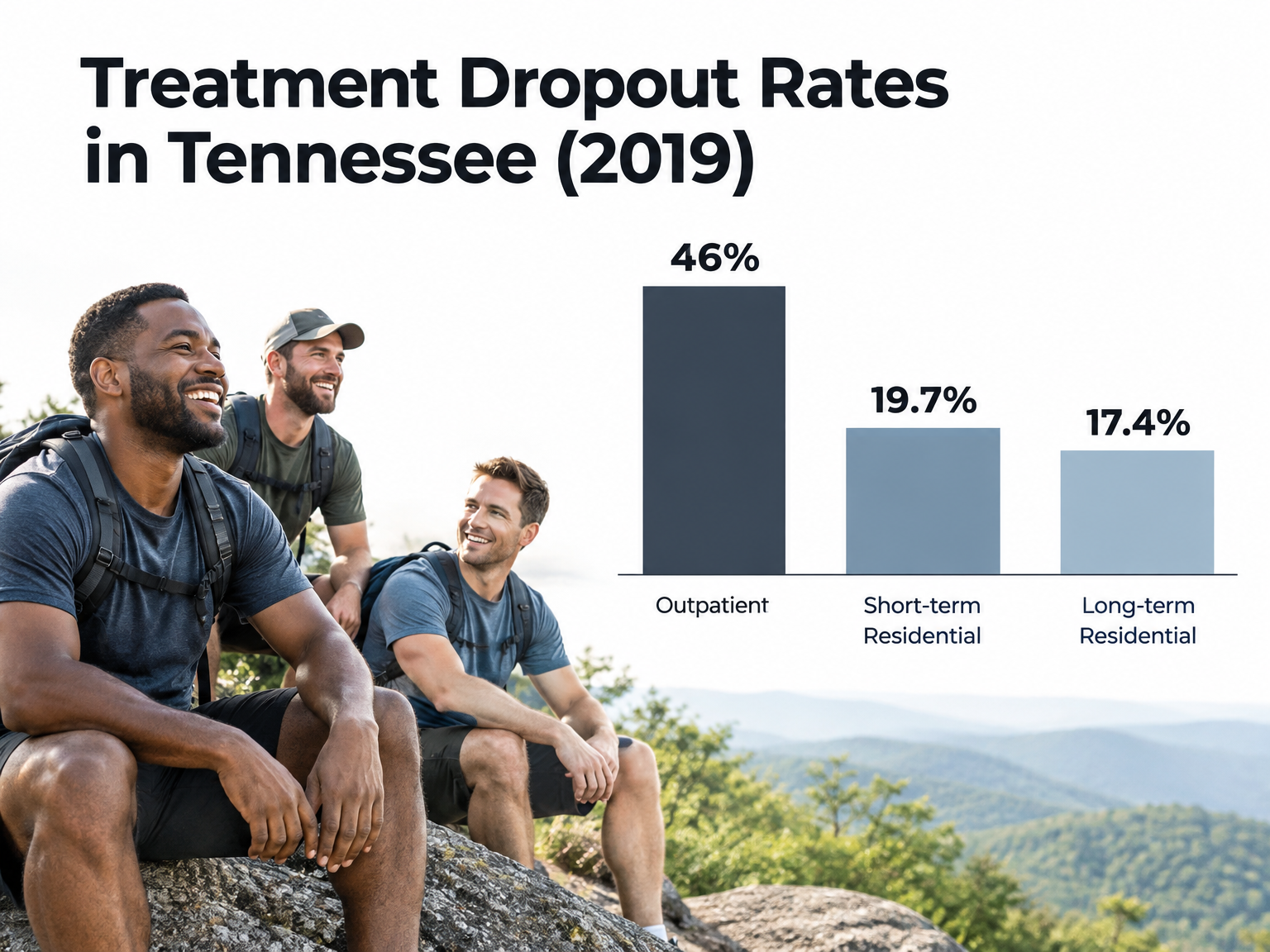
Completion statistics look like a clean way to compare settings, but they measure something narrower than most readers think. The Tennessee Comptroller's 2022 brief reported 2019 Tennessee dropout rates of about 46% in outpatient treatment, compared with 19.7% in short-term residential and 17.4% in long-term residential settings 1. The gap is real, and structure clearly correlates with staying in the program.
What those numbers do not tell you is whether a man who completed treatment stayed in recovery six months or two years later. The same Comptroller report flags this directly: discharge data show whether a course was completed, not whether a person later returned to substance use or built a sustained recovery 1. A 2025 systematic review on how studies define retention found definitions ranging from 30 days to several months, with reported retention rates between 25.3% and 90% depending on the cutoff used 9. Two programs can both claim strong "completion" numbers while measuring entirely different things.
The practical takeaway for comparing Nashville rehab options: ask what a program measures and when. A completion number without a follow-up window is a half-answer. More useful questions are whether the program tracks outcomes 90 days or six months after discharge, how it connects men to continuing care, and what happens when someone struggles rather than drops off a chart.
Length of stay is a clinical judgment, not a personality test. Five factors do most of the work in deciding whether a short-term or long-term residential stay fits, and whether a step-down plan should carry weeks or months after discharge. Tennessee's state-plan framework actually names this process: evidence-based screening up front, then periodic reassessment to adjust the level of care and length as treatment progresses 4.
For many men walking into Nashville rehab, substance use is the loudest symptom but not the whole story. Anxiety that only quiets with a drink, depression that lifts briefly with a stimulant, trauma memories that get easier to carry when numbed, anger that feels manageable only when softened — these patterns are common, and they are treatable. A 2025 umbrella review of 28 systematic reviews found that integrated or coordinated treatment for substance use alongside common mental-health conditions generally produced more favorable outcomes than treating one condition at a time or running parallel, uncoordinated services 13.
Practically, that means a program should assess both tracks on day one, not refer you out for the mental-health piece after discharge. SAMHSA's advisory on co-occurring disorders describes integrated care as the preferred model and notes that placement decisions should account for functional challenges, symptom severity, and the recovery environment — not just the substance use diagnosis 5.
For length of stay, co-occurring symptoms usually tilt toward more time, either as a longer residential episode or a shorter one paired with sustained partial hospitalization and intensive outpatient work. The therapies that help with trauma, mood, and anger — CBT, DBT, EMDR, motivational interviewing — take repetition to stick. A plan that gives those modalities room to work tends to hold up better than one that treats the substance use first and the rest of you later.
A useful way to think about Nashville rehab is as a chain of levels, not a single stop. Most men move through some version of this sequence: medically supervised withdrawal management, residential treatment, partial hospitalization, intensive outpatient, standard outpatient, medication treatment where appropriate, and peer or recovery support. Tennessee's state-plan framework names these levels explicitly and describes step-down services after residential care, including medication treatment for opioid use disorder, intensive outpatient, and peer recovery services 4.
That chain matters because "long-term care" does not have to live inside a single residential bed. SAMHSA's IOP advisory sets a minimum of nine hours per week for adult intensive outpatient and notes that IOP outcomes can be comparable to residential services for people with minimal acute withdrawal, medical, and psychological risk 6. A 30-day residential stay followed by eight to twelve weeks of PHP or IOP can deliver three or more months of structured care, which lines up with the continuing-care review finding that three months or more of combined treatment across residential and outpatient settings was associated with better 12-month outcomes than shorter courses 7.
So the shape of a plan matters as much as the first stop. A short residential stay with a weak handoff looks very different from a short residential stay that lands on day 31 inside a PHP schedule, with therapy, peer groups, and medication appointments already on the calendar. Same number of nights in a bed. Entirely different arc of care.
The gap after discharge is where plans break. An analysis of residential episodes for opioid use disorder found that 62.5% received no follow-up or medication treatment within seven days of discharge, and 46.9% received neither within 30 days 11. The first month after leaving residential care is both the highest-risk window and the one most often left unsupported.
For a man weighing short-term versus long-term rehab in Nashville, the practical move is to judge any program partly by what happens on day 31 or day 61. Is there a confirmed PHP or IOP seat waiting? A medication appointment on the calendar? A peer group that already knows your name? Length of stay sets the stage. Continuing care decides how the next year reads.
Insurance rarely pre-approves a fixed stretch of nights up front. Coverage usually works as a running clinical review: an initial authorization for a few days or a first week, then renewals based on documented medical necessity, response to treatment, and continuing risk. TennCare's state-plan framework spells this out directly, requiring evidence-based screening and periodic reassessment to decide the appropriate level of care and length of stay, with required discharge planning when a step-down is clinically indicated 4.
For commercially insured men in Nashville, the 2026 Tennessee Mental Health Parity Report is the backdrop worth knowing. The federal Mental Health Parity and Addiction Equity Act requires covered mental-health and substance-use benefits to be provided in parity with medical and surgical benefits, subject to applicable plan and regulatory conditions 15. Parity does not mean every requested day is automatically covered. It means a plan cannot apply tighter limits to substance-use care than it applies to comparable medical care.
TennCare itself covers withdrawal management and substance-use treatment at inpatient, residential, and outpatient levels for eligible members, but eligibility, network status, and authorization still shape what any individual gets approved 3. Two practical moves save time: have the admissions team run a real benefits verification before the first day, and ask the clinical team how reauthorizations are documented. A plan built around clear clinical criteria tends to hold its length of stay better than one that assumes the number on the brochure.
Treatment does not have to blow up your work or your home to be real. A practical first step is asking HR about leave options in a general way, or having a family member make the call, before admission so paperwork does not stack up in week one.
Household logistics usually land on a partner or parent. A short planning conversation covers more than people expect: who handles bills, childcare, the dog, the car, the mail, the standing commitments. Writing it down removes a layer of worry that otherwise follows you into group therapy.
Relationships are their own track. SAMHSA's intensive outpatient advisory identifies family psychoeducation as a core component of IOP, alongside counseling, group therapy, and case management 6. Those sessions are not about assigning blame. They are about giving the people closest to you a shared language for what recovery actually asks of a household, so day 31 at home does not undo the work of the first thirty.
For spouses, partners, and parents weighing Nashville rehab on behalf of someone else, the first useful move is usually not picking a program. It is gathering the information a clinical team will actually ask about: what the person is using, how much, how often, for how long, any withdrawal history, any co-occurring diagnoses, prior treatment episodes, and current medications. A short written list shortens every intake call that follows.
Family members do not have to carry this alone. The Tennessee REDLINE is a confidential state referral service available 24 hours a day, 365 days a year at 800-889-9789 by call or text, and it can help identify appropriate levels of care in the Nashville area 16. Admissions teams at individual programs can run insurance verification and describe their continuum, which matters because the right program is the one with a credible plan for day 31, not just day one.
A quieter point: integrated treatment for co-occurring depression, anxiety, trauma, or anger tends to produce more favorable outcomes than treating one condition at a time 13. If the man you love is drinking around grief or using around chronic pain or anxiety, ask any program directly how they handle both tracks from the first assessment forward.
The difference between short-term and long-term rehab in Nashville is less about picking a bed and more about mapping a credible arc of care. Short-term residential of 30 days or fewer and long-term residential of more than 30 days are both starting points, and the stronger plan is the one that already names what day 31 or day 61 looks like.
Three concrete next steps move this from research to action. First, call a program's admissions team and ask them to walk you through the full continuum they offer, from withdrawal management through PHP, IOP, and alumni support, not just the first stay. Second, run a real benefits verification before admission so the clinical team can build a plan around what your coverage will actually authorize 3. Third, if you want a neutral starting point, the Tennessee REDLINE at 800-889-9789 offers confidential referrals 24 hours a day, 365 days a year 16.
Trifecta Healthcare Institute's Columbia, TN program serves men looking for Nashville rehab, with movement-based programming and integrated co-occurring support built into the continuum. One phone call does not commit you to a bed. It commits you to a clearer picture of what the next ninety days could look like.
Sometimes, but not as a universal rule. Pilot evidence suggests residential stays of about 30 to 90 days can be associated with improved outcomes, while stays beyond 90 days do not consistently add benefit 10. What matters more is the full arc of care, since three months or more of combined residential and outpatient treatment correlates with better 12-month outcomes 7.
Short-term residential treatment runs 30 days or fewer; long-term residential treatment runs more than 30 days 2. Both offer 24-hour staffing, therapy, and medical oversight. Short-term stays focus on stabilization and handoff to the next level of care. Long-term stays allow more time for trauma, co-occurring symptoms, and relationship work.
TennCare covers withdrawal management and treatment at inpatient, residential, and outpatient levels for eligible members 3. Length of stay is reviewed through evidence-based screening and periodic reassessment, not pre-approved as a fixed number of days 4. Commercial plans must provide substance-use benefits in parity with medical benefits under federal law, though authorization and medical necessity still apply 15.
Sometimes. SAMHSA sets a minimum of nine hours per week for adult IOP and notes that outcomes can be comparable to residential services for people with minimal acute withdrawal, medical, and psychological risk 6. Men with high withdrawal risk, unstable medical conditions, severe psychiatric symptoms, or unsafe home environments usually need residential care first, with IOP as the step-down.
Integrated treatment is the preferred model. A 2025 umbrella review of 28 systematic reviews found that integrated or coordinated care for substance use alongside common mental-health conditions generally produced more favorable outcomes than treating one condition at a time 13. SAMHSA recommends assessing both tracks on day one and matching placement to symptom severity and recovery environment 5.
Gather the clinical information admissions teams will ask about: substances used, frequency, withdrawal history, co-occurring diagnoses, prior treatment, and current medications. Then call the Tennessee REDLINE at 800-889-9789, a confidential state referral service available 24 hours a day, 365 days a year 16. From there, run insurance verification with programs and ask each one how they handle day 31.
Between facility size limits, waivers, and state-by-state rules, figuring out your Medicaid or private insurance benefits can feel like its own full-time job. Our admissions team will verify your coverage in minutes and walk you through exactly what's available — no guesswork required.
Verify Insurance Benefits →No commitment required. Confidential & HIPAA-protected.
Whether it's you or someone you love, our team can help you figure out the next step — what treatment looks like, what's covered, or just someone to talk to.
Talk to Our TeamConfidential. No commitment required.


