


How to Choose a Dual Diagnosis Partial Hospitalization Program
Use this checklist to assess a dual diagnosis partial hospitalization program, including integrated care, medication support, Tennessee licensure, PHP fit, a...
Read More
Learn when drug detox at home may be dangerous, which withdrawal symptoms require medical care, and how supervised detox and ongoing treatment can reduce risk.
Start Your Journey NowWritten and reviewed by the clinical team at Trifecta Healthcare Institute, a men’s-only treatment center in Tennessee specializing in substance use, mental health, and dual diagnosis care.
Drug detox at home is sometimes reasonable, often risky, and occasionally life-threatening — and which one depends on the substance, the amount, how long someone has been using, and whether a clinician is actually involved. Alcohol and benzodiazepine withdrawal can cause seizures and delirium that kill people in their own bedrooms.2, 7 Opioid withdrawal rarely kills during the acute phase, but detoxing without ongoing medication raises the odds of relapse and fatal overdose afterward.9, 10
Most men looking up this question are not asking in theory. They are weighing a job, a family, a mortgage, and a quiet sense that going to a facility feels bigger than the problem — or bigger than they want to admit it is. That hesitation is understandable, and it deserves a straight answer rather than a sales pitch.
The sections ahead separate what clinicians mean by medical detox at home from what most people picture when they say it, then walk substance by substance through what the risk actually looks like and where safer, lower-friction options begin.
When clinicians talk about home-based detox, they are usually describing clinically supervised ambulatory withdrawal management — a structured program where a prescriber assesses the person, prescribes medication if appropriate, schedules check-ins, and keeps a path open to the ER or an inpatient bed if things turn.2, 3 When most men type "drug detox at home" into a search bar, they are picturing something very different: locking the bedroom door, sweating it out with a bucket and a sports drink, and hoping Monday morning feels manageable.
Those two scenarios share an address and almost nothing else.
In a supervised model, a clinician decides whether someone is a reasonable candidate before anything starts. For alcohol, that often means a withdrawal-severity score of 15 or less on a standard scale and no prior history of seizures, delirium tremens, or withdrawal hallucinations.3 There are scheduled visits or phone checks, a defined medication plan, a support person at home who is not using, and backup available 24 hours a day.3 The 2024 review of home-based detoxification is explicit that these models are not a substitute for inpatient care — they are a bridge for carefully selected people with real medical oversight.2
Unsupervised self-detox has none of that. No one is watching blood pressure or pulse, no one is screening for seizures, and the plan for a bad night is usually to drink again or drive to the ER at 2 a.m. That gap is where most of the harm in "home detox" actually happens.
Medical detox at home is reasonable only when a short list of conditions are all true at once. Skip one, and the model stops being safe.
A clinician has to do the assessment first. That means evaluating the substance and amount used, how long use has been going on, prior withdrawal episodes, any history of seizures or delirium tremens, co-occurring medical conditions, mental health status, and other substances in the picture.1, 14 For alcohol, clinicians commonly use the CIWA-Ar scale; for opioids, scales like CINA help structure the assessment.14 A score alone does not decide the setting — a man with a moderate score, uncontrolled hypertension, and a prior withdrawal seizure is not a home-detox candidate regardless of how he feels on a Tuesday morning.20
The home environment matters just as much. The ambulatory literature and ED disposition reviews describe the baseline: a supportive, substance-free living situation, a sober adult who can observe and respond, the ability to follow return precautions, and realistic odds of showing up for follow-up visits.3, 20 Add a defined medication plan — benzodiazepines for selected alcohol withdrawal, buprenorphine for opioid withdrawal — plus a written escalation plan and 24/7 clinical backup.2, 6
If any of those pieces are missing, what remains is not medical detox at home. It is a person alone with a problem that has outgrown the bedroom.
Not every substance punishes a sudden stop the same way. Lumping "detox" into one experience is where a lot of people get hurt — the medical danger of alcohol withdrawal looks almost nothing like cannabis withdrawal, and the overdose danger after opioid detox looks almost nothing like either.
| Substance | Typical acute timeline | Worst-case medical risk | Is home detox ever reasonable? |
|---|---|---|---|
| Alcohol | About 5–7 days15 | Seizures, delirium tremens, death2, 5 | Only mild cases with clinician oversight and strict criteria3, 20 |
| Benzodiazepines | 1–4 weeks, often longer with a taper15 | Life-threatening seizures, delirium, psychosis7, 8 | Only under a prescriber-guided, patient-specific taper7 |
| Opioids | 4–10 days15 | Rarely fatal acutely; high overdose risk after if use resumes9, 11 | Sometimes, with medication and strong support — not alone4 |
| Stimulants (meth, cocaine) | Days to a few weeks of crash, cravings, low mood18 | Severe depression, suicidal thinking; no FDA-approved medication for withdrawal18 | Medically lower-risk, but relapse and mental health risk are serious18 |
| Cannabis | Roughly 1–2 weeks of irritability, insomnia, appetite loss19 | Not life-threatening; psychosocial symptoms drive relapse19 | Usually yes medically, though behavioral support helps19 |
These timelines are approximate, not promises. The same man can withdraw differently from one episode to the next depending on how much he was using, how long, what else is in his system, and what his sleep, nutrition, and medical history look like.15 The columns to the right of the timeline are what should actually drive the decision about where to detox.
Alcohol withdrawal is one of the few conditions in medicine where stopping the substance can kill a person who was otherwise healthy. The dangerous end of the spectrum includes seizures and delirium tremens — a state of severe confusion, hallucinations, racing heart, and dangerous blood-pressure swings that carries real mortality risk.2, 5
Acute symptoms usually run about five to seven days, with the highest seizure risk in the first 48 hours.15 Benzodiazepines are the standard medication for medically managed alcohol withdrawal because they reduce acute symptoms and help prevent seizures and delirium tremens.6 That medication plan belongs in a clinician's hands, not in a bathroom cabinet.
Who can be managed as an outpatient is not just a question of how someone feels on day one. Reviews of emergency-department disposition point to a bundle of factors:
A past history of delirium tremens, seizures, or withdrawal hallucinations is usually a hard stop on the ambulatory path.3 If a man has been drinking heavily every day for months and is already shaking by mid-morning, this is not a weekend project.
Benzodiazepines — medications like alprazolam, clonazepam, lorazepam, and diazepam — carry one of the clearest warnings in all of U.S. drug labeling about stopping them wrong. The FDA's boxed warning is explicit: abruptly stopping or reducing benzodiazepines too quickly can cause withdrawal reactions that include life-threatening seizures.7 The official labeling for diazepam adds delirium, hallucinations, psychosis, and suicidality to the list of possible severe reactions after abrupt discontinuation.8
Acute withdrawal from benzodiazepines does not follow the tidy week-long arc people expect. It can stretch one to four weeks, and longer when a taper is involved.15 That is not a window most people can "push through" at home without a prescriber actively adjusting doses.
The safer path is a gradual, patient-specific taper designed by a clinician who knows the person's history and other medications.7 For someone taking a benzodiazepine daily for anxiety, insomnia, or alongside alcohol or opioids, stopping without that plan is one of the fastest ways a quiet detox turns into an ambulance ride.
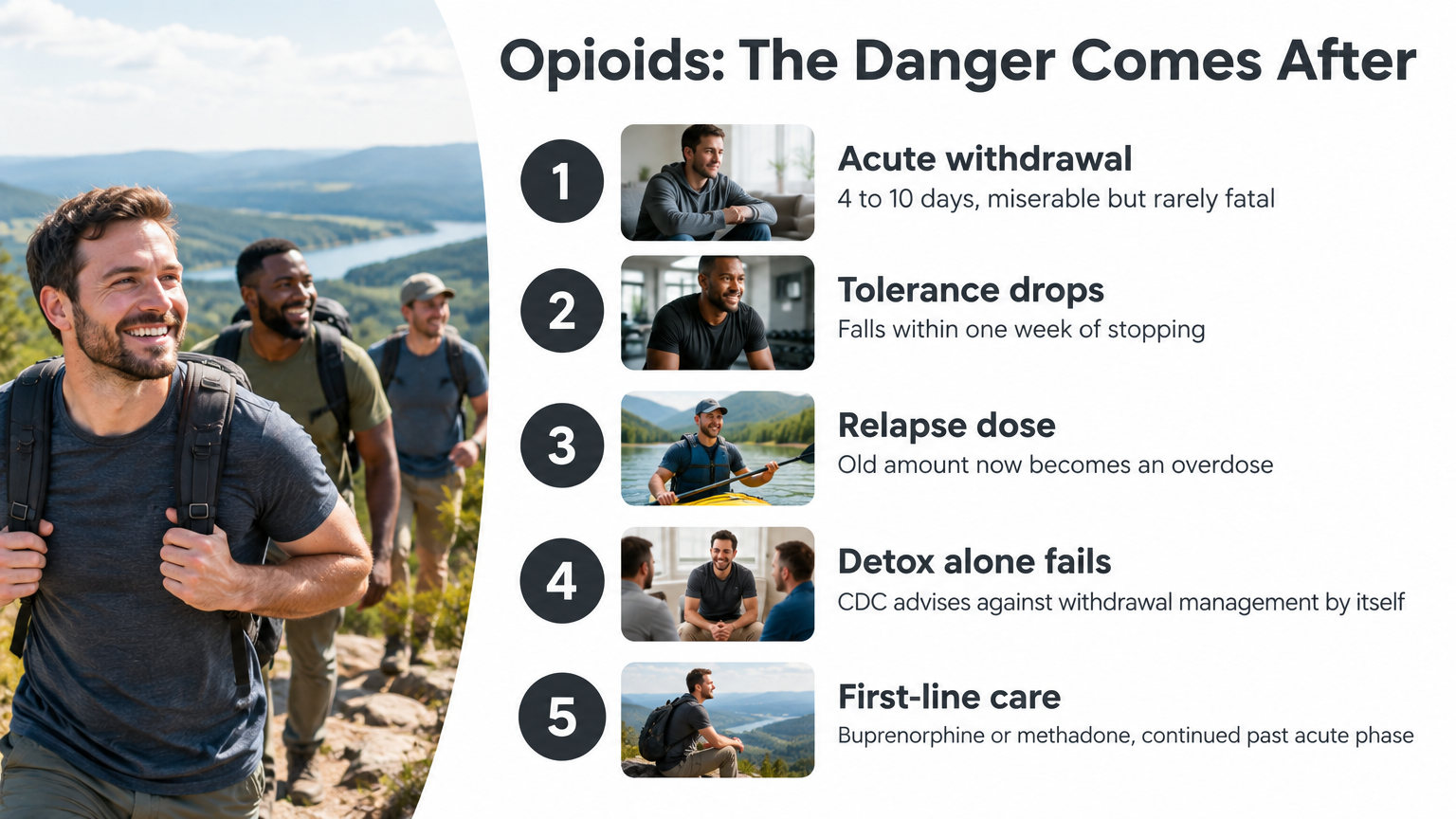
Opioid withdrawal is miserable — body aches, chills, sweats, cramping, diarrhea, insomnia, and a bone-deep restlessness that lasts roughly four to ten days.15 It is rarely fatal in a healthy adult. That fact is often misread as reassurance, when the real danger shows up on the other side of the acute phase.
CDC clinical guidance states that detoxification alone is not recommended for opioid use disorder because it increases the risks of resuming use, overdose, and overdose death.9, 10 The reason is biological: tolerance can decline in as little as one week after stopping opioids, and returning to a previously tolerated dose can exceed what the body can now handle.11, 12 A man who was using fentanyl or high-dose oxycodone before a five-day detox, then uses the same amount on day six, is not restarting at his old baseline — he is overdosing.
This is why guideline-level recommendations across the field point in the same direction. Buprenorphine or methadone are first-line treatments for opioid use disorder, and a 2024 update plainly advises against withdrawal management alone.16, 17 A systematic review of fifteen guidelines reached the same conclusion.17 MedlinePlus acknowledges that medication-supported withdrawal can happen at home with a strong support system — but calls attempting it alone very hard and potentially dangerous.4 If opioids are in the picture, the plan has to extend past the acute week, and naloxone should be in the house regardless.11, 12
Methamphetamine, cocaine, and cannabis withdrawal are, in most cases, medically less dangerous than alcohol or benzodiazepine withdrawal. That does not mean they are easy, and it does not mean home detox is enough on its own.
Stimulant withdrawal tends to look like a crash: heavy sleep, exhaustion, flat mood, intense cravings, and in many cases significant depression that can include suicidal thinking.18 No FDA-approved medication reliably treats acute psychostimulant withdrawal; the standard of care is supportive and psychosocial, with approaches like contingency management and cognitive behavioral therapy.18 A man can usually get through the physical symptoms at home. Whether he can also get through the depression and cravings without a safety net is a different question — one worth taking seriously if there is any history of suicidal thinking.
Cannabis withdrawal brings irritability, sleep problems, appetite changes, and anxiety for roughly a week or two.19 No medication is approved specifically for it; psychosocial support is first-line.19 The medical risk is low. The relapse risk, especially for someone using cannabis to manage anxiety, trauma, or insomnia, is where structured support earns its keep.
Ambulatory detox is a clinical decision, not a preference. A prescriber decides whether a man is a candidate before any medication is written, and the criteria are more specific than most people expect.
For alcohol withdrawal, the ambulatory literature points to a withdrawal-severity score of 15 or less on CIWA-Ar, no lifetime history of delirium tremens, withdrawal seizures, or withdrawal hallucinations, and medical stability without uncontrolled comorbid conditions.3 Emergency-department disposition reviews add the pieces that live outside the chart: a supportive, substance-free home, a sober adult who can observe during the day, the ability to follow return precautions, and a realistic chance of showing up for scheduled follow-up visits.20 Nursing and medical backup should be available 24 hours a day, seven days a week.3
For opioid withdrawal, the ambulatory path leans on medication rather than willpower. Buprenorphine or methadone are the first-line options, and SAMHSA's clinical protocol flags polysubstance use — particularly alcohol or benzodiazepines in the picture — as a reason to reassess whether the setting is safe.13, 16 Clinicians use scales like CINA to track opioid-withdrawal severity rather than guessing.14
Miss any of these pieces — the assessment, the medication plan, the sober observer, the 24/7 backup, the follow-up — and ambulatory detox stops being ambulatory detox. It becomes a man alone with a clinical problem.
Some situations push the decision toward inpatient regardless of how a man feels on day one. These are the ones clinicians treat as hard stops on the home path.
Medical and psychiatric factors matter just as much. Uncontrolled hypertension, significant heart or liver disease, pregnancy, recent GI bleeding, or active suicidal thinking all warrant a higher level of care.1, 18 A home where someone else is still drinking or using, no sober observer, no transportation to follow-up, or no 24/7 clinical backup also moves the decision inpatient — not because the symptoms are worse, but because the safety net isn't there.20
If more than one of these is true at the same time, the question is no longer whether home detox is reasonable. It's which setting gets a man through the first week alive and connected to care that extends past it.
If a man is going through withdrawal at home, the people around him become the monitoring system — and most families have never been trained to tell ordinary misery apart from a medical emergency. The federal clinician guide for detoxification lists specific signs that mean someone needs immediate medical attention, not another hour of wait-and-see.1
Call 911 if any of these appear during withdrawal:
For opioids specifically, slow or stopped breathing, blue lips or fingertips, and the inability to wake him up are overdose signs. Give naloxone if it is in the house, call 911, and support his breathing until help arrives.12 Keep naloxone on hand through the acute week and after, because tolerance drops quickly and a return to a prior dose can be fatal.11, 12
Men rarely try to detox at home because they think it's the clinically correct answer. They try it because leaving the house for 30 days feels impossible, and the alternatives feel like they only come in one size.
The reasons are usually the same, in some combination. A job that doesn't backfill itself. Kids who need picking up at 3:15. A spouse who already carries too much. A deductible that hasn't been touched since January. A quiet calculation about who will know, and what they'll think, and whether the word "rehab" will follow him into performance reviews. For a lot of men, the deciding factor isn't the withdrawal itself — it's not wanting to be the guy who disappeared.
Those reasons are legitimate. The problem is that the standard mental model only offers two options: tough it out alone, or vanish for a month. That framing is wrong. Clinically supervised ambulatory withdrawal management, intensive outpatient programs, and partial hospitalization all exist precisely because the gap between "handle it in the bathroom" and "inpatient for 30 days" is where most men actually live.2, 3 A clinician can meet a man where his week actually is — and still keep seizures, benzodiazepine complications, and post-opioid overdose risk from writing the ending.7, 9
In Tennessee, the lower-friction path usually starts with a clinical assessment, not a packed bag. A prescriber evaluates the substance, the amount, the duration, prior withdrawal history, co-occurring medical and mental health conditions, and what the home looks like.1, 14 From that conversation, a few paths open up.
Medical detox under supervision — inpatient when alcohol, benzodiazepines, opioids with heavy polysubstance use, or a history of seizures or delirium tremens are in the picture; structured ambulatory when the criteria genuinely fit.3, 13 After the acute phase stabilizes, a partial hospitalization program (PHP) typically runs daytime hours and lets a man sleep in his own bed. An intensive outpatient program (IOP) runs a few evenings or mornings a week, which is often what makes it possible to keep a job and stay in the house with the kids. Standard outpatient care keeps the medication plan and therapy in place after that.
For men in East Tennessee, Trifecta Healthcare Institute's Knoxville program ties that continuum to the Smoky Mountains and outdoor-based movement work that supports recovery alongside clinical therapy — not as a replacement for medically supervised withdrawal. For men closer to Middle Tennessee, Trifecta's Nashville-area facility in Columbia, TN offers the same continuum, with brotherhood-based peer support running through every level of care.
[Verify your insurance] with Trifecta to see which level of care fits — before the question becomes an emergency.
Getting through the first week is the beginning, not the finish line. SAMHSA's protracted-withdrawal resource is clear that symptoms — sleep disruption, mood swings, cravings, low energy — often continue past the acute phase and can last weeks or months depending on the substance.15 A man who stops at day seven and goes back to his old routine is walking into the window where relapse rates are highest.
For opioids, this is where the stakes get concrete. Guideline-level evidence recommends against withdrawal management as a stand-alone intervention; buprenorphine or methadone paired with continuing care is what actually lowers relapse, morbidity, and mortality.16, 17 For alcohol, continued therapy, medication where appropriate, and a sober support network do the work the detox itself cannot. For stimulants and cannabis, where no medication reliably treats withdrawal, structured psychosocial care is the treatment.18, 19
What comes after detox is where therapy, peer connection, and movement-based programming earn their place — not as a replacement for medical care, but as the structure that keeps the first week from being the only week. A PHP or IOP keeps the clinical thread live while a man rebuilds a routine that doesn't depend on using to get through the day.
Sometimes, but only for mild cases under clinician oversight. Alcohol withdrawal can cause seizures and delirium tremens, which carry real mortality risk.2, 5Ambulatory programs typically require a withdrawal-severity score of 15 or less, no prior history of seizures or delirium tremens, medical stability, a sober adult at home, and 24/7 clinical backup.3Without those pieces, inpatient care is safer.
Acute withdrawal timelines vary by substance. SAMHSA lists roughly 5–7 days for alcohol, 1–4 weeks for benzodiazepines (longer with a taper), and 4–10 days for opioids.15Stimulant and cannabis withdrawal typically run days to a couple of weeks.18, 19Sleep problems, mood swings, and cravings often continue past the acute phase, which is why ongoing care matters.15
Because the danger shifts to the week after. Tolerance can drop in as little as a week off opioids, and returning to a previously tolerated dose can cause fatal overdose.11, 12CDC guidance states that detoxification alone is not recommended for opioid use disorder; buprenorphine or methadone paired with continuing care is first-line.9, 16Keep naloxone in the house regardless of the plan.12
Medical detox at home is clinician-supervised ambulatory withdrawal management: a prescriber assesses the person, writes medication if appropriate, schedules check-ins, and keeps an escalation route open.2, 3Detoxing alone has none of that — no monitoring, no medication plan, no backup. The two share an address and almost nothing else, and most of the harm attributed to home detox happens in the second scenario.
Call 911 for any seizure, loss of consciousness, confusion or not recognizing people, hallucinations, fever above 100.4°F, racing or very slow heart rate, big blood-pressure swings, severe abdominal pain, vomiting blood, chest pain, or shallow breathing that is hard to rouse him from.1For opioids, blue lips, slow or stopped breathing, and unresponsiveness are overdose signs — give naloxone, call 911, and support breathing.12
A clinical assessment usually opens up several lower-friction options: medically supervised detox when indicated, then a partial hospitalization program (PHP) during the day, an intensive outpatient program (IOP) a few evenings a week, or standard outpatient care.2, 3Trifecta Healthcare Institute offers this continuum for men at its Knoxville location and its Nashville-area facility in Columbia, TN. [Verify your insurance] to see which level fits.
Between facility size limits, waivers, and state-by-state rules, figuring out your Medicaid or private insurance benefits can feel like its own full-time job. Our admissions team will verify your coverage in minutes and walk you through exactly what's available — no guesswork required.
Verify Insurance Benefits →No commitment required. Confidential & HIPAA-protected.
Whether it's you or someone you love, our team can help you figure out the next step — what treatment looks like, what's covered, or just someone to talk to.
Talk to Our TeamConfidential. No commitment required.


