


How to Choose a Dual Diagnosis Partial Hospitalization Program
Use this checklist to assess a dual diagnosis partial hospitalization program, including integrated care, medication support, Tennessee licensure, PHP fit, a...
Read More
Evaluate drug rehab reviews for warning signs like referral payments, inflated success claims, and privacy concerns, then verify licensing and clinical care ...
Start Your Journey NowWritten and reviewed by the clinical team at Trifecta Healthcare Institute, a men’s-only treatment center in Tennessee specializing in substance use, mental health, and dual diagnosis care.
A five-star rating on a drug rehab review page tells you that someone, somewhere, had a good enough experience to click five stars. It does not tell you whether the program is licensed, whether the clinicians are credentialed, whether the medications a man might need are available, or whether the review itself came from a verified patient. Peer-reviewed research on online ratings for substance use disorder treatment facilities has flagged exactly this gap: platform safeguards do not fully filter out fake or unverified reviews, and star averages are not a standardized measure of clinical quality 1.
That matters because the stakes are high. A man weighing treatment for substance use, often alongside anxiety, depression, trauma, or anger, is making a decision about where to spend weeks of his life and real money. A worried spouse or parent reading reviews on his behalf is trying to tell real patient experience apart from marketing copy. Neither deserves to be sold to.
The useful way to read drug rehab reviews is as leads, not verdicts. A five-star review can point to something worth asking about. A one-star review can flag a pattern worth probing. But the decision belongs to independent, verifiable sources: state licensing records, accreditation lookups, and SAMHSA's own guidance on what quality care looks like 7. The rest of this guide walks through how to read reviews with a trained eye, then where to go to confirm what they claim.
Think of a review the way a good investigator thinks of a tip: worth following, not worth acting on alone. Online ratings for drug and alcohol treatment facilities are not standardized clinical measures, and researchers studying them have been direct about the limits. Platform safeguards do not fully screen out fake or unverified posts, reviewers may not be verified patients, and selection bias skews what gets written at all. The people most likely to post are those at the extremes, delighted or furious, which is why a Pennsylvania analysis of 7,823 ratings over eight years found 43% at five stars and 34% at one star, with the middle largely empty 2.
That polarization matters. A 3.3-star average can hide two very different stories, and neither tells a reader whether clinicians are credentialed, whether medications are available when appropriate, or whether the program is licensed to deliver what its page advertises 1.
Reviews are still useful, though, when they are read for leads instead of conclusions. A pattern of complaints about phone communication or appointment access is worth asking about on an admissions call. A string of glowing posts that read like marketing copy is worth checking against the facility's listing in SAMHSA's national directory 12. The verdict comes from the paperwork, not the stars.
Open a treatment center's social feed and count how many posts are client testimonials versus substantive information about the clinical model, staff credentials, or what a day in care actually looks like. A 2025 content analysis of substance use disorder recovery accounts found that treatment-industry pages leaned heavily on client testimonials and scarcity marketing, including posts urging people to call while beds were still available 6.
Scarcity language is designed to short-circuit careful thinking. "Only two spots left this week." "Call before Friday or we can't guarantee a bed." Legitimate programs do have real capacity limits, but a reader should notice when urgency is doing the heavy lifting instead of information about what the care involves.
Testimonials themselves are not proof of anything on their own. The researchers who catalogued these accounts were explicit that content patterns are screening signals, not evidence of deception 6. A feed stacked with before-and-after stories, dramatic transformations, and no visible description of modalities, licensing, or clinician qualifications is a feed built to persuade rather than inform. Treat that as a cue to ask the questions the posts are not answering.
If a stranger reaches out after a man has posted in a recovery forum, called a hotline, or filled out a web form, and that stranger starts offering free flights, free housing, or cash to enroll in a specific program, something is wrong. A 2023 qualitative study on patient brokering in for-profit substance use disorder treatment documented exactly these mechanics: financial and material enticements, including paid travel and money, used to steer people into particular facilities 4.
Patient brokering is the unlawful payment or in-kind benefit for patient referrals. The person on the phone may sound warm and knowledgeable. The offer may feel like a lifeline when a family is exhausted. That is the point. The study's participants described being recruited through incentives that had nothing to do with clinical fit 4.
A few specific tells are worth memorizing:
None of these guarantee misconduct, but each one deserves a direct question: who is paying for this, and how is the referral compensated? If the answer is vague, walk away and call a facility verified through SAMHSA's national directory instead 12.
The top result on a search for drug rehab reviews is not necessarily the best program. It may be the program that paid the most to be there, bought ads styled to look like organic listings, or worked with marketing vendors who specialize in dominating search for high-intent queries like "Knoxville rehab for men" or "Nashville drug rehab."
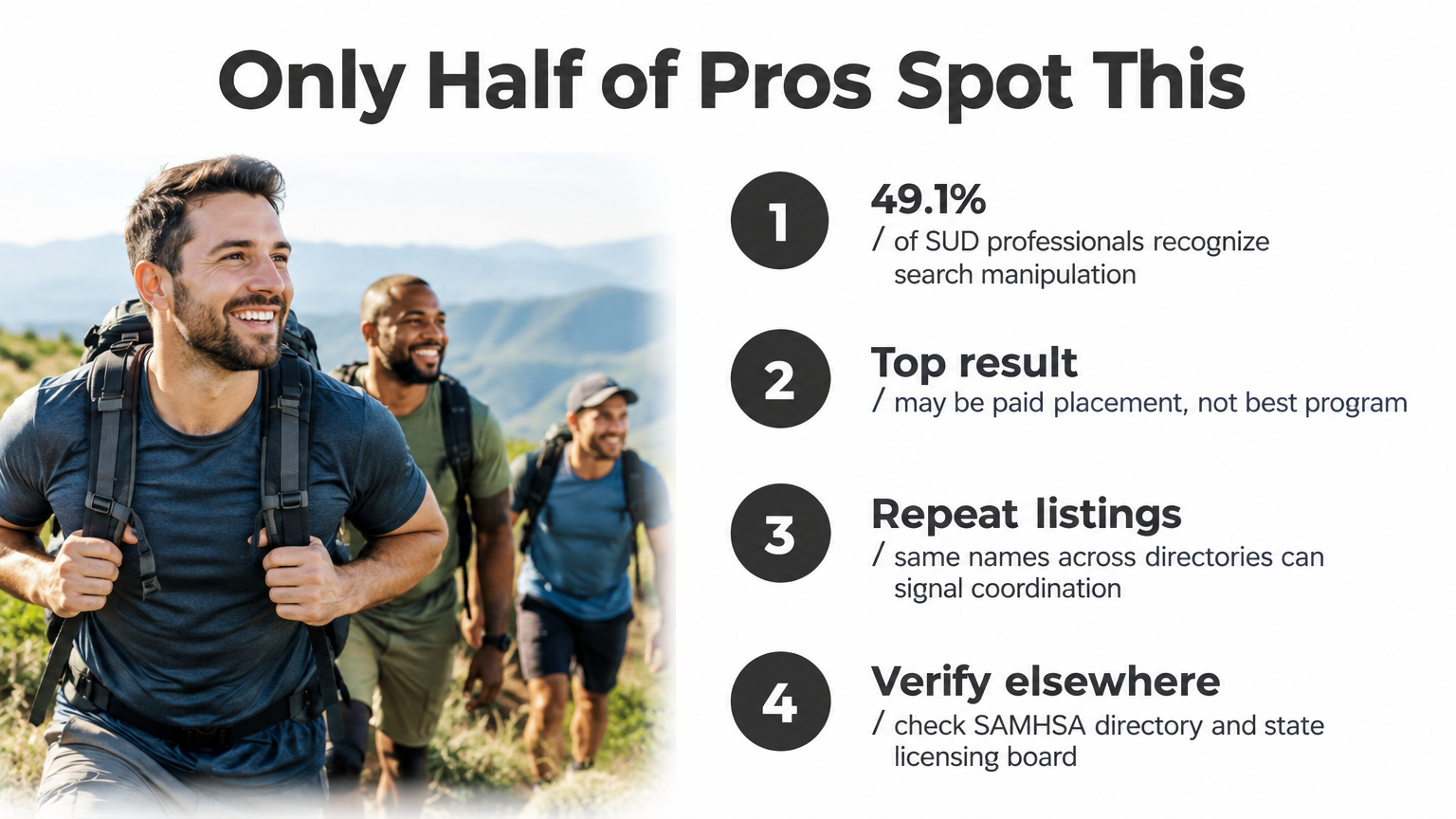
Even people inside the field miss this. In a survey of substance use disorder professionals, only 49.1% correctly identified that providers can mislead consumers by manipulating online search visibility 5. That figure comes from a survey of clinicians and treatment-industry workers, not a general consumer sample, which makes the gap more striking: if roughly half of professionals do not recognize this pattern, families reading reviews at midnight are even less likely to spot it.
A practical check is to notice whether a facility appears across unrelated "best rehab" listicles, directory sites, and review aggregators that all seem to recommend the same handful of names. That consistency can reflect genuine reputation, or it can reflect coordinated placement. Either way, the next step is the same: verify the program's identity, location, and services through SAMHSA's national directory 12 and the state licensing board, not through whichever page ranks first.
A review or ad that cites a specific success rate, say, "87% of our clients stay sober," should raise the hair on the back of a reader's neck. There is no industry-standard definition of success in addiction treatment, no required follow-up window, and no independent audit that would make such a number comparable across programs. NIDA's foundational guide is direct about why: no single treatment is appropriate for everyone, and effective care has to address medical, psychological, social, vocational, and legal needs over time rather than deliver a one-shot cure 9.
The same caution applies to reviews that frame one method as the only method. Posts dismissing medication for opioid use disorder, for example, run against NIDA's guidance that medication should be first-line for opioid use disorder and is usually combined with behavioral therapy 8. A reader does not have to resolve clinical debates to notice the pattern: absolute claims, universal methods, and promises that sound more like a warranty than a treatment plan are not signs of clinical rigor. They are signs that someone is selling.
A review that names a specific client, describes their diagnosis, or quotes them in ways only a staff member could is a privacy warning sign. Federal law requires Part 2 programs to notify patients about the confidentiality of substance use disorder records and the limited circumstances in which information may be disclosed 15. A public post naming identifiable patients does not prove a legal violation on its own, but it raises a question any thoughtful admissions team should be able to answer clearly.
The same question applies in the other direction. If a program pressures discharged clients to post five-star reviews, offers incentives for testimonials, or supplies pre-written content for men to publish under their own names, that is a privacy and ethics concern worth probing. Ask how the program handles consent for any public mention of a client's story, and ask to see the written confidentiality notice patients receive at admission 15. A program that answers plainly is doing its job. A program that bristles is telling you something, too.
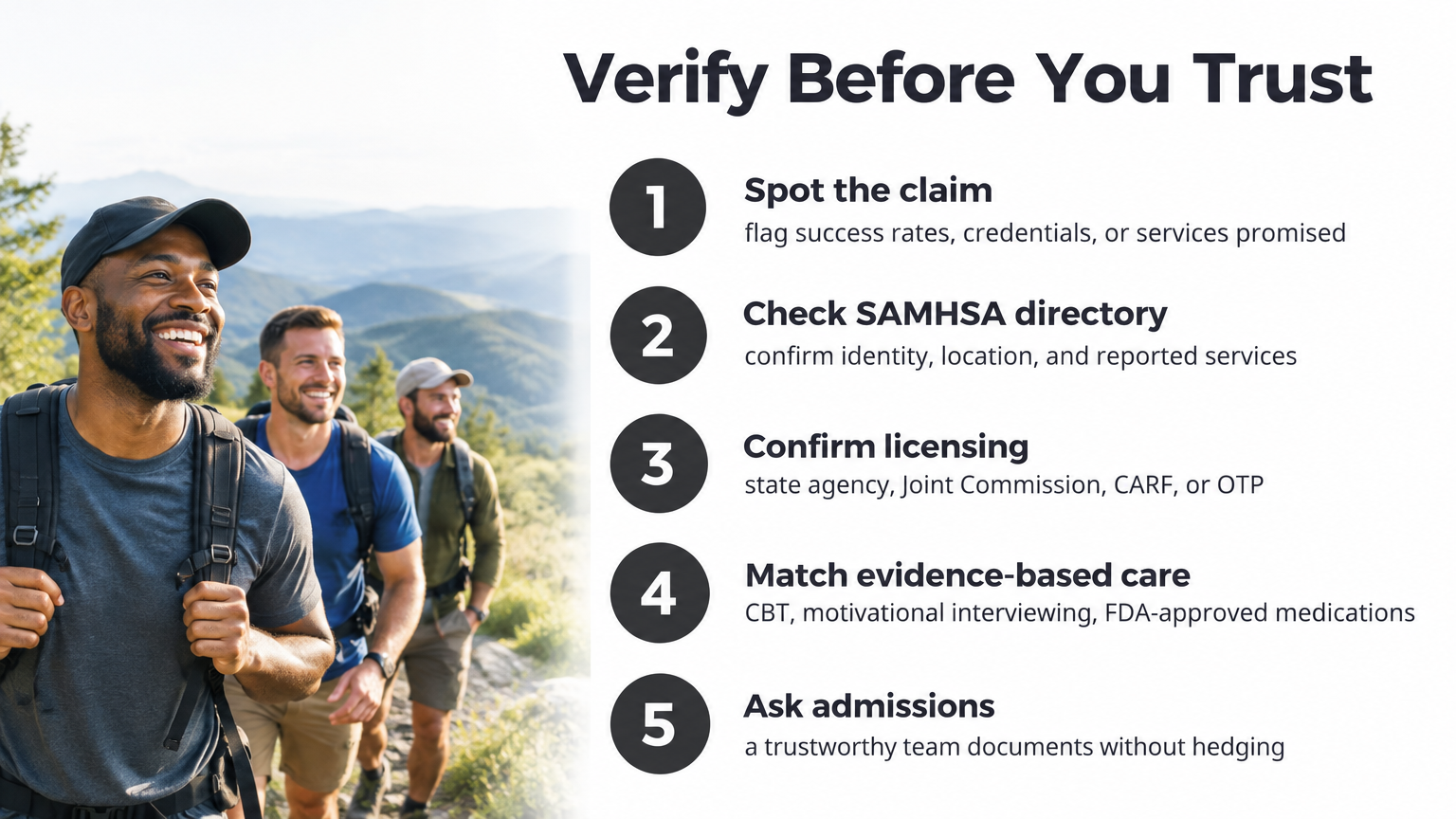
Once a review raises a question, the next move is to answer it somewhere outside the review page. SAMHSA's consumer guidance on quality treatment lays out the short list worth confirming:
Those are the items a trustworthy admissions team should be able to document without hedging.
A few authoritative destinations do most of the work. SAMHSA's national directory confirms facility identity, location, and reported services, and lists only facilities approved by state substance use agencies that responded to the national survey 12. SAMHSA's 2023 Tennessee profile also reports licensing and accreditation categories, including state substance use agency licensing, Joint Commission accreditation, CARF accreditation, and OTP certification where methadone is involved 10. For opioid treatment programs specifically, SAMHSA describes accreditation as a peer-review process involving onsite visits by specialists 13.
Match each red flag to its verification destination. A success-rate promise gets checked against SAMHSA's quality indicators 7 and the independent claims-based measures researchers have proposed for consumer use, including medication continuation and follow-up after inpatient care 3. A scarcity push gets checked against bed availability on a direct admissions call. An unsolicited recruiter gets checked by asking, in writing, how the referral is compensated. A testimonial-heavy social feed gets checked against the facility's listing in SAMHSA's directory 12 and its licensing record. Vague modality claims get checked by asking which specific therapies are delivered, by whom, and with what credentials. The review raises the question; the paperwork answers it.
Not every review theme carries the same weight. The Pennsylvania analysis of 7,823 ratings across specialized drug treatment facilities found that reviewers consistently clustered their complaints and compliments around a short list of concrete topics: staff helpfulness and compassion on the positive side, and waiting times, phone communication, medication handling, appointment availability, and accommodations on the negative side 2. Those are the themes worth reading closely, because they describe operational realities a man will actually encounter.
Repeated mentions of unreturned calls, long holds, or chaotic admissions are a signal. So are recurring notes about rushed medication decisions, abrupt changes to prescribed treatment, or confusion about who is actually running a session. One frustrated post is noise. Twelve posts over two years describing the same breakdown is a pattern worth raising on an admissions call.
Discount the themes that cannot be verified or that reflect taste more than care. Food quality, room decor, and whether the gym equipment felt new are real experiences, but they do not predict clinical outcomes. Dramatic transformation narratives without any detail about modalities, clinician credentials, or length of stay are closer to marketing than measurement. The authors of the Pennsylvania study were explicit that organically generated reviews can surface patient-experience themes but are not standardized and may not represent all patients 2.
Reviews can hint at what a program does well, but they rarely describe the actual clinical model in enough detail to decide. That part happens on the phone. A straightforward opening question works: what specific therapies does the program deliver, and who delivers them? SAMHSA's consumer guidance points to evidence-based practices like cognitive behavioral therapy and motivational interviewing as a baseline worth confirming, along with FDA-approved medications when appropriate for alcohol, tobacco, or opioid use disorder 7.
For a man with opioid use disorder, the medication question is not optional. NIDA states that medication should be first-line treatment for opioid use disorder, usually paired with behavioral therapy or counseling 8. If a program dismisses buprenorphine or methadone on principle, that is a clinical position worth questioning before admission, not after.
Co-occurring concerns deserve the same specificity. Many men enter treatment carrying anxiety, depression, trauma, grief, or anger that substances were quietly managing. Ask how the program assesses those at intake, which clinicians are credentialed to treat them, and whether substance use and mental health care happen in the same treatment plan or get handed off between teams. The answer should name modalities, credentials, and a plan, not adjectives.
Discharge is not the finish line, and reviews rarely say much about what happens after a man walks out the door. That gap is worth closing with direct questions. SAMHSA's 2023 national profile reports that 73.2% of U.S. substance use treatment facilities offered outcome follow-up after discharge, which makes follow-up common but not universal 11. Ask whether the program contacts clients after discharge, on what schedule, and what the follow-up actually involves.
Push for specifics on the step-down path. Does the program move clients from residential or PHP into IOP and outpatient care within its own continuum, or does it hand people off? NIDA's foundational guide emphasizes that treatment plans need to be reassessed and adjusted over time to match changing needs 9. A plan that ends at discharge is not a plan.
Independent quality researchers have proposed concrete indicators consumers can ask about: medication continuation for at least 180 days where clinically appropriate, follow-up after inpatient or residential care, and tracking of substance-use-related emergency department visits 3. A program that can describe how it supports those outcomes, not promise them, is giving a real answer.
Reviews for Tennessee programs read differently when a reader knows what the state actually looks like on paper. SAMHSA's 2023 Tennessee profile counted 314 substance use treatment facilities responding to the national survey, with 98.4% reporting that they screen for substance use at intake 10. Screening is table stakes in Tennessee, in other words. A program's marketing copy that treats a basic intake assessment as a differentiator is overselling something routine.
The profile also lists how facilities are licensed and accredited across the state, including state substance use agency licensing, Joint Commission accreditation, CARF accreditation, and OTP certification where methadone is involved 10. A review that praises a Knoxville or Nashville-area program's clinical quality without any mention of these credentials is incomplete, not disqualifying. SAMHSA's national directory confirms a facility's identity, location, and reported services independent of any review page 12.
Geography matters for how to read specific complaints. Knoxville programs sit in East Tennessee near the Smoky Mountains. Trifecta Healthcare Institute's Nashville-area men's facility is located in Columbia, TN, rather than downtown Nashville, so a review complaining about commute distance is describing a real logistical fact, not a service failure. Match the review to the actual address in SAMHSA's directory before deciding what it means 12.
This section is written for the spouse, partner, parent, or sibling doing the research while the man in their life decides whether he is ready. The reading job is a little different. A loved one is scanning reviews for both operational signals and relational ones: how the program talks to families, how it handles communication during care, and whether it treats the client as the decision-maker or as someone to be delivered.
Weigh patterns over single posts. Repeated complaints about unreturned phone calls, confusing billing, or shifting medication plans are the kinds of operational details the Pennsylvania review analysis found reviewers reliably describe 2. Those are fair to raise on an admissions call. Dramatic testimonials and before-and-after stories, by contrast, are closer to marketing than measurement and should not carry the decision 1.
One last thing: the goal is to hand him a shorter, cleaner list, not to make the choice for him. Adults in recovery do better when the decision is theirs.
Before dialing any program, a reader should be able to answer a handful of questions with evidence, not impressions. Keep this list beside the laptop while reading drug rehab reviews, and treat each item as something to verify through an authoritative source rather than a marketing page.
If the answers hold up, the reviews have done their job. The call is the next step, not the decision.
No. Reviews are useful as leads, not verdicts. Peer-reviewed research on treatment-facility ratings notes that platform safeguards do not fully screen out fake or unverified posts, and star averages are not standardized clinical quality measures 1. Use reviews to generate questions, then confirm licensure, accreditation, and services through independent sources before deciding.
Watch for specific success-rate promises, scarcity language urging immediate action, unsolicited recruiters offering free travel or housing, testimonial-heavy social feeds with little clinical detail, and reviews that name identifiable patients. Patient brokering research documents cash and travel incentives used to steer people toward specific programs 4, and social-media analysis has flagged scarcity marketing as a common tactic 6.
Start with SAMHSA's national directory to confirm the facility's identity, location, and reported services 12. For accreditation claims, contact the accreditor directly to confirm current status. SAMHSA's 2023 Tennessee profile also lists statewide licensing and accreditation categories as a benchmark 10.
Treat it with skepticism. There is no industry-standard definition of success in addiction treatment or required follow-up window that would make such numbers comparable. NIDA's guidance is direct that no single treatment is appropriate for everyone and that effective care addresses multiple needs over time 9. A hard number without defined scope is marketing, not evidence.
Ask which specific evidence-based therapies the program delivers and who delivers them, whether FDA-approved medications are available when appropriate, how co-occurring mental health concerns are assessed and treated, and what continuing care looks like after discharge. SAMHSA's consumer guidance frames licensure, accreditation, evidence-based practices, and medication access as the baseline worth confirming on an admissions call 7.
Yes, treat it as one. Qualitative research on patient brokering in for-profit substance use disorder treatment documents paid travel, cash, and free housing used as enticements to steer people into specific programs 4. Ask directly how the referral is compensated. If the answer is vague, hang up and call a facility verified through SAMHSA's national directory instead 12.
Between facility size limits, waivers, and state-by-state rules, figuring out your Medicaid or private insurance benefits can feel like its own full-time job. Our admissions team will verify your coverage in minutes and walk you through exactly what's available — no guesswork required.
Verify Insurance Benefits →No commitment required. Confidential & HIPAA-protected.
Whether it's you or someone you love, our team can help you figure out the next step — what treatment looks like, what's covered, or just someone to talk to.
Talk to Our TeamConfidential. No commitment required.


