


How to Choose a Dual Diagnosis Partial Hospitalization Program
Use this checklist to assess a dual diagnosis partial hospitalization program, including integrated care, medication support, Tennessee licensure, PHP fit, a...
Read More
Learn about fentanyl withdrawal Tennessee risks, safer medical detox, medication options, and state resources for connecting with treatment and ongoing care.
Start Your Journey NowWritten and reviewed by the clinical team at Trifecta Healthcare Institute, a men’s-only treatment center in Tennessee specializing in substance use, mental health, and dual diagnosis care.
If you use fentanyl daily, fentanyl withdrawal in Tennessee usually starts within hours of your last dose. Opioid withdrawal commonly brings symptoms such as anxiety, restlessness, muscle aches, sweating, gastrointestinal symptoms, insomnia, and intense cravings.1
In the first day or two, most men hit the hardest stretch. Stomach cramping, nausea, and diarrhea often arrive together with climbing anxiety and sleeplessness. Cravings become loud and specific, often louder than the physical pain. This is the window where quitting alone falls apart, and the exit door, going back to use, feels like the only way to make it stop.
After the acute symptoms soften, sleep stays broken, appetite stays off, and energy stays low. What follows is often called the post-acute window: weeks of lingering anxiety, low mood, poor sleep, and cravings that surge without warning. The CDC warns that trying to push through this alone, without medication for opioid use disorder, raises the risk of returning to use and of fatal overdose.21 Knowing the arc matters because it tells you what to prepare for, and who to have beside you when the worst hours hit.
Fentanyl is not the opioid your uncle got hooked on in 2005. The tolerance it builds, and what's mixed into the powder or pressed pills on the street, has changed. That shift matters for anyone thinking about stopping, because the old assumptions about riding out withdrawal at home no longer hold up.
If you're using several times a day to stay level, your body has adapted to a dose range that would stop breathing in someone opioid-naive. That same tolerance is what makes withdrawal so punishing when the drug leaves your system.
The illicit supply compounds the problem. What's sold as fentanyl in Tennessee is almost never pure fentanyl. Potency varies between batches, between bags from the same source, and sometimes within a single pressed pill. SAMHSA notes that people using illicitly manufactured fentanyl often stabilize more quickly on methadone or buprenorphine than through withdrawal alone, precisely because the high tolerance and inconsistent supply make unmedicated detox so hard to sustain.8
Fentanyl is increasingly cut with sedatives that are not opioids, which means naloxone and standard withdrawal protocols don't fully address what your body is going through. Xylazine, a veterinary tranquilizer, has shown up in street supply across the country. Medetomidine, another veterinary sedative, is newer and more alarming.
In 2024 and 2025, the CDC documented 165 hospitalized patients across three Philadelphia health systems whose fentanyl withdrawal was complicated by profound autonomic dysfunction, including severe hypertension and tachycardia; the CDC advised clinicians to consider medetomidine exposure or withdrawal when opioid-overdose management is atypical and autonomic instability is prominent.20 That cluster is regional, and no one has confirmed the same contaminant mix in Tennessee's supply. Still, it's a warning worth taking seriously.
Here's the part most people don't hear until it's too late: your tolerance drops fast. After just a few days without fentanyl, the dose you used to take can kill you. If withdrawal breaks you down and you return to use at your previous amount, the risk of a fatal overdose spikes.
The CDC is explicit on this point. Detoxification without ongoing medication for opioid use disorder raises the risks of resumed use, overdose, and overdose death.21 That's why the agency's prevention guidance pairs treatment access with naloxone in the home and a clear plan to call 911 if an overdose happens.3 Withdrawal is only half the equation. The other half is what keeps you alive on day four, day ten, and day sixty, when a single slip can turn fatal.
Getting through the acute withdrawal window is a real accomplishment. It is also not the finish line. Clearing fentanyl from your system resets your tolerance, but it does nothing to address the brain changes that drive cravings in week two, month two, or month six. NIDA is direct about this: detoxification alone is not sufficient treatment for opioid use disorder, and medication should generally be the first-line approach.2
The CDC puts the stakes in plain terms. Detoxification without ongoing medication for opioid use disorder raises the risks of resumed use, overdose, and overdose death.21 SAMHSA's federal guidelines for opioid treatment programs reach the same conclusion from a different angle: short-term medically supervised withdrawal on its own is not recommended, and any treatment plan should include recurrence-prevention counseling, overdose education, and naloxone in the home.9
What this means practically is that a seven-day detox stay, by itself, leaves you more vulnerable than when you walked in. Your tolerance is low, your coping tools are still forming, and the triggers waiting at home haven't moved. Treatment that holds pairs medically supervised withdrawal with ongoing MOUD, behavioral therapy, and a connected community of men working the same recovery.2
Three FDA-approved medications treat opioid use disorder: methadone, buprenorphine, and naltrexone. A fourth, lofexidine, is identified by NIDA as an approved medication for withdrawal symptoms.1 For men coming off fentanyl, choosing between them is less about picking a winner and more about matching the medication to your tolerance, your schedule, and what you can realistically stick with for a year or longer.
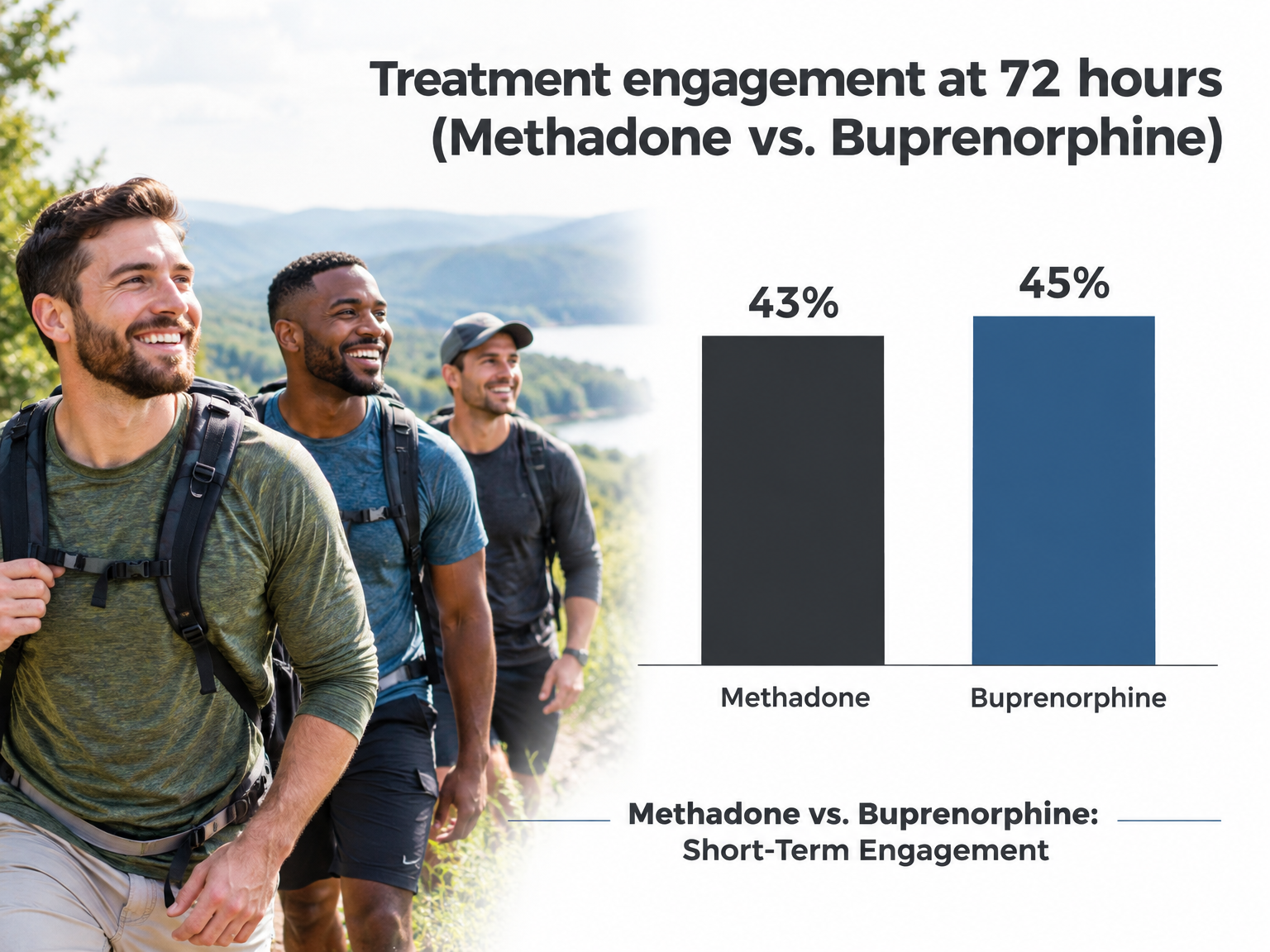
If you're weighing methadone against buprenorphine, the real-world data is reassuring: both pathways keep roughly the same share of patients engaged in treatment through the first critical days. In an open-label emergency-department study that initiated patients on one medication or the other and tracked follow-up, 43% of men and women on the methadone pathway were still engaged in treatment at 72 hours, compared with 45% on the buprenorphine pathway.7
That near-tie matters. It means the choice can be driven by what fits your life rather than by which medication is clinically superior. Methadone usually requires daily visits to an opioid treatment program, at least at first. Buprenorphine can often be prescribed and picked up at a regular pharmacy, which works better for men holding down a job or living outside a city with an OTP.
The study was small and nonrandomized, so it doesn't crown a winner for every person.7 A clinician who knows your use history, your prior attempts, and your tolerance should guide the call.
The short answer is yes, for most men, with a clinician guiding the induction. The longer answer is worth your attention, because fear of precipitated withdrawal, the fast, intense symptom spike that can follow a first dose of buprenorphine while fentanyl is still active, keeps a lot of men from picking up the phone.
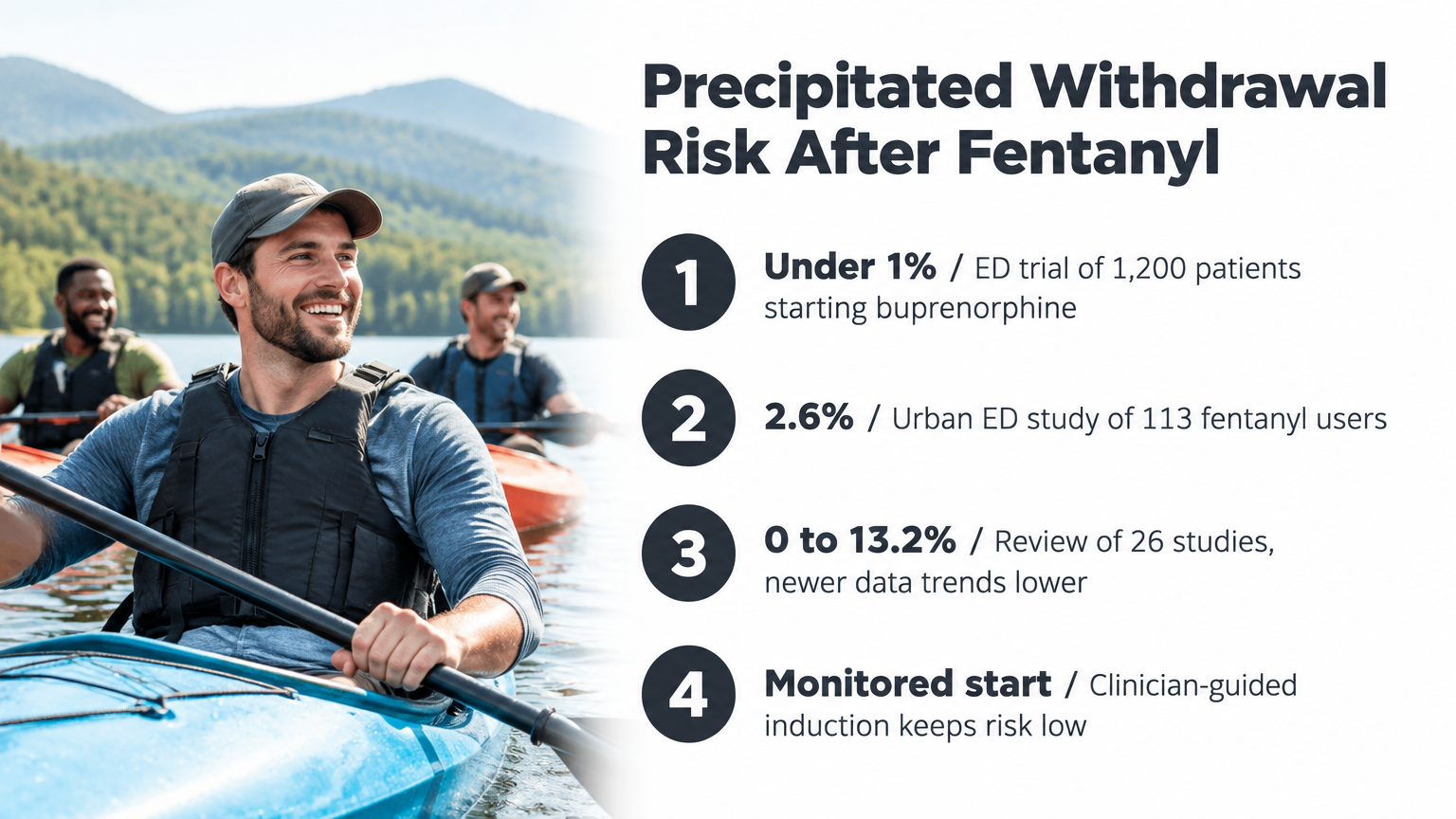
Here is what the strongest clinical data shows. In a prospective multisite trial, approximately 1,200 participants with opioid use disorder started buprenorphine across 28 emergency departments. Precipitated withdrawal occurred in nine people, or 0.76% overall, and fewer than 1% of participants whose use included fentanyl experienced it.4 A separate 2025 study at an urban emergency department found that of 113 patients who reported fentanyl use and received buprenorphine, 3 experienced precipitated withdrawal, a rate of 2.6%.18 A commentary summarizing a systematic review of 26 studies covering 4,497 people put the range at 0% to 13.2%, with most newer studies clustered near the low end.6
Outpatient low-dose protocols tell a slightly different story. In a retrospective cohort of 118 outpatient initiations, 31% of men and women experienced some withdrawal symptoms, broken down as 21% mild, 8% moderate, and 2% severe.5 Mild and moderate symptoms are uncomfortable, but they are not the catastrophic spike men fear when they read about precipitated withdrawal online.
The practical read: in monitored settings, the risk is real but low, and a clinician can adjust timing, dose, and medication choice to manage it. Fear of a rare event should not keep you from the treatment most likely to save your life.6
Tennessee has built out a network of state-supported hotlines, specialists, Medicaid-covered providers, and licensed treatment programs that make it possible to go from a first phone call to a bed, a medication appointment, or a naloxone kit within the same day. Knowing which door to knock on matters, because the right first call shortens the distance between withdrawal and ongoing treatment.
The Tennessee REDLINE is a state referral line for substance use and co-occurring concerns, and it can connect you or a family member to detox beds, MOUD prescribers, and treatment programs across the state. If you don't know where to start, that call is a reasonable first move.
Alongside the REDLINE, the Tennessee Department of Mental Health and Substance Abuse Services runs the Regional Overdose Prevention Specialists program, with 20 specialists serving 13 regional divisions.15 These specialists distribute naloxone, train families and community members in overdose response, and connect people to local treatment resources. If someone in your household uses fentanyl, getting naloxone through your regional specialist is a step worth taking before withdrawal starts, not after.
If you have TennCare, Tennessee's Medicaid program, your coverage already includes medication for opioid use disorder and withdrawal management across inpatient, residential, and outpatient settings.12 That is a meaningful starting point, because cost is one of the first questions men hesitate on when they consider calling.
TennCare also runs a specialized network called BESMART for members with opioid use disorder. BESMART providers must be TennCare providers, hold contracts with the applicable managed-care organizations, and complete the program attestation, which means they have agreed to deliver comprehensive, office-based buprenorphine care rather than piecemeal prescribing.13 Office-based treatment lets you pick up buprenorphine at a pharmacy and see a prescriber on a regular schedule, rather than reporting to a clinic daily. Tennessee's Nonresidential Buprenorphine Treatment Guidelines set the state-specific documentation and assessment standards those prescribers follow.14 If you are commercially insured, your plan likely covers the same medications, though the network and prior-authorization rules will differ.
Opioid treatment programs, or OTPs, are the federally regulated clinics that dispense methadone and, in many cases, buprenorphine and injectable naltrexone. Tennessee's state OTP map lists locations in Nashville and multiple Knoxville-area sites, including clinics in Knoxville, Maryville, and Newport, with additional programs in Chattanooga, Cleveland, and other communities.16 Availability is uneven across the state, so a man in a rural county may drive farther at first than someone in Davidson or Knox.
Federal OTP rules were updated under the 42 CFR Part 8 Final Rule, which took effect April 2, 2024, with a compliance date of October 2, 2024.10 The revision expanded telehealth screening options and gave clinicians more flexibility around take-home methadone early in treatment, which can reduce the number of in-person visits a working man has to coordinate. Clinic location, hours, and services can change, so verify the specific program before you drive.
Tennessee has licensed programs serving both Middle and East Tennessee. Trifecta Healthcare Institute operates its Middle Tennessee facility in Columbia, serving men from Nashville, Franklin, Spring Hill, and surrounding communities, and a Knoxville facility serving men from the Smoky Mountains region, Blount County, and the broader Appalachian corridor.
Picking a program close to home matters for one practical reason: the handoff from withdrawal management into ongoing MOUD and therapy is where most relapses happen, and keeping care coordinated reduces the chance of falling through that gap. Trifecta's team can help coordinate medically supervised withdrawal with a detox partner and admit men into PHP, IOP, and outpatient treatment with therapy, movement-based programming, and brotherhood built in.
Making the call is almost always the hardest part. The call itself is shorter and simpler than you expect. An intake coordinator will ask what you are using, how often, when you last used, and whether you have other health conditions or medications in play. Honest answers help a clinician match you to the right level of care, usually medically supervised withdrawal followed by PHP or IOP with MOUD coordinated in.
You will also be asked about insurance. If you have TennCare, commercial coverage, or Tricare, benefits can usually be verified the same day.12 You do not need to have your paperwork lined up to pick up the phone. [Call Trifecta] [Verify your insurance]
Once the acute symptoms soften, usually by the end of week one, a new problem shows up. The physical crisis is over, but the brain is still rewiring, sleep is still broken, and cravings arrive without warning. This is the stretch where ongoing care decides whether the detox stay was a reset or a revolving door.
The clinical backbone stays the same: medication for opioid use disorder, paired with behavioral therapy. NIDA frames MOUD as first-line treatment, usually combined with counseling such as CBT, DBT, EMDR, or motivational interviewing to address the triggers and co-occurring concerns, including anxiety, depression, trauma, and anger, that fentanyl was quietly managing.2 For many men, co-occurring treatment is where the real work happens, because fentanyl was never really the first problem.
Movement earns a role here, not as a replacement for medication but as research-supported structure around it. Boxing, jiu-jitsu, hiking the East Tennessee ridgelines, strength training, and cold exposure give the nervous system something to do during the long post-acute window when cravings surge and sleep still hasn't caught up. Done alongside MOUD and therapy, physical practice supports mood regulation and the slow neuroplastic work of recovery.
Then there is the piece a prescription cannot write: other men doing the same work. A room full of guys who have been through the first week, the first month, and the first slip is where accountability stops being abstract. That is what brotherhood looks like in practice, and it is often what holds when the medication alone would not have.
If a wife, mother, father, or sister is reading this at 11 p.m. with the lights off and the phone turned down, the first thing to know is that families play a real role in how fentanyl withdrawal goes. The man in question does not have to be ready to go to treatment tomorrow for his family to take meaningful steps tonight.
Two actions matter most. First, get naloxone into the house. Tennessee's Regional Overdose Prevention Specialists distribute naloxone and train family members in how to use it, with 20 specialists serving 13 regional divisions across the state.15 Keep two doses accessible, and know that calling 911 is still the right move after administering it.3 Second, call the Tennessee REDLINE yourself. Families do not have to wait for permission to gather information about detox beds, MOUD prescribers, and insurance options so the pathway is ready when he says yes.
Fentanyl withdrawal is survivable, and the research is clear that medically supervised care paired with ongoing medication for opioid use disorder is what supports men after the acute window closes.2 You do not have to figure out the pathway alone, and you do not have to wait until things get worse to pick up the phone. One call starts the handoff from withdrawal to real treatment, with therapy, movement, and a room full of men doing the same work beside you. [Call Trifecta] The next step is yours to take.
Acute fentanyl withdrawal often begins within hours of your last dose, and the acute symptoms typically ease over several days. A post-acute window of broken sleep, low mood, and surging cravings often lingers for weeks. Medication for opioid use disorder shortens the hardest stretch and protects you from the overdose risk that follows a quick drop in tolerance.
Home detox is not recommended. Street fentanyl is often cut with sedatives like xylazine or medetomidine, which can complicate withdrawal in ways over-the-counter remedies cannot address.20 The CDC also warns that unmedicated detox raises the risk of resumed use and fatal overdose once tolerance drops.21 A medically supervised program keeps you safer and connects you directly to ongoing treatment.
For most men, no. A multisite emergency-department trial of roughly 1,200 participants found precipitated withdrawal in 0.76% overall, with fewer than 1% among people whose use included fentanyl.4 A commentary summarizing 26 studies covering 4,497 people placed the range at 0% to 13.2%, with newer work clustered at the low end.6 A clinician manages timing and dose to minimize the risk.
Yes. TennCare covers medication for opioid use disorder and withdrawal management across inpatient, residential, and outpatient settings.12 It also runs BESMART, a specialized network of office-based buprenorphine providers who must be TennCare providers, hold contracts with the applicable managed-care organizations, and complete the program attestation.13 If you have commercial insurance or Tricare, those plans typically cover the same medications under their own network rules.
Families can take two concrete steps tonight. First, get naloxone into the home through Tennessee's Regional Overdose Prevention Specialists, who distribute it and train households across 13 regional divisions.15 Call 911 after administering a dose.3 Second, call the Tennessee REDLINE to gather detox beds, prescribers, and insurance options so the pathway is ready the moment he says yes.
No. NIDA states that detoxification alone is not sufficient treatment for opioid use disorder and that medication should generally be first-line care.2 SAMHSA's federal guidelines echo that short-term withdrawal management on its own is not recommended and that treatment should include counseling, overdose education, and naloxone in the home.9 Detox clears your system; MOUD, therapy, and brotherhood keep you alive after.
Between facility size limits, waivers, and state-by-state rules, figuring out your Medicaid or private insurance benefits can feel like its own full-time job. Our admissions team will verify your coverage in minutes and walk you through exactly what's available — no guesswork required.
Verify Insurance Benefits →No commitment required. Confidential & HIPAA-protected.
Whether it's you or someone you love, our team can help you figure out the next step — what treatment looks like, what's covered, or just someone to talk to.
Talk to Our TeamConfidential. No commitment required.


