


How to Choose a Dual Diagnosis Partial Hospitalization Program
Use this checklist to assess a dual diagnosis partial hospitalization program, including integrated care, medication support, Tennessee licensure, PHP fit, a...
Read More
Learn when gabapentin for alcohol withdrawal may help, why it cannot reliably prevent seizures or delirium tremens, and when urgent medical care is essential.
Start Your Journey NowWritten and reviewed by the clinical team at Trifecta Healthcare Institute, a men’s-only treatment center in Tennessee specializing in substance use, mental health, and dual diagnosis care.
Here is the short version: gabapentin may help selected men with mild alcohol withdrawal when a clinician is monitoring the picture, and it has a clearer role in longer-term alcohol use disorder care once the first days are behind you. It is not a reliable stand-alone treatment for severe withdrawal, and it does not dependably prevent withdrawal seizures or delirium tremens 10. Those complications can be life-threatening, which is why the NIAAA frames alcohol withdrawal as a condition that needs medical assessment rather than a solo project at home 8.
If you are reading this because you want a quieter, less intimidating way to stop drinking, that instinct makes sense. The question worth asking is not whether gabapentin "works," but whether your situation is one a prescriber would actually choose it for, and whether the setting around that prescription keeps you safe. This article walks through what the evidence shows, where gabapentin fits, and where a supervised detox is the honest answer.
When a man drinks heavily for weeks or months, his nervous system adapts. Alcohol dampens brain activity, so the brain compensates by cranking up its excitatory signals to stay balanced. Pull the alcohol out suddenly, and that compensation has nowhere to go. The result is a nervous system stuck in overdrive, which is what withdrawal actually is at the biological level.
The milder end of that spectrum shows up as shaky hands, racing heart, sweating, nausea, anxiety, and the kind of sleep that never quite arrives. These symptoms are miserable but survivable. The harder end is different. Some men progress to withdrawal seizures, and a smaller subset develop delirium tremens — severe confusion, hallucinations, and dangerous swings in heart rate and blood pressure. The NIAAA is direct about this: alcohol withdrawal can be life-threatening, and seizures and delirium tremens are the complications that make it so 8.
Who ends up where on that spectrum is not always predictable from the outside. Daily drinking volume, prior withdrawal episodes, co-use of other depressants, nutrition, liver function, and underlying medical conditions all shape risk. That unpredictability is why clinicians assess before they prescribe, and why the medication question cannot be separated from the setting question.
Most of the confusion online comes from blending two separate clinical questions into one. The first is about the first few days: how to get a man through acute withdrawal without a seizure, without delirium tremens, and without a trip to the emergency department. The second is about the weeks and months that follow: how to help someone with alcohol use disorder stay stopped, sleep again, and quiet the pull toward the next drink.
Those are not the same job, and the evidence for gabapentin looks very different depending on which one you are asking about. For acute withdrawal, benzodiazepines remain the primary medication class because they reliably reduce the risk of seizures and delirium. Gabapentin, by contrast, has not been shown to suppress withdrawal seizures and is not recommended as a stand-alone treatment for severe acute withdrawal 10. A clinician may still use it for selected lower-risk patients or as part of a layered inpatient protocol, but the ceiling on what it can do during the acute phase is real.
The second question is where gabapentin earns a more interesting conversation, and it is the one most of the published trials actually studied.
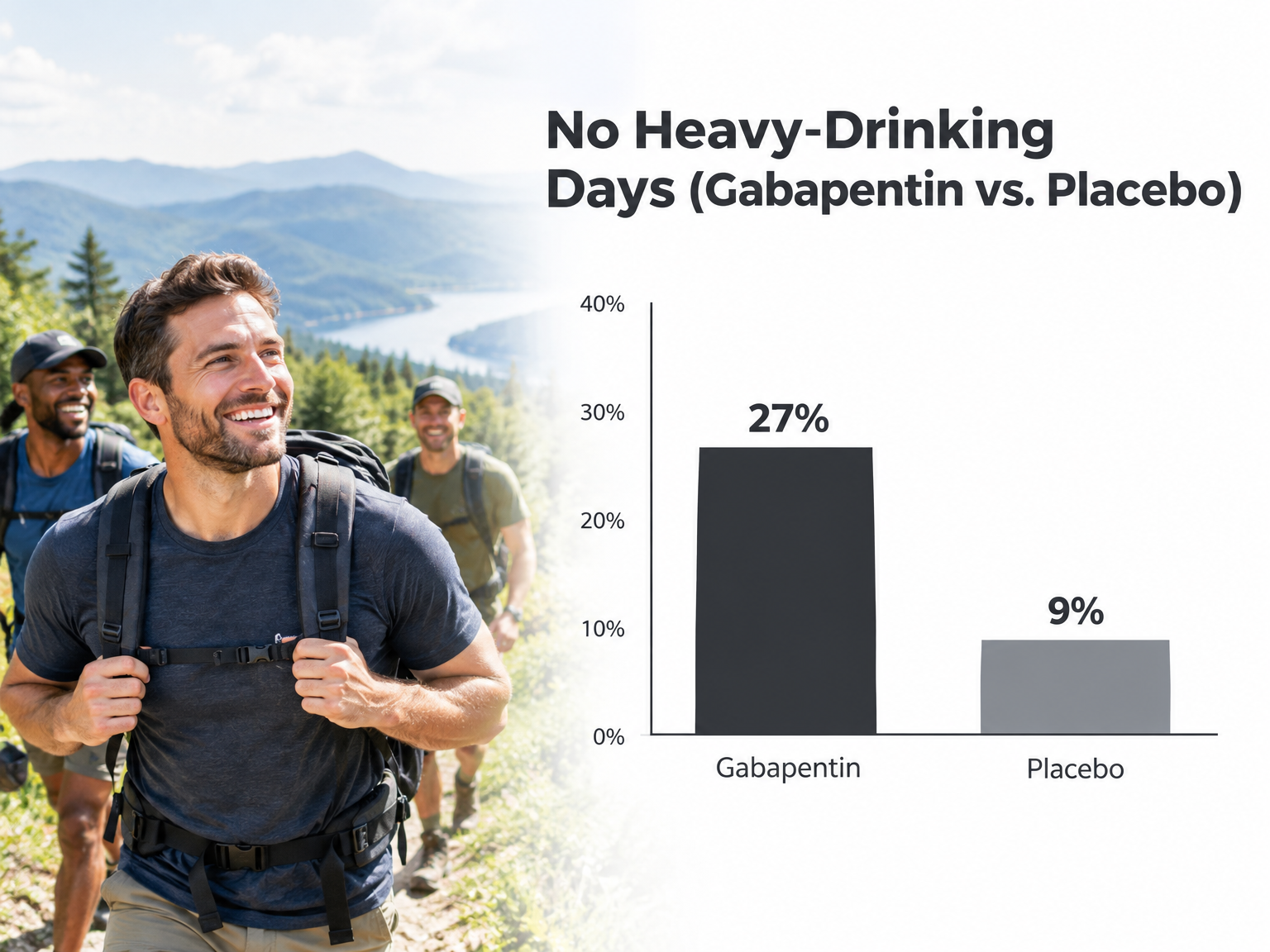
Once the acute storm has passed and a man is three or more days into abstinence, gabapentin starts looking like a different medication. A 2020 double-blind randomized trial tested it in treatment-seeking outpatient adults with alcohol use disorder who had recent withdrawal symptoms and three abstinent days behind them. Twenty-seven percent of participants on gabapentin had no heavy-drinking days during the trial, compared with nine percent on placebo, and eighteen percent on gabapentin achieved total abstinence versus four percent on placebo 1. The effect was strongest in the men and women who had entered the trial with more pronounced withdrawal symptoms, which suggests the medication is doing something specific to the post-withdrawal nervous system rather than acting as a general sedative.
Scope matters here. This was outpatient AUD treatment that started after abstinence, not a study of unsupervised home detox. It cannot be read as evidence that gabapentin is safe to start on day one at the kitchen table.
A separate 12-week dose-ranging trial tested gabapentin at 900 mg and 1,800 mg per day in 150 adults with alcohol dependence and found dose-related improvements in abstinence, heavy drinking, craving, sleep, and negative mood 2. A peer-reviewed synthesis of six randomized trials echoes the pattern: the strongest efficacy signal shows up when gabapentin is used in people with moderate-to-severe withdrawal symptoms, started early in the course of care, and continued for weeks rather than days 3. A separate review of post-acute withdrawal treatments found that gabapentinoids have more support for sleep disturbance, anxiety, and negative affect than for severe acute symptoms, while cautioning that the overall evidence base remains low strength 5.
Translation: gabapentin's clearest value for a man thinking about alcohol is on the back half of this problem, under a prescriber's eye, not as a self-prescribed shortcut through the first days.
Picture a man whose withdrawal symptoms are on the lighter end: some anxiety, poor sleep, a tremor he can mostly hide, no history of seizures, no delirium in past attempts to stop, no opioids in the mix. For a patient like that, a clinician may consider a gabapentin taper as part of an outpatient or inpatient plan, often alongside close symptom monitoring and sometimes layered with other medications.
The 2023 open-label trial comparing a fixed gabapentin taper with symptom-triggered benzodiazepines in hospitalized adults with mild-to-moderate withdrawal reported similar outcomes between groups, with a nonsignificant trend toward shorter length of stay in the gabapentin arm. The study did not reach its planned enrollment, and participants had already received benzodiazepines before randomization, so it cannot settle the question of equivalence 6. What it does suggest is that for a carefully chosen patient, gabapentin can be part of a workable protocol.
The word doing all the work here is "selected." Mild-looking symptoms on day one can shift by day two, which is why a prescriber tracks vitals and withdrawal scores rather than guessing.
The honest line gets drawn at severity. Gabapentin does not reliably suppress alcohol withdrawal seizures, and the NIAAA's Alcohol Research review is explicit that it should not be considered a stand-alone treatment for severe acute withdrawal 10. A broader review of anticonvulsants in withdrawal reaches the same conclusion from a different angle: easing anxiety and insomnia is not the same job as preventing a seizure or delirium tremens, and the evidence base does not support using gabapentin alone for that preventive role 4.
Any of the following moves a man out of the "gabapentin might fit" category and into territory where benzodiazepines and a monitored setting are the appropriate answer: a prior withdrawal seizure, a prior episode of delirium tremens, heavy daily drinking over a long stretch, unstable vital signs on presentation, significant medical comorbidities, or a withdrawal score that is already climbing. These are the situations where the complications NIAAA names as life-threatening — seizures and delirium tremens — become real possibilities 8.
When a prescriber is deciding whether gabapentin belongs in a withdrawal plan, the conversation moves through a short list of specifics. None of these are checkboxes a reader should run alone — they are the reasons a medical assessment exists in the first place.
Where gabapentin may fit:
Where gabapentin does not fit as a stand-alone answer:
Bring this list to the appointment, not to the medicine cabinet. The point is to make the conversation with a clinician sharper, not to replace it.
One of the more interesting threads in recent withdrawal research is whether gabapentin can reduce how much benzodiazepine a hospitalized patient needs. The appeal is practical: benzodiazepines work, but they also sedate, raise fall risk in older patients, and complicate care for men with respiratory issues or a history of sedative misuse. If a layered protocol can take some of that load off, clinicians are interested.
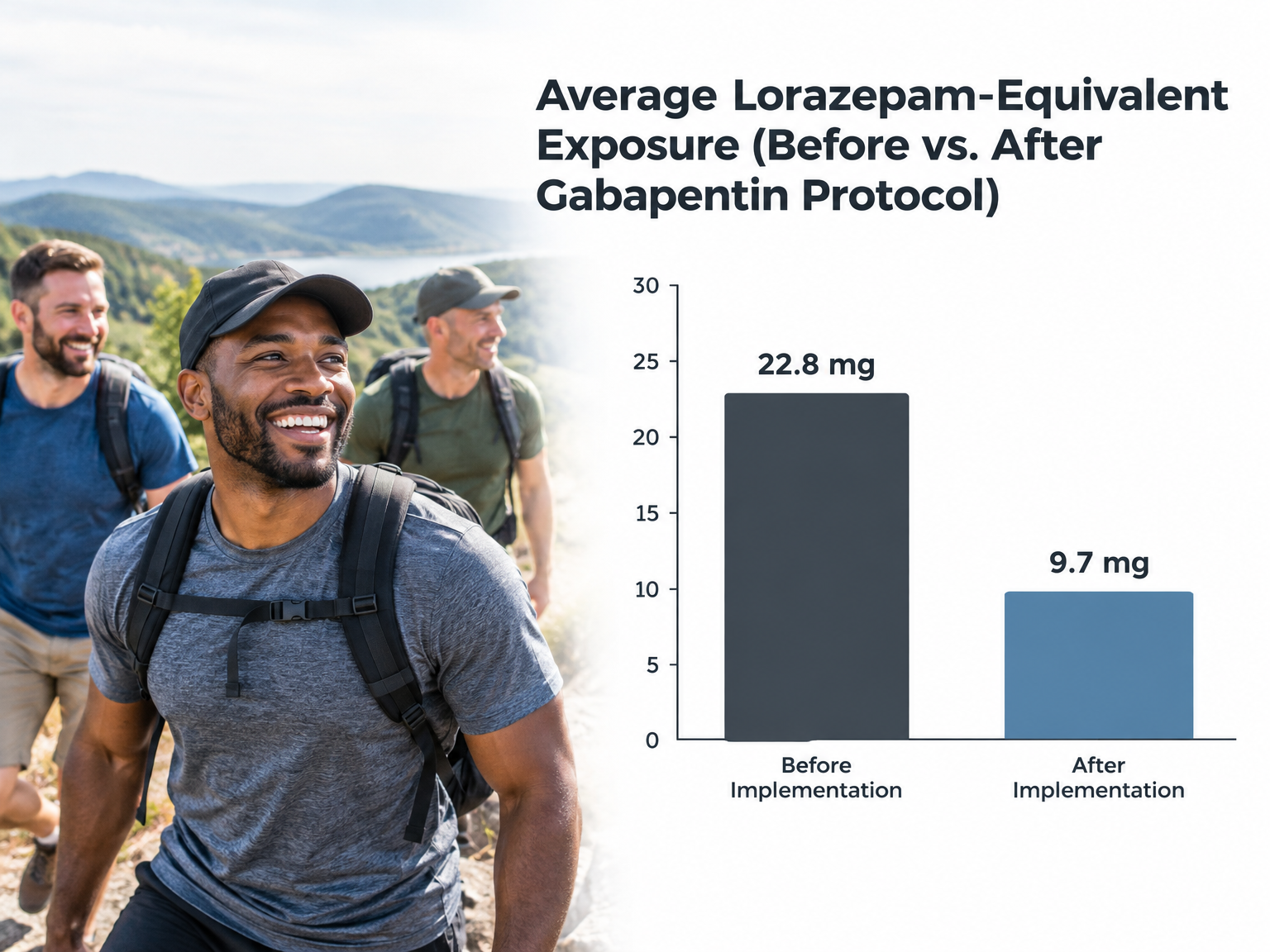
A single-center retrospective study looked at this directly. After a hospital implemented a scheduled gabapentin taper for acute alcohol withdrawal, the average lorazepam-equivalent exposure dropped from 22.8 mg before the protocol to 9.7 mg after, while symptom progression and length of stay stayed roughly the same 7. On its face, that is a meaningful reduction in benzodiazepine exposure without an obvious cost in how patients did.
The honest caveat belongs in the same breath as the number. This was a pre/post design at one hospital, which means it compared two different groups of patients cared for at different times. Changes in staffing, admission patterns, or other protocol tweaks can shift results in ways the study cannot untangle. It does not prove that gabapentin caused the reduction, only that the combined protocol was associated with it 7.
What this body of work does support is narrow and worth stating plainly: in a monitored inpatient setting, a clinician may use gabapentin as part of a protocol that reduces how much benzodiazepine a patient receives. It does not support running the same experiment at home, where the monitoring, the dosing structure, and the ability to escalate care are not there.
The FDA has specifically warned that gabapentin can cause serious breathing difficulties in people with respiratory risk factors, including anyone taking opioids or other central nervous system depressants, and anyone with reduced lung function from conditions like COPD or sleep apnea 11. That warning matters in a withdrawal context because the medication cabinet rarely holds just one thing. A man with chronic pain already on an opioid, a prescription for a sleep aid, or a benzodiazepine from a prior taper is in a different safety category than someone taking gabapentin alone.
The combination risk is why a prescriber asks about every pill, patch, and occasional use before writing anything. It is also why a quiet home environment is not a monitored one — a slowed respiratory rate at three in the morning is only caught if someone is watching for it.
Gabapentin was long considered a low-risk medication, but a 2016 systematic review of misuse, abuse, and diversion found a more complicated picture. Reported misuse prevalence ranged from roughly 1% in the general population to 15–22% in populations with opioid misuse, with gabapentin sometimes taken alongside alcohol or other sedatives to amplify effects 12. The wide range reflects very different study samples and varies substantially across populations, so it is not a universal rate — it is a signal about who warrants closer attention.
For a man with a history of opioid use, sedative misuse, or polysubstance patterns, that history does not automatically rule gabapentin out. It does change the conversation: shorter prescriptions, closer check-ins, pill counts, and a plan that does not leave bulk supplies sitting in a drawer. The medication is a tool, and like any tool, it belongs in hands that are being watched by someone trained to notice when the pattern shifts.
Plenty of men would rather handle this at home. No waiting room, no paperwork, no explaining anything to anyone. If a friend or an urgent care prescriber hands over a bottle of gabapentin, the temptation to tough it out alone is understandable.
The problem is what a kitchen cannot do. It cannot measure a withdrawal score at 2 a.m., catch a blood pressure that is quietly climbing, or recognize the shift from a bad night to a seizure. Gabapentin does not reliably prevent withdrawal seizures or delirium tremens, which means the medication a man is counting on to feel safer is not the medication that keeps him safe when the picture turns 10. The NIAAA puts it plainly: alcohol withdrawal can be life-threatening, and the complications that make it so can appear in the days after the last drink 8.
Add the medication-cabinet reality. An opioid for an old back injury, a prescription sleep aid, a leftover benzodiazepine — any of these combined with gabapentin raises the risk of serious breathing problems, which is exactly what the FDA has warned about 11. At home, a slowed respiratory rate at 3 a.m. is only caught if someone is watching for it. Usually, no one is.
For men who have been imagining a hospital corridor and a paper gown, the actual experience of a men's program tends to land differently. At Trifecta Healthcare Institute's programs in Knoxville and the Nashville-area facility in Columbia, TN, the first step is a clinical assessment: a medical provider reviews drinking history, prior withdrawal episodes, other medications, co-occurring conditions, and vitals, then helps determine the appropriate level of care. That is the step gabapentin alone cannot replace, because the right next move may be supervised detox with a medical partner, residential care, PHP, or IOP, depending on the risk profile the assessment reveals 8.
From there, monitoring takes over the job a kitchen cannot do. Withdrawal scores, blood pressure, heart rate, hydration, and sleep get tracked across the first several days, so a shift from manageable to dangerous gets caught early instead of at 3 a.m. by a frightened partner. If symptoms stay mild and the risk profile allows, medications may be adjusted downward. If they escalate, the clinical response is already coordinated.
Movement enters the picture as the acute phase eases. Boxing, jiu-jitsu, hiking in the Smoky Mountains for the Knoxville program, ice baths, and strength work are used as clinical tools paired with CBT, DBT, EMDR, and motivational interviewing — not as recreation, and not as a replacement for the medical side of care. The brotherhood piece is practical rather than slogan-driven: other men in the same week of recovery, available to talk at the exact moment the pull toward a drink shows up again. That combination of medical oversight, evidence-based therapy, and physical practice is what a supervised first week looks like when it is built for men.
A note for the wife, partner, mother, or father who found this article open on a laptop or who went looking for it themselves: the man you love is probably not minimizing on purpose. Heavy drinkers often underestimate how their nervous system has adapted, and the idea that a single prescription can smooth the first week feels easier than admitting the situation needs a medical team.
A few things worth knowing. Gabapentin alone does not reliably prevent withdrawal seizures or delirium tremens, which are the complications the NIAAA identifies as life-threatening 8, 10. If he has ever had a seizure, hallucinations, or a hospital visit during a past attempt to stop, those are not stories to file away — they are the clearest signal that this attempt needs a supervised setting from day one.
What tends to help in the conversation is specificity rather than pressure. Ask what his plan is for the first several days, who will be watching, and what happens if symptoms climb. If the answer is a bottle and a quiet room, that is the moment to suggest a clinical assessment together.
If you have read this far, you already know the real question is not which pill to try. It is who will be in the room with you during the first week, and what they can do if the picture turns. A clinical assessment answers that in a single conversation: your drinking history, prior withdrawal episodes, other medications, and current symptoms get translated into a plan and the right level of care.
Trifecta Healthcare Institute's men's programs in Knoxville and the Nashville-area facility in Columbia, TN start with that assessment. The next move is a phone call or an insurance check, not a decision made alone at 2 a.m. [Call Trifecta] [Verify your insurance]
Not safely on your own. Gabapentin does not reliably prevent withdrawal seizures or delirium tremens, and the NIAAA is clear that alcohol withdrawal can be life-threatening and needs medical assessment rather than a self-directed plan 8, 10. A clinician may include gabapentin in an outpatient protocol for selected lower-risk patients, but that decision belongs to a prescriber who has reviewed your history.
No. The NIAAA Alcohol Research review states directly that gabapentin should not be considered a stand-alone treatment for severe acute alcohol withdrawal because it is ineffective at suppressing withdrawal seizures 10. A broader anticonvulsants review draws the same line: easing anxiety or insomnia is a different clinical job than preventing seizures or delirium tremens 4. Benzodiazepines remain the primary medication class for that preventive role.
Benzodiazepines have strong evidence for reducing the risk of withdrawal seizures and delirium tremens, which is why they remain the primary treatment for moderate-to-severe withdrawal. Gabapentin may help with anxiety, insomnia, and other subjective symptoms, and a hospital study found a scheduled gabapentin taper was associated with lower lorazepam-equivalent exposure in selected patients 7. It is not a reliable substitute for benzodiazepines when severity is high 10.
It depends on what else is in the mix. The FDA has warned that gabapentin can cause serious breathing difficulties in people taking opioids or other central nervous system depressants, or in people with reduced lung function from conditions like COPD or sleep apnea 11. Tell any prescriber about every medication, prescription or otherwise, before gabapentin is added to a withdrawal plan.
Yes, this is where the evidence is more interesting. A 12-week dose-ranging trial of 900 and 1,800 mg per day in adults with alcohol dependence showed dose-related improvements in abstinence, heavy drinking, craving, sleep, and negative mood 2. The NIAAA notes that the American Psychiatric Association includes gabapentin as a second-line option for selected patients with AUD who prefer it or have not tolerated FDA-approved medications 9.
A supervised detox is the right call when the risk picture is anything but mild. That includes a prior withdrawal seizure or delirium tremens, long-standing heavy daily drinking, unstable vitals, significant medical conditions, concurrent opioids or other CNS depressants, or no reliable way to be monitored across the first several days 4, 8, 11. If any of those apply, a clinical assessment should come before any prescription decision.
Between facility size limits, waivers, and state-by-state rules, figuring out your Medicaid or private insurance benefits can feel like its own full-time job. Our admissions team will verify your coverage in minutes and walk you through exactly what's available — no guesswork required.
Verify Insurance Benefits →No commitment required. Confidential & HIPAA-protected.
Whether it's you or someone you love, our team can help you figure out the next step — what treatment looks like, what's covered, or just someone to talk to.
Talk to Our TeamConfidential. No commitment required.


