


How to Choose a Dual Diagnosis Partial Hospitalization Program
Use this checklist to assess a dual diagnosis partial hospitalization program, including integrated care, medication support, Tennessee licensure, PHP fit, a...
Read More
Trace how the history of intensive outpatient program shifted toward retention, integrated mental health care, telehealth, and Tennessee coverage details.
Start Your Journey NowWritten and reviewed by the clinical team at Trifecta Healthcare Institute, a men’s-only treatment center in Tennessee specializing in substance use, mental health, and dual diagnosis care.
The history of intensive outpatient programs is really the story of a field slowly learning how much structure people actually need to recover from substance use disorder without stepping away from work, family, and daily life. Federal guidance now defines an adult intensive outpatient program, or IOP, as structured treatment generally involving at least nine hours of services each week, delivered as a mix of group therapy, individual counseling, family work, case management, and medication coordination.1
That nine-hour benchmark did not fall from the sky. It emerged from decades of experimentation with outpatient and day-treatment models, randomized trials that challenged the assumption that more hours automatically meant better outcomes, and federal efforts to standardize what had been a patchwork of local programs.2, 4
This article traces that evolution: from the early roots of outpatient care, through the 1990s intensification and SAMHSA's codification of the model, into today's integrated, telehealth-aware, Tennessee-regulated version. Understanding how IOP got here helps explain why a modern program looks the way it does, and what a man or a family vetting treatment today should actually expect from one.
An intensive outpatient program is defined less by its address than by its weekly rhythm. SAMHSA's Advisory, grounded in TIP 47, describes adult IOP as structured treatment that generally involves at least nine hours of services per week, delivered across multiple sessions rather than compressed into a single day.1 Those nine hours typically combine group therapy, individual counseling, family psychoeducation, case management, peer services, and coordination of medications when they are part of the clinical picture.1
The format matters as much as the hour count. Group work carries much of the weight, because peer interaction is where people practice honesty, hear their own patterns reflected back, and build the kind of accountability that lasts after the session ends. Individual counseling adds depth and privacy for issues that are harder to raise in a room of ten. Family involvement and case management extend treatment into the environments where recovery actually gets tested.
Purpose rounds out the definition. An IOP is designed for people who need more structure than a weekly therapy appointment but can safely live at home, hold a job, and sleep in their own bed. The level of care assumes stability outside the clinic walls, which is why screening for medical risk, psychiatric acuity, and housing comes first.1

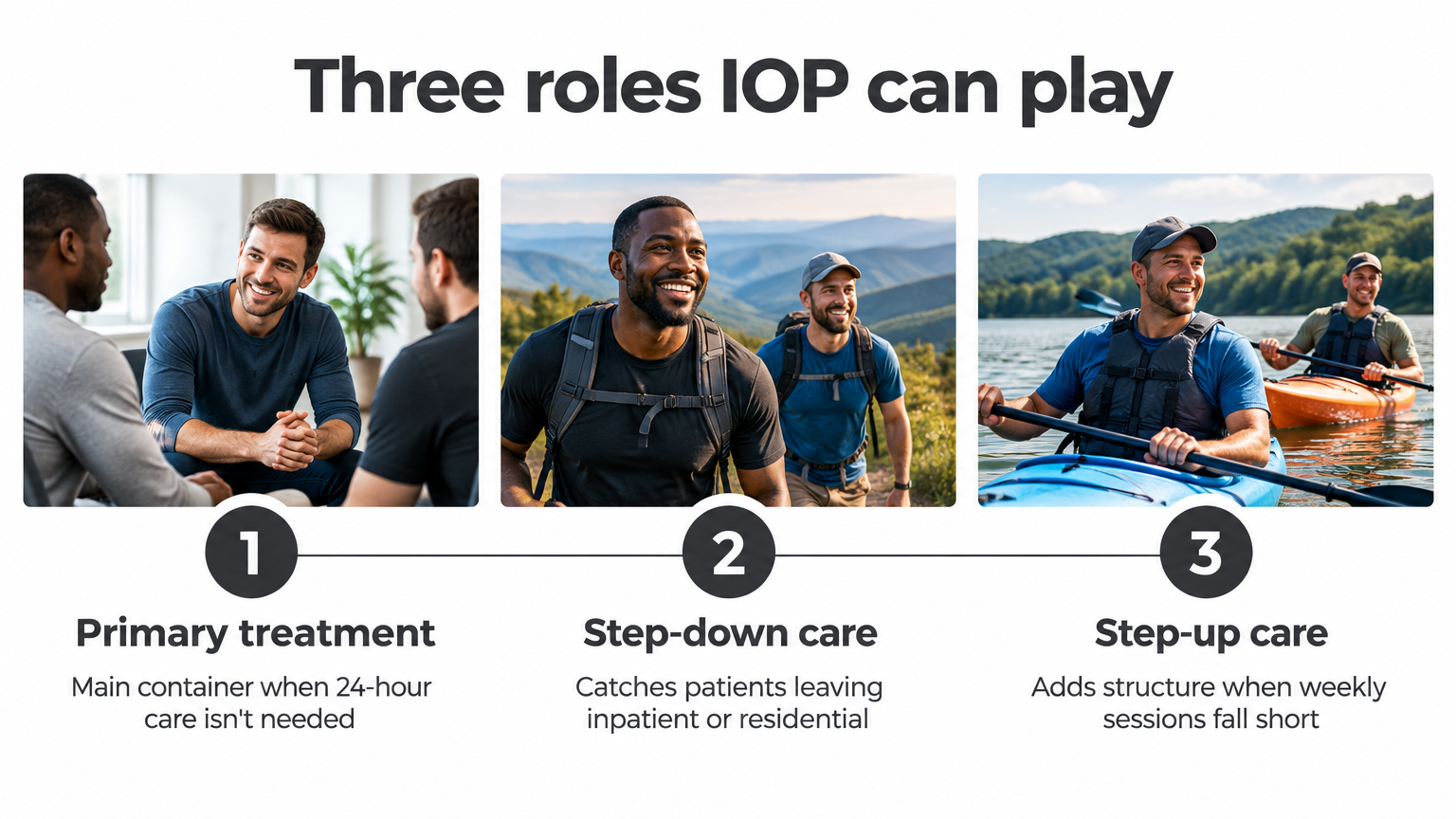
One of the quieter insights in the SAMHSA Advisory is that the same program can serve three very different patient paths. IOP can function as primary treatment, as step-down care after inpatient or residential treatment, or as step-up care from standard outpatient counseling.1 The clinical content may look similar from the hallway, but the role each person is playing inside it is not the same.
As primary treatment, IOP is the main container for someone who needs real structure from day one but does not require 24-hour supervision. The program carries the full weight of stabilization, skill-building, and relapse-prevention planning.1
As step-down care, IOP catches someone leaving a hospital bed or a residential setting. The intensity drops, but the schedule still holds a person's week together while they re-enter work, family, and the ordinary friction of life.2
As step-up care, IOP responds to a person whose weekly outpatient sessions are no longer enough. A relapse, a new stressor, or a worsening co-occurring condition signals that more structure is needed before a crisis forces a higher level of care.1 One level of care, three honest reasons someone might walk through the door.
For most of the 20th century, substance use treatment in the United States meant one of two things: a hospital bed or a weekly counseling appointment. The space in between was thin. Day-treatment programs borrowed from psychiatric partial hospitalization existed in pockets, and community mental health centers ran outpatient groups, but there was no widely shared blueprint for structured, multi-session, nonresidential care.
That changed through the late 1980s and 1990s, as clinicians, researchers, and payers started asking a practical question: could the structure of residential treatment be delivered without the bed? Programs began clustering group therapy, individual counseling, family work, and relapse-prevention sessions into schedules that ran several hours a day, several days a week. SAMHSA's TIP 47 documents this trajectory, describing how intensive outpatient treatment moved from a peripheral service in earlier decades into a multidimensional modality by the late 1990s, with schedules ranging from roughly 6 to 30 contact hours per week depending on the program.2
The intensification was not purely clinical. Shorter inpatient stays, tightening insurance coverage, and a growing understanding of substance use disorder as a chronic condition all pushed the field toward something that could hold a person's week without holding their bed.2
By the mid-1990s, the assumption inside the field was intuitive: if a weekly session helped, then nine or more hours a week should help more. A 1998 randomized controlled trial tested that assumption directly, and the result quietly reshaped how clinicians thought about intensity.
The study randomized 447 participants with cocaine dependence into three arms: weekly individual counseling, individual counseling combined with group treatment, and an intensive group program running three hours a day, three days a week over 12 weeks. At nine months, there were no significant outcome differences between the three modalities. What did predict better results was retention. Participants who stayed in treatment longer, regardless of arm, had fewer drug problems, fewer positive urine tests, better employment outcomes, and fewer psychological problems.4
That finding did not kill the IOP model. It redirected it. If more hours did not automatically translate to better outcomes, then the questions worth asking were different ones: what keeps people in treatment, what content fills those hours, and which patients actually need the extra structure. Retention, matching, and treatment content moved to the center of the conversation, where they have largely stayed.4
Before 2000, a program calling itself an IOP in one state might look very different from one in the next: different hours, different content, different admission rules. SAMHSA's Treatment Improvement Protocol 47, published in its revised 2013 form, pulled the model into something closer to a shared standard.
TIP 47 described IOP as a multidimensional modality with core clinical ingredients: cognitive-behavioral therapy, motivational approaches, family involvement, case management, and continuing care, delivered within a schedule built around group and individual sessions.2 It framed the program not as a fixed dose but as a structured container that could flex to serve people at different points in a continuum of care, with step-up and step-down transitions built in.2
A 2021 SAMHSA Advisory, drawn directly from TIP 47, carried the framework forward and formalized the adult benchmark of at least nine hours of services per week, delivered through a mix of individual counseling, group therapy, family psychoeducation, case management, peer services, medication coordination, and trauma-specific treatment where indicated.1 The federal manual gave the field a common language. Local programs could still differ, but they were now variations on a shared theme.
By the time TIP 47 was consolidating a shared definition, researchers were already stress-testing the model. A SAMHSA-sponsored evidence review covering studies published from 1995 through 2012 pulled together randomized trials, quasi-experimental designs, and naturalistic analyses, and gave intensive outpatient programs a high evidence rating for reducing alcohol and drug use. The same review found that IOPs generally produced outcomes comparable to inpatient or residential treatment for many patients, while noting that people with the most severe medical, psychiatric, or safety needs may still benefit more from a higher level of care.3
The scale picture mattered as much as the effect picture. In 2011, 6,089 facilities reported offering IOP, representing 44% of specialty addiction-treatment facilities in the United States, and those programs served 141,964 patients.3 A model that had been a scattered experiment two decades earlier was now embedded in nearly half of the country's specialty treatment system.
That combination of findings reframed how clinicians, payers, and referral sources thought about IOP. It was no longer a budget version of residential care. It was a distinct level of care with its own evidence base, best suited to people who could safely live at home and needed structured, multi-session treatment to stabilize and build recovery skills. The questions moved from "is IOP legitimate" to "who fits here, what belongs in those weekly hours, and how does the program connect to continuing care after discharge."3

For a long stretch of the field's history, mental health and substance use treatment ran on parallel tracks that rarely met. A person might finish a round of outpatient counseling for depression, then enter a separate program for alcohol use, with little coordination between the two. The results were predictable: unaddressed anxiety, trauma, or mood symptoms kept pulling people back toward substances, and clinicians kept treating one half of a two-part problem.
IOPs became one of the first outpatient settings where that split started closing. Federal evidence on treatment models for people with co-occurring mental and substance use disorders identifies IOP as a potentially effective setting for diverse populations, with reported effects on substance use, abstinence, psychological distress, functioning, and client satisfaction.12 Reduced psychological symptoms and fewer days of substance use tended to move together, which is what integrated care would predict.12
Today's IOPs routinely screen for depression, anxiety, trauma symptoms, and other mental health conditions on intake, then build those findings into the weekly schedule rather than referring them out.
Trauma took longer to move into the room. Clinicians historically worried that trauma-focused work would destabilize someone early in recovery, so PTSD treatment was often delayed until a person had months of abstinence. That caution had a cost, because untreated trauma symptoms frequently drove the next relapse.
Concurrent treatment models have been changing that sequence. A peer-reviewed study of a two-week intensive outpatient program delivering concurrent treatment for PTSD and substance use among 48 post-9/11 veterans and service members who completed the program found that substance use decreased at two weeks and three months after treatment, and that lower PTSD symptoms at the end of treatment were associated with less substance use at follow-up.13 The sample was small and specific to veterans, so the findings do not generalize to every man or every IOP.
Still, the direction is clear: trauma and substance use are increasingly treated inside the same program, in the same weeks, by the same clinical team.
Modern IOPs have also started asking a broader question: if a person is in the room nine hours a week for substance use treatment, what other health risks can be addressed inside that same structure instead of being handed off to another system that may never see them?
Tobacco use is a clean example. A 2024 study inside an intensive SUD treatment program in the Veterans Health Administration tested an opt-out tobacco-treatment group, where participants were enrolled by default rather than asked to volunteer. The opt-out group reported tobacco cessation at 24.57%, compared with 2.55% in the opt-in group, and tobacco-cessation medication prescribing reached 55.00% in the opt-out arm versus 14.65% in the opt-in arm.14 The study involved veterans and reported initial outcomes, so the specific numbers should not be read as what any community IOP would produce.
The design logic matters more than the headline figures. Embedding evidence-based interventions inside the intensive schedule, instead of waiting for a separate referral, is now a common way IOPs expand their reach without expanding their footprint.
Before March 2020, telehealth in substance use treatment was a niche adaptation, used mostly for rural access or specific medication-management visits. Group therapy, the backbone of an IOP schedule, almost always happened in a room with chairs in a circle. The pandemic collapsed that assumption in weeks.
Programs that had never run a video session suddenly had to deliver nine hours of structured care without a shared space. Screening and intake moved to phone and video. Group sessions migrated to secure video platforms. Case management, peer recovery support, and family work followed. A 2024 study comparing substance use treatment organizations in 2020 and 2022 found that telephone and video telehealth use remained above 50% for screening and assessment, case management, peer recovery support, and regular outpatient services even after distancing recommendations lifted, and that telehealth use for IOP shifted significantly between the two survey periods.9
The clinical case for keeping some of that infrastructure held up as the acute crisis receded. A 2025 observational study found that patients treated by clinicians who used more telehealth had more outpatient visits, longer medication supply, and lower SUD-related hospitalization rates, with no observed differences in overdoses, relapses, injection-related infections, or mental-health crises compared with lower-telehealth clinicians; because the design was observational, these associations do not establish that telehealth caused the differences.11 Newer design work has also pushed remote IOP into harder settings, including a qualitative study of a remotely delivered IOP adapted for hospitalized patients with opioid use disorder, where participants emphasized medications for opioid use disorder, personalized relapse-prevention plans, recovery-coach involvement, and treatment linkage after discharge.8
The honest part of the telehealth story is that not every format held up equally. Group work, which carries so much of the clinical weight in an IOP, turned out to be sensitive to the medium.
A 2024 study surveyed 1,037 adults across seven rural Minnesota IOPs and compared in-person, hybrid, and virtual-only group treatment. Hybrid groups did not differ significantly from in-person groups on surveyed outcomes. Virtual-only treatment was rated significantly worse than in-person treatment on six of eight questions involving perceived impact, therapeutic alliance, group cohesion, and insight.10 The study relied on one-time patient surveys and measured perceived experience rather than long-term substance use outcomes, so the findings describe how group care felt and functioned, not every downstream result.
Tennessee's Medicaid program, TennCare, treats intensive outpatient programming as a standard part of its behavioral-health benefit rather than a specialty add-on. The TennCare behavioral-health services page lists partial hospitalization and intensive outpatient programs among the services available to members based on medical necessity, alongside outpatient therapy, case management, and psychiatric support.6 A separate TennCare page on substance use treatment confirms coverage for withdrawal management and treatment at inpatient, residential, and outpatient levels for children, adolescents, and adults.5
The structural detail sits in the federal paperwork. Tennessee's approved state-plan amendment describes IOP as outpatient treatment involving meetings, classes, or counseling multiple times per week, with a minimum of three hours per day, two to five days per week, delivered as medically necessary.7 That schedule maps closely to the national nine-hour benchmark but gives programs room to flex the weekly layout.
Medical necessity is the hinge. A listed benefit does not guarantee admission for every member or every episode; managed-care rules, provider networks, and clinical review decide who moves into IOP, who steps up to a higher level of care, and who steps down to standard outpatient treatment.6, 7
Finding an open IOP seat used to mean working the phones through static provider directories that might be months out of date. Tennessee has been building a different access layer on top of that older infrastructure.
The Tennessee Office of Research and Community Outreach describes FindHelpNowTN.org as a near-real-time treatment locator where participating facilities regularly update residential, inpatient, and outpatient availability. People searching for care can filter by treatment type, payment or insurance options, and location.15 The locator does not decide clinical eligibility or insurance authorization, but it closes the gap between "a program exists" and "a program has an opening this week," which is often where families and referral sources get stuck.
Pull all of this history forward, and the shape of a current Tennessee IOP comes into focus. Weekly structure follows the state-plan rhythm of roughly three hours per day across two to five days, landing near the nine-hour federal benchmark.1, 7 Group therapy carries most of the clinical weight, with individual counseling, family work, case management, and medication coordination layered around it.
Content has broadened well past a single primary substance. Co-occurring mental health conditions are screened and treated inside the same program rather than referred out, and trauma-informed approaches sit alongside cognitive-behavioral and motivational work.12 Telehealth stays in the toolkit for intake, individual sessions, and continuing care, while most group work has returned to a shared room because that is where the research still points.10
For men in Knoxville or at the Columbia, TN facility serving the Nashville area, that history shows up in practical ways: a schedule that holds a working week together, a group room where peers stand together through the hard parts, and a program built on the clinical lessons the field has spent decades learning. Trifecta Healthcare Institute's men's IOP sits inside that tradition.
If you are a man considering treatment, or a family member reading on his behalf, the history above is less a timeline than a vetting tool. A modern IOP is not a budget version of residential care. It is a distinct level of care, built from decades of clinical trial and error, that holds a person's week together while they keep working, parenting, and sleeping in their own bed.3
What that means practically: expect structured weekly hours, group work as the clinical center of gravity, co-occurring mental health care inside the same program rather than referred out, and telehealth used as a tool rather than a substitute for the room.1, 12 Ask any program you consider how it handles trauma, medications, and the step up or step down if your needs change.
Trifecta Healthcare Institute's men's IOP in Knoxville and Columbia, TN sits inside that tradition and is built around it.
IOPs grew out of earlier outpatient and day-treatment models and solidified as a distinct, multidimensional modality by the late 1990s, with weekly contact hours ranging from roughly 6 to 30 depending on the program.2SAMHSA's TIP 47 and its 2021 Advisory later gave the field a shared federal definition and clinical framework.1, 2
The nine-hour adult benchmark comes from SAMHSA's Advisory, which describes IOP as structured treatment generally involving at least nine hours of services per week across multiple sessions.1The number reflects enough weekly structure to carry group work, individual counseling, family involvement, and case management without requiring a residential bed.
A SAMHSA-sponsored evidence review of studies published from 1995 through 2012 gave IOPs a high evidence rating for reducing alcohol and drug use and found outcomes generally comparable to inpatient or residential treatment for many patients.3People with the most severe medical, psychiatric, or safety needs may still benefit from a higher level of care.
COVID-19 pushed phone and video care into screening, case management, peer support, and some group functions, and much of that infrastructure stayed in place after distancing lifted.9Research on group care, however, found virtual-only treatment rated worse than in-person on most dimensions, while hybrid formats held up.10Most IOPs now use telehealth as a tool, not a replacement.
TennCare includes intensive outpatient programming in its behavioral-health benefit, available based on medical necessity.6Tennessee's approved state-plan amendment describes IOP as counseling or classes delivered a minimum of three hours per day, two to five days per week.7FindHelpNowTN.org helps people locate programs with current availability by service type and insurance.15
Federal evidence on co-occurring disorders identifies IOP as a potentially effective setting associated with reduced psychological symptoms, fewer days of substance use, and improved functioning across diverse populations.12Modern programs screen for depression, anxiety, and trauma on intake and treat those conditions inside the same weekly schedule rather than referring them to a separate provider.
Between facility size limits, waivers, and state-by-state rules, figuring out your Medicaid or private insurance benefits can feel like its own full-time job. Our admissions team will verify your coverage in minutes and walk you through exactly what's available — no guesswork required.
Verify Insurance Benefits →No commitment required. Confidential & HIPAA-protected.
Whether it's you or someone you love, our team can help you figure out the next step — what treatment looks like, what's covered, or just someone to talk to.
Talk to Our TeamConfidential. No commitment required.


