


How to Choose a Dual Diagnosis Partial Hospitalization Program
Use this checklist to assess a dual diagnosis partial hospitalization program, including integrated care, medication support, Tennessee licensure, PHP fit, a...
Read More
Learn what safe holistic alcohol detox includes, from medical withdrawal monitoring and nutrition to program screening questions and a clear continuing-care ...
Start Your Journey NowWritten and reviewed by the clinical team at Trifecta Healthcare Institute, a men’s-only treatment center in Tennessee specializing in substance use, mental health, and dual diagnosis care.
A holistic alcohol detox is medical withdrawal management wrapped in whole-person support — nutrition, movement, therapy, co-occurring mental health care, and peer connection. It is not a wellness-only alternative to clinical care. For anyone drinking heavily, abrupt cessation can trigger seizures, delirium tremens, and other life-threatening complications, which is why the National Institute on Alcohol Abuse and Alcoholism urges people to plan cessation with medical help rather than go it alone1, 2.
The word "holistic" gets stretched in a lot of directions online. Some programs use it to mean yoga and green juice. Others use it to describe a serious continuum of care that treats a man as more than a chart — body, mind, relationships, and purpose — while still following the clinical protocols that keep him safe. Only the second meaning is useful during detox.
Think of it this way: the medical layer handles the dangerous physiology of withdrawal. The holistic layer addresses everything heavy drinking has worn down around it — sleep, nutrition, mood, trauma, isolation, physical conditioning. Done well, they reinforce each other. Done separately, the wellness piece becomes decoration, and the clinical piece feels like a hospital stay with no runway back into real life.
Detox is also a starting point, not the finish. NIAAA is explicit that detoxification is not, by itself, alcohol treatment, and that lasting recovery usually requires continued care and often FDA-approved medications such as naltrexone, acamprosate, or disulfiram1, 3. A legitimate holistic program says the same thing out loud.
When a man has been drinking heavily for months or years, his nervous system adapts to the depressant effect of alcohol. Pull that alcohol away suddenly and the brain rebounds hard. Symptoms can start within hours of the last drink: tremor, sweating, racing heart, nausea, insomnia, and rising anxiety. In more severe cases, that progression leads to seizures and, within days, delirium tremens — confusion, agitation, dangerous blood pressure swings, and hallucinations1, 6.
About half of people with alcohol use disorder experience some withdrawal when they stop. A smaller but meaningful portion need intensive medical detox because their symptoms can turn life-threatening4. Severe withdrawal can also uncover hypoglycemia and dangerous drops in magnesium, potassium, or sodium that require urgent correction6.
The public-health picture is sobering. Average annual U.S. deaths from excessive alcohol use rose approximately 29%, from 137,927 in 2016–2017 to 178,307 in 2020–2021, with deaths among males climbing from 94,362 to 119,606 annually13. That is the backdrop against which any "natural" at-home detox should be weighed. The wellness aesthetic does not change the physiology.

Underneath the yoga mats and nutrition plans a good holistic detox markets, there is a clinical protocol doing the heavy lifting. Three pieces of that protocol matter most.
The first is structured monitoring. Clinicians use a validated tool called the CIWA-Ar — the Clinical Institute Withdrawal Assessment for Alcohol, Revised — to score symptoms like tremor, agitation, sweating, and orientation on a regular schedule. Symptom-triggered dosing guided by CIWA-Ar is generally preferred over fixed-dose regimens when trained staff and monitoring are available, because it delivers medication when the body actually needs it rather than on a clock6, 7.
The second is medication. Benzodiazepines are the first-line treatment for clinically significant alcohol withdrawal and have the strongest evidence base for preventing seizures and delirium tremens6, 7. Moderate-to-severe withdrawal should be treated pharmacologically rather than ridden out8. These medications treat acute withdrawal — they are not ongoing anxiety or sleep medications, and legitimate programs are careful about that distinction9.
The third is nutritional repletion. Heavy drinking depletes thiamine (vitamin B1), and giving glucose before thiamine can trigger Wernicke encephalopathy, a serious neurological injury. Clinical guidance recommends thiamine 100 mg orally or intravenously daily, folic acid 100 mg daily, and a multivitamin daily for 7–14 days, with thiamine given before any glucose-containing fluids5. If a program calls itself holistic but cannot name how it handles CIWA-Ar scoring, benzodiazepine authority, and thiamine protocol, the wellness language is doing more work than the medicine.
In Tennessee, detox programs are licensed by the Tennessee Department of Mental Health and Substance Abuse Services (TDMHSAS), and the licensure language usually falls into two categories: clinically managed and medically monitored withdrawal management. Reading those terms correctly tells a family what a program can and cannot do.
Clinically managed withdrawal management is a 24-hour setting staffed primarily by counselors and nurses, with physician access available but not continuously on-site. It fits adults with mild-to-moderate withdrawal risk who need structure and basic medical oversight, but not around-the-clock physician monitoring. Medications may be used, but severe cases are typically transferred up.
Medically monitored withdrawal management is a higher level: 24-hour nursing with regular physician involvement and the authority to run symptom-triggered benzodiazepine protocols, correct electrolyte abnormalities, and manage seizures or delirium tremens on-site. This is the setting most appropriate for men with heavy daily drinking, prior withdrawal seizures, delirium history, or significant medical comorbidities6, 7.
When a man or his family tours a Nashville-area or Knoxville program, the useful question is not "are you holistic?" It is "which level of withdrawal management are you licensed for, who authorizes medication at 2 a.m., and what happens if symptoms escalate?" The answer separates a wellness retreat from a real detox.
A legitimate holistic alcohol detox moves through five stages, in order. Skip one and the "whole-person" label stops meaning anything.
If a program cannot describe all five, it is selling a piece of the picture.
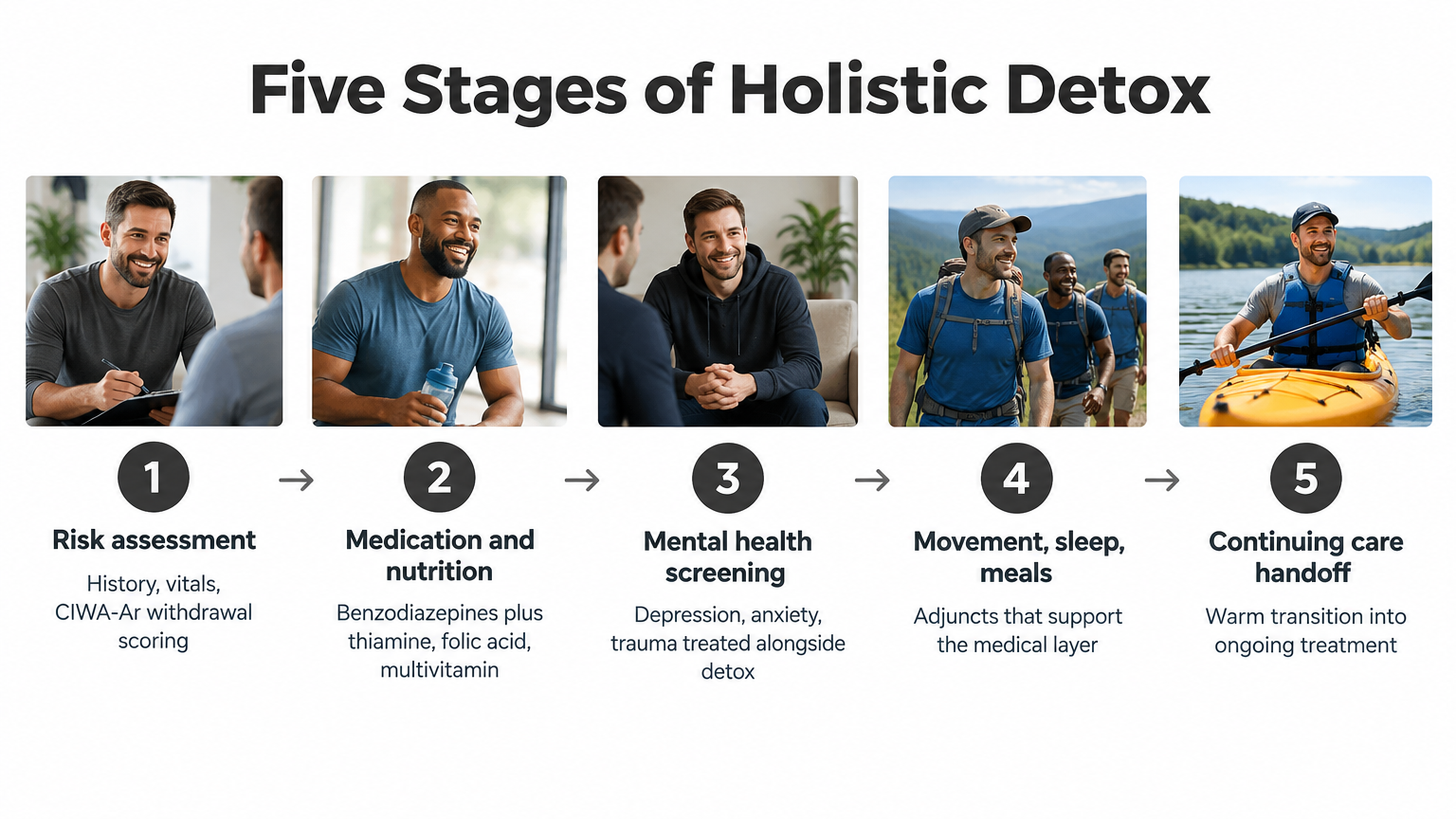
This is where "holistic" earns its keep — or quietly overpromises. The honest version is that nutrition, sleep, and movement do real work during and after detox, but they do not replace the clinical protocol that keeps withdrawal from becoming an emergency.
Nutrition starts with thiamine and the broader vitamin repletion already covered, then widens into regular meals, hydration, and electrolyte stability. Heavy drinking commonly disrupts magnesium, potassium, and sodium, and severe withdrawal can require urgent correction of these — not a smoothie6. Think of food during detox as helping a depleted body rebuild, not as a cure for the physiology of withdrawal.
Sleep is often the first thing to collapse when drinking stops. Programs that build in dark, quiet nights, consistent wake times, and a plan for insomnia without routine benzodiazepine use for ongoing sleep are following the evidence9.
Movement has the clearest data of the three. A systematic review and meta-analysis of seven randomized trials with 492 adults found that exercise added to usual care significantly improved cardiovascular fitness and reduced weekly drinking volume, though it did not reduce binge-drinking episodes10. A 2025 meta-analysis reported significant improvements in anxiety, depression, and stress with exercise, while reductions in daily or weekly alcohol consumption were not statistically significant; the review also noted substantial heterogeneity across included studies, so results varied11. Translation: structured movement helps mood, fitness, and overall drinking volume for many people, and it is not a stand-alone treatment for alcohol use disorder. That is a strong adjunct — not a replacement.
For a lot of men, the drinking sits on top of something else — a depression that has been quiet for years, anxiety that spikes at work, grief that never got processed, or trauma from service, childhood, or a loss. A detox that only treats the alcohol misses the engine driving it.
NIAAA recommends screening for co-occurring mental health conditions during AUD care and coordinating treatment for both at the same time rather than in sequence9. In detox, that looks like a formal mental-health intake alongside the medical workup, with a plan for how depression, anxiety, PTSD, or other concerns will be addressed as symptoms stabilize.
One nuance matters here. Benzodiazepines are the standard for medically managed alcohol withdrawal, but they generally should not become ongoing treatment for anxiety, mood instability, or sleep after detox, because of misuse and overdose concerns9. A credible program is clear about where that line sits and what evidence-based therapies — CBT, DBT, EMDR, motivational interviewing — pick up on the other side. Co-occurring care is not an add-on package. It is how a man finishes detox with somewhere to put what surfaces.
A tour and a nice website do not tell a family what they need to know. A short list of direct questions does. The goal is to confirm that the medical layer is real before the wellness language gets a vote.
Ask these before admission:
Any program worth admitting a man to can answer all six in plain English, without pivoting to brochure language.
Some red flags are easy to spot once a family knows the language.
Licensure and accreditation are two different things, and both matter. In Tennessee, substance use treatment facilities are licensed by the Tennessee Department of Mental Health and Substance Abuse Services (TDMHSAS). Families can call TDMHSAS directly or search its online facility directory to confirm that a specific program holds an active license and to see which level of withdrawal management that license covers. If a program cannot provide a license number on request, the conversation is over.
Accreditation is a separate, voluntary review by an outside body such as The Joint Commission or CARF. Accreditation signals that a program has agreed to be measured against national standards for safety, documentation, staffing, and quality improvement. It is a useful signal — but it is not a substitute for state licensure, and it does not guarantee any particular clinical outcome.
Read both honestly. A licensed, accredited program with a clear withdrawal-management level, named medical staff, and a written continuing-care pathway is the floor, not the ceiling. Everything the word "holistic" promises should sit on top of that foundation1, 2.
Most men who need help for heavy drinking never ask for it. In 2024, only 7.6% of people aged 12 and older with past-year alcohol use disorder received alcohol use treatment — about 2.1 million people out of a much larger population with AUD, according to NIAAA's summary of the 2024 National Survey on Drug Use and Health12. Among adults specifically, the figure was 7.5%12. The gap is not small, and it is not accidental.
The reasons men give are familiar. Work will not pause. The family cannot afford a month away. He is not "that bad." Rehab sounds like losing control of his own life. The word "holistic" often enters the search here, because it hints at something more respectful than a hospital gown and a wristband — a program that treats him like a man rebuilding, not a patient being warehoused.
That instinct is reasonable. The hesitation is not. Heavy drinking does not stabilize on its own, and the longer the physiology compounds, the more dangerous a future unsupervised quit becomes1. The useful read of the 7.6% figure is not shame. It is that calling a program places a man alongside the minority who seek support — and that the right program is built around his life, not against it.
If you are the one reading this at 11 p.m. with a drink in reach, here is what the call actually looks like. It is a phone call, not a confession. The person on the other end is an intake clinician whose job is to listen, ask a few medical questions, and tell you what level of care fits — not to pressure you into a bed.
Expect to be asked how much you drink on a typical day, how long you have been drinking that way, when your last drink was, whether you have ever had a withdrawal seizure or delirium tremens, and what medical conditions or medications are in play. Those answers drive a withdrawal-risk assessment and point to either outpatient or inpatient detox1, 2.
You will also be asked about depression, anxiety, trauma, and sleep. That is not a trap. It is how a program plans co-occurring care alongside detox instead of after it9.
You do not have to be sober to call. You do not have to have a plan. You just have to pick up the phone — once.
When a wife, parent, or adult child is the one researching detox, the hardest part is not finding a program. It is holding the line between support and control. The useful posture is calm, informed, and specific: know what safe withdrawal management looks like, know what to ask, and let him make the call when possible.
A few practical moves help more than most families expect. Learn the difference between clinically managed and medically monitored withdrawal management before touring, so questions about staffing and medication authority land correctly. Ask any program how it screens for depression, anxiety, and trauma during detox, and how that care continues afterward9. Confirm there is a written continuing-care plan into a partial hospitalization or intensive outpatient program, because detox alone does not treat alcohol use disorder3, 4.
Geography matters more than it first seems. A detox that sits a short drive from home makes the handoff into a partial hospitalization or intensive outpatient program easier to actually complete — and completion is where recovery lives1, 3.
In East Tennessee, Knoxville rehab for men draws on the Smoky Mountains and the outdoor rhythm of the region. Trail time, structured movement, and a slower pace outside the city can support the mood and fitness benefits that exercise adds to usual care, without pretending movement does the work of medication during withdrawal10, 11. The question to ask any Knoxville program is the same one that applies anywhere: which withdrawal-management level is licensed on site, and who authorizes medication overnight.
In the Nashville area, the Trifecta Healthcare Institute facility is located in Columbia, TN — about an hour south of downtown Nashville along the I-65 corridor. That matters for families planning visits, intake logistics, and the step-down into PHP or IOP after detox stabilizes.
Confirm TDMHSAS licensure, named clinical staff, co-occurring screening, and a written continuing-care plan before admission. Then pick the location that lets him keep showing up after week one. [Verify your insurance] or [Call Trifecta] to walk through the fit.
Not if you have been drinking heavily or daily. Abrupt cessation after chronic heavy drinking can cause seizures and delirium tremens, which is why NIAAA urges planning cessation with medical help rather than at home1, 2. A whole-person program can still feel humane — nutrition, movement, therapy — but the withdrawal piece needs clinical monitoring and medication when indicated.
It means medical withdrawal management plus whole-person support around it: thiamine and nutritional repletion, co-occurring mental health screening, structured sleep, guided movement, and a continuing-care plan5, 9. Holistic does not mean medication-free or supplement-only. Done well, the wellness layer sits on top of CIWA-Ar monitoring and benzodiazepines when clinically significant withdrawal is present6.
Acute withdrawal typically runs several days, though timelines vary with drinking history, medical status, and severity. Detox itself is a starting point — NIAAA is explicit that it is not, by itself, alcohol treatment1. Afterward, most men step into a partial hospitalization or intensive outpatient program, often with an FDA-approved AUD medication such as naltrexone, acamprosate, or disulfiram3, 4.
A credible one does not. Benzodiazepines are first-line for clinically significant alcohol withdrawal and have the strongest evidence base for preventing seizures and delirium tremens6, 7. They treat acute withdrawal, not ongoing anxiety or sleep9. Separately, naltrexone, acamprosate, and disulfiram are FDA-approved for continuing AUD care and belong in the after-detox plan when appropriate3, 4.
Contact the Tennessee Department of Mental Health and Substance Abuse Services (TDMHSAS) directly or check its facility directory to confirm the program holds an active license and to see whether it is approved for clinically managed or medically monitored withdrawal management. Accreditation from The Joint Commission or CARF is a useful added signal, but it does not replace state licensure or guarantee outcomes1, 2.
Learn the difference between clinically managed and medically monitored withdrawal management before touring, and ask who authorizes medication overnight. Confirm the program screens for depression, anxiety, and trauma during detox and coordinates care afterward9. Make sure there is a written step-down into PHP or IOP, because detox alone does not treat alcohol use disorder3, 4. Then let him make the call.
Between facility size limits, waivers, and state-by-state rules, figuring out your Medicaid or private insurance benefits can feel like its own full-time job. Our admissions team will verify your coverage in minutes and walk you through exactly what's available — no guesswork required.
Verify Insurance Benefits →No commitment required. Confidential & HIPAA-protected.
Whether it's you or someone you love, our team can help you figure out the next step — what treatment looks like, what's covered, or just someone to talk to.
Talk to Our TeamConfidential. No commitment required.


