


How to Choose a Dual Diagnosis Partial Hospitalization Program
Use this checklist to assess a dual diagnosis partial hospitalization program, including integrated care, medication support, Tennessee licensure, PHP fit, a...
Read More
Learn how how long is intensive outpatient treatment typically lasts, what weekly schedules involve, and how clinical progress and continued support shape yo...
Start Your Journey NowWritten and reviewed by the clinical team at Trifecta Healthcare Institute, a men’s-only treatment center in Tennessee specializing in substance use, mental health, and dual diagnosis care.
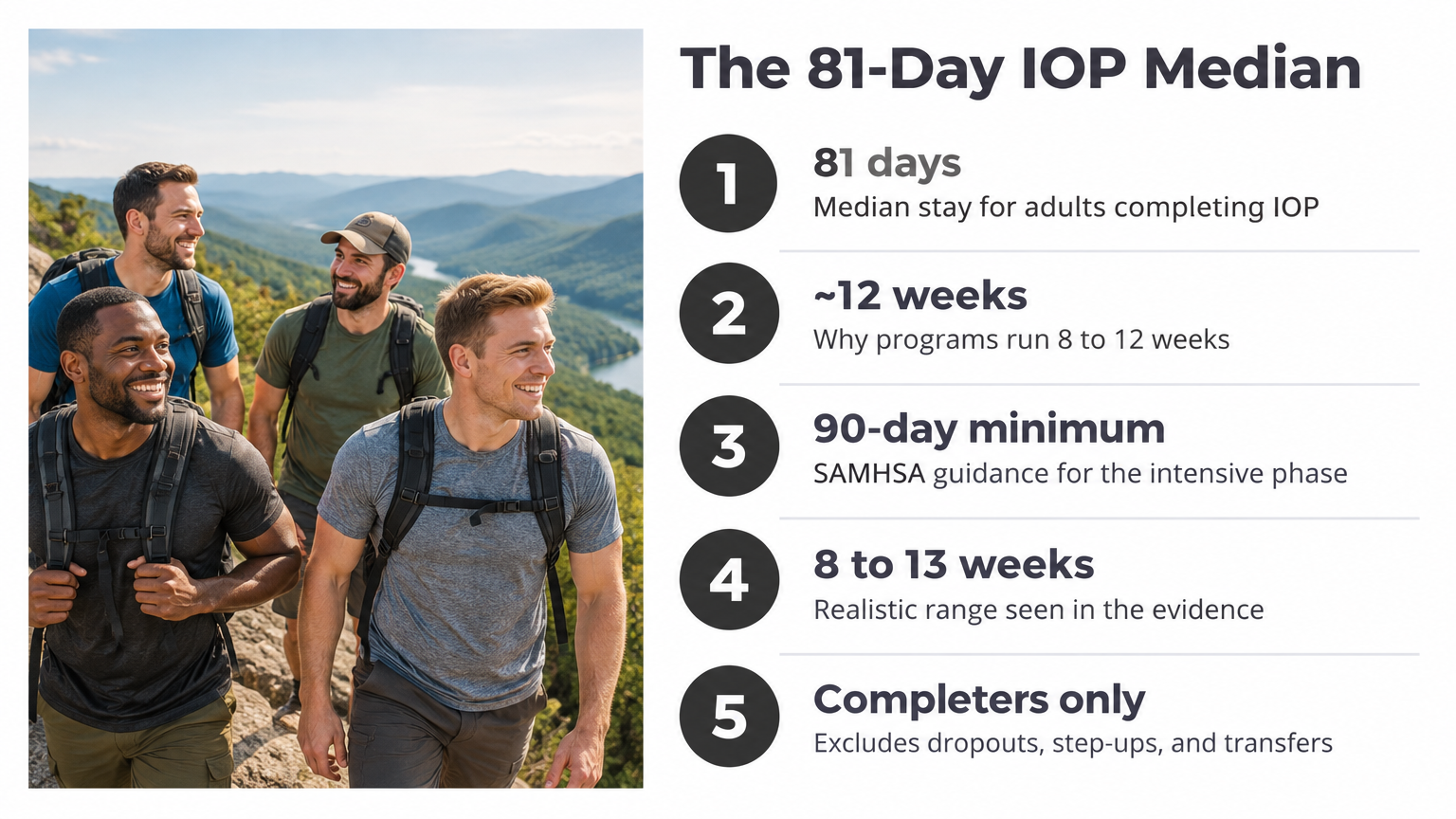
Intensive outpatient treatment for adults generally runs at least 9 hours a week, spread across 3 to 5 days, and most men complete the core phase in roughly 8 to 12 weeks. SAMHSA guidance points to a median stay of 81 days for adults who finished IOP in the 2017 Treatment Episode Data Set, which lines up closely with the 90-day benchmark many clinicians use when they plan the intensive phase.1, 3
That is the quotable answer. The honest one has more texture.
IOP is not a fixed program with a graduation date set on day one. The weekly hour count is a floor, not a ceiling, and ASAM's Level 2.1 definition stretches adult IOP to as many as 19 structured hours per week when clinical needs justify it.6 How long you actually stay depends on how your early weeks go: whether cravings settle, whether sleep and mood steady out, whether home life supports the work, and whether a co-occurring condition like anxiety, depression, or PTSD needs its own runway.
Think of IOP as a phase inside a longer arc. The intensive weeks do the heavy lifting, then care tapers into standard outpatient and alumni support rather than stopping cold. Trifecta Healthcare Institute builds schedules around that reality for men in Knoxville and the Nashville area, so the time commitment can fit a job, custody, or school without shortchanging the clinical work.
Intensive outpatient treatment is a defined clinical level of care, not a vague label. SAMHSA guidance sets the floor at a minimum of 9 hours per week of structured services for adults, usually delivered across 3 to 5 days.1 The ASAM-aligned federal Medicaid resource puts the full adult range at 9 to 19 structured hours per week under Level 2.1, which is where IOP officially lives in the continuum of care.6
Those hours are not just group therapy. SAMHSA's clinical manual describes a broader working range of 6 to 30 contact hours per week across IOP programs nationally, with time split among group work, individual therapy, psychoeducation, family sessions, and clinical check-ins.3 At Trifecta Healthcare Institute, that structure also includes movement programming like boxing, jiu-jitsu, and hiking as part of the clinical day, used to support focus, sleep, and the behavioral work happening in group and individual sessions.
Where does IOP sit relative to everything else? Picture a ladder:
Tennessee's own definition fits this pattern. The state's Department of Mental Health and Substance Abuse Services describes IOP as structured, nonresidential treatment with multiple face-to-face therapeutic contacts each week, including individual, group, and family counseling.5 For a man in Knoxville or the Nashville area, that means your evenings or mornings fill up with clinical work, but your nights are your own and your life stays rooted at home.
The point of the hour count is to be high enough to drive real change and low enough to keep you in your actual life, which is where recovery eventually has to hold.
IOP is not only an aftercare phase. SAMHSA's TIP 47 treats it as a flexible level of care that can play three different roles depending on where you start.2
As primary treatment, IOP is where some men begin. If withdrawal risks are manageable without 24-hour medical supervision, home life is stable enough to sleep safely, and there is no active psychiatric crisis, IOP can be the entry point. The intensive weeks do the frontline clinical work that would otherwise happen in residential care.
As step-down care, IOP picks up after a higher level finishes. A man who completes medical detox or a PHP stint usually transitions into IOP so the gains from those weeks do not evaporate. The hour count drops, but the structure stays close enough to catch early warning signs.
As step-up care, IOP is where you land when standard outpatient is not holding. Maybe sessions moved to once a week too quickly, cravings came back hard, or a slip happened. Returning to IOP for a stretch is not a failure. It is the system working the way it was designed to work.
Trifecta Healthcare Institute builds its programs around all three roles so men in Knoxville and Columbia can enter at the level that actually fits, not the level the brochure describes. That flexibility is also why no two IOP timelines look exactly alike.
When SAMHSA pulled national data on adults who finished intensive outpatient treatment in the 2017 Treatment Episode Data Set, the median length of stay came out to 81 days.1 That number gets quoted a lot, so it is worth saying plainly what it does and does not mean.
It describes adults who completed IOP. People who dropped out early, transferred to a higher level of care, or moved into standard outpatient before finishing the intensive phase are not in that median. The figure is a reasonable planning anchor, not a prediction of your personal timeline.
Eighty-one days works out to just under 12 weeks, which is why many programs talk about IOP in roughly 8-to-12-week terms. SAMHSA's clinical manual separately points to 90 days as a commonly cited minimum for the intensive phase, and the two numbers reinforce each other without being identical.3 A review of historical IOP studies found programs ranging from 30 to 90 days, with 3 to 5 sessions per week as the typical rhythm.4
So the realistic range for the intensive phase is somewhere between about 8 and 13 weeks for most men, with shorter and longer stays both appearing in the evidence. Your actual length depends on how the clinical work moves, not on hitting a specific date on the calendar.
The National Institute on Drug Abuse puts it bluntly: most people need at least 3 months in treatment to meaningfully reduce or stop substance use, and longer durations tend to produce better results. NIDA also says there is no predetermined length that fits every person.7
Read those two sentences together. Three months is a floor supported by research across many studies and populations, not a ceiling you graduate past. NIDA's patient-facing guide reinforces the same point for families trying to plan: appropriate treatment time depends on the type and degree of a person's needs, and shorter stretches often leave the underlying work unfinished.8
At Trifecta Healthcare Institute, the clinical team uses the 3-month minimum as a planning anchor, then adjusts based on how your weeks actually go.
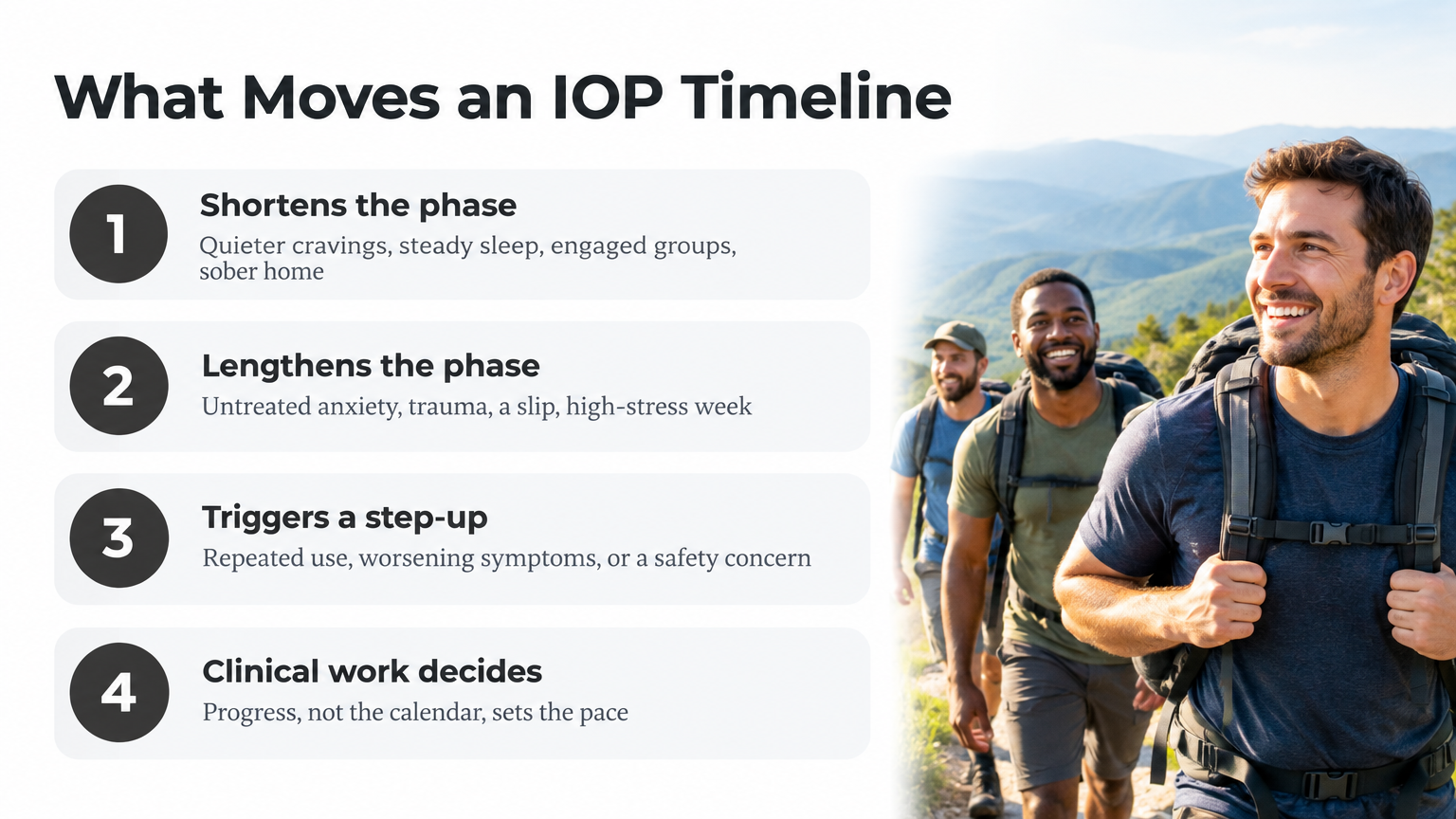
Three forces push an IOP timeline in one direction or the other: how your clinical work moves, what co-occurring symptoms are doing, and whether home gives you a surface to stand on. SAMHSA's TIP 47 frames IOP as a flexible level of care precisely because these variables shift week to week.2
What tends to shorten the intensive phase:
When those pieces line up, the clinical team can start loosening the week sooner.
What tends to lengthen it:
NIDA is direct about this: appropriate treatment time depends on the type and degree of your needs, and shorter stretches often leave the underlying work unfinished.7
What triggers a step-up back to PHP: repeated use during treatment, worsening psychiatric symptoms, or a safety concern that IOP's hour count cannot hold. That is not failure. It is the clinical team using the continuum the way it was built, matching the structure to the week you are actually living.
If anxiety, depression, PTSD, or another mental health condition is riding alongside the substance use, expect the intensive phase to run longer. SAMHSA's practice guidance for co-occurring disorders is clear that the two conditions should be treated at the same time rather than in sequence, because symptoms feed each other and progress on one usually depends on progress on the other.15
In practical terms, that means more clinical ground to cover in the same weekly hours. A man working on alcohol use alongside PTSD may need extra individual sessions for trauma-focused work, slower exposure to high-risk situations, and more careful attention to sleep and mood before step-down makes sense. SAMHSA's broader co-occurring guidance describes a "no wrong door" approach where screening for both conditions happens up front so the plan reflects the full picture from week one.14
At Trifecta Healthcare Institute, that integrated approach pairs evidence-based therapy with movement programming such as boxing, jiu-jitsu, and hiking. Research supports the role of physical activity in supporting mood, sleep, and the behavioral work in therapy, which can help men with co-occurring symptoms engage more fully in group and individual sessions.
Trifecta treats co-occurring mental health conditions alongside substance use disorder care rather than offering primary mental healthcare, so the timeline reflects both tracks moving in parallel.
Most men looking at IOP are not quitting their jobs to attend. They are trying to figure out whether a 9-hour-a-week clinical schedule can slot into a life that already has a boss, a mortgage, and sometimes a 7 a.m. drop-off at school. The answer is usually yes, which is why Tennessee's own continuum definition treats IOP as structured, nonresidential care with multiple weekly contacts rather than an all-day commitment.5
A morning track commonly meets several mornings a week. That shape fits men on second shift, tradesmen whose crews start late, or guys using FMLA for the first few weeks before transitioning back to work. The afternoon is open for shifts, custody pickups, or follow-up appointments with a psychiatrist or primary care doctor.
An evening track usually meets in the evenings, which keeps a traditional 8-to-5 job intact. Dinner at home gets rearranged, not canceled.
Inside those blocks, time splits across group therapy, individual sessions on a weekly rotation, psychoeducation on topics like relapse prevention and emotion regulation, and a movement component. Trifecta Healthcare Institute uses boxing, jiu-jitsu, and hiking as part of the clinical day rather than as weekend extras, so the hours a man spends in programming do double duty for the behavioral work and the physical reset that supports sleep and focus. SAMHSA's clinical manual describes this kind of mixed-contact structure across the 6-to-30-hour weekly range nationally.3
Trifecta runs men's programs in two different parts of Tennessee, and the week looks different in each one because the surrounding geography and work culture are different.
In Knoxville, the program sits in East Tennessee, within reach of the Smoky Mountains foothills. That matters for how movement programming shows up in an IOP week. Hiking is part of the broader movement-based approach, giving the behavioral work in group a physical counterpart when weather and schedule allow. Men in the Knoxville area often come from construction, logistics, and manufacturing roles, which tends to favor morning tracks that leave afternoons open for shifts.
The Nashville-area facility is in Columbia, TN, south of Nashville. Middle Tennessee's job mix leans more toward healthcare, music industry support roles, auto manufacturing, and corporate offices, so evening tracks tend to carry more enrollment. Commute planning matters: a man driving in from Franklin, Spring Hill, or south Nashville needs a schedule that does not collide with I-65 at 5 p.m.
The clinical structure, the 9-hour minimum, and the integrated co-occurring care are the same in both places.1 What changes is the texture of the week, the drive, and the way movement programming uses the ground outside the door. If you are weighing Knoxville rehab for men against a Nashville-area option, the choice usually comes down to commute, work schedule, and which setting makes it realistic to show up three to five days a week for the next few months.
The end of the intensive phase is not the end of risk. A 2024 meta-analysis found that the 90 days after substance use disorder treatment ends is a window of elevated overdose risk, with the sharpest spike in the first 14 days; the finding applies to SUD treatment termination broadly, which is why IOP tapers rather than hard-stops.12 That is not meant to scare you. It is meant to explain why clinicians taper IOP into something lighter rather than cutting the cord on a Friday afternoon.
Here is the physiology behind the clinical caution. Tolerance drops during weeks of reduced or no use, so the dose a body handled before treatment is no longer the dose it can handle after. Add the stress of returning to full work hours, old environments, and the loss of three structured contacts a week, and the first two weeks after a hard stop are the exact weeks where a slip can turn into something worse.
A taper changes the shape of that risk. SAMHSA's clinical manual describes IOP as a phase that can scale down gradually based on clinical need rather than a program with a fixed discharge date.3 In practice at Trifecta Healthcare Institute, that often looks like dropping from three nights a week to two, then to one, then to standard outpatient every other week, with the clinical team watching sleep, mood, cravings, and participation at each step. The hours decrease; the connection does not.
Think of the full arc of recovery in two parts. The intensive phase of IOP is roughly 8 to 13 weeks. Continuing care, which includes standard outpatient sessions, peer support, medications when indicated, and alumni programming, often runs for many months after that. NIDA's research-based guidance treats sustained involvement in care as part of what produces durable change, not an optional add-on.7
The evidence for continuing care is real but modest. A meta-analysis of continuing-care interventions after initial SUD treatment found a small but statistically significant benefit both during the intervention and at follow-up.13 Translation: step-down support does not guarantee a specific outcome, but it meaningfully stacks the odds in your favor compared with treating discharge as the finish line.
What that looks like at Trifecta is standard outpatient check-ins after the intensive phase ends, continued access to the men's peer community, and alumni programming that keeps the brotherhood intact beyond the clinical schedule. Movement stays part of the picture. A hiking group, a jiu-jitsu session, a basketball run with men you went through IOP with is clinical infrastructure in a different form.
So when a man asks how long IOP lasts, the fuller answer is: the intensive phase is the first chapter. The months that follow are where the work holds.
If you are the one doing the research, here is the practical math a family usually needs. The man in your life will likely be in programming three to five days a week, roughly 9 to 19 structured hours total, for about 8 to 13 weeks in the intensive phase, with lighter contact continuing for months after that.6, 1
A few questions tend to come up at the kitchen table.
How long will he be gone each week? An evening track usually pulls him out of the house in the evenings. A morning track pulls him out in the mornings. He sleeps at home either way.
When can he go back to work? Many men stay employed throughout IOP by picking the track that fits their shift. If he took FMLA for detox or PHP, the transition into IOP is often when a phased return to work begins.
When should you expect to see change? Early weeks are uneven. Sleep and mood usually steady first, then cravings, then the harder emotional work. If a co-occurring condition like depression, anxiety, or PTSD is part of the picture, SAMHSA recommends treating both at the same time, which can mean a longer intensive phase but more durable progress.15 Ask the clinical team what milestones they are watching, and give the first month before judging the arc.
Adult IOP generally provides at least 9 hours of structured services per week, usually spread across 3 to 5 days.1 Under ASAM Level 2.1, the full adult range runs from 9 to 19 hours per week depending on clinical need.6 Programs mix group therapy, individual sessions, psychoeducation, and family or movement components inside those hours.
Yes, most men do. Evening tracks commonly meet in the evenings, which keeps a standard 8-to-5 job intact. Morning tracks fit second-shift workers or trades crews that start later in the day. Tennessee defines IOP as structured, nonresidential care with multiple weekly contacts, not an all-day commitment.5
Expect the intensive phase to run longer when anxiety, depression, PTSD, or another condition is part of the picture. SAMHSA recommends treating both conditions at the same time rather than in sequence, which means more clinical ground to cover inside the weekly hours.15 A man working on alcohol use alongside trauma symptoms may need additional individual sessions and a slower step-down. The timeline reflects both tracks moving in parallel.
Care tapers rather than stops. Most men step down from three sessions a week to two, then to one, then into standard outpatient and alumni support. The 90 days after SUD treatment ends is a period of elevated overdose risk, which is why clinicians avoid hard stops.12 Continuing care produces a small but statistically significant benefit on top of the intensive phase, so the months after discharge matter.13
For appropriately selected adults, yes. A peer-reviewed review of randomized and quasi-experimental studies found that IOP or day treatment generally produced reductions in problem severity and increases in abstinent days comparable to inpatient or residential care.9 The caveat matters: men with greater alcohol involvement, more severe clinical instability, or unsafe home environments often benefit more from residential care first, then step down to IOP for the ongoing work.
Insurance influences authorization windows, but clinical need drives the actual length. Payers typically review progress every few weeks and authorize additional time when the record supports continued medical necessity. The clinical team documents what is working, what is not, and what needs to happen before step-down.
Between facility size limits, waivers, and state-by-state rules, figuring out your Medicaid or private insurance benefits can feel like its own full-time job. Our admissions team will verify your coverage in minutes and walk you through exactly what's available — no guesswork required.
Verify Insurance Benefits →No commitment required. Confidential & HIPAA-protected.
Whether it's you or someone you love, our team can help you figure out the next step — what treatment looks like, what's covered, or just someone to talk to.
Talk to Our TeamConfidential. No commitment required.


