



How to Choose a Dual Diagnosis Partial Hospitalization Program
Use this checklist to assess a dual diagnosis partial hospitalization program, including integrated care, medication support, Tennessee licensure, PHP fit, a...
Read More
Understand what an intensive outpatient program curriculum includes, how weekly schedules and therapies work, and how IOP supports different stages of recovery.
Start Your Journey NowWritten and reviewed by the clinical team at Trifecta Healthcare Institute, a men’s-only treatment center in Tennessee specializing in substance use, mental health, and dual diagnosis care.
An intensive outpatient program curriculum is a structured, nonresidential schedule of substance use treatment that combines group therapy, individual counseling, psychoeducation, family involvement, case management, and planned transitions to less intensive care 1. For most adults, that works out to several weekday or evening sessions, usually three to five days a week, each lasting a few hours 2.
Picture a typical week this way. On Monday and Wednesday evenings, you sit in a small clinician-led group of men working through relapse prevention and coping skills. Tuesday afternoon is a one-on-one session with your primary therapist. Thursday brings psychoeducation on topics like stress, sleep, and co-occurring anxiety or depression. Friday or Saturday may hold a family session, a skills group, or movement-based programming built into the clinical day.
Nothing about this is casual. The schedule is written, attendance is tracked, and the content follows a treatment plan built around your assessment 1. The sections below walk through each piece of that plan so you know exactly what to expect before you walk in.
For adults, the clinical standard most programs follow is 9 to 19 hours of structured programming per week 2. That range comes from the ASAM Level 2.1 definition used by Medicaid and most commercial insurers, and SAMHSA's advisory confirms IOP generally requires at least nine hours a week for adults 1. Anything less tends to fall under standard outpatient care; anything more usually points toward a partial hospitalization program.
What fills those hours is specific. Group therapy typically takes the largest share of weekly hours across several sessions, with individual therapy, psychoeducation, family work, case management check-ins, and, in some programs, movement-based or wellness sessions built into the clinical day 1.
Length of stay varies by individual, often spanning several weeks to a few months, because the actual length depends on your assessment and progress. Programs are not supposed to graduate you by the calendar; they are supposed to graduate you when you meet the goals written into your treatment plan 5. If you need more time, you get more time. If you are stable sooner and have a strong support plan in place, you can step down to standard outpatient care while keeping your therapist and recovery community.
One of the reasons IOP exists is that most men cannot pause their lives for 30 days of residential care. You have a mortgage, a job, kids in school, people depending on your paycheck. The federal clinical guidance explicitly notes that IOP services may run during daytime, evening, or weekend hours depending on patient needs 2.
In practice, that usually means three track options:
In Knoxville and in the Nashville area, where facilities serve Columbia, TN and the surrounding counties, evening tracks are the most common choice for working men. If you are considering IOP, ask directly: What time does group start? How many evenings a week? Can my schedule shift if my shift changes? A program that cannot answer those questions clearly is not built for a man who is still working.
Everything in a credible IOP starts with assessment. Before you ever sit in a group, a clinician works through your substance use history, mental health symptoms, medical status, family and social situation, legal pressures, work schedule, and prior treatment 1. The point is not to label you. The point is to figure out what has actually been driving the drinking or using, and what has to change for the plan to hold.
From that assessment comes an individualized treatment plan: written goals, the therapies you will participate in, how often, who is responsible for what, and how progress will be measured. NIDA is direct that treatment has to be matched to the person, address medical, mental, and social needs, and be reviewed as those needs shift 5. A good clinician revisits the plan every few weeks with you, not around you.
Ask to see your plan. If a program cannot show you a written document with your name on it and specific goals you helped shape, that is a signal about how the rest of the curriculum will be run.
Individual therapy is where the private work happens. In most IOPs you meet one-on-one with a primary therapist at least weekly, sometimes more, depending on your plan 1. The modality your therapist leans on usually depends on what you walked in with.
Cognitive behavioral therapy (CBT) is the most common. CBT breaks down the chain between a trigger, a thought, a feeling, and the drink or the pill. A peer-reviewed review of behavioral therapies describes CBT and relapse prevention as centered on functional analysis of substance use and skills training for recognizing and coping with high-risk situations 7. In plain terms: you map out what sets you off, then build specific skills to handle those moments differently.
Trifecta also offers dialectical behavior therapy (DBT), which adds tools for emotion regulation, distress tolerance, and interpersonal effectiveness, and EMDR, a trauma-focused therapy used when combat, childhood trauma, or a specific event is driving the pattern. EMDR is delivered by trained clinicians under a protocol, not casually.
Motivational interviewing (MI) runs underneath most of this work. SAMHSA describes MI as an evidence-based approach for helping people resolve ambivalence and voice their own reasons for change 6. A good therapist does not argue you into sobriety. They ask the questions that let you argue yourself into it.
Group is the backbone of IOP hours. Most programs run small clinician-led groups, and SAMHSA identifies group counseling as a core element of the curriculum alongside individual therapy, family work, and case management 1. Over a typical week, you spend more time in group than in any other setting.
Groups come in two broad flavors:
For a lot of men, group is the part they dread walking in and the part they end up protecting walking out. You are not required to deliver a monologue on day one. You listen. You answer when the clinician checks in. Over a few weeks, you start to recognize your own story in another man's and say so. That is the mechanism — hearing yourself in another man's words and realizing you are not the only one carrying it.
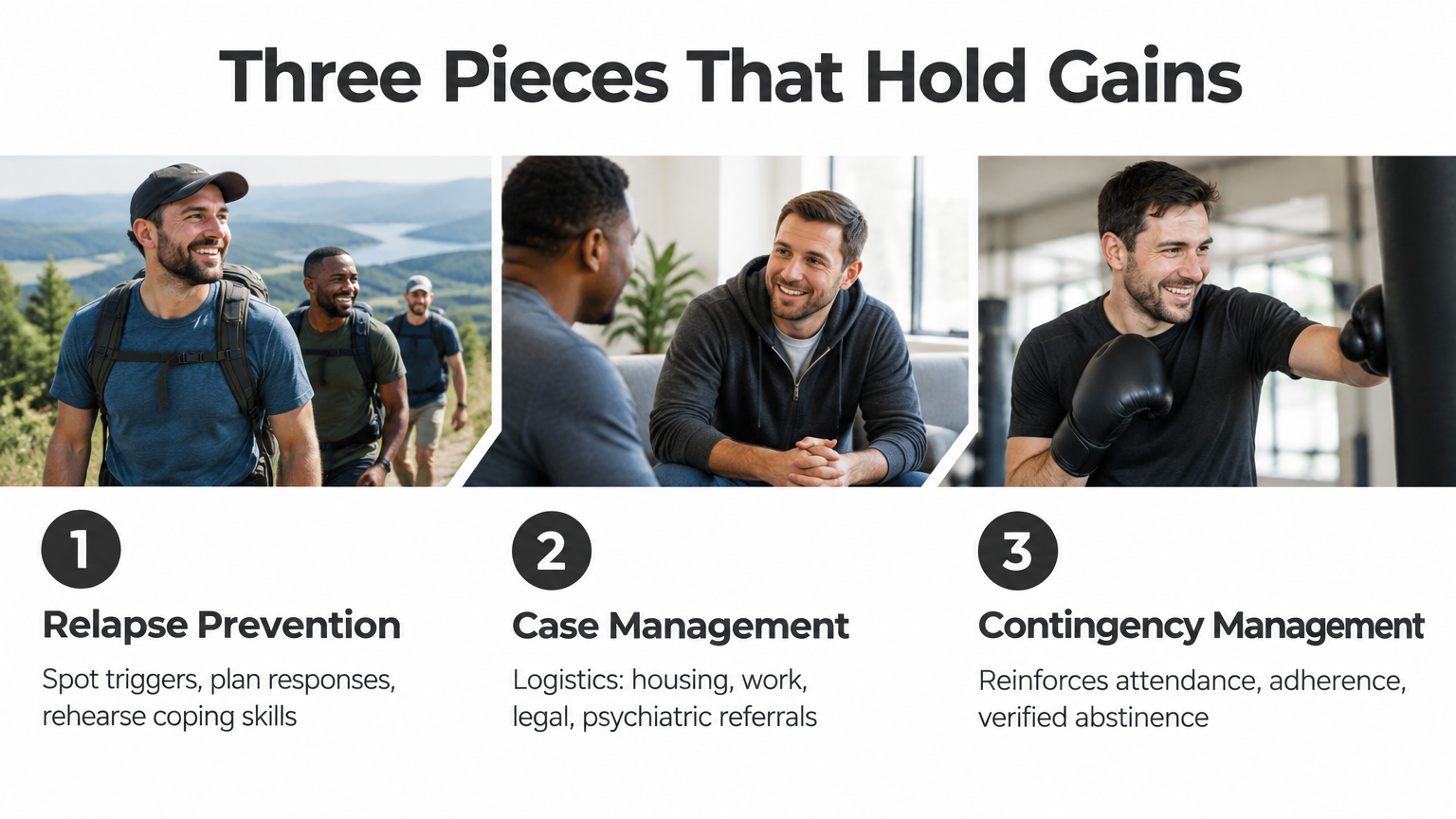
The last structural pieces of an IOP curriculum are the ones that keep gains in place after the session ends. Relapse prevention is a dedicated track built into group and individual work: identifying personal high-risk situations, writing a specific plan for each one, rehearsing refusal and coping skills, and building a sober support network. The behavioral therapies literature treats this skills-training approach as a core component of effective treatment 7.
Case management handles the real-world logistics that can quietly undo a treatment plan. SAMHSA lists case management, vocational support, mutual-support activities, and coordination with community providers among the standard IOP service components 1. Practically, that looks like help scheduling a psychiatric evaluation, coordinating with a probation officer, sorting out insurance, connecting to a sober living bed if home is not safe, or writing a letter to an employer.
Contingency management (CM) is the newest formal addition to many curricula. SAMHSA's January 2025 advisory describes CM as an evidence-based intervention that reinforces specific treatment behaviors — attendance, medication adherence, or verified abstinence — and permits eligible federally funded programs to provide incentives of up to $750 per patient per year, subject to program requirements 9. Not every program uses CM, and the rules are strict, but when it is offered it is a legitimate clinical tool, not a gimmick.
Most men who walk into IOP are not only dealing with alcohol or drug use. They are also carrying anxiety, depression, unprocessed trauma, grief, chronic anger, or the slow burnout that comes from years of holding everything together. The NCBI clinical reference is blunt about this: many clients entering substance use treatment have co-occurring mental disorders, and IOPs should be able to coordinate or collaborate with mental health services to address them 4.
The question is how a curriculum handles that overlap. A weak program treats the drinking in one room and tells you to see someone else for the anxiety. A strong program treats both at the same time, with the same team, inside the same treatment plan. A recent umbrella review of psychosocial interventions for adults with substance use disorders and co-occurring common mental health conditions found that integrated treatment was usually better than treating one condition alone, and sometimes better than parallel services that were not coordinated 10. A 2024 systematic review and meta-analysis on alcohol use disorder with co-occurring psychiatric conditions reached a similar conclusion, describing integrated treatment as a front-line evidence-based approach that combines individual or group therapy with medication when indicated 11.
In practice, integration looks like this. Your intake includes a mental health screen, not just a substance use history. Your individual therapist is trained to work with trauma, mood, and anxiety alongside use patterns. Group topics name the real drivers — panic that shows up as rage, depression that hides behind twelve-hour workdays, grief after a loss nobody let you talk about. Psychiatric support is available on-site or through a tight referral when medication might help 8. If PTSD is in the picture, EMDR or another trauma-focused modality is part of the plan, delivered by a clinician trained to run it safely.
At Trifecta, structured physical activity is built into the clinical day — boxing, jiu-jitsu, hiking, basketball, ropes courses, cold exposure, and work in a gym. Movement is scheduled, staffed, and tied to treatment goals, not offered as a break from the real work.
The clinical argument sits on a well-established point. NIDA notes that behavioral therapies help people manage stress and the triggers that pull them back toward substance use, and that treatment has to address medical, mental, and social needs as a whole person 5. Movement gives men a hands-on way to practice what gets talked about in group: tolerating discomfort without reaching for a drink, regulating a nervous system that has been running hot for years, sleeping through the night, and feeling something in the body besides numbness or rage. The research on exercise and cold exposure in recovery is still developing, so these activities are best described as research-supported supports for the clinical work, not guaranteed treatments on their own.
What this looks like in a Trifecta weekly schedule varies. A session might open with a boxing or jiu-jitsu class led by a coach, followed by a process group that debriefs what came up — the frustration that spiked, the breath that disappeared, the moment a man wanted to quit and did not. A hiking day in the Smoky Mountains outside Knoxville puts men in motion together for a few hours, which has a way of loosening conversations that stay stuck inside a therapy room. An ice bath is a short, controlled dose of stress a man chooses on purpose, with a clinician present, as practice for the uncontrolled stress that used to send him to the bottle.
The piece that makes movement clinical rather than recreational is the connection to therapy. Group topics name what the body just did. Individual sessions use what came up on the mat or the trail as material. Case management keeps the schedule realistic so a man coming off a double shift is not asked to spar on an empty tank. Done this way, movement reinforces the same CBT, DBT, and relapse-prevention skills covered in group — a second place to rehearse them, with other men in the room 7.
A real IOP has rules, and the rules exist because the clinical work depends on them. SAMHSA lists family psychoeducation among the core components of an IOP curriculum, not an optional add-on 1. That usually looks like a scheduled family night, a multi-family group, or a few joint sessions with your partner or parents, depending on what your plan calls for. Loved ones learn what substance use disorder actually is, how to stop patterns that reinforce it, and how to support recovery without taking it over. You get the chance to say hard things in a room where a clinician is present to keep the conversation safe.
Drug and alcohol testing is standard. SAMHSA identifies monitoring as a core IOP service, and most programs use scheduled or random urine screens, breathalyzers, or oral swabs throughout the week 1. The point is not to catch you. It is to give you and your therapist honest data to work with and to let contingency management, when offered, reinforce verified abstinence under SAMHSA's rules 9.
The rest of the rules are straightforward: show up on time, stay sober for session, no phones during group, confidentiality about what other men share, and a clear plan if you miss a day. Programs that enforce these consistently are the ones that work.
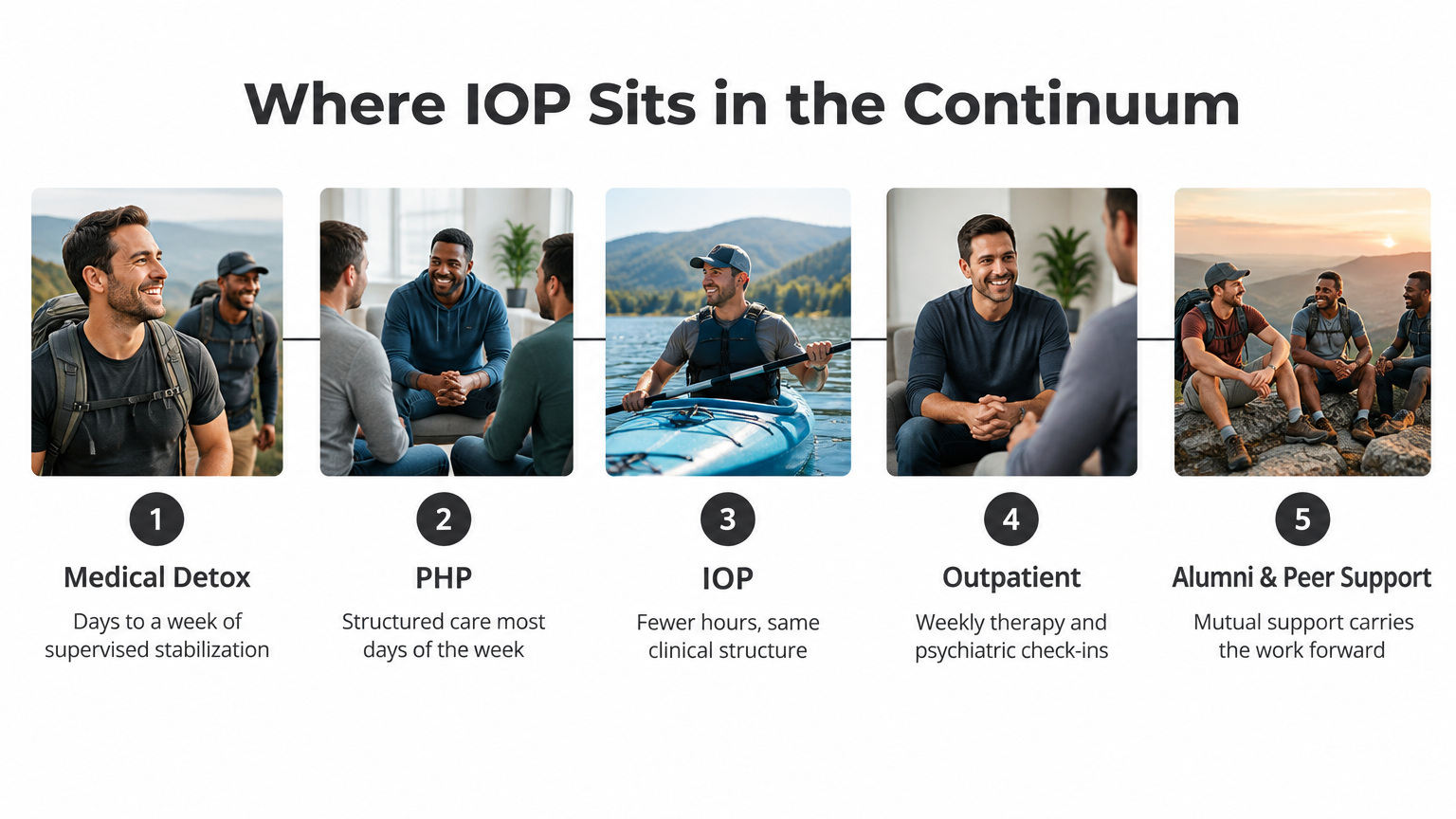
Intensive outpatient is not a standalone product. SAMHSA describes IOP as a level of care that can function in three different roles depending on where a man enters it:
Movement between those levels is normal and expected, not a sign of failure.
A common path looks like this. Medical detox stabilizes the body over a few days to about a week, under medical supervision. PHP picks up next for men who need a more intensive level of structured care most days of the week. IOP follows, cutting the weekly hours but keeping the clinical structure intact. Standard outpatient becomes the longer tail — a weekly therapy session, a psychiatric check-in, continued peer connection. Alumni and mutual-support activities carry the work forward past the end of formal treatment 1.
NIDA is clear that detoxification by itself is not treatment 5. The point of a continuum is to make sure the clinical work actually starts once the body is stable, and that it keeps going as the risk profile shifts.
Tennessee men looking at IOP generally have two regions to work with, and the two feel different on purpose. The Knoxville side sits in East Tennessee, with the Smoky Mountains close enough that outdoor sessions — hiking, ropes work, time in moving water — fit into the clinical week without a major drive. For a man who thinks better outside and who has spent years numbing out indoors, that geography matters.
The Nashville-area program operates out of Columbia, TN, about 45 minutes south of downtown Nashville. That location pulls men from Williamson, Maury, Davidson, and Rutherford counties who want serious treatment without being swallowed by city traffic every evening. Evening IOP tracks in both regions are built around a working man's week — session times that let you finish a shift, show up, do the work, and get home.
When you call to compare programs, ask specifically about the men's track, the staff-to-client ratio, the clinical modalities offered, how co-occurring mental health is handled inside the same plan, and how movement is scheduled around therapy. Trifecta Healthcare Institute runs men's IOP in both Knoxville and the Nashville area with that structure in mind. [Verify your insurance] or [Call Trifecta] to walk through which track fits your schedule.
Three questions come up on almost every first phone call, and they deserve straight answers.
"Will I keep my job?" For most men on an evening track, yes. The schedule is built around a working week, and case management can help you handle disclosure to HR if that becomes necessary 1. If your job itself is part of what is driving the drinking, that is worth working on in individual therapy, not a reason to avoid treatment.
"Do I have to talk in group?" Not on day one. You are expected to be present, listen, and answer when the clinician checks in. Most men find that by week two or three they are talking because they want to, not because they were pushed 3.
"What if I also have anxiety, trauma, or depression?" That is the norm, not the exception. Current research supports treating substance use and co-occurring mental health conditions together inside the same plan rather than passing you between unconnected providers 10. A real IOP curriculum is built to handle both.
If you have read this far, you already know more about what an IOP curriculum should contain than most men who walk through the door on day one. You know the hours, the therapies, the role of family work, and how co-occurring anxiety, depression, or trauma gets handled inside the same plan rather than farmed out somewhere else.
The next move is a phone call or a chat window — not a commitment to anything beyond a conversation about which track fits your week. [Verify your insurance] or [Start live chat] with Trifecta to talk through Knoxville and Columbia options.
Whatever shape the drinking or using has taken, there is a structured way out, and other men are already doing the work alongside you.
For most men on an evening or weekend track, yes. SAMHSA notes that IOP services can be scheduled during daytime, evening, or weekend hours depending on patient needs, so programs are built to accommodate work and family obligations 2. Case management inside the curriculum can also help you coordinate time off, scheduling, or disclosure if that becomes necessary 1.
IOP length varies by individual, often spanning several weeks to a few months, because the actual duration depends on your assessment and treatment plan rather than a set calendar. NIDA emphasizes that treatment should be individualized and reviewed as needs shift, which means you move forward when you meet the goals in your plan, not when a schedule runs out 5.
The main difference is intensity. Partial hospitalization is a more intensive level that typically meets most days of the week, while adult IOP is structured around a lighter weekly load that still delivers clinical care 2. SAMHSA frames IOP as a level of care that can serve as primary treatment, step-down from PHP or detox, or step-up from standard outpatient when more structure is needed 1.
Not on day one. You are expected to show up, listen, and respond when the clinician checks in with you. SAMHSA's clinical manual describes group work as a progressive process where participation deepens as trust builds 3. Most men find they start talking by week two or three because they want to, not because anyone pushed them.
Yes, when the program is set up for integrated care. A recent umbrella review found that treating substance use and co-occurring common mental health conditions together was usually better than treating one alone or running parallel, uncoordinated services 10. In practice, that means a shared treatment plan, a therapist trained in both areas, and psychiatric support available when medication might help 8.
Yes. SAMHSA lists monitoring among the core services inside an IOP curriculum, and most programs use scheduled or random urine screens, breathalyzers, or oral swabs during the week 1. The purpose is honest clinical data for you and your therapist, not punishment, and it supports contingency management when that intervention is part of the plan 9.
Between facility size limits, waivers, and state-by-state rules, figuring out your Medicaid or private insurance benefits can feel like its own full-time job. Our admissions team will verify your coverage in minutes and walk you through exactly what's available — no guesswork required.
Verify Insurance Benefits →No commitment required. Confidential & HIPAA-protected.
Whether it's you or someone you love, our team can help you figure out the next step — what treatment looks like, what's covered, or just someone to talk to.
Talk to Our TeamConfidential. No commitment required.


