


How to Choose a Dual Diagnosis Partial Hospitalization Program
Use this checklist to assess a dual diagnosis partial hospitalization program, including integrated care, medication support, Tennessee licensure, PHP fit, a...
Read More
Understand iop group rules for confidentiality, attendance, respectful sharing, and safety so you know what to expect and how to help keep sessions supportive.
Start Your Journey NowWritten and reviewed by the clinical team at Trifecta Healthcare Institute, a men’s-only treatment center in Tennessee specializing in substance use, mental health, and dual diagnosis care.
IOP group rules are the written and spoken agreements every participant follows during an Intensive Outpatient Program group — covering confidentiality, attendance, respectful communication, voluntary sharing, conduct, facilitator direction, and safety reporting. They exist to make it possible for a group of participants — typically seven to ten in many treatment approaches, and in Trifecta's case all men — to talk honestly about hard things without the session falling apart.1
Think of the rules as the scaffolding around the work, not the work itself. Clinical guidance for IOP groups recommends clear, specific, concrete expectations because vague norms produce uneven participation, interruptions, and avoidable conflict.4 Most programs introduce the rules in a written orientation packet and walk through them out loud before the first full session begins.6
For a man weighing IOP for substance use — often alongside anxiety, depression, trauma, or anger — knowing the rules in advance removes a layer of guesswork. You walk in understanding what will be asked of you, what you can decline, and what the facilitator is responsible for. That changes the first session from an interrogation into a structured conversation.
The seven rules below are drawn from federal clinical guidance and peer-reviewed group-therapy literature. None of them are secret, and none should surprise you on day one. If a program can't explain its rules in plain language before you commit, that itself is useful information.
Every rule in an IOP group traces back to one practical question: what has to be true for a man to say something honest in a room with nine strangers? Federal clinical guidance frames the answer in six trauma-informed principles — safety, trustworthiness, peer support, collaboration, empowerment, and attention to cultural context.7, 10 The rules are how those principles get operationalized at 6 p.m. on a Tuesday.
Safety comes first because people who feel threatened don't disclose, and people who don't disclose don't recover. SAMHSA's trauma-informed care manual tells providers to shape the environment around physical and emotional safety rather than defaulting to a provider-knows-best posture.8 Clear expectations also keep rules from drifting into stigma. Low-barrier care guidance makes the distinction plain: boundaries that protect the group are not the same as punitive policies that push men out of treatment.9
The first rule in almost every IOP group agreement is simple to state and easy to misunderstand: don't repeat what you hear in the room. The harder part is knowing where that promise actually comes from — and where it stops.
Two things protect your privacy at the program level. Under HIPAA, anything a clinician discusses in a group therapy session counts as a treatment disclosure, which means the facility handles that information under the same privacy rules it uses for individual sessions.13 On top of that, federal regulation 42 CFR Part 2 adds a separate layer of protection for records that identify someone as receiving substance use disorder care, and the program must tell you about those protections at admission.11, 12
Here's what those laws do not do. They bind the program and its staff. They cannot force the man sitting next to you to stay quiet after the session ends. State professional guidance puts it plainly: group confidentiality is structurally different from individual confidentiality because the information is already in the room with everyone present, and any participant can repeat it.14 That's why the group agreement asks every member to commit, in writing and out loud, not to share names, stories, or identifying details outside the room.
Staff can also be required to disclose limited information in narrow situations — when someone threatens imminent harm, when a medical emergency makes it necessary, or when a valid release or court order applies.5 Knowing those exceptions in advance beats being surprised by them later.

Attendance isn't a formality. SAMHSA's Matrix client handbook tells participants to attend every scheduled group, arrive on time or early, and give the program advance notice when something gets in the way.3 IOP clinical guidance backs that up by recommending programs actively monitor attendance and follow up when someone misses, because missed sessions are often the earliest warning sign that a man is losing traction in his recovery.4
The clinical reason sits underneath the policy. Punctual starts and consistent attendance give the group its shape — people trust the container, settle in faster, and go deeper because they know who is in the room and who will be back next time.19 When men drift in late or disappear without a word, the group has to spend energy re-stabilizing instead of doing the work.
Practically, this means a few things for you. Build the schedule into your week the same way you'd build in a shift at work. If you're sick, stuck in traffic, or hit a crisis, call the program before the session rather than ghosting. Most programs have a documented absence process; using it protects your spot and keeps staff informed about what's actually happening in your life.
Showing up is also how you stand with the other men. Half the value of group is being someone the room can count on — and letting the room be something you can count on back.
Respectful communication is where a lot of IOP groups either come together or fall apart. The Matrix handbook spells it out: listen when someone else is speaking, don't make personal attacks, support other participants, and keep disagreement focused on ideas rather than people.3
Language matters more than it sounds like it should. CDC guidance recommends person-first language — a man who has a substance use disorder, not a label slapped on his identity — because stigmatizing terms make people shut down and share less with the people trying to help them.22 The CDC's addiction medicine primer tells clinicians to listen actively, engage without judgment, and skip slang that reduces a person to a diagnosis.24 The same standard applies to peers in group.
There's also a clinical reason not to argue a peer out of what he said. Motivational interviewing, one of the evidence-based methods used across IOP, works because the participant drives his own reasons for change — a facilitator or peer who presses, debates, or lectures tends to produce resistance instead of movement.16 You don't have to agree with everything you hear. You do have to let the man finish, let the facilitator do the clinical work, and bring your reaction back as a question or your own experience rather than a verdict.
If a peer uses a slur or a label about himself or someone else, the facilitator will usually redirect. You can too, calmly. Groups that hold that line feel safer, and safer groups talk about harder things.
One of the most common fears men bring into IOP is that they'll be forced to open up about things they aren't ready to say out loud. The clinical literature is unusually direct on this: you aren't required to.
The NCBI chapter on group leadership instructs facilitators that when group pressure starts pushing someone to disclose, the leader should remind members they only need to share information at a level they're comfortable with — pressure should not obligate anyone to reveal intimate details before they're ready.18 Guidance on time-limited group therapy reaches the same conclusion: clear boundaries and voluntary self-disclosure are what make honest sharing possible in the first place, not demands for it.19
What this looks like in a session: you can pass. You can give a short answer. You can speak generally about a theme without naming specifics. You can say, "I'm not ready to talk about that yet," and the facilitator will move on. For virtual and hybrid groups, HHS teletherapy guidance explicitly recommends letting participants know they may pass if they don't want to talk.2
That said, pacing is not the same as checking out. The men who get the most from IOP generally share something, even if small, in most sessions. Start where you can. The group earns your trust by showing it can handle what you say, and you build on that over weeks.
Every IOP has a short list of conduct expectations the program will not bend on: no threats or intimidation, no physical aggression, no showing up intoxicated, no behavior that keeps the group from functioning. SAMHSA's IOP clinical guidance recommends programs set these rules clearly, specifically, and concretely, then intervene early to de-escalate situations before they turn into something worse.4
The NCBI IOP chapter adds the operational layer: give participants the rules in writing, explain the consequences for disruptive behavior up front, and apply those consequences consistently so no one is guessing where the line is.6 Consistency is what makes the rule feel like safety instead of favoritism.
Showing up under the influence lands in its own category. It's not a moral failure — relapse is part of what IOP exists to address — but you can't do the clinical work while impaired, and your presence in that state changes the room for everyone else. Programs typically ask you to leave the session, meet with a clinician, and come back with a revised plan rather than pushing through.
If you feel yourself escalating during a session — anger spiking, urge to walk out, something a peer said hit a nerve — tell the facilitator. That's not a rule violation. That's exactly what the facilitator is there for.
The facilitator runs the group for a reason. Clinical guidance identifies the leader as the person responsible for orienting members to the structure, keeping the group on its stated goals, enforcing norms, and protecting the time so everyone gets a turn.1 When the facilitator asks you to pause, shift topics, or wait on a response, follow it — even if you have more to say.
Staying "inside the group" also means something specific. TIP 41 and peer-reviewed process-group guidance both recommend that members keep heavy self-disclosure, cross-member confrontation, and sensitive personal exchanges within the structured session rather than carrying them into the parking lot or private texts.5, 17 Side relationships that process clinical material outside the room can quietly erode trust and change how people show up in group.
Facilitator trust isn't just etiquette. Research on outpatient substance use treatment has found that participant-rated therapeutic alliance early in care is associated with better retention — a finding from a multisite twelve-step facilitation trial, so scope is specific, but the direction is consistent across the field.25 Working with the facilitator rather than against them is one of the quieter ways men stay in treatment long enough for it to help.
If something the facilitator does doesn't sit right, raise it with staff after group. That's inside the system too.
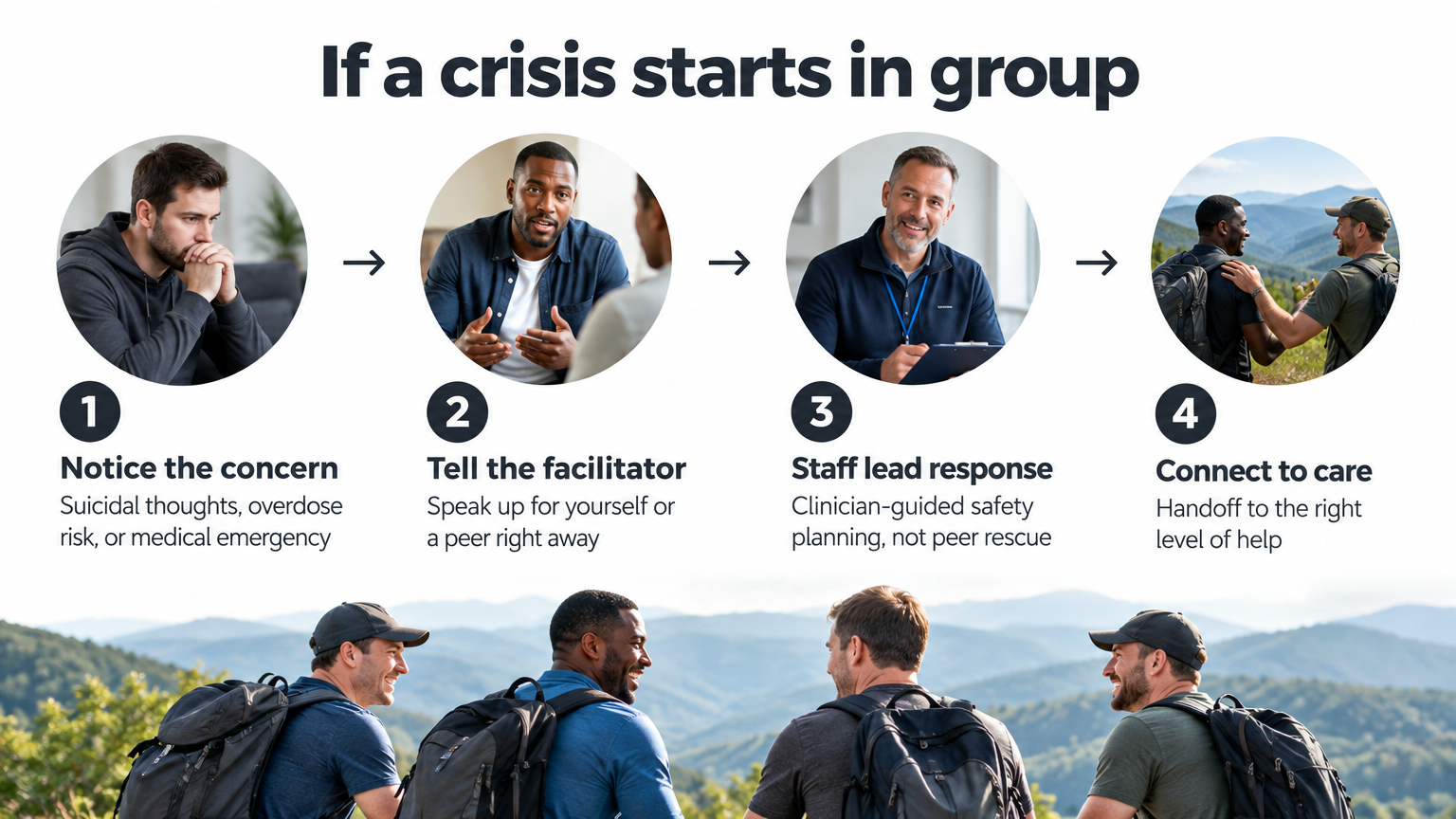
The last rule is the one that overrides everything else. If you're having thoughts of suicide, thinking about hurting yourself or someone else, at risk of overdose, or in a medical emergency — tell the facilitator or another staff member right away. Same thing if you believe a peer is in that kind of danger.
SAMHSA's safety planning resources are built for exactly this moment: clinicians and staff use structured tools to organize coping strategies, supports, and crisis responses with the person at risk, rather than leaving them to manage it alone.20 SAMHSA's national guidelines for behavioral-health crisis care describe collaborative, person-centered safety planning and timely pathways to care as the standard — meaning staff lead the response and connect you to the right level of help.21 This isn't peer work. A fellow participant trying to counsel you through an acute crisis can't substitute for a clinician.
TIP 41 is explicit that confidentiality has limits when someone threatens imminent harm or faces a medical emergency, and limited disclosure may be required so staff can act.5 That's not a loophole in your privacy — it's the piece that keeps the rules from costing someone their life.
The reporting path is almost always the same: notice the concern, tell the facilitator, let staff lead the next step.
Here are the seven rules in one place, each paired with the clinical reason it exists. Keep this near you before your first session.
If something on this list isn't covered in your orientation packet, ask about it before day one.
The first IOP session is usually part orientation, part introduction, and part logistics — not a deep dive into your history. Clinical guidance recommends programs orient every new member to the group's structure, function, goals, norms, and attendance expectations before clinical work begins.1 Expect the facilitator to walk through the written rules out loud and ask you to sign a group agreement.6
Most programs then move into brief introductions. You might share your first name, what brought you in, and one thing you want to work on — short answers are fine. The NCBI chapter on group leadership is clear that members should only share at a level they're comfortable with on day one, and facilitators are trained to prevent group pressure from pushing anyone further.18
You'll also hear the confidentiality limits said plainly: what the program protects, what peers are asked to protect, and the narrow situations where staff may need to disclose.5, 12 Bring questions. Asking them in session one is normal and makes everything after it easier.
If your IOP meets by video or runs a hybrid schedule, the same seven rules apply — the mechanics just change. HHS teletherapy guidance recommends joining from a private room where no one else can hear you, using a raise-hand feature so people don't talk over each other, and knowing you can pass if you don't want to speak on a given prompt.2 Programs typically ask you to keep your camera on, use headphones, and avoid driving or multitasking during the session.
Privacy takes a little more work on your end. The confidentiality rule covers what the program protects, but a roommate within earshot or a family member walking through the frame changes what the room actually knows. Pick a door that closes. If that's not possible every week, tell the facilitator so you can plan around it.
A 2025 scoping review of hybrid and virtual group models for substance use disorder therapy found that virtual-only formats can weaken therapeutic alliance and group cohesion, while hybrid models may perform closer to in-person groups — though the authors describe the evidence base as limited and still developing.26 Translation: show up fully on camera, follow the speaking procedures, and treat the virtual room the same way you'd treat a chair in a circle.
Programs rarely treat a broken rule as a reason to push a man out. The response is usually clinical first and administrative second — a brief pause, a private conversation, and a plan to come back ready to work. SAMHSA's IOP guidance recommends intervening early to de-escalate rather than waiting for a situation to grow.4
The steps tend to follow a predictable path. The facilitator names what happened in the moment, redirects the group, and may ask the member to step out for a short conversation with a clinician. Written orientation materials usually spell out consequences in advance, so no one is guessing — missed sessions trigger outreach, repeated disruption may trigger a treatment plan review, and a confidentiality breach is addressed directly with the person who committed it.6
Serious actions — threats of harm, intoxication, assault — move faster and may involve a same-day meeting with the clinical team. Low-barrier care guidance is clear that boundaries are not the same as punishment; the goal is keeping you in treatment, not ending it.9
A note for the spouses, partners, and parents reading this: if your loved one is in IOP, the program will not share what he says in group with you, and that is by design. Group disclosures count as treatment information, which the facility handles under HIPAA's privacy rules.13 Federal regulation 42 CFR Part 2 adds a second layer of protection specifically for substance use disorder records.11 Without a signed release from him, staff cannot confirm attendance, repeat what was said, or discuss his progress with you.
That silence isn't a brush-off. Honest work in group depends on him knowing the room won't leak back home. If you want to be involved, ask him to sign a limited release naming you and specifying what staff can share, or ask the program about family sessions, which run on separate consent. Support him by holding the schedule, protecting his drive time, and letting the clinical conversations happen in the clinical room.
Knowing the rules before day one changes what IOP feels like. You walk in understanding what the program protects, what you can decline, what the facilitator handles, and when staff need to step in — and that lets you spend your energy on the actual work instead of guessing at the room.
Trifecta Healthcare Institute serves men in Knoxville and in the Nashville-area program in Columbia, TN. If you want a straight answer about how a group runs before you commit, ask. [Call Trifecta] or [Verify your insurance] to start the conversation.
Showing up prepared is already part of the work.
Yes, with honest limits. Anything a clinician discusses in group counts as a treatment disclosure under HIPAA, and substance use disorder records get extra federal protection under 42 CFR Part 2.13, 11Peers sign a group agreement to not repeat what they hear, but that promise is behavioral, not legal — which is why programs explain confidentiality's limits up front.14
No. Clinical guidance for group leaders is explicit that members should only share at a level they're comfortable with, and facilitators are trained to stop pressure from pushing anyone further.18You can pass, give a short answer, or speak generally about a theme without naming specifics. Sharing deepens over weeks as trust builds.19
Programs expect you to attend every scheduled group and arrive on time or early, and to call ahead when something gets in the way.3Staff monitor attendance and will follow up when you miss, because gaps often signal early trouble.4One absence isn't a crisis — ghosting the program is. Use the absence process and keep your spot.
Tell the facilitator — in the moment if you can, or privately after. That's exactly what the facilitator is there for, and leaders are trained to redirect emotional contagion and protect the room.18You don't have to argue the peer out of what he said; motivational interviewing works because people drive their own reasons for change, not because peers debate them.16
Tell staff immediately. This is clinical work, not peer rescue. SAMHSA's safety planning tools and SAMHSA's national crisis-care guidelines both describe staff-led, collaborative responses as the standard pathway when someone is at risk.20, 21Confidentiality has clear exceptions for imminent harm and medical emergencies, so staff can act on what you report.5
Not without your written permission. Group disclosures are treatment information under HIPAA, and 42 CFR Part 2 adds another layer of protection specifically for substance use disorder records.13, 11If you want family involved, sign a limited release naming them and specifying what staff can share, or ask about family sessions, which run on separate consent.
Between facility size limits, waivers, and state-by-state rules, figuring out your Medicaid or private insurance benefits can feel like its own full-time job. Our admissions team will verify your coverage in minutes and walk you through exactly what's available — no guesswork required.
Verify Insurance Benefits →No commitment required. Confidential & HIPAA-protected.
Whether it's you or someone you love, our team can help you figure out the next step — what treatment looks like, what's covered, or just someone to talk to.
Talk to Our TeamConfidential. No commitment required.


