



How to Choose a Dual Diagnosis Partial Hospitalization Program
Use this checklist to assess a dual diagnosis partial hospitalization program, including integrated care, medication support, Tennessee licensure, PHP fit, a...
Read More
Learn how iop program requirements are assessed, which symptoms may call for a higher level of care, and what insurers typically require before treatment.
Start Your Journey NowWritten and reviewed by the clinical team at Trifecta Healthcare Institute, a men’s-only treatment center in Tennessee specializing in substance use, mental health, and dual diagnosis care.
You generally qualify for an Intensive Outpatient Program (IOP) when a clinician determines that you need structured substance use treatment several days a week, but you do not need round-the-clock supervision to stay safe. That decision follows a comprehensive, multidimensional assessment of your use, health, mental state, home environment, and readiness, rather than a self-scored checklist 1.
In practical terms, suitable IOP candidates share a few things: little or no risk of acute intoxication or withdrawal, physical health conditions that can be managed outside a hospital, emotional and cognitive stability sufficient to participate in group and individual therapy, and enough support outside program hours to stay safe between sessions 1, 4. Under adult ASAM Level 2.1, that typically means 9 to 19 hours of structured programming per week 5.
If acute withdrawal, medical instability, suicidality, or an unsafe home are in the picture, the right first step is usually medical detox or a Partial Hospitalization Program, then IOP. The rest of this guide walks through how clinicians actually make that call for men in Knoxville, Columbia (Nashville area), and across Tennessee.
If you have landed on a page promising a quiz that tells you whether you need IOP, close it. Level-of-care decisions follow a comprehensive, multidimensional assessment of the problems you present with, your goals, and what your recovery needs actually look like day to day 1. A diagnosis alone does not determine where you start. Two men with the same alcohol use disorder diagnosis can land in very different places based on their withdrawal history, physical health, home environment, and what they are willing to try.
That matters because the wrong starting point is not a neutral mistake. Place someone in IOP when they need medical detox, and you risk a dangerous withdrawal at home. Place someone in residential care when outpatient would hold, and you disrupt work, income, and family life for no clinical gain. A proper assessment protects against both errors.
Clinicians working inside the ASAM and SAMHSA frameworks evaluate six dimensions during an intake. Each one can independently move a man toward a higher or lower level of care, which is why no single answer settles the question 1, 6.
1. Acute intoxication and withdrawal potential. How much are you drinking or using, how often, and what happens when you stop? A man with a history of alcohol withdrawal seizures, severe benzodiazepine dependence, or heavy daily opioid use typically needs medical detox before IOP can hold 6. Suitable IOP candidates have little risk of acute intoxication or dangerous withdrawal during program hours and between sessions 1.
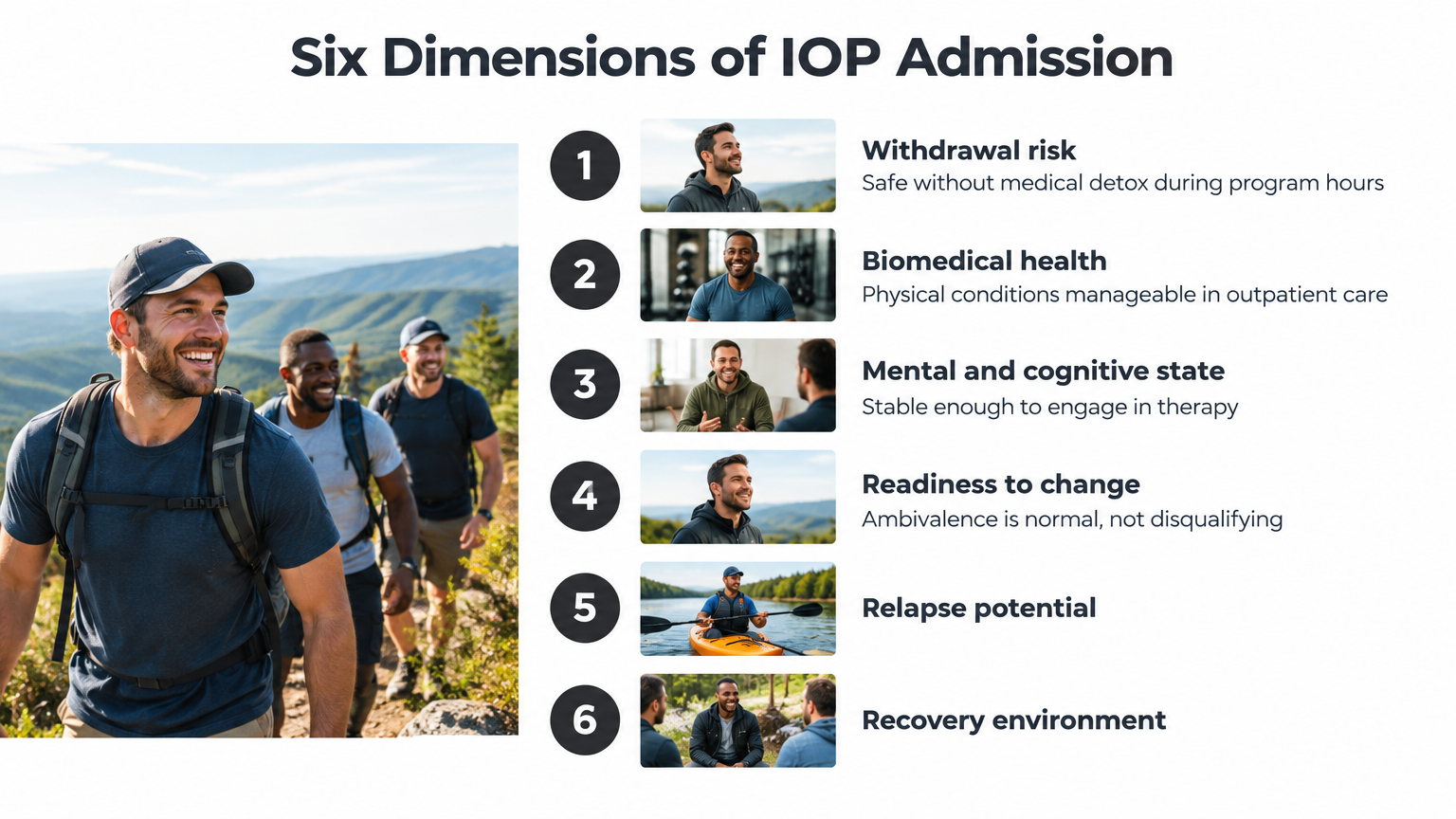
Put the six dimensions together and a profile emerges. A suitable IOP candidate generally has little risk of acute intoxication or withdrawal, physical health conditions that can be managed outside a hospital, emotional and cognitive stability sufficient to engage in group work, and enough support outside program hours to stay safe between sessions 1, 4. He needs more than a weekly therapy appointment, but he does not need 24-hour supervision.
In plain terms, that often looks like a man in his 30s or 40s who has been drinking heavily most nights for years, has tried to cut back on his own, is still employed or recently employed, lives with a spouse or family willing to support treatment, and has no acute medical crisis. It can also look like a man stepping down from detox or residential care, where the acute phase has been handled and the next job is building skills, routines, and connection.
If that profile does not describe your situation, that is useful information, not a disqualification. It tells the clinical team where to start.
Partial Hospitalization Programs sit one rung above IOP in structure. PHP typically runs 20 or more hours per week and is built for men who need daily clinical contact but still return home at night. IOP, by contrast, delivers 9 to 19 hours per week under ASAM Level 2.1 5. The gap matters when symptoms are heavier than IOP can hold.
PHP tends to fit better when you are fresh out of detox and still fragile, when depression or anxiety is severe enough to interfere with daily functioning but does not require inpatient care, when early sobriety keeps collapsing within days of a lower-intensity attempt, or when a co-occurring mental health condition needs closer psychiatric monitoring than a few weekly sessions allow 1, 4. Many men step down from PHP to IOP after two to four weeks, once routines stabilize.
IOP works only if the hours you spend outside the program are safe. CMS and SAMHSA guidance both require adequate support when the client is not in treatment and that the person is not an acute danger to himself or others 1, 4. Two situations commonly disqualify someone from starting at IOP.
The first is active suicidality, psychosis, or an inability to contract for safety between sessions. That calls for inpatient stabilization or PHP with close psychiatric follow-up, not a thrice-weekly outpatient group. The second is a home environment that undermines recovery: a roommate still using in the kitchen, a partner who drinks heavily nightly, an unstable or violent household, or active homelessness. In those cases, residential treatment or sober-supportive housing paired with PHP is usually the honest next step before IOP becomes realistic 1.
A typical Tennessee IOP runs three to five days a week, with each session lasting about three hours. Programs are built around the ASAM Level 2.1 range of 9 to 19 hours of structured programming per week, so a man working a full-time job can usually attend without quitting 5. Morning tracks tend to serve men on second or third shifts; evening tracks, which often run from 5:30 or 6:00 p.m. to 9:00 p.m., are built for men keeping a 9-to-5.
Inside those hours, the week is not just sitting in a circle talking. A standard IOP block mixes group therapy, individual counseling, psychiatric check-ins when needed, skills work drawn from CBT and DBT, and relapse-prevention planning. Clinicians also coordinate with any medical, laboratory, toxicology, or medication services a man may need, which is why ASAM guidance expects IOPs to have access to that full range of support 5. Random drug screens and brief case-management touchpoints usually fit into the same visit.
Most men stay in IOP for roughly eight to twelve weeks, though length is driven by clinical progress, not a fixed clock. Expect a four-day-a-week start that steps down to three days as stability builds. If a week derails, programs can add hours or shift schedules before the question of a higher level of care comes up.
Here is a distinction that trips up almost everyone researching IOP: payer rules and clinical rules are not the same thing. Medicare uses one set of minimums to decide what it will reimburse. Your clinical team uses a wider assessment to decide what you actually need. The two overlap, but they are not interchangeable.
Most commercial insurers borrow heavily from this framework when they build their own medical-necessity criteria, which is why the 9-hour threshold shows up in so many authorization letters.
If you carry Aetna, Anthem, BCBS of Tennessee, Cigna, United Healthcare, or Tricare, IOP is typically a covered behavioral health benefit, though specifics vary by plan. Most commercial plans require prior authorization, a documented clinical assessment showing medical necessity, and periodic utilization reviews to continue coverage as treatment progresses.
Before your first session, verify five things with the program's admissions team or your insurer directly: whether the facility is in-network, your deductible and remaining balance, your copay or coinsurance per session, how many IOP sessions or days are authorized up front, and what documentation the plan requires for continued stay. Ask whether telehealth or hybrid sessions are reimbursed at the same rate as in-person visits, because Tennessee plans do not treat this uniformly.
Most admissions teams run a benefits check for you in under an hour. Bring your insurance card, a photo ID, and any recent medical records that document withdrawal history, prior treatment, or current prescriptions. That paperwork shortens the authorization conversation considerably.
Virtual IOP works for some men and does not work for others. The honest version: if your withdrawal risk is low, your home is private and safe, your internet connection is stable, and you can commit to being on camera for three hours at a stretch, telehealth or hybrid IOP is a real option. If any of those pieces is missing, in-person is usually the better call.
The evidence base is still developing, but it is encouraging within scope. In a study of 4,724 participants enrolled in a single telehealth substance use IOP between 2021 and 2023, nearly 80% remained engaged for 30 days, 91% achieved at least 30 consecutive abstinent days during treatment, and roughly 45% no longer required IOP-level care by the end of the program 10. Those are study-specific findings from one program, not guarantees for every virtual IOP in Tennessee. A broader systematic review of telepsychiatry in addiction treatment found outcomes often comparable to in-person care, with some evidence that hybrid delivery supports retention better than fully virtual care in certain populations 11.
For a man in rural East Tennessee outside Knoxville, or in a county without a nearby program outside Columbia, a hybrid schedule can mean one in-person day a week paired with two virtual groups. Ask the admissions team whether your plan reimburses telehealth sessions at the same rate as in-person visits, and whether withdrawal monitoring and drug screens can be handled locally.

The first call is shorter than most men expect, and it is not a therapy session. An admissions counselor asks a handful of practical questions: what substances you are using and how often, when you last used, whether you have been through withdrawal before, whether you are currently safe, what medications you take, and whether you have insurance. The point is triage, not diagnosis. The counselor is trying to figure out whether IOP is a plausible starting point or whether you need detox or PHP first 1, 6.
Expect questions about work schedule, transportation, who is at home, and whether you have tried treatment before. You do not need polished answers. If a family member is making the call on your behalf, that is normal and the counselor will walk them through what information helps and what has to come from you directly. Most calls end with a scheduled clinical assessment within 24 to 72 hours and a benefits check already in motion.
The clinical assessment is where the six-dimension evaluation actually happens. A masters-level clinician spends roughly 60 to 90 minutes going through your use history, medical conditions, mental health, prior treatment, home environment, and goals. All men entering treatment are screened for co-occurring psychiatric conditions during this step, since anxiety, depression, trauma, and anger patterns commonly travel alongside substance use 6. A physician reviews the findings and certifies the level of care, which is both a clinical and a billing requirement 2, 4.
If IOP is the right fit, you leave the assessment with a schedule, a named primary counselor, and an individualized treatment plan that spells out goals and the services you will receive each week 2. The first week typically includes a baseline drug screen, a psychiatric consultation if co-occurring symptoms are flagged, two or three group sessions, and an individual meeting with your counselor to build the therapeutic alliance that research identifies as central to staying in treatment 7. If something is not working by week two, the plan gets adjusted rather than scrapped.
A fair question before you commit three nights a week for two months: does this level of care actually move the needle? The honest answer, from the strongest available review, is yes for most men who fit the clinical profile. A peer-reviewed evidence review of randomized and quasi-experimental IOP studies found consistent reductions in alcohol and drug use and increases in abstinent days at follow-up, with outcomes often comparable to inpatient or residential care in the studies reviewed 9. That is not a promise. It is a pattern.
Two caveats matter. First, those reviewed studies were published mostly between the mid-1990s and 2012, and comparable average outcomes across groups do not mean IOP is safe for every individual. A man in acute withdrawal, with unmanaged medical issues, severe psychiatric symptoms, or an unsafe home still needs a higher level of care first 9. Second, outcomes track with engagement. If you show up, work with your counselor, and stay long enough for the therapeutic alliance to form, the odds move in your favor 7.
If you fit the profile, the research supports taking the step. If you do not yet, the assessment will tell you where to start instead.
This section speaks to the families doing the research. If you are the man considering treatment, skip ahead or read on — either is useful.
Family members often arrive at an IOP page carrying more urgency than the man they love. That difference in pace is normal, and it matters. What families can do is gather information, run the benefits check, and schedule the clinical assessment. What they cannot do is answer the assessment questions on his behalf. Clinicians need to hear from him directly about his use, his withdrawal history, and his willingness to show up, because the six-dimension evaluation depends on his own account 1, 6.
A few practical moves help. Make the first call yourselves if he is hesitant; admissions counselors routinely talk with spouses, partners, and parents to map out options. Have his insurance card, a list of his medications, and a rough timeline of his use ready. Expect ambivalence from him, not certainty. Research on IOP retention identifies the counselor–client working relationship as central to staying in treatment, which means your job is to get him to the first session, not to argue him into readiness 7.
IOP requirements set the floor: nine to nineteen weekly hours of structured treatment, physician-certified medical necessity, and an individualized plan built around therapy and coordinated clinical services 2, 5. A men's program in Tennessee adds a second layer on top of that foundation. The clinical hours still cover CBT, DBT, EMDR, motivational interviewing, and co-occurring support screened at intake 6. What changes is who you sit next to in group and what fills the hours around treatment.
In Knoxville, that often means hiking into the Smokies, ropes course work, and gym sessions that use boxing or jiu-jitsu as physical outlets for anger, anxiety, and restlessness many men have never learned to name. In Columbia, the Nashville-area program leans on CrossFit-style conditioning, cold exposure, and basketball or Topgolf as structured peer activities. Research-supported, not guaranteed: movement paired with evidence-based therapy may support the neuroplasticity recovery depends on. The clinical requirements do not change. The men around you, and the way the week is built, do.
If you are weighing where to start, the honest next move is a conversation with an admissions team that can run the six-dimension assessment. [Call Trifecta Healthcare Institute] or [Verify your insurance] to find out where you actually fit.
Adult IOP under ASAM Level 2.1 runs 9 to 19 hours of structured programming per week, usually spread across three to five days 5. Most Tennessee programs schedule three-hour blocks in a morning or evening track so you can keep working while in treatment.
Yes. IOP is built for that. Evening tracks typically run from around 5:30 or 6:00 p.m. to 9:00 p.m., and morning tracks serve men on later shifts. You will need to protect those hours and show up consistently, but you do not have to quit a job or step away from school to attend.
Only if your clinical assessment indicates acute withdrawal risk. SAMHSA guidance identifies detoxification as the first priority when medically necessary and recommends it be completed before entering a full IOP schedule 6. Heavy daily alcohol, benzodiazepine, or opioid use usually points toward medical detox first, with IOP as the next step.
Most commercial plans in Tennessee, including Aetna, Anthem, BCBS, Cigna, United Healthcare, and Tricare, cover IOP as a behavioral health benefit, though prior authorization and medical-necessity documentation are usually required. Medicare also began covering intensive outpatient services for substance use and mental health conditions on January 1, 2024 3. An admissions team can run a benefits check in under an hour.
Often, yes. Virtual IOP works when withdrawal risk is low, your home is private and safe, and you have reliable internet. A systematic review of telepsychiatry in addiction treatment found outcomes often comparable to in-person care, with some evidence that hybrid delivery may support retention better than fully virtual care in certain populations 11. Ask whether withdrawal monitoring and drug screens can be handled locally.
Families can make the first call, run the insurance verification, and schedule the clinical assessment, but the man himself has to speak to the clinician during intake because the multidimensional evaluation depends on his own account 1. Research on IOP retention identifies the counselor–client working relationship as central to staying in treatment, so the family's job is getting him to session one, not arguing him into certainty 7.
Between facility size limits, waivers, and state-by-state rules, figuring out your Medicaid or private insurance benefits can feel like its own full-time job. Our admissions team will verify your coverage in minutes and walk you through exactly what's available — no guesswork required.
Verify Insurance Benefits →No commitment required. Confidential & HIPAA-protected.
Whether it's you or someone you love, our team can help you figure out the next step — what treatment looks like, what's covered, or just someone to talk to.
Talk to Our TeamConfidential. No commitment required.


