


How to Choose a Dual Diagnosis Partial Hospitalization Program
Use this checklist to assess a dual diagnosis partial hospitalization program, including integrated care, medication support, Tennessee licensure, PHP fit, a...
Read More
Compare iop vs php by weekly hours, medical support, and who each level may suit. Learn how clinicians assess your needs and plan a step-down in care.
Start Your Journey NowWritten and reviewed by the clinical team at Trifecta Healthcare Institute, a men’s-only treatment center in Tennessee specializing in substance use, mental health, and dual diagnosis care.
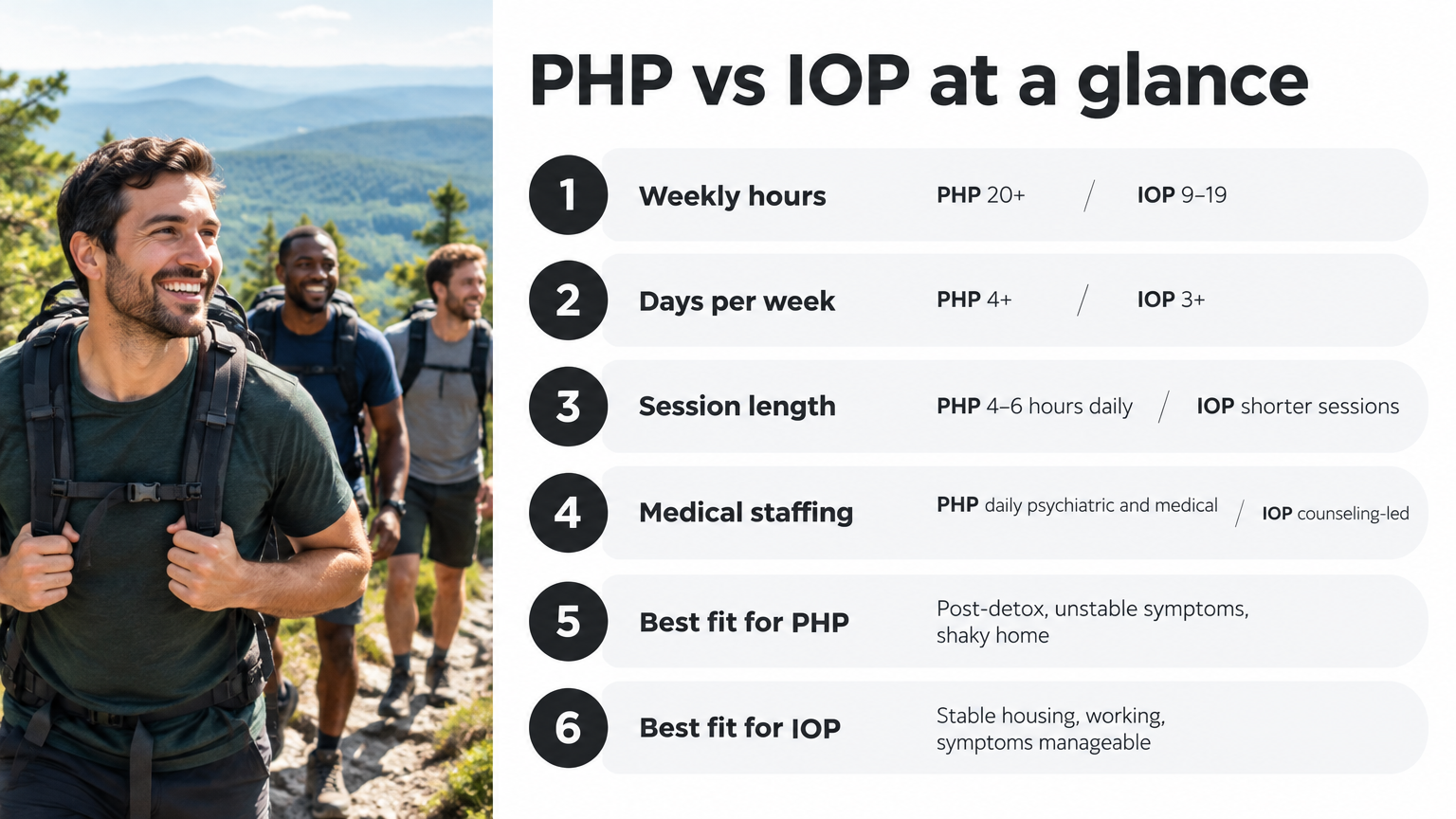
When comparing IOP vs PHP, the quickest way to see the difference is in weekly hours and on-site medical support. A Partial Hospitalization Program (PHP) runs about 20 or more structured hours a week, often four to six hours a day across four or more days, with direct access to medical and psychiatric services during program hours 2, 3. An Intensive Outpatient Program (IOP) runs roughly 9 to 19 hours a week, usually across three days, and is built to fit around work, school, or caregiving 2, 3.
Both are nonresidential, meaning a man sleeps at home or in a supportive living situation and travels to the program. PHP sits one rung below inpatient care; IOP sits one rung below PHP. The right level is not a preference pick — it's a clinical placement decision based on withdrawal risk, co-occurring conditions, relapse history, and how stable his home environment actually is 6.
A Partial Hospitalization Program runs at least 20 structured hours per week, and in most adult programs that means four to six hours of clinical programming a day, four or more days a week 2, 3. Think of it as a full workday of treatment: a man leaves home in the morning, spends the day in a mix of group therapy, individual sessions, psychiatric check-ins, and skills work, then goes home at night.
What those 20-plus hours buy is not just more time in a chair. PHP is designed to provide direct medical and psychiatric services on site during program hours, including medication management, laboratory work when needed, and daily monitoring for people whose symptoms or recovery environment are not yet stable 2. That is the real line between PHP and IOP — the clinical capability waiting in the next room, not the number on the schedule alone.
Weekly hours can run higher than 20 depending on the person's needs and the program's design. SAMHSA's clinical guidance notes that weekly outpatient programming across this part of the continuum can range from roughly 6 to 30 hours, with intensity matched to the individual rather than a fixed template 1. For a man leaving detox or stabilizing a serious co-occurring condition, that upper end is often where PHP starts.
An Intensive Outpatient Program for adults runs between 9 and 19 structured hours each week, spread across at least three days 2, 3. In practice, that often looks like several sessions a week — a weekday evening group, a Saturday morning block, or some mix a man can hold down without walking away from his job or his kids.
A typical week includes group therapy as the backbone, usually two to three times a week, with individual counseling layered in once a week or every other week. Expect topics like relapse-prevention planning, trauma-informed skills work, family dynamics, and coping strategies for high-risk situations — the Friday happy hour, the jobsite, the drive past the old liquor store. Programs that treat co-occurring anxiety, depression, or PTSD build those sessions into the schedule rather than treating them as a separate appointment somewhere else 7.
Duration varies more than people expect. IOP is not a fixed-length program; the clinical consensus is to match intensity and length to what a person actually needs, with weekly programming spanning anywhere from six to roughly thirty hours on the broader outpatient continuum 1. Length of stay is set by clinical need and adjusted as symptoms and recovery environment change, so the schedule bends to the recovery, not the other way around.
Here is the whole decision in one view. The side-by-side below pulls the hour ranges, day minimums, and clinical capabilities straight from the federal and state definitions used to place adults into either level of care 2, 3.
| Factor | Partial Hospitalization (PHP) | Intensive Outpatient (IOP) |
|---|---|---|
| Weekly structured hours | 20+ hours 2 | 9–19 hours 2 |
| Days per week | At least 4 days 3 | At least 3 days 3 |
| Typical session length | 4–6 hours per day | Multiple sessions per week |
| On-site clinical staffing | Direct medical and psychiatric services, daily monitoring, lab work as needed 2 | Counseling and group therapy as the core, with medical and psychiatric services less directly embedded 2 |
| Typical duration | Varies by clinical need 1 | Varies by clinical need 1 |
| Who it fits | Men stepping out of detox or inpatient; unstable co-occurring symptoms; higher relapse risk; shaky home environment 3, 6 | Men with a stable place to sleep, work or family they can keep showing up for, and symptoms that no longer need daily medical eyes on them 3 |
| Home-life expectations | Program fills the day; evenings and weekends at home or in supportive housing | Program fits around a job, custody schedule, or school |
Two things worth noting about the table. First, the hour ranges come from Medicaid and state clinical guidelines that define PHP as ASAM Level 2.5 and IOP as ASAM Level 2.1 — the same framework most programs and insurers reference when they talk about level of care 2. Second, the staffing line is where the real daylight sits. PHP is built to handle a day that could include a medication adjustment, a lab draw, and a psychiatric check-in without rescheduling the week. IOP's core is counseling and group work, with medical and psychiatric services less directly embedded 2.
The duration row deserves a caveat. SAMHSA's clinical guidance is clear that programming should match the person, not a template, which is why actual stays vary by individual need 1. Use this table as a starting map for the conversation with an admissions clinician, not as a prescription.
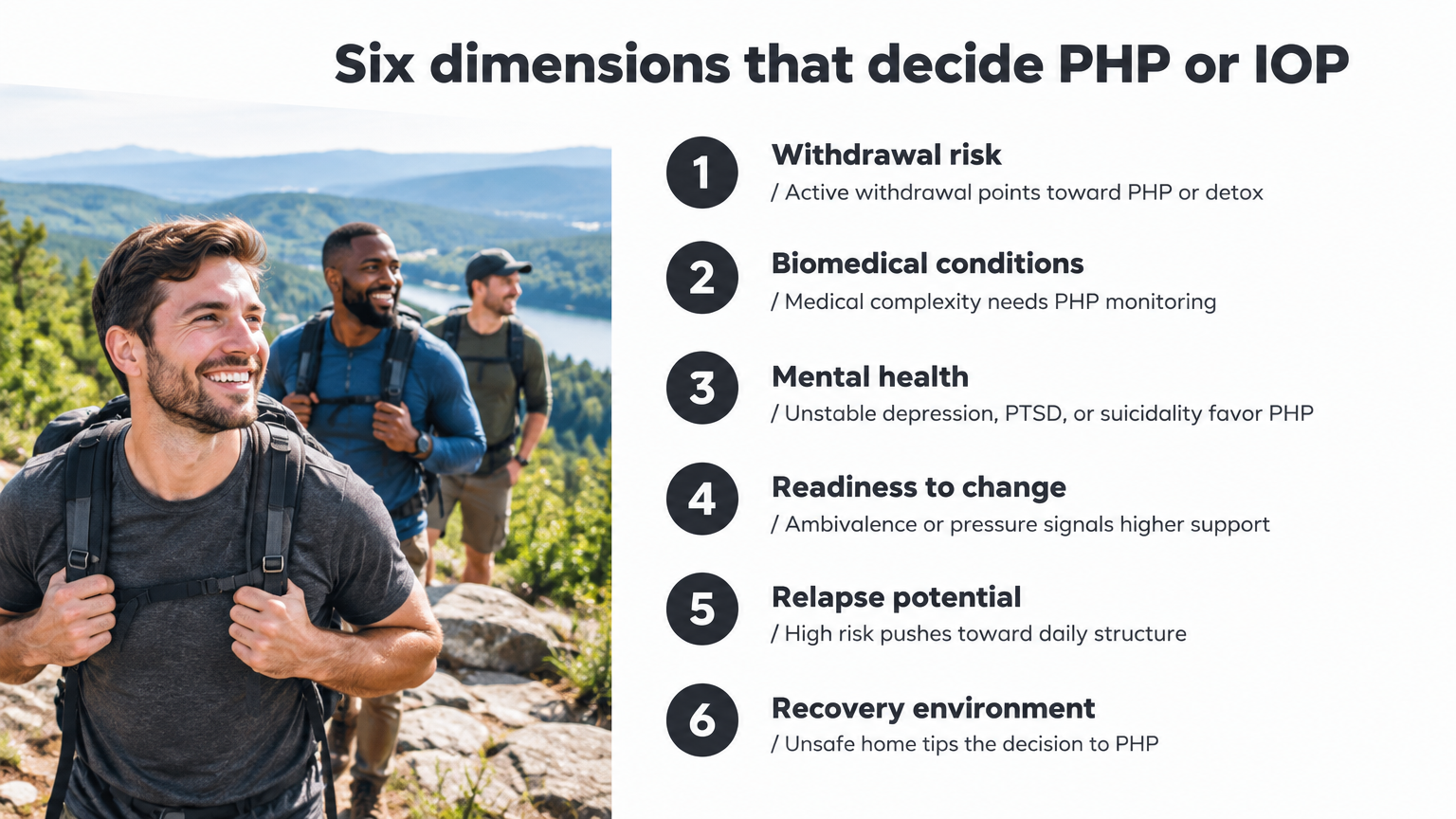
Admissions clinicians do not pick PHP or IOP by asking what a man prefers. They work through six dimensions pulled from the ASAM placement criteria that most state Medicaid programs and treatment centers reference when deciding where someone belongs on the continuum 3. Each dimension is a question with a real answer, and together they push the decision toward the more intensive rung or the less intensive one.
Here is what the six dimensions ask, and what each one tends to mean in a PHP-or-IOP conversation 3, 6:
The six dimensions tell a clinician where to place someone. For a man reading this at the kitchen table, the question is more practical: what does his week actually look like, and what will the next 30 days ask of him? The three scenarios below map the most common PHP and IOP decisions, plus a short section for the family members who are usually the ones doing the first round of research.
PHP is usually the right first step if you just finished medical detox, if you came out of an inpatient stay in the last week or two, or if the last relapse was serious enough that your family is scared. The day structure matters here. Four to six hours of programming, four days a week or more, keeps you busy during the stretch when cravings and old routines pull hardest 2, 3.
PHP also fits when a co-occurring condition is doing real damage — depression that keeps you in bed, panic attacks that shut down your workday, PTSD symptoms that spike at night. Having psychiatric support on site during program hours means a medication adjustment can happen the same week, not three Wednesdays from now 2, 7.
The home-environment question is the quiet one. If you are going back to a house where someone else is still drinking or using, or if you do not yet have a safe place to sleep, PHP buys time to line that up before you are home all day with a problem you cannot outrun 3.
IOP fits when you have a steady place to live, people around you who are not actively using, and a job or school schedule you can protect. Three sessions a week — often evenings or weekend mornings — lets you keep showing up for work and for your kids while still getting real clinical hours in 2, 3.
It also fits as a step-down from PHP once your symptoms have settled and the daily medical check-ins are no longer necessary. The evidence base for IOP is strong: multiple studies have found outcomes comparable to inpatient or residential care for many people, though program models vary and the most clinically unstable patients may still need something more intensive 4.
One honest note. If you are showing up because a court date or a boss made the choice for you, and you still half-believe the drinking was not the problem, that ambivalence is not a reason to pick IOP by default. Readiness is one of the six placement dimensions for a reason — a few weeks of PHP first can shorten the overall path, not lengthen it 6.
If you are a wife, partner, mother, or sibling doing this research before anyone has made a call, a few things are worth knowing. Level of care is not a feature to pick — it is a clinical placement decision an admissions clinician will make after a phone assessment, usually in the same conversation where insurance gets verified 6. Your job is not to diagnose. Your job is to bring a clear picture of what the last six months have looked like.
Write down the things that matter to the six dimensions: the last time he used, any withdrawal symptoms, medical conditions, mental health history, prior treatment episodes, and what his daily environment is actually like 3. That information shortens the call and makes placement more accurate.
One more thing. In a single-center retrospective study, being male and not engaging in follow-up SUD treatment were each separately associated with higher relapse risk — a reminder that your continued presence after the program ends can matter more than most families realize 5.
Weekly hours tell you how much time a man will spend in the building. They do not tell you whether the program can actually meet him where he is. Three capability questions decide whether a given PHP or IOP will hold up for a specific person, and none of them show up on the schedule.
If opioids are part of the picture, the level of care matters less than whether the program can start or continue buprenorphine, methadone, or naltrexone. The CDC identifies medications for opioid use disorder, combined with behavioral therapy when appropriate, as evidence-based treatment — not an optional add-on 8. A 25-hour PHP that cannot prescribe or coordinate those medications is a weaker fit than a 12-hour IOP that can.
Ask the admissions clinician directly: Who prescribes? Is induction done on site, or coordinated with an outside provider? What happens on day 30 when the first prescription needs a refill? The answers tell you more about clinical capability than the weekly hour count ever will.
Both PHP and IOP are supposed to treat co-occurring mental health conditions alongside substance use, not refer them out. SAMHSA's guidance names integrated treatment — concurrent care for the substance use disorder and the mental health condition — as the preferred model 7. The gap between programs is in execution.
A capable program has psychiatric providers who see clients during program hours, adjusts medications on a reasonable timeline, and uses therapies matched to what a man is actually dealing with: CBT and DBT for anxiety and emotion regulation, EMDR or other trauma-informed work for PTSD symptoms. Ask how often a psychiatric provider is on site, and how long it takes to get a medication change after a group clinician flags a concern. Two weeks is a different program than two days.
Virtual sessions are now part of most outpatient care, and the evidence so far is reassuring. HHS research summaries report promising results for telehealth across behavioral health, including counseling and medication treatment for opioid use disorder 9. A 2025 peer-reviewed study on telehealth integration in SUD treatment found more telehealth-related outpatient visits with no differences in adverse outcomes compared with standard in-person care in the study context 10.
That does not make virtual equal to in-person for every man or every intensity. PHP's clinical weight — daily medical eyes, lab work, same-day medication adjustments — is hard to replicate on a screen. IOP travels better. Trifecta's Peak program in the Nashville area offers a nighttime virtual IOP that admits both men and women, which is useful for someone whose shift work or caregiving makes an in-person schedule impossible. The right question is not whether a program offers telehealth, but which pieces are virtual and which stay in the room.
Moving from PHP to IOP is not a sign that treatment is winding down because something went wrong. It is the design. The continuum of care exists so a man can enter at the intensity he needs and move to less intensive levels as his stability holds, not because a program ran out of sessions 12.
A common path looks like this: medical detox clears the acute window, PHP handles the first few weeks of fragile ground, IOP carries the schedule back toward work and family, and standard outpatient plus alumni connection keeps the thread intact. Each handoff is a decision point, not an automatic graduation. The same six placement dimensions that pointed toward PHP get re-asked — withdrawal stable, co-occurring symptoms settling, home environment holding, relapse risk lower — and if the answers still line up, the step down happens.
The reason step-down planning matters is that treatment gains fade without something structured on the other side. A meta-analysis of continuing care for substance use disorders found a small but statistically significant benefit at the end of treatment and at follow-up, with effect sizes of g=0.187 and g=0.271; the authors cautioned about a limited number of studies and did not identify which specific continuing-care model works best 11. Small sounds modest until you consider that it is the difference between the people who kept showing up and the people who did not.
Treat the step-down as the plan from day one. Ask what IOP looks like after PHP, what outpatient looks like after IOP, and who stays in the picture after that. The rungs are built to connect.
At either level of care, the clinical bones are the same for men in Knoxville and the Nashville-area facility in Columbia: CBT and DBT for the thought patterns and emotion regulation work, EMDR and other trauma-informed approaches when PTSD symptoms are driving the use, motivational interviewing when readiness is still shaky, and psychiatric support for co-occurring anxiety, depression, or trauma — delivered concurrently with substance use treatment rather than parked at a separate provider down the road 7. In PHP, those pieces fill a four- to six-hour day. In IOP, they get compressed into three sessions a week built around work and family.
Movement is where a men's program in Tennessee tends to look different from the standard outpatient script. Boxing, jiu-jitsu, hiking in the Smokies out of Knoxville, ropes course and white-water rafting work, basketball, ice baths — these are built into the schedule as clinical tools, not as a reward or a field trip. Men in PHP get more of it, more often; men in IOP get a tighter dose that stacks with their training schedule or their weekends.
The brotherhood piece is the quiet variable. In a single-center retrospective study, being male and not engaging in follow-up SUD treatment were each separately associated with higher relapse risk 5. A program that keeps men connected to each other through group work, alumni ties, and shared physical activity is building the structure that outlasts the schedule — whether the schedule started at 20 hours a week or nine.
If you have read this far, you already know enough to make the call. The placement decision — PHP, IOP, or something in between — belongs to an admissions clinician who can hear the specifics. Your job is to pick up the phone and give them something to work with: how often you have been using, what your last 30 days have looked like, any medications or diagnoses, and what home actually looks like when the day ends.
Tennessee men can reach Trifecta Healthcare Institute in Knoxville or the Nashville-area facility in Columbia. [Verify your insurance] or [Call Trifecta] to start the conversation. The next right move is a short one.
PHP is the more intensive of the two. It provides at least 20 hours of structured programming per week with direct on-site medical and psychiatric services, while IOP runs 9 to 19 weekly hours and leans on counseling and group therapy as its core 2. Both are nonresidential, so a man sleeps at home either way.
Yes. IOP is built for it. Three sessions a week, often in the evening or on weekend mornings, let you keep showing up for work, custody time, or school while still getting 9 to 19 clinical hours each week 2. PHP is harder to pair with a full-time job because the day itself is the program. Many men start at PHP, then step down to IOP once they can hold a work schedule again.
Both are expected to. SAMHSA names integrated treatment — concurrent care for the substance use disorder and the mental health condition — as the preferred model, which means anxiety, depression, PTSD, or trauma symptoms get addressed inside the program rather than referred out 7. PHP provides more directly available on-site medical and psychiatric services, while IOP's core is counseling and group therapy 2.
Coverage varies by plan, so verify benefits with your insurer. Medicaid programs commonly reference the ASAM Level 2.5 (PHP) and Level 2.1 (IOP) definitions used in national clinical guidelines 2. Benefits, prior authorization rules, and in-network status differ, and a short insurance verification call with the admissions team will confirm coverage, expected out-of-pocket costs, and authorized length of stay.
Between facility size limits, waivers, and state-by-state rules, figuring out your Medicaid or private insurance benefits can feel like its own full-time job. Our admissions team will verify your coverage in minutes and walk you through exactly what's available — no guesswork required.
Verify Insurance Benefits →No commitment required. Confidential & HIPAA-protected.
Whether it's you or someone you love, our team can help you figure out the next step — what treatment looks like, what's covered, or just someone to talk to.
Talk to Our TeamConfidential. No commitment required.


