


How to Choose a Dual Diagnosis Partial Hospitalization Program
Use this checklist to assess a dual diagnosis partial hospitalization program, including integrated care, medication support, Tennessee licensure, PHP fit, a...
Read More
Compare long term drug rehab options by clinical fit, mental health support, medication access, and discharge planning to choose care that supports continued...
Start Your Journey NowWritten and reviewed by the clinical team at Trifecta Healthcare Institute, a men’s-only treatment center in Tennessee specializing in substance use, mental health, and dual diagnosis care.
Long term drug rehab is less about one extended stay and more about staying connected to care for the months after the initial crisis settles. The clinical literature on continuing care generally recommends at least three to six months of structured follow-up, and up to twelve months when the goal is durable recovery.2 That window includes residential or partial hospitalization, step-downs like intensive outpatient, and the peer connections that come after.
Many men picture a 30-, 60-, or 90-day inpatient stay when they hear the phrase. That image is incomplete. A review of residential and outpatient care found better 12-month outcomes among people who received at least three months of treatment than among those who received less.2 The signal there is engagement over time, not the roof over anyone's head on a given night.
It also helps to zoom out. NIDA's 2025 research update describes recovery for many people as a long process that can involve repeated treatment and mutual-support engagements over years, with access and sustained engagement doing much of the heavy lifting.1 That is a population-level picture, not a prediction for any single person. For a man weighing options in Nashville, Columbia, or Knoxville, the practical read is simple: judge a program less by the brochure's day count and more by how it plans to stay in your life after week one ends.
Extended treatment is better pictured as a path with stops than a single long stay. A partial hospitalization program (PHP) runs most of the day, most days of the week, for several weeks. That is where the clinical work gets serious: individual therapy, group work, psychiatric evaluation, and, when a man has a co-occurring mental health concern, coordinated planning for both conditions at once.6
Intensive outpatient (IOP) is the next step down. Sessions usually meet three to five times a week for several hours, which lets a man start reintroducing work, family time, and routine while still showing up for structured care. Standard outpatient follows that, with weekly or twice-weekly sessions that stretch across months. For men in East Tennessee, a Knoxville rehab for men or a Nashville-area program in Columbia may run this stepped sequence inside one organization or coordinate it with a trusted partner.
Peer connection is the final, often undervalued stop. Federal clinical guidance treats continuity across residential and outpatient settings, long-term follow-up, and peer support as part of the treatment plan, not a bonus feature.6 Residential therapeutic-community models, where used, commonly run six to twelve months, with discharge planning, housing, and medication coordination handled before anyone walks out the door.7 The point is engagement across the whole path, not clocking hours in any single setting.
Three months keeps showing up in the research as a line worth crossing. The continuing-care literature generally recommends at least three to six months of structured follow-up, with better twelve-month outcomes among people who stayed engaged in long-term residential or outpatient care for three months or more compared to those who received less.2 A 2025 review of treatment-outcome measures notes that a three-month retention period was identified as a strong predictor in one study, with most retention research focused on outpatient populations and definitions of retention that vary.12
So three months is a floor worth clearing, and the next question is what fills those months. Active engagement, services matched to a man's actual needs, medication when it is clinically indicated, and real handoffs between levels of care all matter more than the length printed on the brochure. If a program wants to sell you ninety days, ask what week eleven looks like.
The weakest link in long term drug rehab is almost never the first week. It's the Tuesday after discharge, when a man is supposed to show up at a new outpatient office he's never been to, with a therapist he's never met, after a weekend back in his old house. That gap is where plans fall apart.
Roughly 40% to 50% of residential clients initially transition into outpatient continuing care, and many of those who do start outpatient don't stay for the full recommended duration.11 That isn't a story about weak willpower. It's a story about handoffs. A referral slip and a phone number is a passive referral. An active handoff looks different: the first outpatient appointment is scheduled before discharge, records move with the man, case management confirms transportation, and someone follows up when a session gets missed instead of closing the file.
When you're comparing programs, this is a question worth asking out loud. Who schedules the next appointment, and when? Does the clinical team coordinate directly with the outpatient provider, or hand over a packet and wish you luck? Is there a case manager assigned through the transition, and for how long? A program that answers those questions in specifics is treating the handoff as part of the treatment. A program that answers in generalities is leaving the hardest week to chance.

Before any brochure matters, ask how a program figures out what you actually need. A thorough intake looks at substance use history, physical health, mental health symptoms, trauma exposure, family and work situation, legal issues, and prior treatment experiences. Federal clinical guidance treats ongoing assessment of both substance use and mental health as a baseline expectation, not a one-time form at admission.6
Clinical fit also shows up in what happens after the paperwork. A systematic review of organizational factors found that service-to-needs alignment in residential settings was associated with longer treatment engagement, and that readiness-for-change work and cultural competence tracked with better engagement too.10 In plain terms, a program that matches its services to the man in the room tends to keep him in the room.
Most men who show up for extended substance use treatment are carrying something else too. Anxiety, depression, trauma, grief, anger, or long-running sleep problems commonly travel alongside substance use, and NIDA reports that integrated treatment for co-occurring drug use and mental illness is consistently superior to treating each diagnosis separately or in sequence.9 That is one of the clearer signals in the research, and it should shape how you compare programs.
Integrated care is more than a counselor who is willing to talk about depression. Federal guidance recommends ongoing assessment of both disorders throughout treatment, coordination between therapy and medication management, relapse-prevention planning, and attention to housing, employment, and peer support.6 When you're comparing programs, ask whether assessment of both conditions is ongoing, how prescribers and therapists coordinate, and whether clinicians are trained in trauma-focused modalities like EMDR.
Medication is not required for every man in extended treatment, but when it's clinically indicated, a program's position on it matters a lot. National clinical guidance recommends offering pharmacologic treatment for opioid use disorder and identifies buprenorphine, methadone, and extended-release naltrexone as the three options, with long-term pharmacologic treatment preferred over withdrawal management alone.8
Programs vary. Some initiate medication during residential or PHP and continue it through step-down. Some stabilize a man on medication and coordinate a transfer to a community prescriber. Others do not offer or support medication at all. None of those are automatically wrong, but a program that excludes evidence-based medication without a clinical reason is narrowing the options for men with opioid use disorder in particular.
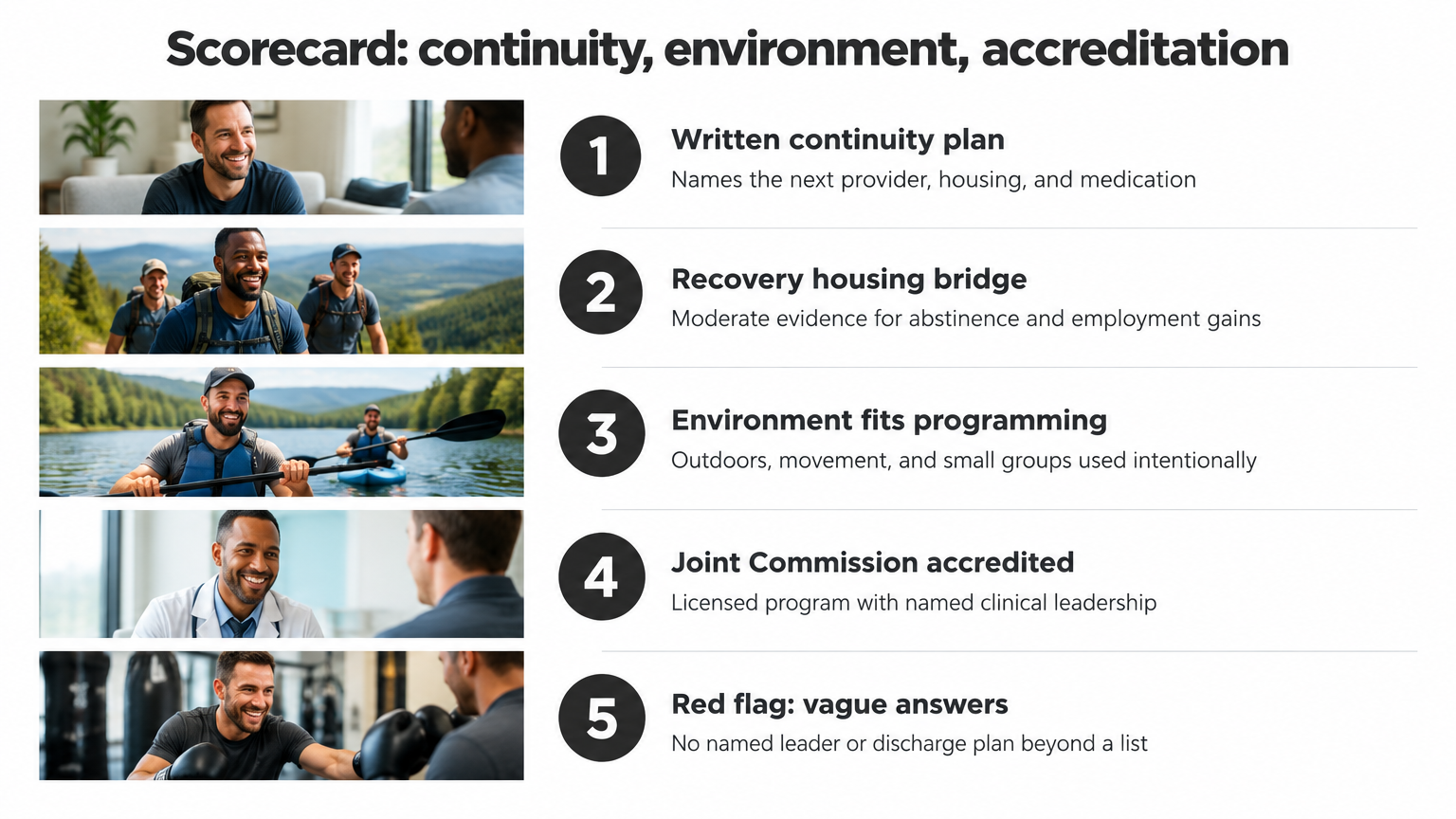
The last three columns of a scorecard are the ones families most often forget to ask about: what comes after, where it happens, and who vouches for the program's standards. Federal guidance recommends continuity of care across residential and outpatient settings, with discharge planning that addresses housing, medication, and long-term follow-up before a man leaves.7 A recovery-housing step may fit here as a bridge; a 2025 systematic review found moderate evidence that recovery housing improved abstinence, income, employment, and criminal-legal outcomes compared with usual care, though the ideal duration is not firmly established.4
Environment is harder to measure but easier to feel. In Knoxville, East Tennessee's outdoor setting can be a legitimate backdrop for recovery when movement and the outdoors are woven into programming. In Nashville and Columbia, gym space, movement programming, and small group sizes do similar work. Accreditation and licensing matter in the background; a review of organizational factors associated licensed programs and higher continuity of care with longer treatment engagement.10
The substance you're trying to step away from changes what long term treatment should include. For opioid use disorder, national clinical guidance recommends offering pharmacologic treatment with buprenorphine, methadone, or extended-release naltrexone, and favors long-term medication over withdrawal management alone.8 A program that handles opioid use disorder well will discuss which of those medications fits your situation, who prescribes it, and how prescribing continues after you step down to outpatient care.
Stimulants are a different conversation. CDC reports that, unlike opioids, stimulant overdose has no reversal agent and no FDA-approved medication for stimulant use disorder.13 That doesn't mean treatment is thin. It means the clinical weight shifts to behavioral care, like cognitive behavioral therapy, contingency management, trauma-focused work, and sustained engagement over months. Ask a program what its stimulant-specific protocol actually looks like, because "we treat everyone" is not an answer.
Alcohol use disorder sits in between, with medically supervised care often the right starting point. Across all three categories, integrated care for co-occurring mental health concerns is consistently more effective than treating diagnoses in sequence.9 The substance sets the medical options; the mental health picture shapes the therapy plan.
Here's the fear most men don't say out loud when they call about extended treatment: if I disappear for three months, I come back to no job, no income, and a family that resents me for leaving. That fear is reasonable, and it keeps a lot of men stuck in a cycle of short stays that don't hold. A good long term program takes it seriously instead of waving it off.
Employment is not a side issue in recovery. A SAMHSA guide on employment and substance use recovery reports that clients who are employed while in treatment are significantly more likely to complete treatment than those who are not, and that employment is associated with reduced substance use and improved ability to maintain sobriety.5 SAMHSA also notes that many of the studies behind those findings have relatively short follow-up periods, so this is a strong signal, not a lifetime guarantee. Federal clinical guidance for people with co-occurring conditions names vocational skills, gainful employment, case management, and long-term follow-up as continuing-care goals, not optional extras.6
What that looks like in practice: vocational counseling built into treatment, case management that helps negotiate FMLA or short-term disability with an employer, resume and interview work during IOP, and connections to Nashville-area employers or Knoxville trade programs willing to hire men in active recovery. Ask admissions directly: who on staff handles employment questions, and what happens if a man is a welder in Columbia or a project manager in East Tennessee with a job he wants to keep? Specific answers signal real support. Shrugs signal a gap you'll feel on week six.
A man can finish PHP strong and still lose his footing the week he moves back into a house where someone drinks every night or a lease fell apart during treatment. Housing is one of the quieter variables in long term drug rehab, and it's one of the ones that most decides whether the clinical work holds.
Recovery housing can serve as a bridge between structured treatment and independent living. A 2025 systematic review of five studies, including three randomized trials, found moderate evidence that recovery housing performed better than usual care on abstinence, income, employment, and criminal-legal outcomes.4 The authors also note that the ideal duration has not been firmly established, with correlational evidence pointing toward roughly three to six months. Federal guidance treats housing as part of discharge planning rather than a separate problem to solve later.7
Trifecta Healthcare Institute does not operate on-site sober living, so the practical question for men in Nashville, Columbia, or Knoxville is how a program coordinates with recovery residences in the area, who makes the referral, and whether the clinical team stays in contact once a man moves in.
This section is written for the people doing the research when the man in your life can't or won't. You're reading admissions pages at midnight, trying to tell real care from marketing. A few things are worth knowing before you make the next call.
First, the question that matters most is not how many days the program lasts. It's what the next six to twelve months look like. Continuing-care research generally recommends at least three to six months of structured follow-up, with up to twelve months when durable recovery is the goal.2 Ask admissions how they plan step-downs from PHP to IOP to outpatient, who schedules the first appointment at each transition, and how they stay in contact if he misses a session.
Second, if he has anxiety, depression, trauma, or another mental health concern alongside substance use, integrated treatment that addresses both at once is consistently more effective than treating them in sequence.9 Ask who assesses mental health, how often, and how prescribers coordinate with therapists.
Third, you don't have to carry this alone. A good admissions team will talk with you, verify insurance, and walk through options without pressuring him before he's ready.
Tennessee gives men a few real geographic choices when they're weighing long term drug rehab, and the differences are more than scenery. The Nashville-area option sits in Columbia, south of Nashville in Middle Tennessee, which puts a man close enough to family and employers without planting him back in the exact neighborhood where he was using. Trifecta Healthcare Institute's Knoxville location sits in East Tennessee, where the regional outdoor setting of the Smoky Mountains foothills shapes the surroundings.
Both locations offer a stepped continuum of care in Tennessee. For men with co-occurring anxiety, depression, or trauma, integrated assessment and coordinated care sit inside the clinical model rather than getting referred out.6 For men who want to keep working, case management and vocational conversations are part of what to ask about during admissions.
Practical next step: a short admissions call clarifies level of care, insurance, and timing for Nashville, Columbia, or Knoxville. [Verify your insurance] or [Start a live chat] to see what fits.
Comparing long term drug rehab comes down to a short list of questions: Does the program match care to the man in the room, treat mental health alongside substance use, offer medication when it's indicated, plan the handoff before discharge, and stay in contact for the months that follow? Length of stay is a variable, not the verdict.
If you're the man weighing this, the hardest part is usually the first phone call. If you're a wife, partner, or parent, the hardest part is often waiting for him to make it. Either way, the next step is small: a conversation about what fits. [Call Trifecta] or [Verify your insurance] to talk through options in Nashville, Columbia, or Knoxville. Recovery isn't a date on a calendar. It's the next right move, and then the one after that.
Long term drug rehab usually refers to a connected continuum of care that runs at least three to six months, and sometimes up to twelve, counting the initial stay plus structured step-downs and continuing care.2 The residential portion may be days or weeks; the engagement that follows is where most of the "long term" actually happens.
Ninety days is a meaningful floor rather than a finish line. A meta-analysis of 33 controlled trials found that planned months of continuing care were not significantly associated with effect size, which means the quality of engagement during those months matters as much as the number.3 Plan for the first three months, then plan the next six.
Ask who assesses mental health, how often that assessment is repeated, and how prescribers and therapists coordinate. Federal guidance recommends ongoing assessment of both substance use and mental health conditions throughout treatment, with coordinated medication, therapy, and relapse-prevention planning.6 A clear answer about staffing and shared records is a stronger signal than a general promise of "dual diagnosis."
Often, yes, especially once you step down to IOP or outpatient. SAMHSA reports that clients employed during treatment are significantly more likely to complete it, with the caveat that most studies have short follow-up periods.5 Ask admissions how they handle FMLA conversations, scheduling around shift work, and vocational support for men in Nashville, Columbia, or Knoxville.
It can, and for opioid use disorder it usually should. National clinical guidance recommends offering pharmacologic treatment with buprenorphine, methadone, or extended-release naltrexone, and favors long-term medication over withdrawal management alone.8 Ask any program which medications they offer and how prescribing continues after discharge.
In Tennessee, extended treatment typically runs through PHP, IOP, and outpatient, delivered in Nashville-area programs in Columbia or in Knoxville rehab for men settings in East Tennessee. Trifecta Healthcare Institute runs a stepped continuum at both locations, with integrated co-occurring care alongside substance use treatment.
Between facility size limits, waivers, and state-by-state rules, figuring out your Medicaid or private insurance benefits can feel like its own full-time job. Our admissions team will verify your coverage in minutes and walk you through exactly what's available — no guesswork required.
Verify Insurance Benefits →No commitment required. Confidential & HIPAA-protected.
Whether it's you or someone you love, our team can help you figure out the next step — what treatment looks like, what's covered, or just someone to talk to.
Talk to Our TeamConfidential. No commitment required.


