


How to Choose a Dual Diagnosis Partial Hospitalization Program
Use this checklist to assess a dual diagnosis partial hospitalization program, including integrated care, medication support, Tennessee licensure, PHP fit, a...
Read More
Learn how medical detox medications vary by substance, what they help manage during withdrawal, and why a planned transition to ongoing care matters.
Start Your Journey NowWritten and reviewed by the clinical team at Trifecta Healthcare Institute, a men’s-only treatment center in Tennessee specializing in substance use, mental health, and dual diagnosis care.
Medical detox medications are short-term tools that keep withdrawal from becoming dangerous while the body clears a substance. They are not a cure, and they are not a shortcut. Think of them as guardrails: calming an overactive nervous system, quieting cravings, protecting against seizures, and keeping vital signs stable long enough for the next phase of care to begin.
Many men picture detox as white-knuckling it alone in a bedroom. Supervised withdrawal looks different. A clinician matches the medication to the substance involved, the severity of symptoms, medical history, and the monitoring available in that setting.1 Benzodiazepines are the standard medication class for alcohol withdrawal because they prevent seizures and delirium.7 Buprenorphine, methadone, and clonidine are the common choices for opioid withdrawal.1 Benzodiazepine dependence calls for a gradual, individualized taper, never an abrupt stop.14 Stimulant withdrawal has no FDA-approved medication, so care centers on sleep, nutrition, and behavioral support.16
The point of every one of these medications is the same: lower the medical risk of coming off a substance, so the real work of recovery can begin.
Medication selection during detox is not a lookup table. A clinician weighs several inputs at the same time and keeps re-weighing them as symptoms change over the first 24 to 72 hours. The goal is to match the right medication, the right dose, and the right setting to the person in front of them.
Five inputs usually drive the decision:
A good clinician also asks what previous attempts looked like. Prior withdrawal seizures or delirium tremens weigh heavily in that risk picture, which is why intake questions about past episodes shape the plan more than any single score.1, 5 The honest answer at intake is usually the one that keeps you safest.

If you have been drinking heavily for months or years, stopping suddenly can be dangerous. Alcohol withdrawal can produce tremor, anxiety, nausea, high blood pressure, hallucinations, seizures, and delirium tremens, a confused and medically unstable state that can be fatal without treatment. Benzodiazepines are the first-line medication class for alcohol withdrawal because they calm the same brain receptors alcohol has been artificially pressing on, which prevents seizures and reduces the risk of delirium.7, 8
Common choices include chlordiazepoxide, diazepam, and lorazepam. No single benzodiazepine has been shown to be clearly superior to the others in general emergency-department use, so the choice depends on your medical history and how long the medication stays in the body.7 Lorazepam is often used when liver function is impaired because it is metabolized differently than longer-acting agents.6 A network meta-analysis found that several fixed-schedule regimens, including diazepam, lorazepam, chlordiazepoxide, and divalproex, were associated with reduced incident seizures compared with placebo, though methodological limits make head-to-head comparisons uncertain.10
Dosing comes in two main styles. Symptom-triggered therapy uses a validated score, usually CIWA-Ar, to give medication only when symptoms rise above a threshold. This approach can reduce total medication exposure and shorten detox in mild-to-moderate withdrawal when trained staff can score reliably.8 Fixed-schedule dosing gives medication on a set clock, which is safer when symptoms are harder to measure or when a man cannot communicate clearly.
Benzodiazepines are not the only option. The VA/DoD clinical guideline lists carbamazepine, gabapentin, and valproic acid as alternatives in selected patients when the risks of benzodiazepines outweigh the benefits.5 Phenobarbital may be added in severe or resistant withdrawal, though randomized trials have not shown clear superiority over benzodiazepines and the evidence base remains small.9 For severe withdrawal, high CIWA-Ar scores, a history of seizures or DTs, or serious medical conditions, inpatient medically supervised management is strongly supported.5
Opioid withdrawal is rarely fatal on its own, but it is miserable enough to drive most men back to use within hours: body aches, chills, sweating, cramping, vomiting, diarrhea, insomnia, and a crawling restlessness that does not let up. Medications shorten that window and, more importantly, make it possible to stay off opioids long enough to engage in treatment.
Three FDA-approved medications treat opioid use disorder: buprenorphine, methadone, and naltrexone.11, 12 During acute withdrawal, buprenorphine and methadone do most of the work.
Buprenorphine partially activates the same receptors opioids do, which quiets withdrawal and cravings without producing the full high of a short-acting opioid.11 It can be prescribed in office-based settings and is available as a dissolving tablet, cheek film, or extended-release injection.12 Clinicians time the first dose carefully to avoid starting it before enough time has passed since the last opioid, which is part of why induction happens under supervision.
Methadone is a full opioid agonist that prevents withdrawal and reduces cravings when dosed daily. For opioid use disorder, methadone must be provided through certified opioid treatment programs rather than a regular doctor's office.11, 12 That access requirement shapes which patients can realistically use it as a long-term option.
Clonidine and lofexidine are alpha-2 agonists that do not act on opioid receptors at all. They take the edge off the autonomic symptoms of withdrawal, sweating, elevated heart rate, high blood pressure, GI distress, by calming the sympathetic nervous system. They can be used alone in selected patients or alongside buprenorphine for added symptom relief, and they are among the five commonly used approaches to opioid detoxification identified in the ambulatory-detox literature along with methadone, buprenorphine/naloxone, and guanfacine.1, 2
Naltrexone is a different animal. It blocks opioid effects rather than relieving withdrawal, and it generally requires 7 to 10 days opioid-free before it can be started safely.11 For most men entering detox, that means naltrexone becomes an option after the acute phase, not during it.
Benzodiazepine withdrawal is the one most people underestimate. After weeks or months of regular use, stopping abruptly can trigger rebound anxiety, insomnia, tremor, confusion, and seizures that can be life-threatening.
Safe management means a gradual, individualized taper, not a one-size schedule copied from a protocol sheet. The 2025 ASAM-led joint clinical practice guideline recommends shared decision-making, ongoing risk-benefit assessment, individualized tapering, adjustment based on how you respond, and psychosocial support throughout the process.15 In plain terms: your clinician reduces the dose in small steps, watches how your body and mind react, and slows down when symptoms flare.
Several factors change the pace. Dose, duration of use, which benzodiazepine you have been taking, co-occurring medical and psychiatric conditions, and your prior experience with dose reductions all shape the plan. The FDA notes that no standard tapering schedule is suitable for every patient, which is why clinicians individualize the pace and adjust it as symptoms respond.14, 15
Tapers can take weeks or months, and that is appropriate. The goal is not speed; it is finishing the taper without a seizure, without a crisis, and with your nervous system intact enough to engage in the next phase of care.
Cocaine and methamphetamine do not produce the kind of dangerous physical withdrawal alcohol or benzodiazepines do, but the crash is still brutal. SAMHSA describes stimulant withdrawal as a cluster of fatigue, heavy sleep, insomnia later in the course, depression, anxiety, cognitive fog, and sometimes paranoia.16 The low mood and anhedonia can last well past the first week, which is often when men are most vulnerable to returning to use.
There is no FDA-approved medication for stimulant use disorder.17 A peer-reviewed systematic review of reviews found that evidence for psychostimulants, N-acetylcysteine, antidepressants, disulfiram, and other agents was insufficient to support or reject routine clinical use.18 No single pill resolves stimulant withdrawal the way benzodiazepines resolve alcohol withdrawal.
Supportive care is the standard: protected sleep, nutrition, hydration, calm surroundings, and medical monitoring for cardiovascular and psychiatric symptoms.16 On the behavioral side, the strongest evidence sits with contingency management, which uses structured positive reinforcement for verified abstinence, alongside cognitive behavioral therapy, motivational interviewing, and community reinforcement.16, 17, 18 For stimulants, the first days are about getting through the crash; the real traction comes from the behavioral work that follows.
If you are trying to find yourself quickly, this matrix pulls the by-substance picture into one view. Specific choices still depend on your history, medical conditions, and the monitoring available where you are being treated.
| Substance | First-line medication | Common alternatives | Typical setting |
|---|---|---|---|
| Alcohol | Benzodiazepines (chlordiazepoxide, diazepam, lorazepam)1, 7 | Carbamazepine, gabapentin, valproic acid; phenobarbital as adjunct in select cases5, 9 | Inpatient for severe withdrawal, CIWA-Ar ≥20, history of seizures or DTs; ambulatory possible for mild-to-moderate5, 8 |
| Opioids | Buprenorphine or methadone1, 11 | Clonidine, lofexidine, guanfacine2 | Office-based for buprenorphine; certified opioid treatment program for methadone12 |
| Benzodiazepines | Gradual individualized taper of the current benzodiazepine14, 15 | Shared decision-making with psychosocial support15 | Outpatient or inpatient depending on dose, duration, and medical risk14 |
| Stimulants | No FDA-approved medication17 | Supportive care; contingency management, CBT, motivational interviewing16, 18 | Outpatient for most; inpatient when psychiatric or medical risk is high16 |
Use this as a starting map, not a prescription. A good intake conversation turns it into a plan that fits you.
Plenty of men entering detox are coming off more than one substance. Heavy drinking paired with daily opioid use is one of the most common combinations, and it is also one of the most medically delicate situations in withdrawal management.
The problem is physiologic. Benzodiazepines are the right medicine for alcohol withdrawal, and buprenorphine or methadone is the right medicine for opioid withdrawal, but both classes can suppress breathing. Stacking them without close observation raises the risk of oversedation and respiratory depression.3, 6 The answer is not to withhold either medication. A 2023 peer-reviewed review concluded that first-line treatments for alcohol and opioid withdrawal can be used together in controlled inpatient settings when clinicians provide close monitoring for oversedation and respiratory depression.3 New York State guidance similarly emphasizes early, risk-stratified treatment and stabilization on buprenorphine or methadone for opioid use disorder when both syndromes are clinically significant.4
Practically, that means concurrent withdrawal belongs in a setting with continuous vital-sign monitoring, trained nursing staff, and rapid medical response, not an outpatient taper at home.
If this is your situation, say so plainly at intake. The honesty changes the plan.
The first week is less dramatic than most men picture and more structured than most expect. The specifics depend on your substance and medical picture, but the shape of the week tends to follow a predictable arc.
Day 1: Intake and stabilization. You meet a clinician who takes a full history, including every substance used in the last 72 hours, past withdrawal episodes, seizures, medical conditions, and current medications. Vital signs and a validated withdrawal score, such as CIWA-Ar for alcohol or COWS for opioids, drive the first medication decisions. If you are in moderate withdrawal already, treatment starts promptly rather than waiting for symptoms to peak.1
Days 2 to 3: Symptom peak. This is usually the hardest stretch. For alcohol, seizure risk and autonomic symptoms are highest in the first 48 hours, and benzodiazepine dosing is adjusted frequently based on your score.7 For opioids, buprenorphine or methadone is titrated to hold symptoms steady, with clonidine added if autonomic symptoms break through.1 Expect frequent vital checks, fluids, nutrition support, and sleep medication at night.
Days 4 to 7: Taper and transition. Medications step down as scores drop. The conversation shifts toward what comes next: a treatment plan, continuing medication where indicated, and the handoff to the next level of care so the stability you just built does not get set back down at the curb.
Finishing detox feels like crossing a finish line. In reality, it is a starting line. The medications that carried you through withdrawal did their job by keeping your body safe. What they did not do is address the reasons you were using in the first place, or build the structure that keeps you from going back.
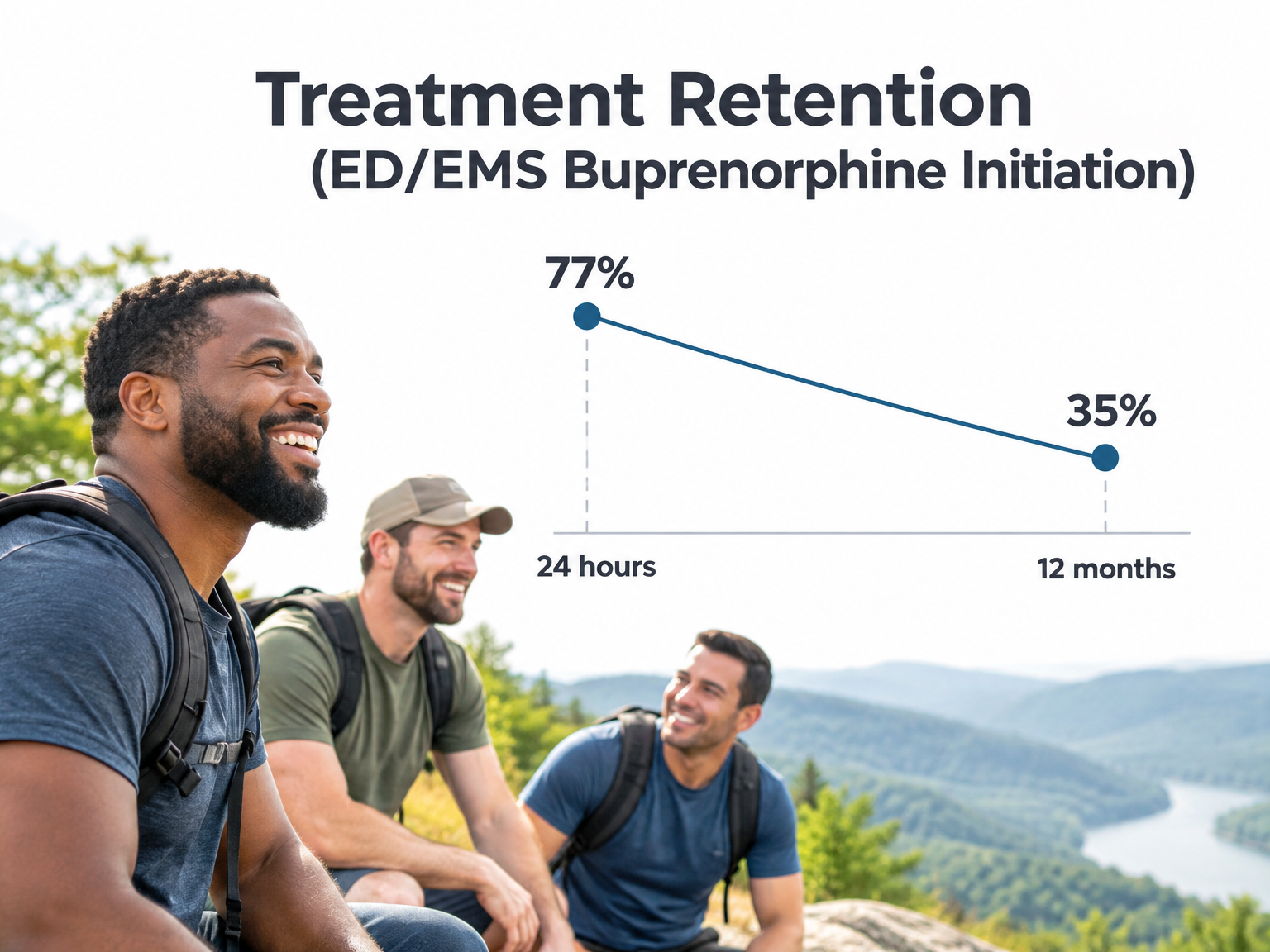
The data on what happens next is sobering. A 2025 systematic review and meta-analysis of buprenorphine started in emergency departments and emergency medical services found that retention in treatment was 77% within the first 24 hours but dropped to 35% at 12 months.20 Those figures come from acute-care initiation studies, not residential medical detox, and retention ranged across the included evidence. The broader pattern it describes is the one that matters here: early engagement is high, and without a plan for the months that follow, more than half of patients fall out of care.
A separate 2026 systematic review compared emergency-department-initiated buprenorphine with brief intervention or referral alone. Adherence was 61% with medication initiation versus 52% with brief intervention, and opioid-use prevalence was 17% versus 28%.21 Starting the medication during the acute encounter clearly outperforms a handshake and a phone number.
The practical takeaway for a man finishing a week of medical detox is similar: the medication plan you leave with, the appointment that is already on the calendar, and the people you will be in a room with next week matter more than the detox itself. A warm handoff into partial hospitalization, intensive outpatient care, or continuing medication treatment turns a stable week into a durable change. Walking out the door with a prescription and a hope is where the drop-off happens.
Where you detox in Tennessee shapes which medications are realistically on the table. Methadone for opioid use disorder is only available through certified opioid treatment programs, which the Tennessee Department of Mental Health and Substance Abuse Services oversees through the State Opioid Treatment Authority.19 If you live outside Nashville (Columbia) or Knoxville, travel distance to a certified program can matter as much as the clinical argument for methadone. Buprenorphine does not carry the same program requirement and can be started in office-based or detox settings.12
When you call a program, a short list of questions tells you most of what you need to know:
A clear answer to each question is a better signal of quality than any brochure.
If you are reading this because someone you love is weighing detox, a few things are worth knowing before the first phone call. The medications used in supervised withdrawal are not a sedative holiday or a substitute for willpower. They are short-term medical tools that lower the risk of seizures, delirium, and dangerous vital-sign swings while the body clears a substance.1 For alcohol and benzodiazepine dependence in particular, abrupt stopping at home can be life-threatening, which is why clinicians use structured tapers and monitored protocols instead.14
A common worry is that buprenorphine or methadone simply swaps one drug for another. The clinical picture is different. These medications are prescribed at steady doses that quiet cravings and withdrawal without producing the cycle of highs and crashes, and they are part of a broader care plan that includes counseling and monitoring.13
What helps most from the outside is steady presence, not pressure. Ask what the handoff from detox into ongoing care looks like, who will be on the phone the day after discharge, and how you can be part of that plan without becoming his clinician.
If you have read this far, you already know enough to make the first call. The medication piece of detox is solvable; clinicians have long established protocols for it. The harder question is what you do with the week after discharge, when the medications have done their job and the rest of your life is still there waiting.
A good next step is small and specific: pick up the phone, ask the questions in the Tennessee section above, and get an appointment on the calendar before you walk out of detox. Trifecta Healthcare Institute's admissions team can talk through medical detox, insurance verification, and what the step down into continuing care looks like for men in Knoxville or Nashville (Columbia).
[Call Trifecta] or [Verify your insurance]. The first week is hard. The second one is easier when you are not standing in it alone.
When used in a supervised setting with monitoring, yes. Benzodiazepines for alcohol, buprenorphine or methadone for opioids, and individualized tapers for benzodiazepine dependence all have strong evidence behind them when matched to the right patient and dose.1, 15 Safety comes from the pairing: the right medication, trained staff watching vital signs and symptoms, and dose adjustments as your body responds.
Most medical detox stays run three to seven days, though the timeline shifts with the substance and your history. Alcohol withdrawal typically peaks in the first 48 hours and settles over the following days.7 Opioid withdrawal eases faster with buprenorphine or methadone. Benzodiazepine tapers are different; a safe reduction can take weeks or months rather than days.14
Not safely, in most cases. Alcohol withdrawal can produce seizures and delirium tremens, and benzodiazepine withdrawal carries a similar seizure risk if the medication is stopped abruptly.14 The FDA explicitly warns against stopping benzodiazepines suddenly after sustained use. Ambulatory detox is possible for mild-to-moderate alcohol withdrawal in medically stable, supported patients with close follow-up, but severe or complicated cases belong in a monitored setting.2
No. These medications are prescribed at steady doses that quiet cravings and withdrawal without producing the highs and crashes of short-acting opioid use, and they come packaged with counseling, monitoring, and recovery supports.13 CDC and SAMHSA identify buprenorphine, methadone, and naltrexone as FDA-approved medications for opioid use disorder that reduce cravings and withdrawal.11, 13
The medications stabilize your body; the next phase builds the structure that keeps the change. Most men step down into partial hospitalization or intensive outpatient care, continue medication where indicated for opioid use disorder, and start the therapy and peer work that address what was underneath the use.13 The strongest outcomes come when the next appointment is already scheduled before you walk out of detox.
Most major insurance plans cover medically necessary detox, though specifics depend on your policy, deductible, and the facility's network status. Trifecta accepts most major commercial insurance plans; the fastest answer is a verification call. An admissions team can pull your benefits, confirm what detox and the step down into continuing care will cost, and tell you what paperwork to bring.
Between facility size limits, waivers, and state-by-state rules, figuring out your Medicaid or private insurance benefits can feel like its own full-time job. Our admissions team will verify your coverage in minutes and walk you through exactly what's available — no guesswork required.
Verify Insurance Benefits →No commitment required. Confidential & HIPAA-protected.
Whether it's you or someone you love, our team can help you figure out the next step — what treatment looks like, what's covered, or just someone to talk to.
Talk to Our TeamConfidential. No commitment required.


