


How to Choose a Dual Diagnosis Partial Hospitalization Program
Use this checklist to assess a dual diagnosis partial hospitalization program, including integrated care, medication support, Tennessee licensure, PHP fit, a...
Read More
Understand medical detox vs rehab, when withdrawal needs medical supervision, how treatment levels differ, and why planning ongoing care can reduce risk afte...
Start Your Journey NowWritten and reviewed by the clinical team at Trifecta Healthcare Institute, a men’s-only treatment center in Tennessee specializing in substance use, mental health, and dual diagnosis care.
Medical detox and rehab are two different stages of the same recovery process, not two choices on a menu. Detox is a short, medically supervised phase that keeps the body safe while a substance clears the system and acute withdrawal passes. Rehab is the longer phase that treats why substance use took hold in the first place and builds the skills, support, and medical care that make the change last.
Here is the misread that gets people hurt: the belief that finishing detox means the work is done. Federal clinical guidance is direct on this point. SAMHSA's quick guide based on TIP 45 states plainly that"detoxification alone is not sufficient in the treatment and rehabilitation of substance use disorders"and describes detox as the first door to care, not the full house behind it 1. The National Institute on Drug Abuse draws the same line, noting that withdrawal management and treatment are not the same thing 2.
So the real question for a man weighing a first call is not detox or rehab. It is which level of care comes first, and what the handoff looks like after.
Medical detox has one job: keep the body safe while a substance clears the system. In a clinical setting, that means 24-hour monitoring of vital signs, medication to blunt dangerous withdrawal symptoms, hydration and nutrition support, and a protected environment during the days when the risk of seizure, severe anxiety, dehydration, or cardiac strain is highest. SAMHSA frames detox as three linked tasks performed together:
Here is where detox stops. It does not teach a man how to handle a stressful Tuesday afternoon six weeks from now. It does not treat the depression, trauma, chronic pain, or grief that often sits underneath heavy drinking or opioid use. It does not rebuild sleep, repair relationships, or sort out work and family logistics. NIDA is explicit that withdrawal management and treatment are not the same intervention, and that completing detox should not be mistaken for completing care 2.
Think of medical detox as the emergency-room equivalent of resetting a broken bone. The acute danger passes, swelling comes down, and the fracture is stabilized. But rehabilitation — the physical therapy, the strengthening, the gradual return to load — is a separate, longer process. SAMHSA notes that detox services do not themselves provide a cure and are most useful when they open the door to the next level of care rather than close out the episode 1.
Rehabilitation picks up where detox ends and tackles the questions detox was never built to answer. Why did drinking become the easiest way to fall asleep? Why did pain pills turn into the only tool for a stressful week? What has to change in the next six months at home, at work, and in the body for the shift to hold? NIDA frames effective treatment around a few core elements that medical detox simply does not deliver on its own:
Three things rehab does that detox cannot stand out:
Detox stabilizes a crisis. Rehab is where the life gets rebuilt.
The two phases of care differ on nearly every dimension a man or his family would want to compare before making a first call. The table below puts them next to each other so the handoff from one to the other becomes obvious.
| Dimension | Medical Detox | Rehabilitation |
|---|---|---|
| Primary purpose | Safely manage acute intoxication and withdrawal 1 | Treat the substance use disorder and related life, medical, and psychological factors 2 |
| Typical duration | Several days to about a week, depending on substance and severity 1 | Weeks to months of active treatment, with alcohol use disorder care often measured in months or years 3 |
| Setting | Inpatient or closely supervised outpatient withdrawal management 1 | Residential, partial hospitalization, intensive outpatient, or standard outpatient 5 |
| Clinical focus | Vital signs, symptom control, hydration, safety, assessment 1 | Counseling, behavioral therapy, co-occurring mental health care, skills, relapse-prevention planning 2, 9 |
| Medications used | Benzodiazepines for acute alcohol withdrawal; comfort medications; initiation of buprenorphine or methadone for opioid withdrawal 3, 2 | Longer-term medications for opioid or alcohol use disorder paired with counseling, including buprenorphine, methadone, or naltrexone 2 |
| What it does not do | Does not, by itself, treat the use pattern or prevent return to use 1 | Does not substitute for medical withdrawal management when acute risk is present 1 |
Read the final row twice. The point of this comparison is not to pick a winner. It is to show that each phase has a gap the other is built to close.
Not every substance requires inpatient medical detox, and not every withdrawal is safe to ride out at home. The substance class, how long it has been used, how much, and whether other drugs are in the mix all shape the answer. The sections below walk through the three patterns that drive most detox admissions and explain where medical supervision stops being optional.
Alcohol is the substance most people underestimate. After a long stretch of heavy daily drinking, suddenly stopping can trigger withdrawal symptoms that range from tremor, sweating, and insomnia to seizures and delirium tremens. NIAAA states directly that alcohol withdrawal can be life-threatening following sudden cessation after prolonged heavy drinking, which is why clinicians treat significant acute withdrawal as a medical event rather than a willpower problem 3.
Benzodiazepines are the standard medication for clinically significant acute alcohol withdrawal, dosed and monitored in a setting equipped to catch complications early 3. The decision between inpatient and outpatient withdrawal management turns on drinking history, prior withdrawal episodes, co-existing medical conditions, and whether the home environment can support close monitoring. If a man has had a withdrawal seizure before, is drinking heavily throughout the day, or has unstable health conditions, inpatient medical detox is the safer floor to start from.
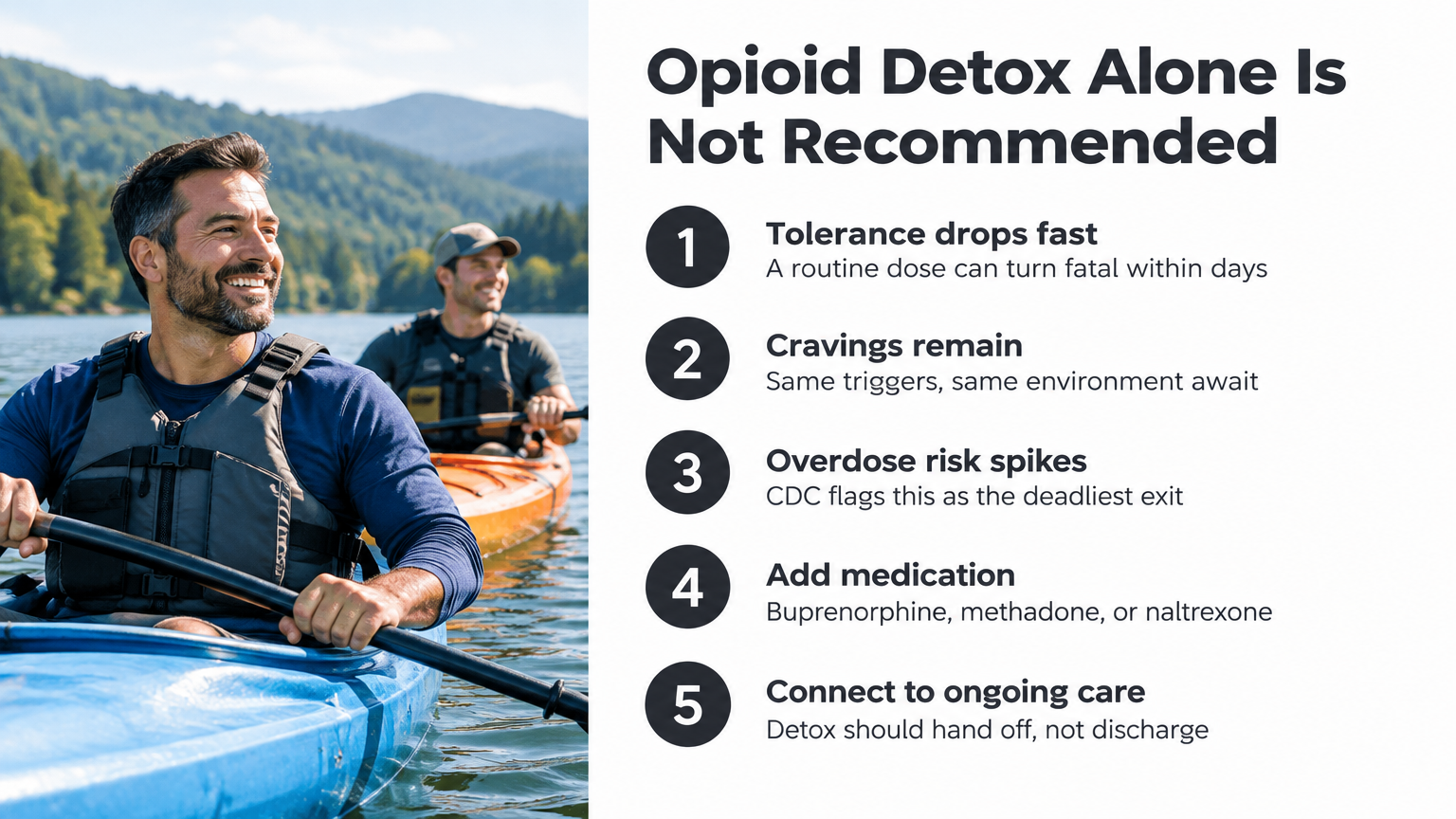
Opioid withdrawal is rarely fatal on its own, but it is intensely uncomfortable — muscle aches, gastrointestinal distress, agitation, insomnia, cravings that spike for days. The real danger lives on the other side. Tolerance drops quickly during withdrawal, and a return to the previous dose after even a short period off opioids can cause fatal overdose. CDC clinical guidance highlights elevated risk of resuming use, overdose, and overdose death after withdrawal, which is why medications for opioid use disorder are meant to begin during detox rather than after 4.
Buprenorphine and methadone can be started as part of managed withdrawal and continued into ongoing treatment, blunting cravings and lowering overdose risk 2, 4. Opioid detox without a medication plan is the pattern most strongly linked to the deadliest outcomes.
Benzodiazepine withdrawal, like alcohol, can produce seizures and belongs in a supervised taper rather than an abrupt stop. Stimulant withdrawal from cocaine or methamphetamine is less physically dangerous but often brings deep depression, exhaustion, and suicidal thinking that need a safe setting to pass through. Polysubstance use — alcohol with opioids, benzodiazepines with stimulants — raises the risk of every category stacked together, and SAMHSA's TIP 45 guidance treats careful evaluation as the first task of detox for exactly this reason 1.
"Detoxification on its own, without medications for opioid use disorder, is not recommended"because it is linked to higher risks of resumed use, overdose, and overdose death after withdrawal 4.
There are three FDA-approved medications for opioid use disorder: buprenorphine, methadone, and naltrexone 4. The first two can be started during withdrawal itself and continued into ongoing care. Opioid detox that connects directly to one of these medications is a different clinical event from opioid detox that ends at discharge. For anyone weighing a first call about opioid use, that connection is the question to ask.
Rehab is not one setting. It is a tiered set of options that step down as stability grows, and the right starting point depends on withdrawal risk, home environment, work and family demands, and whether a man needs a protected space to focus or structured hours he can wrap around daily life. The four most common rungs after medical detox are residential, partial hospitalization (PHP), intensive outpatient (IOP), and standard outpatient care.
One useful finding to carry into this choice comes from an observational study of opioid use disorder care: residential treatment was linked to better six-month retention, but it did not reduce opioid overdose or opioid-related emergency outcomes compared with outpatient care. Medication treatment, on the other hand, was tied to significantly lower overdose risk regardless of setting 7. The lesson is practical. Setting shapes structure and protection. Medication and sustained engagement shape safety.
Residential rehab provides a substance-free environment with 24-hour support, which can matter most when a man's home or neighborhood exposure actively works against treatment goals 8. Days are built around group and individual therapy, medical and psychiatric care, and skills work, without the daily pulls of job sites, old routines, or old company.
Partial hospitalization is a step down — intensive clinical days with evenings and nights spent at home or in supportive housing. PHP suits men who are medically stable after detox but still need intensive therapy hours and close monitoring before returning to a lighter schedule 2.
Intensive outpatient programs offer structured hours of group therapy, individual sessions, and medication management, scheduled around work and family. A peer-reviewed review of IOP evidence found high-quality support that these programs reduce alcohol and drug use, with outcomes comparable to inpatient or residential care in many studies for patients who do not need medical detox or 24-hour supervision 5. The same review noted wide variation in how IOPs are structured, so hours, therapy mix, and medication support are fair questions to ask on a first call.
Standard outpatient care is lighter still — less frequent sessions, continued medication for opioid or alcohol use disorder when prescribed, and a maintenance rhythm that fits long-term recovery. Treatment needs and duration vary from person to person, and care should be matched to individual needs rather than a fixed program length 2.
Men who come in for substance use often arrive carrying something else too — a long run of anxiety, a depression that predates the drinking, untreated PTSD from military service or a bad accident, grief that never had anywhere to go. Those conditions and the use pattern feed each other, and treating one without the other tends to leave both intact. NIMH describes integrated care — coordinating mental health and substance use treatment through behavioral therapies, medications, and care management — as the standard for people living with both 9.
Here is the catch that frustrates families: a clean diagnosis of what is underneath often cannot be made during the first week. Withdrawal itself produces anxiety, low mood, sleep disruption, and irritability that look identical to a primary mental health condition. NIMH is explicit that symptoms overlap and that accurate diagnosis matters, which is why clinicians typically watch, reassess, and refine the picture over time rather than labeling everything on intake 9. That patience is not a delay in care. It is how co-occurring treatment avoids chasing symptoms that belong to withdrawal and missing the ones that will still be there in six weeks.
Structured physical activity has earned a real, if measured, place in substance use disorder care. A 2024 systematic review and meta-analysis of 17 randomized controlled trials involving 1,905 patients found that exercise interventions produced significant improvements in alcohol dependence measures, daily drinks, AUDIT scores, physical status, anxiety, depression, and stress for people in treatment for alcohol use disorder 10. That is a solid base of evidence for programming built around movement as part of the clinical day.
Two honest caveats sit alongside it. The trials studied exercise as an adjunct, not a replacement for therapy, medication, or medical withdrawal management 10. And no single activity, intensity, or routine has been shown to guarantee recovery or prevent return to use. What the evidence supports is this: when programming like boxing, jiu-jitsu, hiking, or strength work is woven into rehab alongside counseling and, when appropriate, medication, it can contribute meaningfully to mood, physical health, and the ability to stick with the harder clinical work.
Discharge is not a finish line. It is a handoff, and the weeks right after formal treatment are when the risk of return to use climbs. A 2025 study of relapse risk after non-hospital residential treatment underscored that the post-discharge window is a high-risk transition that calls for structured follow-up and clear connection to the next level of care rather than a quiet goodbye at the door 8.
Continuing care is the term for what fills that window. Think weekly or biweekly check-ins, continued medication for opioid or alcohol use disorder when prescribed, step-down therapy, peer groups, and alumni programming that keeps a man connected to the people he got sober with. A peer-reviewed review of continuing care across alcohol and drug use disorders found generally supportive evidence, with more consistently positive effects when care lasted longer and used active efforts to keep patients engaged — reaching out, following up, re-engaging people who miss sessions rather than waiting for them to come back on their own 6. The review was honest about limits: effect sizes in individual studies were often small, and formats vary widely.
The practical read: the full sequence of care runs from assessment through medical detox, PHP, IOP, and outpatient to alumni and continuing support, with the entry point set by withdrawal risk rather than preference 1. The longer and more active the back half, the better the odds the earlier work holds 6.

A note to the wives, partners, parents, and adult children reading this on his behalf: what helps him move is almost never a longer argument. It is a shorter list of options and a clear next action. Clinicians who treat substance use disorders describe the first useful step as a professional assessment that sorts out withdrawal risk, substance pattern, and any co-occurring mental health concerns, rather than deciding on a program before the clinical picture is clear 1, 9.
Three practical moves tend to help:
For men in Tennessee, the practical question is rarely whether detox and rehab exist. It is whether they connect without a gap. A completed detox that hands a man a discharge paper and a phone number is a different clinical event from a detox that walks him into partial hospitalization or an intensive outpatient program the same week. The post-discharge window is a documented high-risk transition, and structured follow-up at that handoff is what the evidence supports 8.
Two local realities shape the choice. In East Tennessee, men searching for Knoxville rehab for men often prioritize programs that keep the full continuum — detox through PHP, IOP, and continuing care — under one clinical team so the treatment plan does not reset at each step. Around the Nashville area, where several programs including Trifecta's Columbia, TN facility serve middle Tennessee, the same question applies: does the Nashville rehab option arrange medication for opioid or alcohol use disorder started during detox and carry it into ongoing care, or does it end at the detox door 2, 4? Ask that on the first call.
The decision tree is shorter than most people expect. Three questions sort the first move.
No. Medical detox safely manages acute withdrawal over a few days, while rehab is the longer phase that treats the substance use disorder itself through counseling, medication when appropriate, and co-occurring mental health care. SAMHSA describes detox as the first door to treatment, not treatment on its own 1.
Sometimes, yes. Men who are not in acute withdrawal and do not need 24-hour medical monitoring can start directly in a rehab setting such as PHP or IOP, and evidence supports comparable outcomes in appropriate patients 5. If heavy daily drinking, benzodiazepine use, or significant medical conditions are in play, medical detox comes first 3.
Medical detox typically runs several days to about a week, depending on the substance and severity 1. Rehab is measured in weeks to months of active treatment, with alcohol use disorder care often extending across months or years when counseling, medication, and continuing support are included 3, 6.
No, and this is the single most important safety point in opioid care. CDC clinical guidance states that detoxification alone, without medications for opioid use disorder, is not recommended because of elevated risks of resumed use, overdose, and overdose death after withdrawal 4. A detox that connects directly to buprenorphine, methadone, or naltrexone is a different clinical event 2.
Both paths exist. A peer-reviewed review found intensive outpatient programs reduce alcohol and drug use with outcomes comparable to residential care for patients who do not need 24-hour supervision 5. Residential care offers a substance-free environment that helps when the home setting works against treatment goals 8. The right level depends on withdrawal risk, medical needs, and daily environment.
Clinicians expect it and watch it over time. NIMH notes that symptoms of withdrawal can overlap with anxiety, depression, and other conditions, so accurate diagnosis often requires repeated assessment rather than a label on day one 9. Integrated care that coordinates mental health and substance use treatment is the standard once the clinical picture becomes clear 9.
Between facility size limits, waivers, and state-by-state rules, figuring out your Medicaid or private insurance benefits can feel like its own full-time job. Our admissions team will verify your coverage in minutes and walk you through exactly what's available — no guesswork required.
Verify Insurance Benefits →No commitment required. Confidential & HIPAA-protected.
Whether it's you or someone you love, our team can help you figure out the next step — what treatment looks like, what's covered, or just someone to talk to.
Talk to Our TeamConfidential. No commitment required.


