


How to Choose a Dual Diagnosis Partial Hospitalization Program
Use this checklist to assess a dual diagnosis partial hospitalization program, including integrated care, medication support, Tennessee licensure, PHP fit, a...
Read More
Learn what to expect during meth detox knoxville, why 24/7 clinical monitoring matters, what to ask local programs, and how care continues after withdrawal.
Start Your Journey NowWritten and reviewed by the clinical team at Trifecta Healthcare Institute, a men’s-only treatment center in Tennessee specializing in substance use, mental health, and dual diagnosis care.
Meth detox in the Knoxville area offers medically supervised withdrawal care, ensuring safety during the 5 to 14 days when the body and brain adjust to being off methamphetamine. The most challenging period typically occurs within the first 72 hours 2. Unlike alcohol withdrawal, which can involve seizures and tremors, the danger with meth withdrawal is more subtle: a severe crash into exhaustion, dysphoria, and in some cases, suicidal thoughts or paranoia, often coinciding with intense cravings 1, 14.
A medically monitored detox program is designed to manage this critical window. Withdrawal symptoms usually begin within hours of the last use and peak around day two or three. These symptoms can include hypersomnia, a flat or hopeless mood, irritability, vivid dreams, significant appetite swings, and overwhelming cravings 1, 3. Admission to detox provides supportive care, 24/7 nursing observation, and screening for depression and psychosis, as stimulant withdrawal depression can be prolonged and intense, requiring more than willpower alone 14.
While the acute phase is survivable and relatively short, the period immediately following presents significant risks. Post-acute symptoms, such as low mood, poor concentration, and cravings, can persist for weeks, and sometimes up to six months. This is why detox is most effective when it transitions directly into continuing care 3, 4.
Methamphetamine withdrawal follows a generally predictable pattern, allowing clinical teams in the Knoxville area to plan care effectively. Symptoms typically start within hours of the last use, progress through an acute phase lasting approximately 5 to 14 days, and reach their peak around the 72-hour mark 2. Many individuals are unprepared for the post-acute phase that follows the first week, characterized by dysphoria, anxiety, cognitive fog, and cravings that can continue for up to six months 3.
The following is a general illustrative timeline synthesized from clinical descriptions in the current literature; individual experiences vary 1, 2, 3:
A 5-to-7-day detox stay addresses the medically riskiest part of withdrawal but not the entire recovery journey. A plan that concludes at discharge leaves an individual vulnerable during the period when relapse is most probable. Therefore, reputable East Tennessee programs view acute admission as the initial segment of a continuous care continuum, rather than a standalone solution 4.
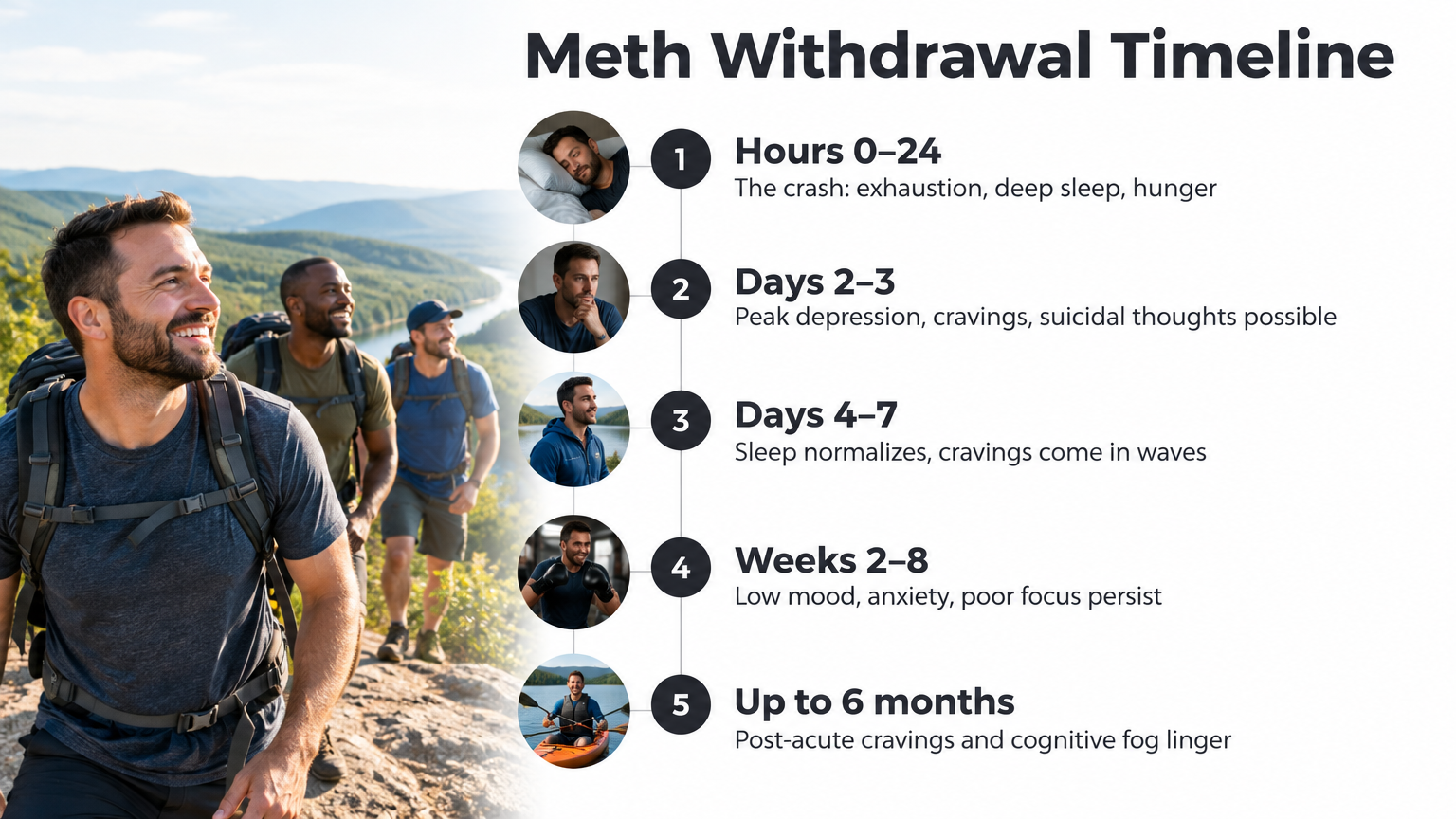
While alcohol and benzodiazepine withdrawal can lead to visible emergencies like seizures and delirium tremens, methamphetamine withdrawal typically does not. An individual withdrawing from meth often appears to have a severe flu and a poor mood: sleeping for extended periods, eating minimally, becoming irritable, and staring blankly. This quiet presentation makes the acute withdrawal window easy to underestimate.
Knoxville-area clinicians maintain round-the-clock observation during the first 72 hours due to several specific concerns:
Attempting to manage the first week of withdrawal alone, whether in a Knoxville apartment or a spare bedroom, often leads to relapse. The physical urge for the drug is not what typically breaks resolve on day three; rather, it is the depression and intense cravings. A medically monitored setting provides the necessary support to navigate this specific window with constant attention.
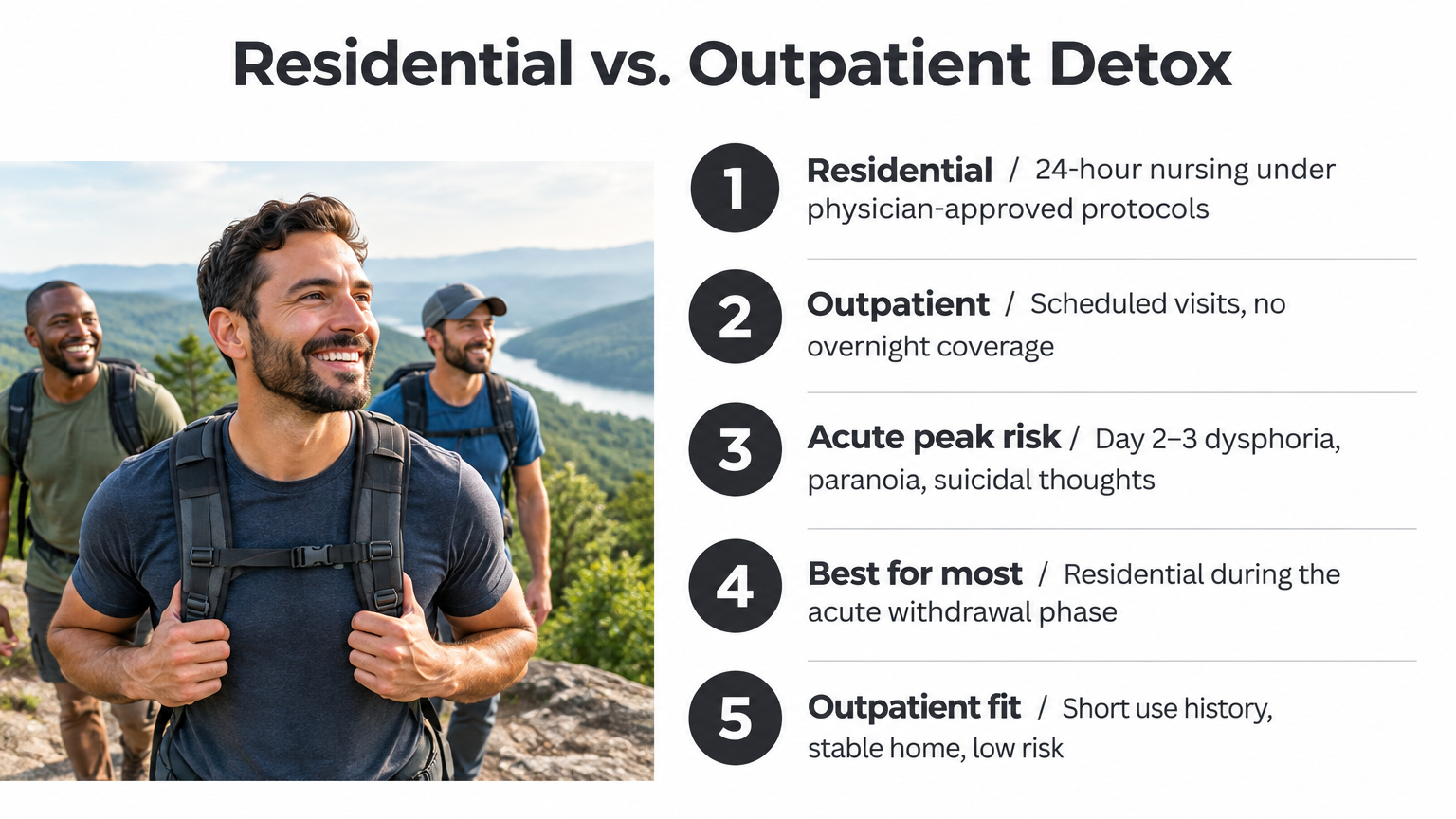
Tennessee licenses two distinct types of detox programs, and a facility's website description may not always align with its official licensed level of care. The state's Department of Mental Health and Substance Abuse Services defines residential detoxification treatment facilities as providing intensive 24-hour residential care. This care aims to reduce or eliminate a toxic agent until withdrawal signs and symptoms resolve, delivered under physician-approved policies and clinical protocols. Outpatient detoxification is a separate category, structured around scheduled visits rather than continuous overnight nursing coverage 12.
For most individuals withdrawing from methamphetamine, residential detox is the appropriate choice during the acute phase. While meth withdrawal typically does not produce the same medical emergencies as alcohol or benzodiazepine withdrawal, the peak-crash window around day two or three brings profound dysphoria, potential suicidal thoughts, possible residual paranoia, and intense cravings that are difficult to manage without constant supervision 14, 2. Twenty-four-hour nursing observation transforms this critical period from a gamble into a clinically managed process.
Outpatient detoxification may be suitable for a narrower range of situations, such as a shorter history of use, strong housing and support at home in Knox or a surrounding East Tennessee county, no active suicidal ideation, no psychosis, and no complicating medical or co-occurring substance use issues 2. It offers a less intensive clinical environment and is not a shortcut to recovery.
When contacting programs in the Knoxville area, it is advisable to ask about their specific Tennessee license and the nature of their overnight medical coverage. A residential detox program should have on-site nursing around the clock and physician-directed protocols. If a program describes itself as detox but only provides staff during business hours, it is an outpatient detoxification program. While a legitimate level of care for the right individual, it is not the same as residential care.
A typical medically monitored detox admission lasts approximately five to seven days, aligning with the 5-to-14-day acute withdrawal window and the 72-hour symptom peak described in clinical literature 2. The daily routine is straightforward, primarily involving nursing care, rest, meals, hydration, assessment, and quiet observation as the brain and body stabilize.
Day 1 – Intake and the crash. Upon arrival, individuals are often exhausted, sometimes still experiencing the effects of the stimulant. A nurse takes vital signs and a medical history. A clinician conducts a substance use assessment, covering other drugs (opioids, alcohol, benzodiazepines, which can alter the treatment plan), mental health history, and any existing medical conditions. Bloodwork, a brief physical examination, and a safety screening for suicidal thoughts are completed early 14. The individual typically then gets an extended period of sleep.
Days 2–3 – The peak window. This is when continuous nursing presence is most crucial. Vital signs are regularly checked. Staff monitor for signs of agitation, psychosis, severe sleep disruption, or cardiovascular symptoms that may require further evaluation 2. Suicidality screenings continue, as withdrawal depression can be prolonged and intense 14. Symptom-targeted medications may be administered under physician direction for sleep, anxiety, or specific psychiatric concerns; there is no stimulant-specific withdrawal medication 14.
Days 4–5 – Beginning to stabilize. Sleep patterns start to normalize, and appetite returns. Mood remains uneven, concentration is still impaired, and cravings occur intermittently. Clinical focus shifts towards co-occurring assessment, examining depression, anxiety, trauma-related symptoms, and any residual psychosis. Integrated treatment of these conditions alongside substance use generally leads to better outcomes than treating them sequentially 13.
Days 6–7 – Discharge planning and warm handoff. Acute symptoms have subsided, but the post-acute phase is just beginning. This stage determines whether the admission serves as a bridge to continued recovery or a dead end. A well-structured program arranges the next level of care—typically a partial hospitalization or intensive outpatient program with evidence-based therapies for stimulant use disorders—before discharge 4. Leaving without this planned transition significantly increases the risk of relapse.
Many families contacting an admissions line in the Knoxville area are surprised to learn that there is no FDA-approved medication specifically for methamphetamine use disorder, nor a single pill that can eliminate the withdrawal crash 1. Federal clinician guidance on stimulant detoxification is clear: no medication has been developed specifically for stimulant withdrawal. Clinical care focuses on close observation, symptom-targeted support, and monitoring for suicidality 14.
However, medications do play a role. During acute admission, a physician may prescribe short-term support for sleep, anxiety, or specific psychiatric symptoms. Some clinical reviews note that agents like mirtazapine or bupropion have been studied for selected symptoms or to reduce methamphetamine use in certain patients, though evidence and suitability vary 2. These are clinical judgments, not standard protocols.
Newer research, while promising, is more relevant to continuing care than to the detox setting. For example, the ADAPT-2 trial, which combined extended-release injectable naltrexone with oral extended-release bupropion, showed a weighted response of 13.6% compared to 2.5% with placebo over 12 weeks 7. A 2025 randomized trial of lisdexamfetamine found only weak evidence of benefit at 13 weeks 8. These are modest findings in motivated trial populations, not readily available cures. A clinician discussing these options would typically describe them as considerations for after detox stabilization, in coordination with the next level of care.
Given that the medical risks of methamphetamine withdrawal are primarily psychiatric, comprehensive assessment is a critical component of a detox admission. Nursing and clinical staff vigilantly monitor for specific presentations that make this period dangerous: a mood drop leading to hopelessness, intrusive thoughts of self-harm, residual paranoia, and sleep disruption severe enough to induce psychosis.
Federal guidance prioritizes this, advising clinicians to closely monitor individuals withdrawing from amphetamines for suicidality, as withdrawal depression can be prolonged and intense 14. Peer-reviewed clinical reviews further indicate that agitation, psychosis, severe sleep disruption, and cardiovascular symptoms can manifest during the acute window, potentially requiring additional medical evaluation 2. These screenings are not a one-time intake process but are repeated throughout the stay, particularly around the 72-hour peak.
Often, withdrawal reveals pre-existing co-occurring conditions: untreated depression, an anxiety disorder, a history of trauma, unresolved grief, or periods of psychotic symptoms that coincided with heavy substance use. NIDA's guidance on co-occurring disorders emphasizes that these conditions are often best treated concurrently with the substance use disorder, and integrated treatment can improve health outcomes 13. Addressing one condition while neglecting the other often leaves the underlying issues that fueled substance use unresolved.
In a Knoxville-area detox setting, this integrated approach includes:
Detoxification addresses the physical presence of the drug but does not treat the underlying condition. The federal consensus on stimulant use disorders is that detox is an initial step that must connect to ongoing evidence-based treatment. The most effective practices include motivational interviewing, contingency management, the community reinforcement approach, and cognitive behavioral therapy 4. These modalities are typically integrated within a structured program.
Contingency management, often unfamiliar to many, has a strong research signal. It involves providing tangible incentives for verified drug-negative tests, and SAMHSA identifies it as a proven intervention particularly effective for stimulant use disorders 5. A 2025 network meta-analysis of 72 randomized trials involving 6,836 participants found low-certainty evidence that contingency management, either alone or combined with CBT, may extend abstinence 6. Low-certainty evidence means the findings are suggestive but not definitive, and additional research is needed.
In a Knoxville men's program, this evidence-based approach typically involves a step-down from detox into a partial hospitalization program (PHP) and then an intensive outpatient program (IOP). These programs incorporate individual CBT, group work, motivational interviewing, and co-occurring care for depression, anxiety, or trauma 4, 13. Movement-based programming—such as boxing, jiu-jitsu, hiking in the Smokies, or structured gym work—is often integrated into the daily rhythm, providing an outlet for post-acute energy alongside therapy.
Regarding medications, emerging combinations like naltrexone plus bupropion show modest signals in trial populations but are not standard detox protocols. These discussions belong in continuing care with a physician, not in the detox room itself 7, 9. The most impactful treatment after detox is the structured program an individual enters on day eight, rather than a prescription on day two.
Families are often the first to notice significant changes. A spouse, parent, or adult child in Knoxville observing someone go days without sleep, experience rapid weight loss, or spiral into paranoia is frequently the one who initiates contact for help. If you are in this situation, some clear guidance may be helpful.
Effective communication is typically brief, concrete, and avoids ultimatums. Consider saying something like:"I'm worried about you. I believe you need medical help to get through the next few days, and I will assist you in getting there today."Emphasizing the medical aspect is crucial, as many individuals mistakenly believe detox is about punishment or willpower, rather than nursing care, rest, and safety during a 72-hour peak 2. Avoid stigmatizing labels, as they can shut down conversation and are not how clinicians describe the condition.
For serious but non-emergency situations—such as heavy substance use, poor sleep, worsening mood, or cravings that cannot be managed—contacting a medically monitored detox program in the Knoxville area is the appropriate next step. Be prepared with an ID, an insurance card, and a brief list of substances used in the last week. You do not need to have the complete story; the intake team is trained to gather the necessary information.
The most challenging aspect of starting meth detox is often not the admission itself, but the hesitation before making the call. This is when individuals might convince themselves they can manage withdrawal alone or that seeking help signifies failure. Neither is true. Entering a medically monitored setting means accessing nursing care, rest, and a safe environment during the 72-hour window when the brain is most vulnerable to deceptive thoughts 2, 14.
A practical first step can be small. Gather an ID and an insurance card. Document the substances used in the last week, including alcohol and any opioids, as this detail is crucial for the clinical plan 2. Then, call an East Tennessee admissions line and ask two direct questions: what level of Tennessee detox license the program holds, and what the transition into PHP or IOP looks like on day seven 12, 4.
Recovery from methamphetamine use is not confined to a single week in a quiet room. It encompasses that week, followed by the structure, therapy, and brotherhood that support an individual on the other side. The next step is a phone call. [Call Trifecta] or [Verify your insurance] to start the conversation today.
Acute withdrawal typically lasts 5 to 14 days, with the most intense period occurring around the 72-hour mark 2. Most Knoxville-area medically monitored admissions are five to seven days to cover this peak. Post-acute symptoms such as low mood, poor concentration, and cravings can persist for weeks, and sometimes up to six months, underscoring the importance of continuing care after discharge 3.
While methamphetamine withdrawal typically does not produce seizures like alcohol or benzodiazepine withdrawal, federal clinician guidance recommends close monitoring for suicidality due to potentially prolonged or intense withdrawal depression 14. Agitation, residual psychosis, severe sleep disruption, and cardiovascular symptoms can also occur and may require evaluation 2. For most individuals with regular use, a medically monitored setting provides a safer option through the 72-hour peak.
No. There is no FDA-approved medication specifically for methamphetamine use disorder, nor any medication developed specifically for stimulant withdrawal 1, 14. A physician may use short-term, symptom-targeted support for sleep, anxiety, or specific psychiatric concerns 2. Emerging combinations, such as naltrexone plus bupropion, show modest signals in trials but are not standard detox protocols and are typically discussed in continuing-care conversations with a physician 7.
Tennessee licenses residential detoxification facilities as intensive 24-hour residential treatment, operating under physician-approved policies and clinical protocols, with nurses on-site around the clock 12. Outpatient detoxification is a separate licensed category structured around scheduled visits rather than overnight coverage 12. For most individuals withdrawing from methamphetamine, residential care is appropriate for the acute phase due to the significant mood crash and craving intensity experienced around day two or three 14.
Detox is the initial phase of care, not the complete treatment. SAMHSA identifies motivational interviewing, contingency management, the community reinforcement approach, and cognitive behavioral therapy as core practices for stimulant use disorders 4. In Knoxville, this typically involves transitioning into a partial hospitalization program and then an intensive outpatient program, with integrated care for co-occurring depression, anxiety, or trauma 13.
Keep conversations concise, concrete, and free of stigmatizing labels. Emphasize the medical aspect: the need for nursing care, rest, and safety during the 72-hour peak of withdrawal 2. Call 911 for active suicidal statements, psychosis, chest pain, seizures, or suspected overdose, especially if opioids may be involved alongside stimulants 14. For serious but non-emergency situations, contact a Knoxville-area medically monitored detox program with an ID, insurance card, and a brief list of substances used.
Between facility size limits, waivers, and state-by-state rules, figuring out your Medicaid or private insurance benefits can feel like its own full-time job. Our admissions team will verify your coverage in minutes and walk you through exactly what's available — no guesswork required.
Verify Insurance Benefits →No commitment required. Confidential & HIPAA-protected.
Whether it's you or someone you love, our team can help you figure out the next step — what treatment looks like, what's covered, or just someone to talk to.
Talk to Our TeamConfidential. No commitment required.


