


How to Choose a Dual Diagnosis Partial Hospitalization Program
Use this checklist to assess a dual diagnosis partial hospitalization program, including integrated care, medication support, Tennessee licensure, PHP fit, a...
Read More
Compare non medical detox with medically supervised care, learn which withdrawal risks require clinical monitoring, and identify the safer level of support.
Start Your Journey NowWritten and reviewed by the clinical team at Trifecta Healthcare Institute, a men’s-only treatment center in Tennessee specializing in substance use, mental health, and dual diagnosis care.
Non medical detox is a clinically managed withdrawal setting that relies on structure, supervision, counseling, and peer support rather than 24-hour medical and nursing care. Staff are typically counselors and trained technicians who monitor comfort and safety, maintain a predictable daily rhythm, and connect each man to the next step of care. Medications are limited or not used at all, and anyone whose symptoms escalate is transferred to a higher level of care.
In older language, this is sometimes called a social model detox. Tennessee programs often describe it as clinically managed residential withdrawal, which sits a step below medically monitored withdrawal, where physicians, nurses, and physician-approved protocols run the clinical day.
Non medical detox is not a "natural" alternative to real care, nor is it inherently safer. It is also not a treatment program. Federal guidance clarifies that detoxification of any kind is not the same as treatment, and withdrawal management without follow-on care usually leads back to substance use7.
This setting can be appropriate for a man with milder withdrawal risk, a stable medical history, no prior seizures or delirium tremens, no heavy benzodiazepine use, and a plan to move into ongoing treatment the moment detox ends11. The practical takeaway is that non medical detox is a supervised doorway, not a destination. The right question is whether a man's substance, symptoms, and history actually match what this setting can safely handle.
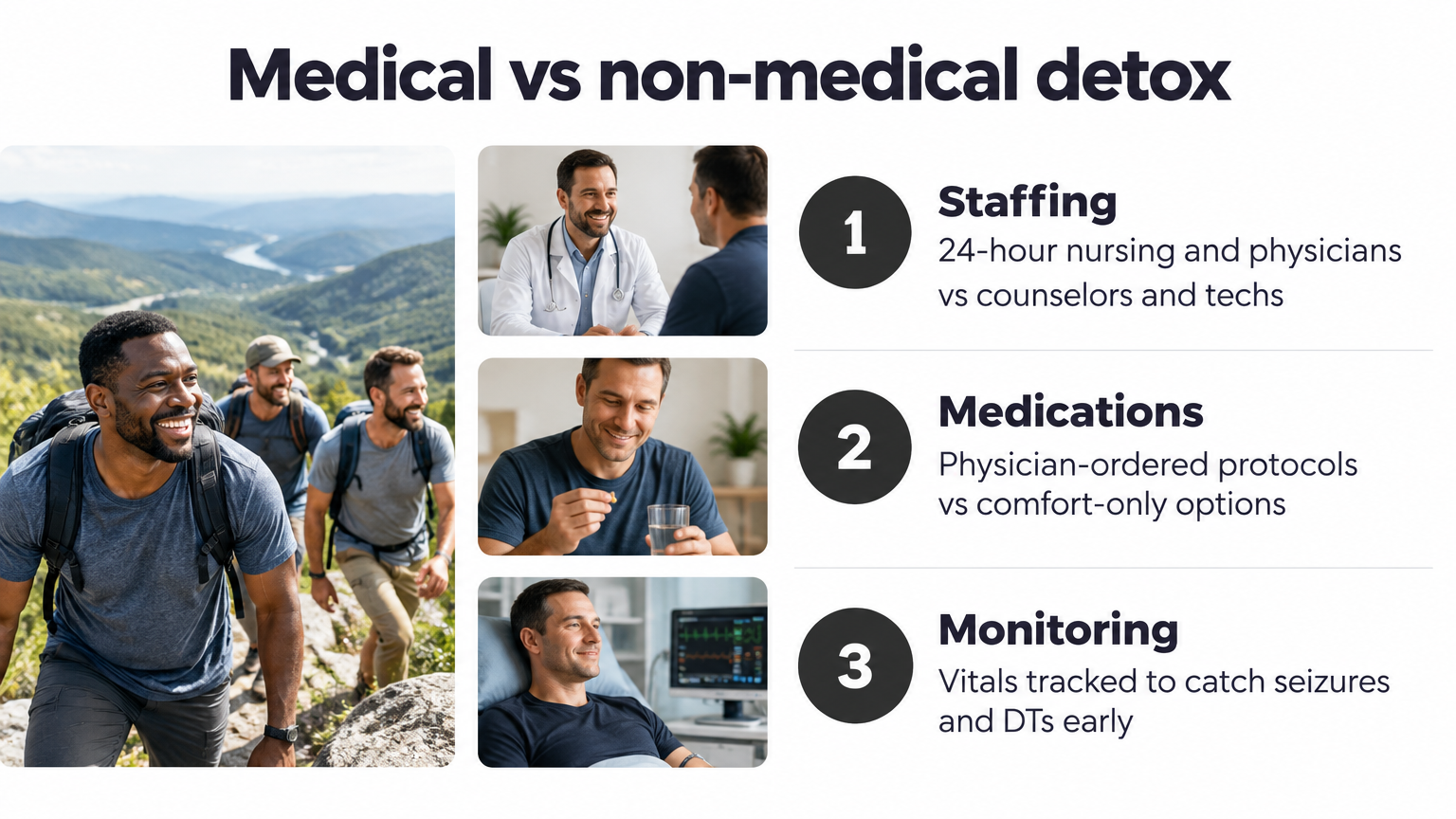
Medical detox is built around a clinical team working under physician-approved protocols, with the ability to treat withdrawal as a medical event the moment it starts to escalate. The gap between the two settings shows up most clearly in three places: who is in the building, what they can give a patient, and how closely they watch what the body is doing.
Staffing. Non medical detox is typically staffed by counselors, recovery support technicians, and case managers. They provide structure, hydration, meals, groups, and a steady eye on how each man is coping. Medical detox adds 24-hour nursing and on-call or on-site physicians, often with an addiction medicine specialist overseeing care. That team can respond to a rising heart rate, a blood pressure spike, confusion, or a seizure in minutes rather than waiting for a transfer.
Medications. This is where the two models part ways. Non medical settings keep medications limited: comfort items for sleep, nausea, or headache, and sometimes a short course of a non-controlled option if a prescriber is involved. Medical detox uses physician-ordered protocols. For alcohol withdrawal, benzodiazepines remain the established treatment because they reduce acute symptoms and help prevent seizures and delirium tremens3. For opioid use disorder, medical detox can start FDA-approved medications for opioid use disorder, including buprenorphine, methadone, and naltrexone, and connect the patient to ongoing treatment with those medications5. For benzodiazepine dependence, a medical team can design an individualized, gradual taper rather than a rigid schedule, which the FDA specifically recommends because no single taper fits everyone10.
Monitoring. Non medical programs rely on scheduled check-ins, observation, and clear escalation rules. Medical detox adds continuous vital-sign tracking and structured withdrawal scoring, such as the CIWA-Ar for alcohol, with repeated reassessment as symptoms shift. This is crucial because moderate-to-severe alcohol withdrawal generally requires inpatient care with frequent symptom and vital-sign checks, especially when risk factors like prior seizures, delirium, medical comorbidities, older age, or benzodiazepine dependence are present11.
Setting. Non medical detox usually looks residential and home-like, with a social-model feel. Medical detox runs in a medically monitored residential unit or a hospital, depending on severity. The VA/DoD clinical practice guideline specifically favors inpatient medically supervised withdrawal for men with severe withdrawal, prior delirium tremens or withdrawal seizures, inability to tolerate oral medication, serious co-occurring medical conditions, concurrent withdrawal from other substances, repeated unsuccessful outpatient attempts, or active psychosis1.
Best-fit risk profile. Non medical detox is designed for lower-risk withdrawal in a man with a stable medical and psychiatric picture and a clear handoff into treatment. Medical detox is designed for the risk profile above, plus anyone whose symptoms could change fast enough to need a medication order written in the next hour, not the next day.
Both settings can be the right call, but they are not interchangeable. The decision turns on what the body is likely to do during withdrawal and who is standing there when it does.
Alcohol is the substance where the gap between non medical detox and medical detox matters most, because the body's reaction to stopping can range from uncomfortable to life-threatening. Up to half of people with alcohol use disorder may experience withdrawal symptoms when they stop drinking, according to NIAAA2. This figure describes men and women who already have alcohol use disorder and then stop, not the general population of drinkers, and it is the reason a careful setting decision comes first.
Mild alcohol withdrawal usually looks like anxiety, shaky hands, sweating, trouble sleeping, nausea, and a racing pulse. In a man with no major risk factors, that picture can sometimes be managed in an ambulatory or clinically managed setting with close observation and a clear plan for escalation11. Non medical detox can fit here, as long as the program screens honestly and keeps a medical pathway ready.
Moderate-to-severe withdrawal is a different animal. Hallucinations, severe tremor, high blood pressure, confusion, withdrawal seizures, and delirium tremens all land in this range, and this is where inpatient medical care with repeated symptom and vital-sign reassessment becomes the standard11. Benzodiazepines remain the established treatment for medically managed alcohol withdrawal because they reduce acute symptoms and help prevent seizures and delirium tremens3. A non medical setting cannot write that order or run that protocol.
Several factors push a man into the medical column before withdrawal even starts: prior withdrawal seizures or delirium tremens, long-standing heavy drinking, benzodiazepine dependence, serious medical conditions, older age, or active psychiatric symptoms11. Any one of these raises the stakes enough that a social-model floor is the wrong place to find out how the body is going to react.

Alcohol gets most of the attention in detox conversations, but opioids, benzodiazepines, and polysubstance withdrawal each change the setting decision in ways non medical detox cannot work around. The substance drives the clinical answer. Preference does not.
Opioids. Opioid withdrawal rarely kills a man directly, but detox alone is still the wrong plan. The CDC explicitly states that detoxification on its own, without medications for opioid use disorder, is not recommended due to increased risks of resumed opioid use, overdose, and overdose death4. This is because tolerance drops fast during abstinence, and a return to a previously tolerated dose can cause a fatal overdose6. CDC Recommendation 12 pushes care toward buprenorphine, methadone, or naltrexone, the three FDA-approved medications for opioid use disorder, started during withdrawal and continued afterward5. A non medical program cannot induct buprenorphine, dose methadone, or run naltrexone safely. Ultrarapid detox under anesthesia is not a shortcut either; CDC states it carries substantial risks, including death, and should not be used6. For opioid use disorder, the real question is not non medical versus medical detox. It is which medical setting can start medication and hand off to ongoing treatment the same week.
Benzodiazepines. Benzodiazepine withdrawal is the quietest emergency in this category. The FDA warns that abruptly stopping or rapidly reducing benzodiazepines can cause serious withdrawal reactions, including seizures, and states that no single tapering schedule is appropriate for everyone10. This is the opposite of what a non medical setting can offer. A safe benzodiazepine taper requires an individualized plan from a prescriber, adjusted to dose, duration of use, half-life, and symptoms as they appear. Any man coming off daily benzodiazepines, whether prescribed or not, needs a medical team writing the taper, not a social-model floor watching for a seizure.
Polysubstance withdrawal. When alcohol stacks with benzodiazepines, opioids with alcohol, or stimulants with sedatives, the risk picture compounds. The VA/DoD clinical practice guideline specifically favors inpatient medically supervised withdrawal when a man is withdrawing from more than one substance at the same time1. NIAAA notes that medication decisions get harder when alcohol withdrawal co-occurs with opioid or other sedative use, because of oversedation and respiratory depression risks3. Stimulants on their own, like methamphetamine or cocaine, do not usually produce dangerous physical withdrawal, but the crash can bring severe depression and suicidal thinking, which is its own clinical reason to be around people trained to respond.
The pattern across all three is the same. Non medical detox was built for a narrow lane: a man coming off alcohol with mild symptoms, a clean medical history, and no sedative or opioid dependence in the mix. Opioids, benzodiazepines, and polysubstance use fall outside that lane. The honest move is to say so up front and start with the setting that can actually treat what is happening.
Some men should not start withdrawal in a non medical setting, full stop. The clearest list comes from the VA/DoD clinical practice guideline, which identifies the situations that favor inpatient medically supervised withdrawal: severe withdrawal, prior delirium tremens or withdrawal seizures, inability to tolerate oral medication, serious co-occurring medical conditions, concurrent withdrawal from more than one substance, repeated unsuccessful outpatient attempts, inability to complete outpatient care, and active psychosis1. Any one of these is a reason to pick up the phone and ask for medical detox, not a social-model bed.
A few red flags deserve a closer look:
If any of these describe you or the man you are calling about, say so plainly when you reach a program. A good admissions team will screen for exactly these factors before offering a bed. If a non medical program is willing to admit someone with this history without a medical plan, that is the signal to call somewhere else.
Picking a detox setting is less about preference and more about matching a man's risk picture to what the building can handle. The questions below give men and families a plain way to sort it out before a single call is made.
Start with the substance. Alcohol only, with mild symptoms and no major risk factors, can sometimes fit a clinically managed non medical setting11. Opioids point toward a medical program that can start buprenorphine, methadone, or naltrexone and keep that medication going5. Daily benzodiazepine use points toward a prescriber-led taper, not a social-model floor10. Polysubstance withdrawal pushes toward inpatient medically supervised care1.
Then look at history. Any prior withdrawal seizure, delirium tremens, hospitalization for withdrawal, or failed outpatient attempt moves the decision toward medical detox1. The same is true for serious medical conditions, active psychosis, or acute suicidal thinking1.
Questions a man should answer honestly before admission:
Questions families should ask a program on the phone:
A good admissions team will ask most of these before being asked. If the answers are vague, or if a program is willing to admit someone with high-risk history without a medical plan, that is the signal to keep calling. Detox is a doorway. The job is to pick the doorway that opens into treatment safely.
Price is usually the first thing a family looks at, and the gap between settings is real. One included study in a 2025 systematic review of alcohol-withdrawal economics reported average service costs roughly 12 times higher for inpatient than outpatient treatment8. That is a striking spread, and it is worth understanding what it does and does not mean before using it to pick a setting.
What the figure does tell you: lower-intensity withdrawal management can carry a meaningfully smaller price tag per episode when a patient is appropriate for it, and that cost gap is part of why non medical and ambulatory options exist. The same review noted that outpatient care can preserve engagement and reduce stigma when adequate support is in place8. A 2025 systematic review of home-based detoxification also found acceptable alcohol-related outcomes in selected studies and high satisfaction among patients and families, though it flagged small samples, limited high-quality evidence, and poor evidence for opioids9.
What the figure does not tell you: whether the cheaper setting is safe for a specific man. The 12-fold difference came from one study, with varying treatment durations and cost definitions, and the review's authors were explicit that cost advantages do not establish clinical suitability for higher-risk patients8. A non medical bed that costs a fraction of a hospital day is still the wrong choice if the man in it needs benzodiazepines ordered at 3 a.m.
Access matters too. Insurance plans in Tennessee often cover multiple levels of detox, and a good admissions team will verify benefits before quoting anything. The honest sequence is clinical first, financial second: match the setting to the risk, then work out what the plan covers and what a program can do to close any gap. Picking down a level of care to save money is the one place where the cheaper option can cost the most.

Detox clears the acute storm. It does not change the patterns, pressures, or pain that made substances feel like a solution in the first place. NIDA is blunt about this: detoxification is not the same as treatment, and withdrawal management without follow-on care generally leads back to substance use7. The useful way to think about any detox, medical or non medical, is as the first week of a longer plan that has already been scheduled.
What that longer plan looks like for a Tennessee man usually means stepping down from detox into a residential or partial hospitalization program, then into intensive outpatient, with the clinical and peer scaffolding built around him from day one. Evidence-based therapies like CBT, DBT, EMDR, and motivational interviewing do the work on the drivers underneath, including anxiety, depression, trauma, grief, and the identity pressures men often carry quietly. For opioid use disorder, that plan includes starting and continuing buprenorphine, methadone, or naltrexone, not stopping medication at discharge5.
Movement belongs in that plan too. Boxing, jiu-jitsu, hiking in East Tennessee, ice baths, and strength work are not filler between sessions. Used as part of clinical care, they give a man a daily way to regulate his body while his brain and routines rebuild. Pair that with a group of men going through the same thing, and the isolation that fed the substance starts to lose its grip.
Trifecta Healthcare Institute serves men in Tennessee with co-occurring mental health support alongside substance use care. [Call Trifecta] or [Verify your insurance] to talk through what a safe first week could look like, and what week two through month six would be built around.
Withdrawal ends. The man on the other side of it gets to decide what comes next, and he does not have to figure it out alone.
It can be, but only for a narrow group. Mild alcohol withdrawal in a man with no major risk factors can sometimes be managed in an ambulatory or clinically managed setting with close observation11. It is not safe for anyone with a history of withdrawal seizures, delirium tremens, long-standing heavy drinking, benzodiazepine dependence, serious medical conditions, or active psychiatric symptoms. Those situations call for inpatient medically supervised withdrawal with physician-ordered benzodiazepines and frequent reassessment1.
It is not the recommended path. CDC states that detoxification on its own, without medications for opioid use disorder, is not recommended, because of increased risks of resumed opioid use, overdose, and overdose death4. Tolerance drops quickly during abstinence, and returning to a previously tolerated dose can be fatal6. The recommended approach is a medical program that can start buprenorphine, methadone, or naltrexone and continue that medication into ongoing treatment5. A non medical setting cannot do that.
Benzodiazepine withdrawal can cause seizures and other serious reactions when the drug is stopped abruptly or cut back too fast. FDA warns that patients should not abruptly stop after weeks or months of use without discussing a gradual plan with a healthcare professional, and that no single tapering schedule fits everyone10. A safe taper is designed around dose, duration, half-life, and symptoms as they appear. That kind of individualized medical plan is not something a non medical detox setting is built to provide.
Several factors push the decision toward medical detox: severe withdrawal, prior delirium tremens or withdrawal seizures, inability to tolerate oral medication, serious co-occurring medical conditions, concurrent withdrawal from more than one substance, repeated unsuccessful outpatient attempts, or active psychosis1. Daily benzodiazepine use and opioid use disorder also point to a medical setting5, 10. If any of these describe you, say so when calling a program. A good admissions team screens for exactly these factors before offering a bed.
No. NIDA is explicit that detoxification is not the same as treatment, and that withdrawal management on its own generally leads back to substance use7. Detox clears the acute storm, but it does not address the patterns, pressures, or pain underneath. Treatment is what comes next: therapy, co-occurring mental health care, peer support, and, for opioid use disorder, continued medication5. Picking a detox setting is really about picking the first week of a longer plan that is already scheduled.
After withdrawal stabilizes, most men step down into a residential or partial hospitalization program, then into intensive outpatient, with alumni support holding the connection afterward. The clinical work turns to CBT, DBT, EMDR, and motivational interviewing on what has been driving substance use, including anxiety, depression, trauma, and grief. Movement-based programming, co-occurring mental health support alongside substance use care, and a group of men going through the same thing are built in. Trifecta Healthcare Institute runs this continuum in Knoxville and Columbia.
Between facility size limits, waivers, and state-by-state rules, figuring out your Medicaid or private insurance benefits can feel like its own full-time job. Our admissions team will verify your coverage in minutes and walk you through exactly what's available — no guesswork required.
Verify Insurance Benefits →No commitment required. Confidential & HIPAA-protected.
Whether it's you or someone you love, our team can help you figure out the next step — what treatment looks like, what's covered, or just someone to talk to.
Talk to Our TeamConfidential. No commitment required.


