


How to Choose a Dual Diagnosis Partial Hospitalization Program
Use this checklist to assess a dual diagnosis partial hospitalization program, including integrated care, medication support, Tennessee licensure, PHP fit, a...
Read More
Learn how the opioid withdrawal scale scores symptoms, what severity ranges mean, and how clinicians use results to guide buprenorphine timing and reassessment.
Start Your Journey NowWritten and reviewed by the clinical team at Trifecta Healthcare Institute, a men’s-only treatment center in Tennessee specializing in substance use, mental health, and dual diagnosis care.
The opioid withdrawal scale is a short, structured check that a clinician uses to rate how much opioid withdrawal a person is experiencing right now. The most common version, the Clinical Opioid Withdrawal Scale (COWS), is an 11-item clinician-administered tool that scores specific signs and symptoms to estimate severity and guide the next step in care1, 2. It is a snapshot, not a verdict on anyone's character, willpower, or future.
That framing matters. For a man weighing medical detox, the scale can feel like a test he has to pass before anyone will help him. It is not. The score is a shared piece of information a clinician uses with the patient to decide things like when to start buprenorphine, how to ease symptoms, and how often to reassess14.
This article walks through what COWS actually measures, how the numbers get interpreted, and how it compares to patient-reported tools like the Subjective Opiate Withdrawal Scale (SOWS). Families reading alongside will get a clearer picture of what happens in the first hours of a Tennessee medical detox, so the clipboard in the room looks less like a judgment and more like what it is: a careful conversation.
The Clinical Opioid Withdrawal Scale, usually shortened to COWS, is an 11-item paper-and-pencil tool a clinician fills out while sitting with a patient. It rates common withdrawal signs and symptoms on short, defined scoring choices, then adds them into a single total score that estimates how severe withdrawal is at that moment2. The tool was designed to be reproducible, so two clinicians assessing the same person should land in a similar range.
COWS is built for both inpatient and outpatient use, which is one reason it shows up in medical detox units, hospital wards, emergency departments, and ambulatory clinics across Tennessee and the rest of the country1. A full assessment can usually be completed in about two minutes, which lets a care team repeat it often during the early hours of withdrawal without disrupting other treatment4.
The scale was introduced by Wesson and Ling as a short clinician-administered instrument covering 11 common opiate-withdrawal signs or symptoms2. Those items mix things a clinician can see or measure, like pulse rate and pupil size, with things only the patient can describe, like bone or joint aches. The total score sits between 0 and 47, and clinicians read it against standard severity bands to help decide what comes next11. The score itself is not a diagnosis or a treatment plan. It is a structured way to describe where someone is right now, so the care team can match the response to the moment.
COWS covers 11 specific domains that show up during opioid withdrawal:
Each item has its own short scoring choices, usually ranging from 0 to a handful of points. A clinician moves through them in order, scoring what applies, and the numbers add up to a single total.
The items are not interchangeable, and that is the part most summaries skip. A secondary analysis of COWS found that the scale breaks into three groups: six items are objective, one is purely subjective, and four combine what the clinician observes with what the patient describes7. In practice, that means the total score is a summary of different kinds of information, not a single biological reading.
The six objective items are the ones a clinician can see, measure, or count without asking the patient how they feel. Pulse rate gets taken with a watch or monitor. Sweating is observed on the face and body. Restlessness shows up as shifting in the chair or pacing. Pupil size is checked in normal room light. Yawning and gooseflesh are either present or not. These items anchor the score in things that do not depend on how well someone can describe what is happening inside their body.
The one purely subjective item is anxiety or irritability. The clinician cannot measure it directly; the patient has to say what they feel, and the clinician scores based on that description along with how the person presents during the visit.
The four mixed items sit in the middle. Bone or joint aches, runny nose or tearing, gastrointestinal upset, and tremor all involve something a clinician can look for alongside something the patient reports. A patient might mention stomach cramps, and the clinician notes whether vomiting or loose stools have actually occurred. A tremor might be visible when the hands are held out, but the patient's description of how shaky they feel still matters.
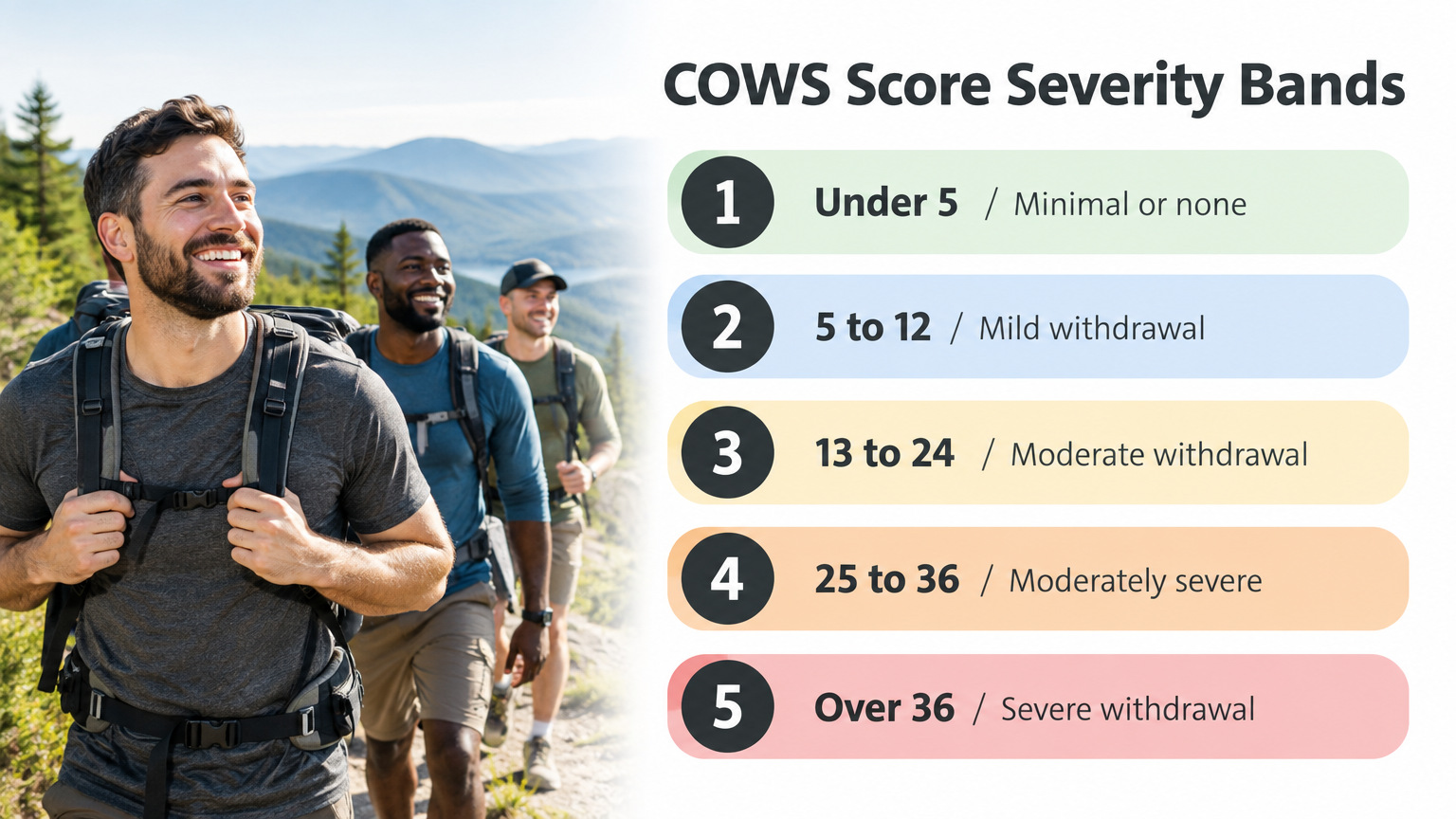
COWS totals range from 0 to 47, and clinicians read that number against four standard severity bands to describe where someone is in withdrawal at the moment of assessment11. The bands are a shared shorthand, not a diagnosis. They give the care team a quick way to agree on what the score is pointing at and what the next step should be.
Here is how the ranges map, as published with the standard COWS instrument1:
| Total score | Severity |
|---|---|
| 5–12 | Mild withdrawal |
| 13–24 | Moderate withdrawal |
| 25–36 | Moderately severe withdrawal |
| More than 36 | Severe withdrawal |
A score below 5 is generally read as minimal or no observed withdrawal at that moment, which does not mean someone is comfortable, only that the signs and symptoms the scale measures are not showing up yet. Withdrawal often builds over hours, and a low early score can climb quickly as the last dose wears off.
Two details matter when reading any single number. First, a COWS total is a snapshot. The score an hour from now may look very different, which is why clinicians repeat the assessment rather than treating one result as the final word. Second, the bands are a guide for conversation, not a cutoff for whether someone deserves care. A man in mild-range withdrawal still gets supportive treatment; a man in the severe range gets a faster, more intensive response. The number helps the team calibrate, then they keep watching.
The assessment usually starts with a short conversation and some basic observation. A clinician checks resting pulse, looks at pupil size in normal room light, and watches how the person is sitting or moving. Then they ask about specific symptoms: stomach, aches, chills, anxiety. Each answer gets scored against the defined choices on the COWS form2.
The whole thing takes about two minutes once the clinician is familiar with the tool, which is one reason it fits into busy detox units, emergency departments, and outpatient clinics4. Speed matters because withdrawal moves. A score at hour one often looks different from a score at hour three, so clinicians repeat the assessment on a schedule rather than treating any single number as final.
One instruction built into the standard form shapes how scoring works in practice: clinicians are told to score only findings that are attributable to opioid withdrawal, not to unrelated causes1. A fast pulse from climbing stairs to the exam room, a runny nose from seasonal allergies, or tremor from caffeine should not inflate the total. This is where honest conversation helps. Mentioning the coffee, the allergies, or the sprint upstairs lets the clinician score what withdrawal is actually doing, so the next treatment step matches the real picture.
COWS has been studied against other established withdrawal measures, and the core finding is that it tracks acute opioid withdrawal well enough to guide treatment decisions. In a controlled naloxone-challenge validation study, peak COWS scores correlated with peak scores on the Clinical Institute Narcotic Assessment (CINA) at 0.85, and COWS also tracked patient visual-analog ratings of feeling sick and bad drug effect. The scale's internal consistency in that same controlled naloxone-challenge study, measured by Cronbach's alpha, came in at 0.783.
In plain terms, two different scales measuring the same person during the same episode landed in close agreement, and the items inside COWS held together as a coherent set. That is what a care team needs from a bedside tool: when the number moves, something real is moving with it.
Reliability has limits worth naming. The validation sample was studied under a controlled naloxone challenge, so the exact performance of every score threshold may not transfer identically to every patient, opioid, or setting3. Clinicians weigh the score alongside the full clinical picture rather than treating any single total as the final answer14. The research supports COWS as a trustworthy structured measure, not as a stand-alone verdict on what a person needs next.
COWS is not the only way to describe opioid withdrawal, and it was never meant to be. It belongs to a small family of instruments that each handle the job from a different angle. Knowing who scores the tool and what it captures explains why the same person, assessed at the same hour, can land on noticeably different numbers depending on which form is used.
The Subjective Opiate Withdrawal Scale (SOWS) is the patient's voice on paper. In its original form, it contains 16 patient-rated symptoms scored from 0 to 4, giving each item a range of intensity rather than a yes-or-no answer5. Later versions have appeared with as few as 10 items, so research and clinical teams specify which SOWS they are using8. The Objective Opiate Withdrawal Scale (OOWS) is the clinician's counterpart to that experience: 13 physically observable signs rated as present or absent during a timed observation5. It leaves out what the patient feels and sticks to what can be seen.
The Clinical Institute Narcotic Assessment (CINA) is the older clinician-rated instrument that researchers used as the comparison standard when they validated COWS. In that study, peak COWS and CINA scores correlated at 0.85, which is the main reason COWS can be trusted to track real changes in withdrawal severity3. CINA still appears in some clinical and research settings, and a scoping review identifies COWS as among the most widely used withdrawal instruments4.
COWS sits in the middle of that group by design. It is clinician-administered like OOWS and CINA, but it folds in a handful of items that depend on what the patient reports, which is closer to how SOWS works2. That is why score differences between tools are expected, not a sign that one is wrong. SOWS tends to pick up symptoms earlier than COWS and has been more strongly associated with taper completion in at least one direct comparison, likely because patients feel changes before many of them become visible to an observer9. A care team that uses only one tool is choosing which angle to privilege; a team that uses two is building a fuller picture of what the person is going through.
A man can feel awful and still land a modest COWS number. He can also look worse to the clinician than he feels in the moment. Both situations are normal, and neither means someone is lying or exaggerating. The scales simply capture different things.
A direct comparison study of observer-rated withdrawal and patient self-ratings during opioid detoxification found no correlation between the two in a small sample of 20 participants, and the authors concluded that self-reports remain important when judging how treatment is working6. Later work comparing SOWS and COWS in people going through withdrawal management found that symptoms were more likely to be reported on SOWS than picked up on COWS, and that patient reports often detected changes earlier9. Interior experience tends to shift before outward signs do.
The practical takeaway is simple: say what is actually happening. If the aches feel worse than the clinician's score suggests, speak up. The score is a starting point for the conversation, not a ceiling on what the care team can respond to.
Buprenorphine works by partially occupying the same receptors other opioids bind to. If it is given while those receptors are still fully loaded, it can shove the other opioid off and trigger a sudden, intense wave of withdrawal. That is why clinicians wait for withdrawal to be clearly present before the first dose, and why COWS has become the standard way to confirm it.
Federal treatment guidance states that patients should show opioid-withdrawal signs before the first buprenorphine dose to reduce the risk of precipitated withdrawal, with a COWS score of 12 or higher typically adequate under the cited protocol12. A consensus practice review of 11 clinical guidelines reached a similar conclusion: a validated tool like COWS should be used to confirm withdrawal before buprenorphine, with induction occurring during mild-to-moderate withdrawal and the score guiding ongoing dosing alongside cravings and other symptoms14. In hospital settings, consensus guidance describes COWS scores of roughly 8–10 as mild withdrawal that may be adequate to begin treatment in context15.
Emergency departments follow the same logic with a timing twist. When a patient has been reversed with naloxone, NIDA guidance recommends waiting about two hours before performing COWS, so the score reflects true withdrawal rather than the lingering effect of the reversal agent13. Moderate-to-severe withdrawal at that point is used as a prevention strategy against precipitated withdrawal when buprenorphine is given.
For a man arriving at a Tennessee medical detox, this is what the clipboard is actually doing. The first COWS is a baseline. The next one, often an hour or two later, tells the team whether withdrawal has climbed into the range where buprenorphine is likely to help rather than hurt. The score is one input. The clinician also considers the last opioid used, how recently, and the full picture of how the patient looks and feels12. The number sets up the decision; the care team makes it with him.
Precipitated withdrawal is the sudden spike in symptoms that can happen when buprenorphine is given too early. One study offered a working definition using the scales themselves: a rise of 6 COWS points or 10 SOWS points within one hour of a dose signals a clinically meaningful jump in withdrawal experience10. That is the scale doing a different job than baseline scoring. Instead of asking "how sick is this person right now," it is asking "did this dose make things worse, and by how much."
The arrival of fentanyl has changed the math for a lot of care teams. Low-dose initiation protocols are one response: start with very small amounts of buprenorphine while the person is still using or only mildly withdrawing, then build up over days. The goal is to avoid making someone reach substantial spontaneous withdrawal before treatment can begin.
Early outpatient data on these newer protocols is encouraging but limited. In a retrospective cohort of people using fentanyl who began outpatient low-dose buprenorphine initiation, precipitated withdrawal occurred in 10 cases, or 8% of initiations with follow-up17. That figure comes from a single retrospective study in an outpatient setting, not a universal rate, and incomplete follow-up makes direct comparison with other protocols difficult. Still, the number gives care teams and patients a realistic frame: precipitated withdrawal is uncommon under careful low-dose protocols, not impossible. For a man asking whether starting medication will make him feel worse before it helps, the honest answer is that modern protocols are built specifically to lower that risk.
For families: this section walks through what the first three days of medical detox usually look like, so you can picture what a loved one is going through when he arrives.
The first hours are mostly observation and conversation. A clinician takes a baseline COWS, asks about the last opioid used and when, and reviews medical history. If withdrawal is still mild, the team waits and reassesses on a schedule rather than rushing to dose medication14. That waiting period is deliberate, not neglect. It gives the body time to show the signs that make buprenorphine safer to start12.
As withdrawal builds, scores climb, the clinician repeats the assessment, and medication decisions get made in response to what the numbers and the patient are both saying. For fentanyl, the timing can look less predictable, which is one reason many Tennessee medical detox programs now use low-dose initiation protocols rather than waiting for substantial spontaneous withdrawal17. Supportive medications for nausea, cramps, sleep, and anxiety are typically available alongside buprenorphine or methadone.
By 48 to 72 hours, most men are stabilizing. The score comes down, sleep starts to return, and the focus shifts from managing acute symptoms to planning what comes after detox. For loved ones waiting for a call, the quieter update is usually the good one.
The opioid withdrawal scale has evolved alongside the medicine around it. A scoping review of the field identified 18 different instruments developed over roughly 80 years of research, with COWS, CINA, and SOWS-Gossop emerging as the most widely used4. The direction of travel is toward tools that capture more of what withdrawal actually feels like, more often, with less burden on both the patient and the clinician.
Wearable sensors and continuous physiologic monitoring are one piece of what researchers are exploring, as potential complements to the intermittent bedside check rather than replacements for it4. The point of any of this work is the same point the current scale serves: give the care team a clearer, faster read on what is happening so the next decision fits the person in front of them.
For a man weighing medical detox in Tennessee, the practical message is simpler than the research arc. The score sheet is the start of a conversation with a care team that is paid attention to how he feels, not a hurdle he has to clear alone.
The Clinical Opioid Withdrawal Scale measures 11 specific signs and symptoms of opioid withdrawal, including pulse rate, sweating, restlessness, pupil size, bone or joint aches, runny nose or tearing, gastrointestinal upset, tremor, yawning, anxiety or irritability, and gooseflesh16. The clinician scores each item and adds them into a total between 0 and 47 to estimate how severe withdrawal is at that moment11.
Federal treatment guidance notes that a COWS score of 12 or higher is typically adequate to begin buprenorphine, with the patient showing clear withdrawal signs before the first dose to reduce the risk of precipitated withdrawal12. Some hospital protocols treat scores around 8–10 as sufficient mild withdrawal to start, depending on the clinical picture15. The exact threshold depends on the setting, opioid used, and care team's protocol.
COWS is clinician-administered and rates 11 withdrawal signs and symptoms the care team observes and asks about2. SOWS, the Subjective Opiate Withdrawal Scale, is patient-rated and originally included 16 self-reported symptoms scored from 0 to 4, though later versions range from 10 to 16 items5, 8. SOWS often picks up symptoms earlier than COWS because interior experience tends to shift before outward signs become visible9.
Withdrawal changes hour by hour, so clinicians repeat COWS on a schedule rather than treating any single score as final14. The assessment can usually be completed in about two minutes, which makes frequent reassessment practical in detox units, hospital wards, and ambulatory clinics4. Timing often tightens around medication decisions, like confirming withdrawal before a first buprenorphine dose, then spaces out as symptoms stabilize over the first few days.
Precipitated withdrawal is a sudden spike in symptoms that can follow a buprenorphine dose given too early, when other opioids are still bound to the receptors. One study proposed an operational definition using the scales themselves: a rise of 6 COWS points or 10 SOWS points within one hour of a dose signals a clinically meaningful increase in withdrawal10. Modern low-dose initiation protocols are designed to lower that risk.
Yes. The score belongs to the shared conversation about care, not just to the chart. Asking what the number is and what the care team plans to do next is a reasonable, useful question, and most clinicians will walk through it. If what the body feels does not match the score, saying so out loud matters: self-reports remain important for judging how treatment is working, even when observable signs look mild6.
Between facility size limits, waivers, and state-by-state rules, figuring out your Medicaid or private insurance benefits can feel like its own full-time job. Our admissions team will verify your coverage in minutes and walk you through exactly what's available — no guesswork required.
Verify Insurance Benefits →No commitment required. Confidential & HIPAA-protected.
Whether it's you or someone you love, our team can help you figure out the next step — what treatment looks like, what's covered, or just someone to talk to.
Talk to Our TeamConfidential. No commitment required.


