


How to Choose a Dual Diagnosis Partial Hospitalization Program
Use this checklist to assess a dual diagnosis partial hospitalization program, including integrated care, medication support, Tennessee licensure, PHP fit, a...
Read More
Learn what partial hospitalization experiences involve, from daily therapy hours and living at home to choosing the right level of care and planning continue...
Start Your Journey NowWritten and reviewed by the clinical team at Trifecta Healthcare Institute, a men’s-only treatment center in Tennessee specializing in substance use, mental health, and dual diagnosis care.
A partial hospitalization program, or PHP, is a structured day of substance use and mental health treatment you attend during business hours while sleeping at home at night. Picture a weekday that runs roughly four to eight hours, built around group therapy, individual sessions, psychiatric check-ins, and clinical programming. Medicare's own standard describes qualifying PHP as a minimum of 20 therapeutic hours per week delivered by a multidisciplinary team under physician direction 2. In plain terms: it is a working day of recovery.
For a man in Knoxville or Nashville (Columbia, TN) weighing this step after detox, a crisis, or a failed try at standard outpatient care, you want to know what the room feels like, how the hours stack up, whether you can keep your job, and what the research honestly shows. The sections ahead walk through all of it — the schedule, the therapies, the movement block, the outcomes, the insurance realities, and what comes after discharge.
Most PHP days start between 8:30 and 9:00 a.m. You walk in, sign the attendance sheet, hand over your phone or stow it in a locker, and sit down for a brief check-in with staff. A nurse or counselor usually asks a short set of questions: how you slept, cravings on a 0–10 scale, any medication side effects, mood, and whether anything happened at home overnight that the team should know about. If you take medication for anxiety, depression, or opioid use disorder, this is often when it's dispensed or logged.
From there, the first group of the day — frequently called a morning check-in or community meeting — pulls everyone into a circle. You say your name, where your head is, and one thing you're working on today. It takes maybe twenty minutes. For a man who hasn't been in a treatment room before, that first hour is the part that feels longest. By the second or third day, it starts to feel like clocking into a job you actually need.
After the opening circle, the schedule shifts into clinical programming. A mid-morning process group runs about ninety minutes and digs into what's actually happening in your life — cravings, resentments, a hard conversation with your wife, a shift at work you're dreading. A psychoeducation block follows, often focused on relapse prevention, the neuroscience of addiction, or a specific therapy skill the team is teaching that week. SAMHSA's overview describes day treatment programs as running roughly four to eight hours per day, which lines up with what you'll experience 1.
Lunch is usually a 45-minute break. Some programs provide food; many ask you to bring your own. It's a quieter stretch where men talk about anything but recovery — football, trucks, their kids — and that unstructured time matters more than it looks.
Afternoons typically open with a movement block: boxing, jiu-jitsu, a gym session, a hike, or a mobility class, depending on the program and the day. From there, the back half of the afternoon holds an individual therapy session, a family session, a specialty group (trauma, grief, anger), and a short closing group that puts a lid on the day. Added together across the week, the hours hit the 20-therapeutic-hour-per-week floor that CMS uses to define qualifying PHP 2.

Most men leave the building between 3:00 and 5:00 p.m. and head back to their own house, their parents' place, or a sober living residence they've arranged separately. Sleeping at home is the defining feature of PHP compared with residential care 1, and it cuts both ways. You get your bed, your dog, dinner with your kids. You also get the trigger of a familiar kitchen, the group chat, the drive past the old bar.
Evenings are usually light on assignments — a worksheet, a journal prompt, sometimes a 12-step or SMART Recovery meeting the clinical team recommends. The honest work of the evening is protecting sleep and showing up tomorrow. Men who treat the first week like a temporary job, not a program to pass, tend to settle into the rhythm fastest.
Think of substance use treatment as a staircase. Medical detox and residential care sit at the top — 24-hour supervision, every meal and bed inside the facility. Standard outpatient sits at the bottom — a counseling session or two a week. PHP is the second step down from residential: structured, intensive, clinically supervised, but you sleep in your own bed 1.
The clinical definition that payers and clinicians actually use is specific. CMS requires a qualifying PHP to deliver at least 20 therapeutic hours per week through an individualized plan of care, with a multidisciplinary team under physician direction 2. Medicaid's clinical guidance frames PHP the same way — a structured outpatient level providing 20 or more hours of clinically intensive programming weekly, appropriate for men whose symptoms are still shaky but who can be safely managed outside a residential bed 3. Translated: real treatment, real medical oversight, no overnight stay.
Most men choosing between PHP and intensive outpatient (IOP) are really asking two questions: how much time will this take, and how much support will I actually get? The peer-reviewed literature draws the line clearly. PHP generally runs at least five days per week and around 20 hours of direct clinical service weekly. IOP typically runs about three days per week and roughly nine hours 8. CMS reinforces the PHP end of that comparison with its 20-hour-per-week floor 2.
| Level | Days per week | Therapeutic hours per week |
|---|---|---|
| PHP | ~5 | ~20 2, 8 |
| IOP | ~3 | ~9 8 |
The practical difference lands in your calendar. PHP eats most of a working day for several weeks and is usually the right fit after detox, after a relapse, or when co-occurring anxiety, depression, or trauma symptoms are loud enough that three evenings a week won't hold you. IOP works better when you're more stable, back at work, and need structure that fits around a job. Many men move through both — PHP first to get traction, IOP next to step down without stepping off entirely.
The clinical core of a PHP week is talk therapy, and most programs rotate through a handful of named evidence-based approaches. Cognitive behavioral therapy (CBT) teaches you to catch the thought-feeling-behavior loop that runs under a craving — the Friday evening story that says you earned it. Dialectical behavior therapy (DBT) adds skills for distress tolerance, emotion regulation, and the kind of interpersonal fire that burns down a marriage mid-recovery. Motivational interviewing (MI) is less a group format and more the way counselors talk with you, especially early, when ambivalence is loud.
Trauma-focused work is handled carefully. Eye movement desensitization and reprocessing (EMDR) is typically delivered one-on-one, often after you've stabilized a week or two, because reprocessing a memory while your sleep is still ragged can backfire. CMS requires PHP to be individualized, structured, multimodal, and medically supervised, which is why the schedule mixes these modalities rather than running one on repeat 2. Expect a weekly rotation, not a single track.
In a well-built men's PHP, the afternoon movement block is written into the plan of care — not tacked on as a break. The hour might be boxing drills, a jiu-jitsu class, a hike on a Smoky Mountains trailhead out of Knoxville, a gym circuit, or a controlled cold-water exposure. Research on exercise and recovery is still developing, but there is credible support for physical activity helping mood, sleep, craving intensity, and the brain's capacity to form new patterns, which is what clinicians mean when they talk about neuroplasticity. The honest frame is "supports recovery," not "resets your brain."
Treating movement as programming matters because PHP is a multimodal level of care by design 2. A ninety-minute group where you learn to roll on a mat with another man you'll see in process group tomorrow does two jobs at once: it moves your body and it builds the trust that makes group work actually land. Many men say the movement block is where recovery stopped feeling abstract and started feeling like something they could do with their hands.
Most men who land in PHP are carrying more than a drinking or drug problem. Anxiety, depression, PTSD, unresolved grief, and anger that's cost you jobs or relationships tend to sit under the substance use, not next to it. SAMHSA's 2024 national data continues to show that co-occurring mental illness and substance use disorder are common in the same person, which is part of why standard outpatient often isn't enough the first time 10.
A PHP that treats co-occurring conditions runs a specialty group or two inside the week — trauma-focused work, a men's anger and shame group, a depression skills group — alongside psychiatric medication management. The point isn't to treat your anxiety as a side note. It's to work the substance use and the mental health piece in the same room, by the same team, in the same week.
The honest answer about PHP outcomes is that the research is encouraging and incomplete. A study of people treated for opioid use disorder in inpatient or PHP settings found meaningful gains in quality of life, emotional health, and reduced opioid use. Roughly 40% of the 113 participants who completed follow-up reported complete abstinence at a one-month mark, with greater improvement in health and emotional-health domains linked to lower relapse likelihood 4. Scope matters: the study was observational, mixed inpatient and PHP participants, and the window was short.
A separate alcohol-treatment PHP study tells a similar story with similar caveats. Of 89 participants who completed the follow-up assessment, 62 — about 69.7% — were abstinent during the follow-up window, and the researchers found that continued mental-health-provider visits and 12-step attendance were associated with staying abstinent 5. That is a subset of enrollees, a short follow-up, and a single program, not a national benchmark.
PHP only works if you keep walking in the door, and the attrition picture is honest about how hard that is. A retrospective study across one behavioral-health center's continuum found high dropout before program completion and before step-down into continuing care, with relapse more likely among people who never engaged in follow-up 7. In other words, the men who disappear in week two are the ones the data worries about most.
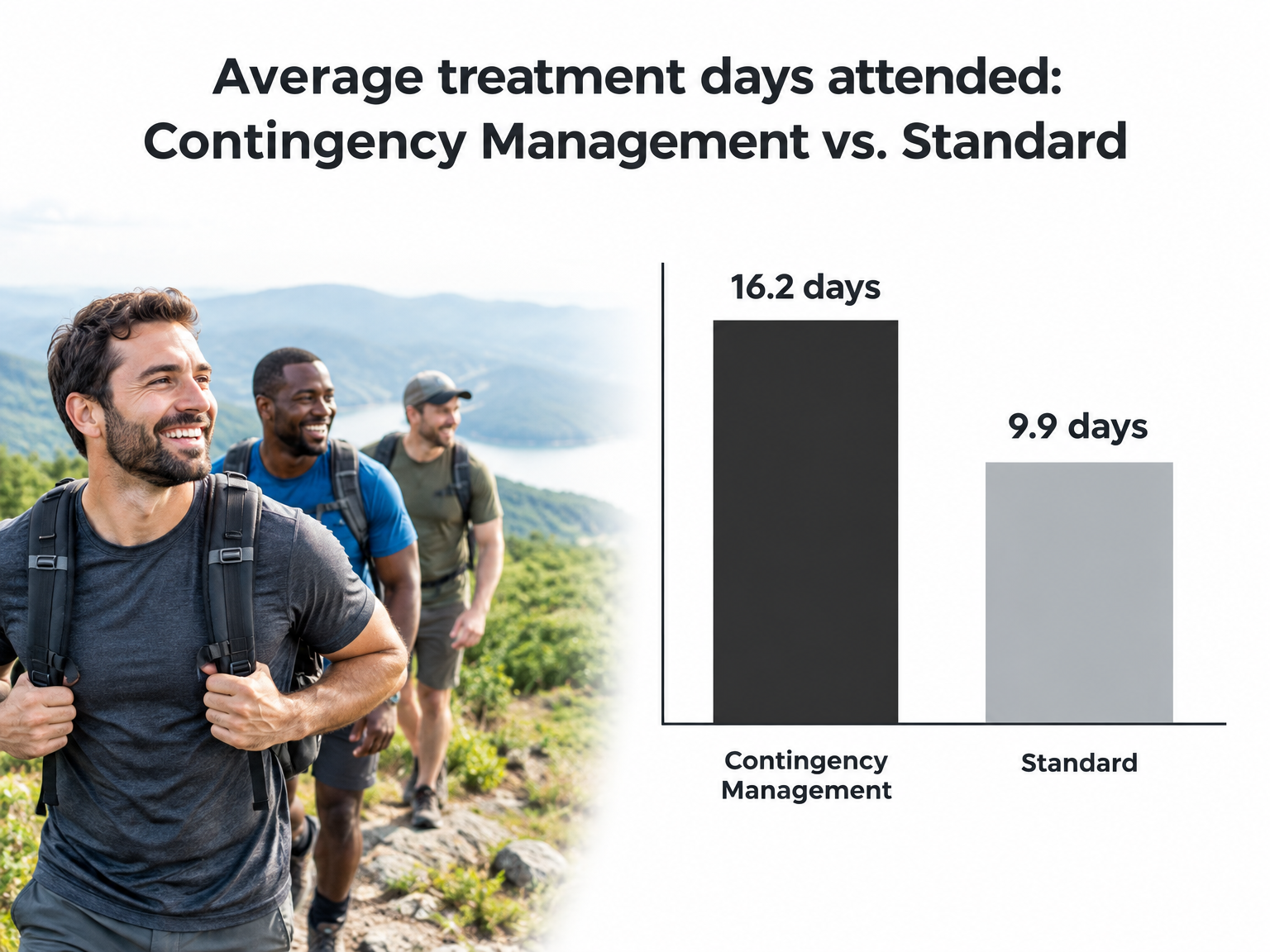
What moves the needle on showing up? Structured reinforcement, for one. A quality-improvement evaluation of a six-week PHP for people with co-occurring disorders tested contingency management — small, consistent rewards tied to attendance and treatment goals. Participants exposed to contingency management attended an average of 16.2 treatment days, compared with 9.9 days among those who were not 6. The same study found no significant between-group difference in drug-free days, which is worth stating plainly: better attendance did not automatically translate into better abstinence in that sample.
The practical read is this. External structure — rides lined up, a work leave in writing, a sponsor or family member checking in, a program that rewards consistency — keeps men in chairs. What happens in those chairs is a separate question, which is why continuing care after PHP matters as much as the weeks inside it.
The quiet question most men ask on day one is whether they'll feel like themselves in a circle of guys they've never met. The honest answer: not really, not at first. The first two or three groups feel like a work meeting you didn't prepare for. Men keep answers short, test the room, and watch who talks and who doesn't.
Then something shifts, usually by the end of the first week. Someone a few years older says the thing you were afraid to say — about a daughter who won't text back, a DUI, a father who drank. The temperature in the room changes. Group becomes less about performance and more about recognizing your own story in another man's mouth. You don't have to love everyone in the circle. You just have to be willing to be seen by them, one honest sentence at a time. That is the part of PHP men remember long after the schedule fades.
The clinical answer and the insurance answer for how long you'll be in PHP are not the same thing, and that gap matters. On the clinical side, PHP is designed as a short, intensive stretch — commonly two to four weeks of five-days-a-week, 20-plus-hour weeks before stepping down to IOP 2, 8. On the payer side, the picture is tighter. A qualitative study of substance use treatment stakeholders in Connecticut, Kentucky, and Wisconsin found that PHP stays commonly averaged around 10 to 12 days in some settings because of authorization limits, even when clinicians believed longer care was clinically appropriate 9. That is three-state stakeholder reporting, not Tennessee data, but the pattern shows up here too.
What this means practically: expect your program to re-authorize care every few days with your insurer, and expect your clinical team to document medical necessity actively. If you're on TennCare, a commercial plan like BCBS or Cigna, or a state-employee plan where prior authorization applies to facility-based SUD services 13, ask on day one how long the first authorization runs and who requests the next one.
If you're in East Tennessee and looking at a Knoxville rehab for men, or closer to Middle Tennessee and looking at Nashville-area care, the first step is the same: a clinical assessment that matches you to the right level. That might be medical detox, PHP, or IOP, depending on how recent your last use was, how your withdrawal is tracking, and what co-occurring symptoms are in play. Trifecta Healthcare Institute's Nashville-area program is located in Columbia, TN, not inside the city of Nashville itself — worth knowing when you're mapping the drive.
For a confidential starting point, the Tennessee REDLINE provides 24/7 substance-use-treatment referrals and can be reached by calling or texting 800-889-9789 12. For TennCare members, PHP sits within covered outpatient-level treatment and runs through behavioral-health benefits; commercial and state-employee plans generally require prior authorization 12, 13, so a verification-of-benefits call before admission saves you a surprise later. Verify your insurance is the cleanest way to find out what your specific plan covers before day one.
Discharge from PHP is not a finish line. It's a handoff. The research is consistent that what you do in the three to six months after the structured weeks matters as much as what happened inside them — a review of continuing-care models found that longer engagement with outpatient treatment and recovery supports was associated with better longer-term outcomes 8. A retrospective look at one behavioral-health center's full continuum reinforced the point from the other direction: relapse was more likely among people who did not engage in follow-up SUD treatment after a higher level of care 7.
The usual step-down is PHP to IOP, then IOP to standard outpatient, with recovery supports layered underneath — a sponsor, a weekly men's group, a psychiatrist managing medication, a sober peer you text on hard nights. The alcohol-PHP study cited earlier found that mental-health-provider visits and 12-step attendance after discharge were specifically linked to staying abstinent 5, which is a useful translation of "continuing care" into actions you can put on a calendar.
Before you leave the building, ask for three things in writing:
Men who walk out with that paper in hand step down. Men who walk out planning to figure it out later tend not to.
A quick scope shift: this section is for the people around him — wives, partners, parents of adult sons — who are trying to picture what PHP will look like from the outside. Here is the honest version. He will be gone roughly 8:30 a.m. to late afternoon, five days a week, for a few weeks. He will come home tired, sometimes raw, often quieter than usual. Dinner conversations may feel strange before they feel normal again. That is the shape of a working day of treatment, not a sign something is wrong 1.
Three things tend to help families most. First, protect his sleep and the morning routine — getting to the door on time is half the battle, and attendance is the lever that moves outcomes 6. Second, expect a family session to be part of the plan; show up when the clinical team invites you, even if the conversation is uncomfortable. Third, start learning the step-down map now — IOP, continuing care, a prescriber, weekly recovery meetings — because what happens in the three to six months after discharge matters as much as the weeks inside the building 8. You do not have to fix him. You have to be a steady person in a steady house while he does the work.
Not every PHP looks the same from the inside, and the N-SUMHSS national facility survey makes clear that programs vary widely in staffing, services, and medication access 11. Before you commit to a program in Knoxville or Nashville (Columbia, TN), get straight answers on seven things:
PHP generally runs about five days per week with around 20 hours of direct clinical service. Intensive outpatient (IOP) typically runs about three days per week and roughly nine hours 8. PHP is the higher-intensity step; IOP is usually where you step down once you're more stable.
Clinically, PHP is often two to four weeks before stepping down to IOP 8. Insurance can shorten that. A three-state qualitative study of SUD stakeholders described PHP stays commonly averaging about 10 to 12 days because of payer authorization limits 9. Ask your program how reauthorization works on day one.
You'll live at home — sleeping in your own bed is the defining feature of PHP compared to residential care 1. Full-time work during PHP is rarely workable, since the schedule eats most of a weekday. Many men use FMLA, short-term disability, or an employer leave arrangement for the first few weeks.
Yes. CMS requires PHP to be individualized, structured, multimodal, and medically supervised, which is how trauma, depression, and anxiety work gets built into the weekly schedule alongside substance use treatment 2. Co-occurring mental illness and SUD often appear in the same person, per SAMHSA's 2024 national data 10, so integrated care is standard.
Start with a clinical assessment that matches you to the right level — detox, PHP, or IOP. For a confidential 24/7 referral in Tennessee, the Tennessee REDLINE can be reached by calling or texting 800-889-9789 12. If you're on TennCare, PHP is covered through behavioral-health benefits; commercial and state-employee plans generally require prior authorization 12, 13.
Between facility size limits, waivers, and state-by-state rules, figuring out your Medicaid or private insurance benefits can feel like its own full-time job. Our admissions team will verify your coverage in minutes and walk you through exactly what's available — no guesswork required.
Verify Insurance Benefits →No commitment required. Confidential & HIPAA-protected.
Whether it's you or someone you love, our team can help you figure out the next step — what treatment looks like, what's covered, or just someone to talk to.
Talk to Our TeamConfidential. No commitment required.


