


How to Choose a Dual Diagnosis Partial Hospitalization Program
Use this checklist to assess a dual diagnosis partial hospitalization program, including integrated care, medication support, Tennessee licensure, PHP fit, a...
Read More
Understand partial hospitalization program requirements, including diagnosis, safety, weekly therapy hours, and support at home, to assess whether this level...
Start Your Journey NowWritten and reviewed by the clinical team at Trifecta Healthcare Institute, a men’s-only treatment center in Tennessee specializing in substance use, mental health, and dual diagnosis care.
Partial hospitalization program requirements come down to a clinical fit decision, not a gatekeeping test. You generally qualify for a PHP if you have a documented substance use disorder (often with a co-occurring mental health concern), you are medically and psychologically stable enough to live outside a hospital, your care plan calls for at least 20 hours of structured therapeutic services each week, and you have a safe-enough place to spend your off-hours 5, 6.
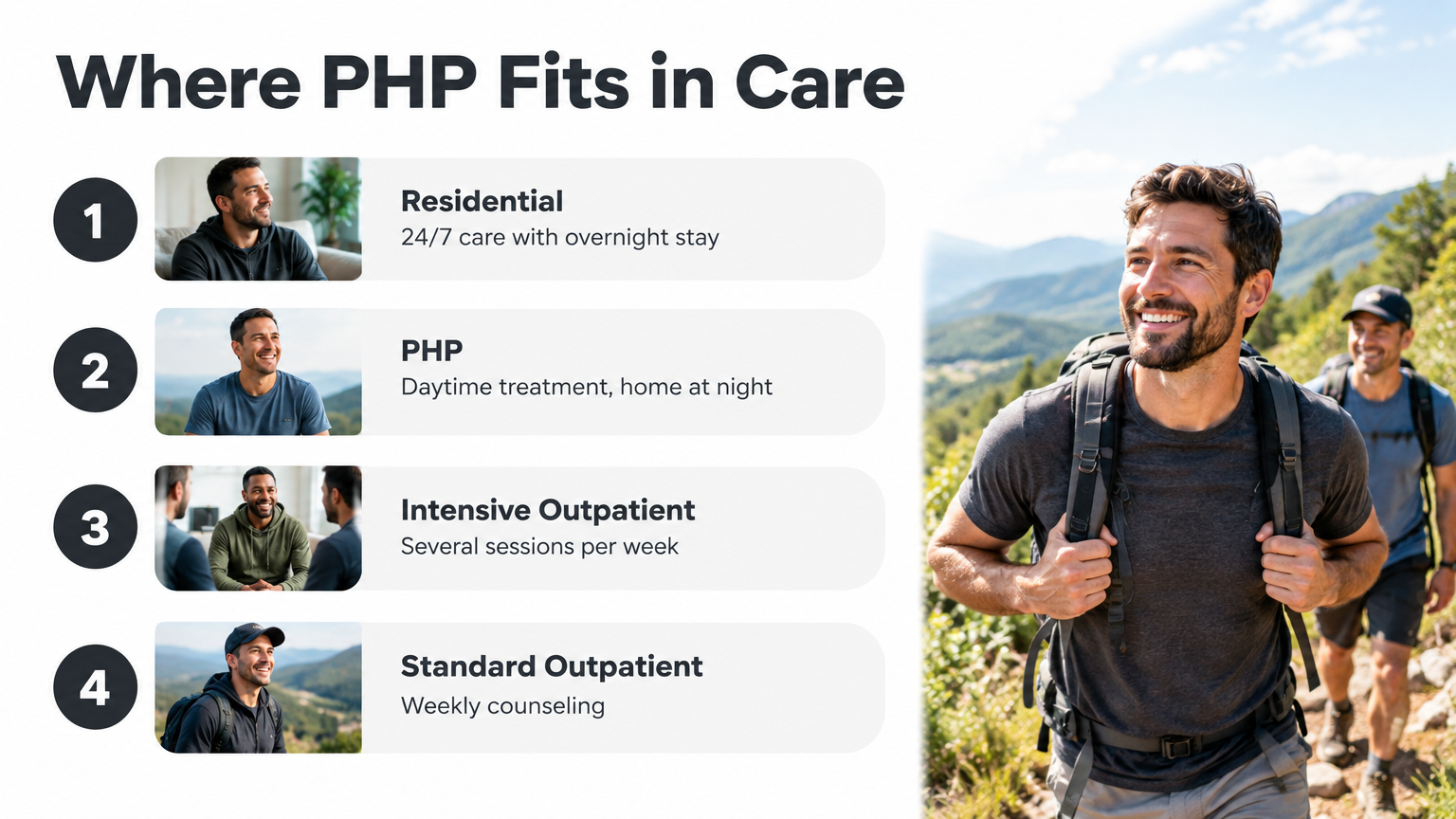
In Tennessee, substance use PHP is classified as ASAM Level 2.5 and sits between residential care and intensive outpatient treatment on the state's continuum 1, 2. It is the right level when standard outpatient visits are not enough but 24-hour supervision is not needed.
Admission is also not a one-and-done verdict. Tennessee's FY2027 guidance calls for ASAM-based review at least every seven calendar days, so your level of care can step up or down as your situation changes 2. The rest of this guide walks through each requirement in plain language, so you can get a realistic read before you pick up the phone.
A partial hospitalization program, or PHP, is daytime treatment that looks a lot like residential care without the overnight stay. You spend most of your weekday hours in group therapy, individual sessions, psychiatric check-ins, and skills work, then you go home or to a supportive living situation at night. Under Medicare's framework, PHP is defined as active treatment delivered through an individualized plan by a multidisciplinary team under physician direction 7. In Tennessee, substance use PHP is classified as ASAM Level II.5 and carries structured expectations for assessment, treatment planning, and documentation 2.
Placement is the easiest way to understand it. On the SAMHSA continuum, PHP and intensive outpatient services sit above standard outpatient care and are matched to more severe substance use disorders or unstabilized mental or physical health conditions 8. Tennessee's own guidance frames PHP as an alternative to residential treatment for people who cannot be managed in a strictly outpatient setting 1.
That middle position matters. PHP is more intensive than once-a-week counseling because the problem is bigger than once-a-week counseling can hold. It is less restrictive than residential care because you are stable enough to sleep somewhere other than a hospital bed. For many men, that combination is the point: real clinical weight during the day, real life to practice in at night.
The first pillar is a clinical diagnosis that lines up with the intensity of PHP. For substance use PHP, that typically means a documented substance use disorder, and often a co-occurring mental health concern like anxiety, depression, PTSD, or an unresolved anger pattern tied to trauma. CMS's PHP patient profile is explicit that a qualifying diagnosis is one of the core characteristics for admission, alongside the clinical judgment that symptoms substantially interfere with daily functioning 5, 7.
Diagnosis alone does not get you in, and it does not keep you out either. A man who drinks heavily on weekends but functions well at work and home may not meet criteria for this level of care. A man whose drinking has cost him sleep, his job, and his relationships, and who is now using alcohol to blunt depressive symptoms, is a different clinical picture.
In Tennessee, that picture gets translated into ASAM Level 2.5 placement during the intake assessment, which is where a licensed clinician matches your symptom severity and functioning to the right level of care 2. Bring any prior records you can. Discharge summaries from detox, therapist notes, past psychiatric evaluations, and medication histories all help the assessor build an accurate diagnosis instead of starting from zero.
The second pillar is stability. PHP is nonresidential, so you need to be well enough to leave the building at the end of the day and come back the next morning. CMS frames this plainly: a PHP candidate should not require 24-hour care, should not be judged to pose an immediate danger to self or others, and should be able to tolerate the intensity of a full-day program 5.
Medical stability usually means acute withdrawal has been managed. If you are still in the thick of alcohol or benzodiazepine withdrawal, or opioid withdrawal that needs close medical monitoring, detox comes first. Once withdrawal symptoms are controlled and vital signs are steady, PHP becomes a reasonable step down. Tennessee's continuum of care treats PHP as the layer below residential, not a substitute for medical detox when detox is what the body actively needs 1.
Psychological stability is about functioning, not perfection. You can be depressed, grieving, anxious, and still clear a PHP assessment. What matters is whether you can keep yourself safe between sessions, participate in group work, and follow a treatment plan. If active suicidal intent, psychosis, or severe self-harm risk is on the table, a higher level of care is the honest answer, and a PHP team will say so.
The third pillar is dose. PHP is defined by its intensity: Medicare's guidance states that a care plan must indicate the need for at least 20 hours of therapeutic services each week 6. CMS echoes the same floor in its broader PHP patient profile 5. If a standard outpatient schedule of one or two sessions a week would meet your needs, you do not need PHP. If your symptoms, cravings, or functioning say you need something closer to a workweek of structured care, you probably do.
What does 20+ hours actually look like? A typical PHP weekday might open with a morning check-in and vitals, move into process group, break for an individual therapy or psychiatric session, run a skills-focused group like CBT or DBT around the lunch hour, include a movement or wellness block in the afternoon, and close with a wrap-up before you head home. Stack five of those days and you clear the 20-hour threshold with room for family work or case management.
That weekly dose is why PHP sits where it does. It is not about filling a calendar. It is about delivering enough contact hours to interrupt old patterns, build new skills, and stabilize mood and cravings before stepping down.
The fourth pillar is where you sleep. Because PHP ends in the late afternoon, admissions teams need to know your off-hours environment will not undo the day's work. CMS lists adequate support outside program hours as one of its core characteristics for PHP admission 5. That does not mean a perfect home. It means a place where you can rest, eat, take medication, and avoid active use between sessions.
For some men, that is their own house with a supportive spouse and no substances in the cabinet. For others, it is a parent's spare room or a sober living residence arranged through the admissions team. If your current living situation includes a roommate who is actively using, a partner in crisis, or no stable address, say so during intake. The clinical team can often help coordinate housing before day one so that this pillar holds. If the environment cannot be stabilized, residential care is the more honest level of care.
Tennessee does not treat PHP as a one-size category. The state's FY2027 Administrative and Service Provision Guide identifies Adult Partial Hospitalization Services as ASAM Level II.5, which is the formal placement tier for structured, nonresidential substance use care that runs most of the day 2. That classification tells the admissions team which assessment tools, treatment-planning standards, and documentation rules apply to your case from the first phone call forward.
The practical effect is that your intake clinician will use ASAM criteria to build a multi-dimensional read of your situation, looking at factors like withdrawal risk, co-occurring conditions, readiness, and your recovery environment. That multi-dimensional read is why two men with the same diagnosis can land at different levels of care. One ends up in PHP; the other steps down to IOP or steps up to residential.
The second Tennessee rule that matters is the recurring review. The FY2027 guide calls for ASAM-based review at PHP at least every seven calendar days, which means your team formally re-examines whether this level of care still fits your clinical picture each week 2. If you are stabilizing fast, you may step down to IOP sooner than expected. If something new surfaces, like a medication side effect or a crisis at home, the team can adjust the plan or recommend a higher level of care.
Two fears tend to pull men in opposite directions before they call: "I'm not sick enough for this" and "I'm too far gone for anything but a hospital." Both can be wrong, and both usually come from guessing at admission rules that are actually pretty specific.
The clearest disqualifiers for PHP are clinical, not moral:
What does not disqualify you may surprise you. A relapse last week does not. A co-occurring diagnosis like depression, PTSD, or an anxiety disorder does not; integrated care is the expected approach 9. Previous failed outpatient attempts, a messy work history, legal issues, or shame about how long this has gone on are not clinical disqualifiers either. If anything, a pattern of outpatient care not holding is often what moves a man up to ASAM Level 2.5 in the first place 2.
A co-occurring mental health concern is one of the most common reasons men talk themselves out of calling about PHP, and it is almost never a reason they get turned away. Anxiety that keeps you up at night, depression that has flattened the last two years, unresolved trauma that resurfaces when you stop drinking, anger that has cost you a job or a relationship—these are the exact patterns PHP intake teams expect to see alongside substance use, not deal-breakers that disqualify you.
SAMHSA's guidance is explicit: when someone shows up for substance use treatment, they should be screened for mental health concerns, and when someone shows up for mental health care, they should be screened for substance use. That "no wrong door" approach is the standard for a reason 11. Integrated treatment, meaning both conditions addressed by the same team at the same time, is the recommended practice when they occur together 9.
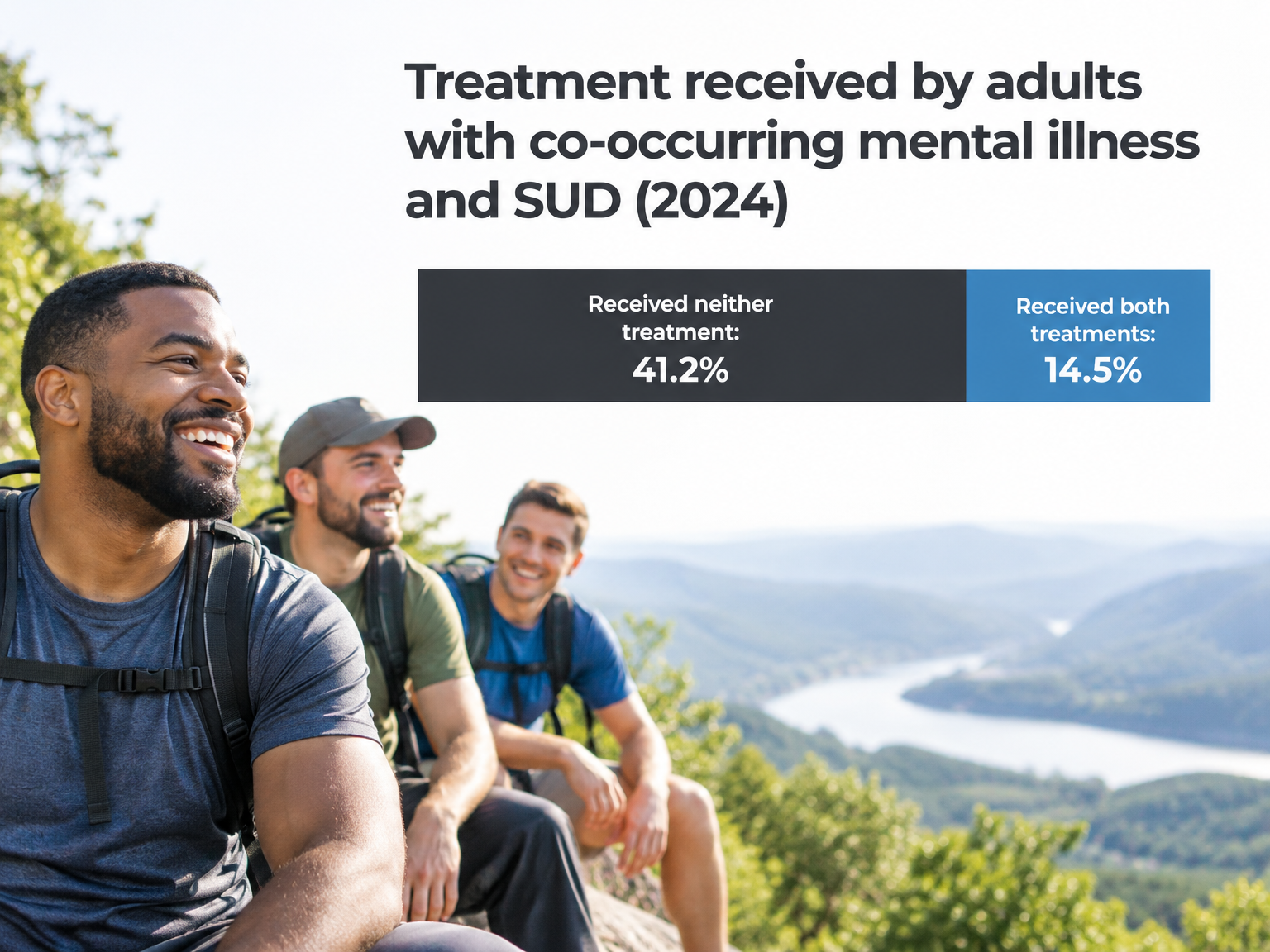
The treatment gap for this group is wider than most men realize. Among U.S. adults with co-occurring mental illness and substance use disorder in 2024, 41.2% received neither type of treatment and only 14.5% received both 10. A lot of that gap is logistical and emotional, not clinical. Men wait because they assume a provider will tell them to handle depression first, or sober up first, before anyone will treat the other side.
At a PHP assessment, expect direct questions about mood, sleep, trauma history, panic, intrusive thoughts, and anger patterns, alongside the substance use questions. Answer them honestly. The information shapes your treatment plan, your medication review, and the specific groups you are placed in. It does not shrink your chances of admission; in Tennessee's ASAM framework, co-occurring concerns often strengthen the case that this level of care fits 2.
Walking into a PHP intake unprepared is survivable, but showing up with a short stack of records speeds everything up and sharpens the treatment plan. The admissions team is building a clinical picture that satisfies ASAM Level 2.5 documentation standards in Tennessee, and the more they have in hand, the less they are guessing 2.
Pull together what you can before day one:
Expect the assessment itself to run a few hours and cover an ASAM-based review of your clinical status, as called for by Tennessee's FY2027 guidance 2. A physician or advanced practice clinician will review your medical status, because PHP operates as active treatment under physician direction 7. A separate screening will cover co-occurring mental health concerns, in line with SAMHSA's recommendation that anyone showing up for substance use care gets screened for mental health symptoms too 11. Honest answers here save weeks of rework in the plan.
Coverage is usually the second question after eligibility, and it has a cleaner answer than most men expect. TennCare recognizes partial hospitalization within its behavioral-health benefit structure, listing "Intensive Outpatient/Partial Hospitalization" among adult service categories in its policy manual 4. On the member side, TennCare confirms that it covers withdrawal management and substance use treatment at inpatient, residential, and outpatient levels for eligible members 3. PHP falls inside that outpatient-tier framework in Tennessee, which is why it shows up as a covered service category rather than a specialty carve-out.
That said, "covered as a category" and "covered for you, at this provider, starting Monday" are two different sentences. TennCare benefits depend on your specific plan, the provider's network status, and a medical-necessity determination tied to ASAM Level 2.5 criteria 2. Commercial behavioral-health plans typically cover PHP as well, but each one applies its own prior-authorization rules, in-network requirements, and continued-stay reviews.
A few practical moves speed this up:
Insurance should not be the thing that keeps you on the fence. If verification comes back with a gap, admissions teams can often walk through self-pay options, sliding arrangements, or a step down to a covered level of care that still gets the work started.
Three levels of care get confused in the same conversation, and the differences matter when you are weighing time, cost, and clinical fit. Residential care puts you in a treatment facility 24 hours a day. PHP runs most of the weekday and sends you home at night. Intensive outpatient, or IOP, is a less intensive step with fewer weekly hours than PHP. The honest way to pick is to match the intensity to what your clinical picture actually calls for, not to what feels easiest or hardest to say yes to.
Residential makes sense when you cannot stay safe or sober outside a treatment setting, when withdrawal still needs medical oversight, or when the people and places around you make daytime-only treatment unrealistic 1. PHP fits when you are medically stable, your home or sober living arrangement can hold you between sessions, and your care plan calls for roughly 20 or more structured hours each week 5, 6. IOP is the right step down once you have built skills and stability and can protect your recovery with less contact, often while returning to work or school.
Tennessee's ASAM framework is what formalizes those lines. The seven-day continued-stay review built into PHP means you can start at Level 2.5 and step down to IOP as your assessments support it, or step up if something shifts 2. Pick the level that matches where you are this month, not where you hope to be in six.
A note for the people doing the quiet work of looking all of this up: if you are a wife, girlfriend, mother, or father reading this on behalf of someone you love, you are not overstepping by learning what PHP requires. You are doing the groundwork that often moves a man from "maybe" to a scheduled intake.
A few things are worth knowing. First, he does not have to agree to residential care to get real help. PHP sits between residential and intensive outpatient on Tennessee's continuum, which gives him a serious option that still lets him sleep at home or in a sober living arrangement 1, 2. Second, co-occurring symptoms like depression, trauma, or anger do not disqualify him. SAMHSA's "no wrong door" standard means intake teams expect to screen for both substance use and mental health concerns in the same conversation 11.
What helps most is practical. Gather his insurance card, a rough timeline of his substance use, any recent medical or psychiatric records, and a short list of what has changed at home or work. Offer to sit with him when he calls, or make the first call yourself to ask about the assessment process and verification of benefits. The admissions team can speak with you in general terms before he is a patient. Your steadiness in this stretch may be the thing he leans on when he says yes.
Reading this far means you already have a working answer to the eligibility question. If you have a substance use disorder, you are stable enough to sleep outside a hospital, you need something closer to a full week of structured care than a single weekly session, and you have a safe-enough place for your off-hours, you likely meet partial hospitalization program requirements at the Tennessee ASAM Level 2.5 tier 2, 5, 6. A clinical assessment is what turns that likely into a plan.
The practical next step is small. Call an admissions team, run a verification of benefits, and schedule the assessment. Bring your insurance card, a medication list, and any recent records. [Call Trifecta] or [Verify your insurance] to get the clock moving this week instead of next month.
The hardest part of recovery is rarely the treatment itself. It is the quiet decision to stop waiting.
Medicare's PHP guidance sets the floor at a care plan calling for at least 20 hours of therapeutic services each week 6. PHPs are structured to clear that threshold with room for individual therapy and case management.
Not always. If active withdrawal still needs round-the-clock medical monitoring, detox comes first in Tennessee's continuum of care 1. Once withdrawal is managed and you are medically stable, PHP can be the starting point without a residential stay in between. The intake assessment makes that call based on your current clinical picture.
TennCare recognizes partial hospitalization within its behavioral-health benefit structure and covers substance use treatment at inpatient, residential, and outpatient levels for eligible members 3, 4. Commercial plans generally cover PHP as a behavioral-health benefit, with authorization typically tied to ASAM Level 2.5 medical necessity 2. Verify your specific plan before day one.
Usually not full-time. PHP occupies most of your weekday hours, which rules out a standard workday or class schedule during the program. Some men take short-term FMLA leave, use PTO, or arrange reduced hours with an employer. Once you step down to IOP, returning to work or school is much more realistic.
Tennessee's FY2027 guidance calls for ASAM-based review at PHP at least every seven calendar days, so your team formally reassesses your level of care each week 2. If you stabilize quickly, you may step down to IOP. If something new surfaces, like a crisis at home or a medication issue, the plan adjusts.
Between facility size limits, waivers, and state-by-state rules, figuring out your Medicaid or private insurance benefits can feel like its own full-time job. Our admissions team will verify your coverage in minutes and walk you through exactly what's available — no guesswork required.
Verify Insurance Benefits →No commitment required. Confidential & HIPAA-protected.
Whether it's you or someone you love, our team can help you figure out the next step — what treatment looks like, what's covered, or just someone to talk to.
Talk to Our TeamConfidential. No commitment required.


