



How to Choose a Dual Diagnosis Partial Hospitalization Program
Use this checklist to assess a dual diagnosis partial hospitalization program, including integrated care, medication support, Tennessee licensure, PHP fit, a...
Read More
A partial hospitalization program schedule typically includes 20 or more hours of weekday care, therapy, medication support, and evenings at home; learn how ...
Start Your Journey NowWritten and reviewed by the clinical team at Trifecta Healthcare Institute, a men’s-only treatment center in Tennessee specializing in substance use, mental health, and dual diagnosis care.
A partial hospitalization program schedule typically runs about 20 or more hours of clinical treatment each week, usually spread across four or five weekdays, with participants heading home or to a supportive living setting at the end of each day 2, 3. One real-world example from a peer-reviewed opioid use disorder program ran Monday through Friday, 9:00 a.m. to 3:30 p.m. 6. That shape, a full daytime workload of therapy and clinical care, is what makes PHP sit between inpatient hospitalization and a lighter intensive outpatient program.
For a man weighing this level of care, the practical question is not just how many hours but what fills them. A PHP week combines group therapy, individual sessions, psychiatric and medical check-ins, skills education, and recovery planning, with direct access to clinicians during the day 2. Movement and wellness programming may sit alongside those clinical hours, not in place of them.
This article walks through the hours, the daily blocks, how PHP compares with IOP and inpatient care, and how a schedule gets shaped around the individual rather than handed down as a fixed timetable.
Federal guidance from CMS and SAMHSA describes a partial hospitalization program as generally offering 20 or more hours of clinically intensive services each week 2. The ASAM Level 2.5 resource guide used by state Medicaid programs lands at the same number and adds a key clinical distinction: PHP participants have direct access to psychiatric, medical, and laboratory services during those hours, which is what separates this level from a lighter intensive outpatient program 3.
The 20-hour figure is a floor, not a ceiling. Some programs exceed the 20-hour minimum based on clinical need, payer authorization, and the mix of therapies the team recommends 1, 2. The hours themselves are structured, not open-ended drop-in time. They include scheduled group therapy, individual sessions, medication management, and skills education, with clinicians available throughout the day 2.
For a man comparing options, the practical read is this: PHP asks for roughly a part-time job's worth of weekly hours, delivered as actual clinical treatment rather than general support.
Those 20-plus hours are usually spread across four or five weekdays. A peer-reviewed study of an alcohol-and-drug PHP serving people with opioid use disorder documented a schedule of Monday through Friday, 9:00 a.m. to 3:30 p.m., which is a common shape for programs built around a weekday clinical workload 6. A separate alcohol and drug PHP described the same weekday 9:00 a.m. to 3:30 p.m. structure 7. Evening or hybrid formats exist, but the daytime weekday block is the pattern readers will encounter most often.
Length of stay varies more than daily hours. In an acute psychiatric PHP sample of roughly 2,000 patients, the mean stay was about 5.3 days, which reflects a short-term stabilization model rather than a full substance use continuum 5. For substance use and co-occurring PHPs, duration is set by the individualized plan required under CMS guidance rather than a fixed program length 1. A clinician reassesses the schedule as a man moves through treatment, and the length may extend or compress based on how he is responding 8.
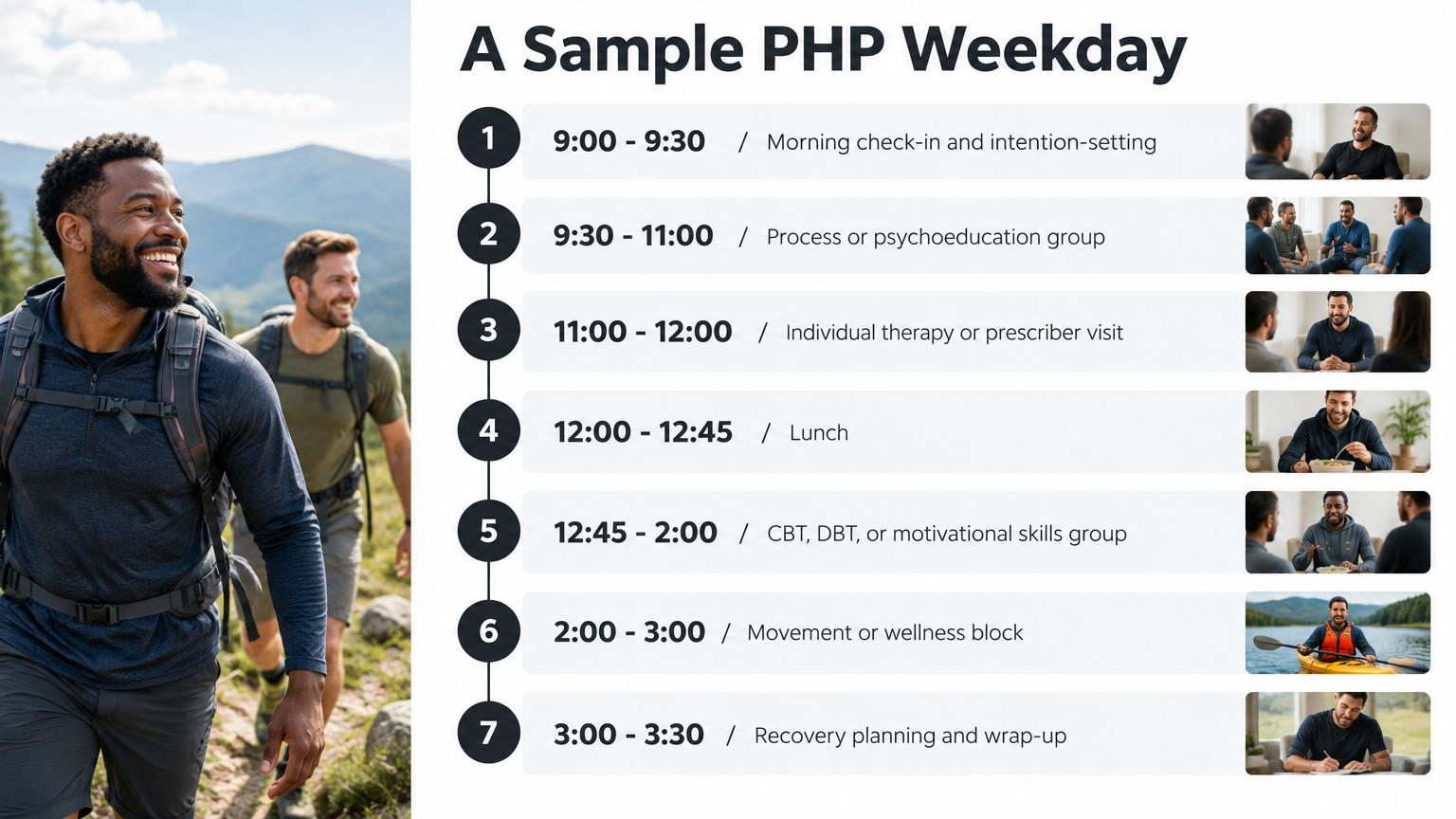
A good way to picture a PHP day is to anchor it to a real schedule published in peer-reviewed research. The opioid use disorder PHP documented in the 2018 study ran Monday through Friday, 9:00 a.m. to 3:30 p.m., giving roughly six and a half hours of structured programming each day 6. Federal guidance describes those hours as filled with clinically intensive services and direct access to psychiatric, medical, and laboratory care during the day 2, 3.
A representative weekday built from that structure looks something like this:
Programs vary this block based on clinical need, payer authorization, and the day of the week. Family sessions, lab work, or coordination calls may displace one of the groups when needed 1.
The hours in a PHP day are not generic support time. Federal guidance lists the kinds of services that commonly make up the week: individual and group counseling, medication management, family therapy, educational groups, occupational therapy, and recreational therapy 2. ASAM Level 2.5 adds that participants have direct access to psychiatric, medical, and laboratory services, which is the clinical access that separates PHP from a lighter outpatient level 3.
Group therapy usually anchors the day. Men in a PHP for substance use and co-occurring concerns often rotate through process groups, where the work is on what is actually happening in their lives, and skills groups built on evidence-based modalities like CBT, DBT, EMDR preparation, and motivational interviewing. Individual therapy typically happens one to three times a week, giving a man a confidential space to work on trauma, relationships, or anger that may be harder to open up about in a group.
Medication management is woven into the schedule rather than treated as a side appointment. A prescriber monitors any medications for substance use disorder, mental health symptoms, or physical health concerns, and nursing may run routine checks or labs as clinically indicated 2, 3. Family sessions, when appropriate, pull a spouse, partner, or parent into the plan.
Recovery planning closes the loop. Case management time is used to coordinate step-down to IOP, housing stability, work re-entry, and continuing care contacts, which NIDA frames as a core principle of good treatment 8.
Movement earns a spot on a PHP schedule as a clinical adjunct, not as a replacement for therapy or medication. Federal guidance explicitly lists recreational and occupational therapy among the service types that can be part of a PHP week, which gives programs room to build in structured physical activity alongside counseling and medical care 2.
The research on exercise in substance use treatment is cautious but promising. A 2022 systematic review of exercise interventions for people with opioid or amphetamine use disorders screened 14 randomized controlled studies and found no clear difference in exercise time, frequency, or cycle between the protocols examined, which means there is no single evidence-based dose a schedule has to hit 9. A 2024 systematic review and meta-analysis of 17 randomized controlled trials with 1,905 participants with alcohol use disorder reported improvements in alcohol-dependence measures, physical status, anxiety, depression, stress, and fitness outcomes when exercise was integrated into care, though study protocols varied and the findings do not establish that exercise should replace medication, psychotherapy, or other evidence-based care 10. Neither review shows that movement treats substance use on its own, and neither establishes an ideal activity or timetable.
Inside a PHP week, that evidence supports a modest and honest claim: a daily movement block, whether that is boxing, strength work, yoga, hiking, or a group walk, can support the physical and mental health side of recovery while the clinical hours do the primary therapeutic work.
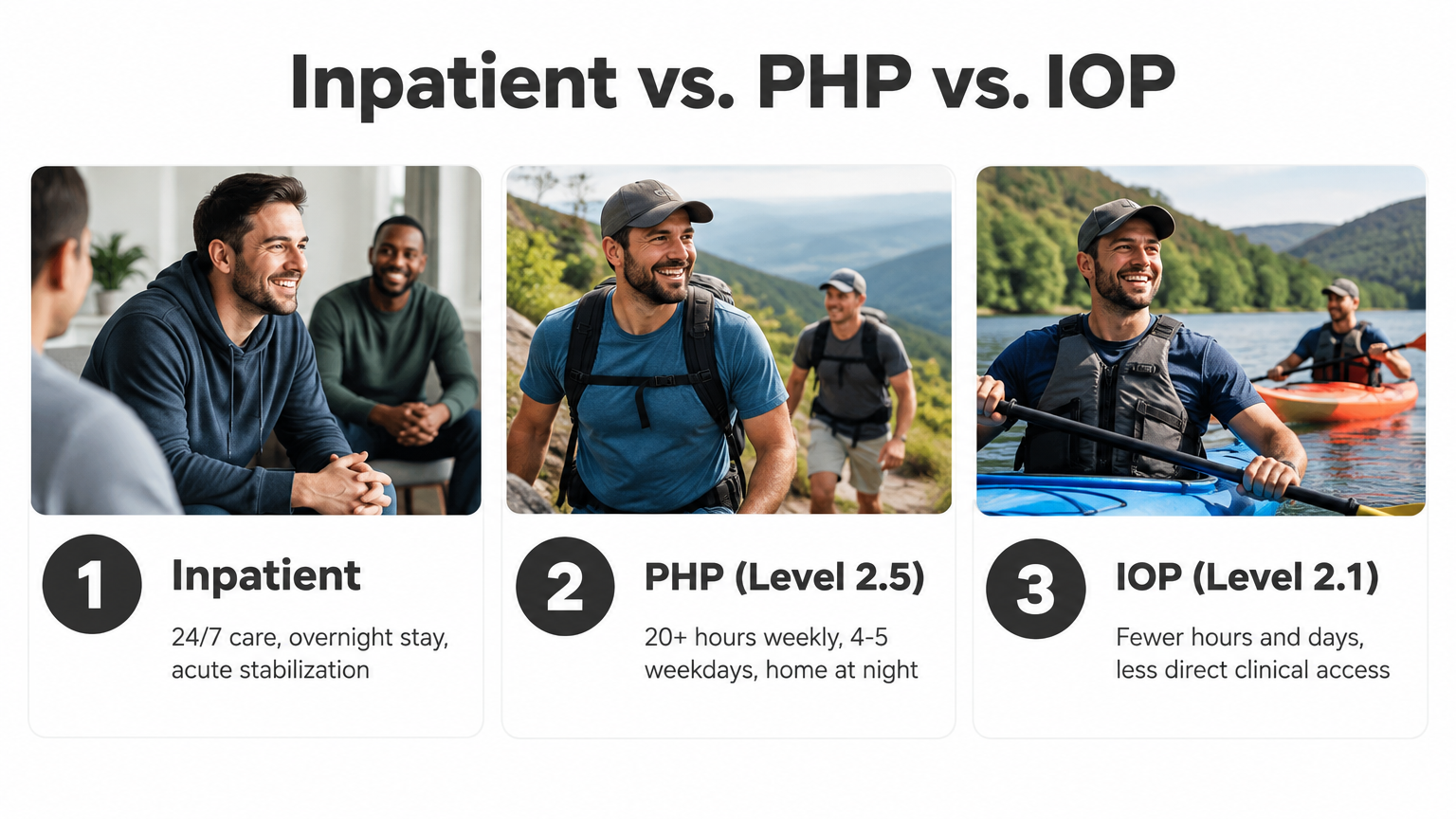
The clearest way to understand a partial hospitalization program schedule is to put it next to the levels of care on either side of it. Inpatient treatment keeps a man in a facility overnight with 24-hour nursing and medical coverage. PHP sends him home at the end of each clinical day, but still asks for about 20 or more hours of structured programming per week with direct access to psychiatric, medical, and laboratory services during those hours 2, 3. Intensive outpatient (ASAM Level 2.1) sits a step below PHP, with fewer intensive hours and less direct clinical access during the week 3.
The table below lays out the practical differences a man and his family usually want to see side by side.
| Factor | Inpatient | PHP (ASAM Level 2.5) | IOP (ASAM Level 2.1) |
|---|---|---|---|
| Weekly clinical hours | 24/7 structured care | Generally 20+ hours 2, 3 | Fewer intensive hours than PHP 3 |
| Days per week | 7 | Usually 4-5 weekdays | Generally fewer days than PHP |
| Overnight stay | Required | Not required; home at day's end | Not required |
| Direct access to psychiatric, medical, and lab services | Continuous | During program hours 2, 3 | Less direct access than PHP 3 |
| Typical use case | Acute stabilization, withdrawal management, safety needs | Needs intensive daily treatment without 24-hour care 1 | Step-down from PHP or a lower-acuity entry point |
A couple of practical notes about reading this comparison. First, PHP is not a lighter version of inpatient; it is a different model built for men who have an adequate support system at home and can participate in active treatment during the day 1. Second, the step between PHP and IOP is mostly about clinical intensity and access, not just hours. Dropping to IOP usually means fewer group sessions, less frequent individual therapy, and less day-to-day contact with a prescriber or medical team 3. That is why clinicians often treat PHP as the natural step down from detox or inpatient care, and IOP as the next step after a man has stabilized inside the PHP schedule.
A partial hospitalization program schedule is not pulled off a shelf. CMS guidance describes PHP as appropriate for people who do not require 24-hour care, have an adequate support system outside the program, and can tolerate the intensity of active daytime treatment 1. That last piece matters: PHP asks a man to show up, engage in group work, and complete between-session assignments, so the clinical team confirms he can participate before building the week around him.
For a man entering PHP for substance use with co-occurring anxiety, depression, trauma, or anger, the written plan is where his specific picture gets translated into a schedule. The team may weight more individual therapy early on, add family sessions once a spouse or parent is ready, or build in extra psychiatric time while medications are being adjusted 2.
A PHP schedule is a living document. NIDA's treatment principles state that an individual's treatment and services plan must be assessed continually and modified as needs change, and that a continuing-care approach, with intensity varying over time, tends to produce the best results 8. Inside PHP, that principle shows up as a schedule that shifts week to week rather than one that locks a man into the same blocks for a month.
Early in treatment, the week may lean heavier on stabilization: more frequent psychiatric check-ins, closer medical monitoring, and trauma-informed individual work paced carefully. As cravings settle and sleep, appetite, and mood steady out, the clinical team may trade some of that acute support for more skills groups, family sessions, or recovery-planning time 1, 8. If a setback happens, a missed day, a return to substance use, a crisis at home, the plan adjusts in the other direction rather than treating the man as having failed the schedule.
The written plan also defines when PHP ends. A step-down to IOP usually happens when a man is holding stability with less direct clinical access, which is the practical signal that the next level of care fits better than the current one 3.
The research on PHP is useful, but it is narrower than most marketing pages suggest. A long-standing systematic review comparing partial and full hospitalization in adults with psychiatric distress covered 18 investigations and found no evidence of different outcomes between the two levels of care in the selected patient populations, with patients and families reporting greater satisfaction with partial hospitalization within a year of discharge 4. The authors flagged real limits: more than half of eligible patients were excluded in advance, and diagnostic severity varied widely. The honest read is that PHP is a legitimate alternative to inpatient care for selected patients, not a proven equivalent for everyone.
Length of stay is less fixed than the hours-per-week figure. An acute psychiatric PHP sample of roughly 2,000 patients reported a mean stay of about 5.3 days with meaningful short-term improvements in symptoms and cognitive functioning, but that was acute stabilization work rather than a substance use continuum 5. For substance use and co-occurring PHPs, the exact duration is driven by clinical progress and the individualized plan the team writes and revises as a man moves through care 1, 8. The schedule is a tool the team uses, and the research backs letting that tool flex rather than locking in a fixed stay.
A partial hospitalization program schedule asks for roughly a part-time job's worth of weekly hours. With 20 or more clinical hours spread across four or five weekdays, and real-world programs often running 9:00 a.m. to 3:30 p.m., most men cannot hold a standard daytime job while in PHP 2, 6. That is a logistical fact worth planning around rather than a reason to delay care.
In practice, men entering PHP in Knoxville or the Nashville-area program in Columbia, TN typically use short-term disability, FMLA, PTO, or a leave arrangement with their employer for the active weeks of treatment. Case management time inside the PHP day exists partly to help work through those conversations and the paperwork that comes with them 2. School schedules, custody arrangements, and transportation to and from the program also get mapped out as part of the written individualized plan 1.
Evenings and weekends stay yours. The schedule ends by mid-afternoon, which leaves time for family dinners, recovery meetings, sleep, and the between-session assignments the clinical team sends home.
For family members trying to picture what their person will actually be doing, the week is more structured than most imagine. He leaves in the morning, spends the day in a clinical setting with therapists, prescribers, and a consistent group of other men, and comes home by late afternoon 2, 6. He is not hospitalized, and he is not loosely checking in; he is in active treatment on a weekday schedule.
His day combines group therapy, individual sessions, psychiatric and medical check-ins, skills education, and recovery planning, with movement or wellness programming built in as an adjunct to the clinical work 2, 3. Family sessions may be added when the clinical team and the family are ready, and those sessions give spouses, partners, or parents a direct place to ask questions and work on the household side of recovery.
What families can expect at home is a man who is tired some evenings, carrying homework from skills groups, and asked to practice new tools between sessions. The schedule flexes as he progresses, with the plan reassessed and adjusted rather than held fixed 1, 8. Weekends are usually unstructured by the program, which is when outside support, routine, and connection matter most.
A partial hospitalization program schedule is a serious weekday commitment, but it is also a workable one. Twenty or more clinical hours across four or five days, with evenings and weekends at home, gives a man real treatment without pulling him out of his life for a month 2, 3. The right schedule is the one a clinical team builds around his diagnosis, support system, and goals, then revises as he moves forward 1, 8.
For men in East Tennessee or the Nashville-area program in Columbia, TN, the next step is usually a clinical conversation: a confidential call to walk through what he is dealing with, verify insurance, and talk about whether PHP, a step up to detox, or a step down to IOP fits best. Trifecta Healthcare Institute's admissions team handles that conversation directly, and the clinical assessment that follows is what shapes the actual week. The schedule becomes real once a man and his team sit down together and start writing it.
Federal CMS and SAMHSA guidance describes PHP as generally offering 20 or more hours of clinically intensive services each week, with direct access to psychiatric, medical, and laboratory care during program hours 2. The ASAM Level 2.5 resource guide uses the same 20-hour benchmark 3. Some programs exceed the 20-hour minimum depending on clinical need and the written individualized plan 1.
PHP (ASAM Level 2.5) runs about 20 or more clinical hours per week, usually across four or five weekdays, with direct access to psychiatric, medical, and laboratory services during program hours 2, 3. IOP (ASAM Level 2.1) involves fewer intensive hours and less direct clinical access during the week 3. The gap is about clinical intensity and daily access, not just total hours on a timetable.
Length of stay varies by diagnosis, acuity, and progress. An acute psychiatric PHP sample of roughly 2,000 patients reported a mean stay of about 5.3 days 5. For substance use and co-occurring PHPs, duration is driven by the written individualized plan and ongoing clinical reassessment rather than a fixed program length 1, 8.
Usually not during standard daytime hours. Real-world PHPs frequently run Monday through Friday, 9:00 a.m. to 3:30 p.m., which conflicts with most daytime jobs and class schedules 6, 7. Men commonly use short-term disability, FMLA, PTO, or a leave arrangement during active PHP weeks. Case management time inside the program helps coordinate those conversations and plan a return to work or school after step-down 2.
A representative day combines a morning check-in, a clinician-led process or psychoeducation group, individual therapy or a psychiatric or medical check, lunch, a skills group grounded in CBT, DBT, or motivational interviewing, a movement or wellness block, and a recovery-planning wrap-up 2, 3. Real-world programs documented in peer-reviewed research run Monday through Friday, 9:00 a.m. to 3:30 p.m., giving roughly six and a half structured hours daily 6.
A licensed clinical team decides, based on an assessment of diagnosis, acuity, and support outside the program. CMS guidance identifies PHP as appropriate for people who do not require 24-hour care, have an adequate support system, and can tolerate active daytime treatment 1. NIDA adds that the plan should be reassessed and modified as needs change, so the level of care may shift during treatment 8.
Between facility size limits, waivers, and state-by-state rules, figuring out your Medicaid or private insurance benefits can feel like its own full-time job. Our admissions team will verify your coverage in minutes and walk you through exactly what's available — no guesswork required.
Verify Insurance Benefits →No commitment required. Confidential & HIPAA-protected.
Whether it's you or someone you love, our team can help you figure out the next step — what treatment looks like, what's covered, or just someone to talk to.
Talk to Our TeamConfidential. No commitment required.


