


How to Choose a Dual Diagnosis Partial Hospitalization Program
Use this checklist to assess a dual diagnosis partial hospitalization program, including integrated care, medication support, Tennessee licensure, PHP fit, a...
Read More
Learn common paws symptoms, how they may affect mood, sleep, focus, and cravings, what timelines can look like, and when to seek medical care.
Start Your Journey NowWritten and reviewed by the clinical team at Trifecta Healthcare Institute, a men’s-only treatment center in Tennessee specializing in substance use, mental health, and dual diagnosis care.
PAWS symptoms, short for post-acute withdrawal symptoms, are the mood, sleep, cognitive, and craving changes that can linger after the acute withdrawal from alcohol or other substances fades. Think anxiety, low mood, poor sleep, foggy thinking, irritability, and cravings that show up in waves weeks or months into recovery1, 4. They are a sign the brain and nervous system are still recalibrating, not evidence that treatment failed.
Most men searching for "PAWS symptoms" are asking something quieter underneath: Is what I'm feeling normal, and does it mean I'm doing recovery wrong? If you detoxed, did the work, and still feel flat, wired, or unable to sleep three months later, that question hits hard. The honest answer is that persistent symptoms are common after prolonged substance use, their course varies by person and substance, and researchers still debate exactly how to define the syndrome1, 2. The rest of this guide names what those symptoms look like, how long they can last, when to call a clinician, and what actually helps when a wave hits.
Post-acute withdrawal describes the mood, sleep, thinking, and craving changes that can stick around after acute withdrawal ends. The acute phase is the physical storm right after someone stops drinking or using: tremor, sweating, nausea, racing heart. Post-acute symptoms are quieter and slower. They include anxiety, low mood, trouble sleeping, cognitive fog, irritability, reduced ability to feel pleasure, and cravings that come and go in waves1, 4.
These symptoms are the nervous system recalibrating after prolonged substance use. The brain adapted to a steady chemical input, and now it has to rebuild its own regulation. That takes time. Not everyone experiences post-acute symptoms, and when they do appear, their shape and length vary by person and by substance4.
PAWS does not appear as a standalone diagnosis in the DSM or ICD. Researchers use the term, clinicians use it, and recovery communities use it, but studies apply different definitions, timelines, and symptom lists, which is why a single textbook description is hard to pin down1, 2.
That matters for two reasons. First, no one can hand a man in month three a fixed calendar for when symptoms will lift; the evidence does not support that kind of promise. Second, lingering anxiety, depression, or sleep problems should not be dismissed as "just PAWS." They may reflect a co-occurring mental health condition that needs its own assessment and treatment, not just time15.
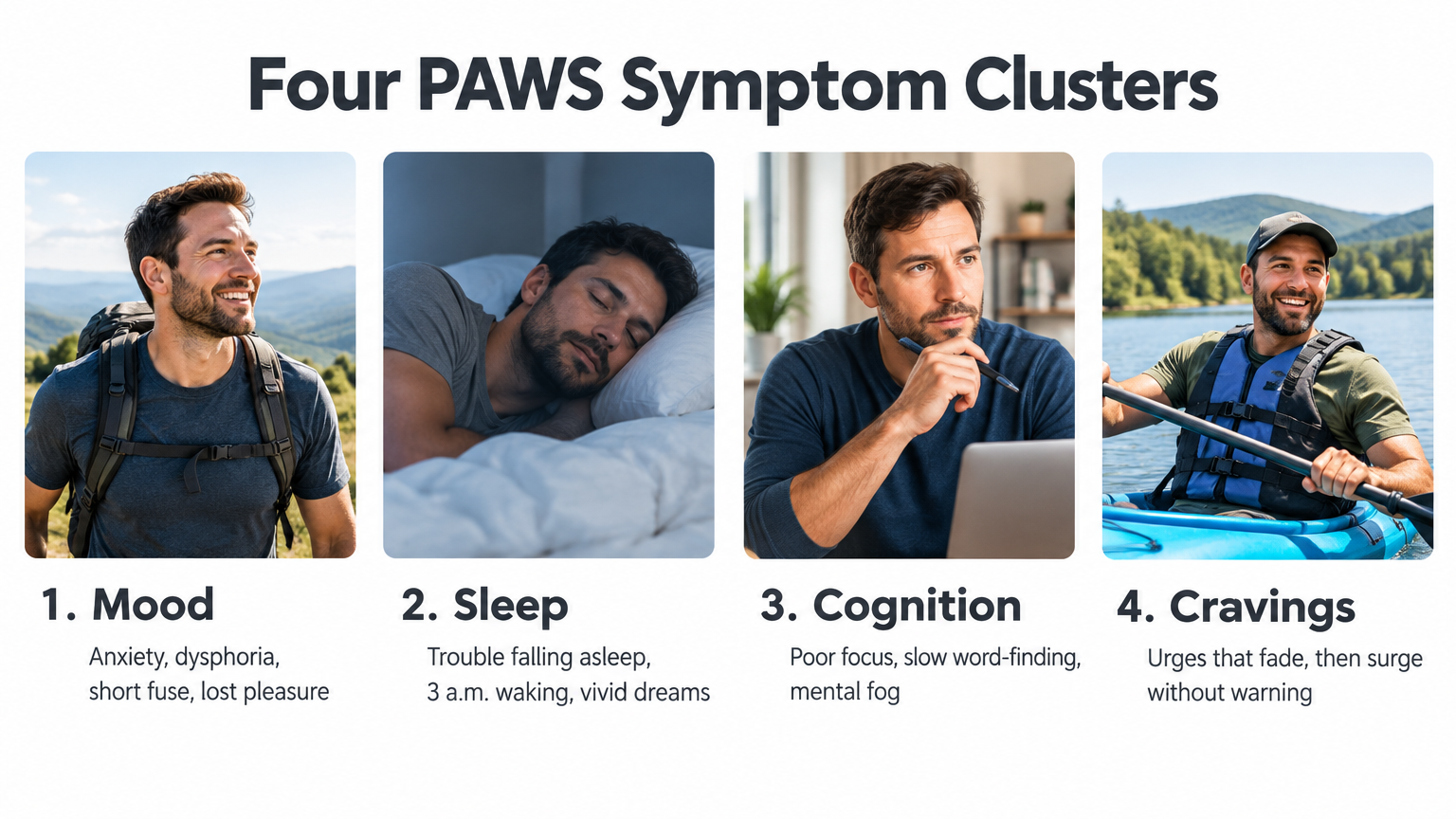
Most men in early recovery do not describe post-acute withdrawal as one feeling. They describe four, often tangled together. Grouping them makes the experience easier to name, and easier to tell a clinician about.
If a reader can place what he is feeling into one or two of these buckets, he can describe it to his treatment team without having to find the perfect clinical word.
One of the most disorienting things about post-acute withdrawal is that it does not fade on a straight line. A man may string together two solid weeks, then wake up on a Tuesday feeling like week one again. That pattern is normal. SAMHSA notes that protracted-withdrawal symptoms can come and go, and that some people even develop symptoms later in abstinence rather than right after detox4.
Stress, poor sleep, skipped meals, conflict at home, an anniversary, a familiar bar on the drive to work: any of these can set off a wave. The wave is not evidence that recovery is unraveling. It is evidence that the nervous system is still sensitive while it recalibrates1. Knowing waves are expected makes them easier to ride instead of fight.
After acute alcohol withdrawal clears, what often lingers is not a shake or a sweat. It is a mood problem. A systematic review of 27 studies describes post-acute alcohol withdrawal as predominantly a negative-affect state that can persist for 4–6 months or longer, with symptoms including anxiety, dysphoria, anhedonia, sleep disturbance, cognitive impairment, cravings, and irritability1.
A separate 2023 review that focused specifically on craving, sleep disturbance, and anhedonia found these three can continue after acute symptoms resolve, though they generally decline in intensity over time3. The 4–6 month figure is a reported range from the alcohol literature, not a countdown clock. Some men feel steadier sooner. Some notice symptoms flare and fade well into year one.
Opioid withdrawal has a sharper acute phase than alcohol and a quieter, longer tail. WHO-linked clinical guidance lists acute opioid withdrawal at roughly 4–10 days for short-acting opioids like heroin or oxycodone, and 10–20 days for methadone6. The physical symptoms, bone aches, chills, GI distress, usually resolve inside that window.
What can follow is a post-acute phase described in the same guidance as lasting up to about six months, marked by reduced well-being and strong cravings6. For a man in month four who thought he was through it, that framing matters. The urges and the flatness are documented, not imagined. SAMHSA also notes that some people develop symptoms later in abstinence rather than right after detox4.
Methamphetamine and cocaine withdrawal usually opens with a crash: heavy fatigue, long sleep, big appetite, flat mood. A Cochrane review of amphetamine withdrawal describes that initial crash resolving in about a week, followed by less well-defined symptoms that may continue for roughly three weeks, or longer for some people14.
A broader psychostimulant review lists what those weeks can hold: dysphoric mood, fatigue, vivid dreams, insomnia or excessive sleep, increased appetite, psychomotor slowing or agitation, and craving7. The pattern is subtler than alcohol or opioid withdrawal, which is part of why men dismiss it. The symptoms are real, and they still shape how a week feels.
Cannabis withdrawal is often minimized, including by the person going through it. A clinical review puts the onset at 24–48 hours after stopping, with symptoms peaking on days 2–6 and lasting up to three weeks or longer in heavy users8.
Common symptoms include anxiety, irritability, anger, sleep disturbance, depressed mood, and appetite loss8. For a man who used daily for years, the first two weeks without sleep or appetite can feel like proof that cannabis was holding something together. It was not. The nervous system is adjusting on its own schedule.
That is why clinicians use a slow, structured taper rather than a cold stop. The onset and duration of symptoms depend on the specific drug's half-life, the dose, and how long someone has been taking it5. Anxiety, insomnia, sensory sensitivity, and mood changes can persist for weeks or months after the taper ends, blurring into what many people call PAWS. If benzodiazepines are in the picture, the first call is to a prescriber, not to a willpower plan.
Put side by side, the reported ranges look like this:
These are reported ranges, not guarantees. SAMHSA notes some people have no symptoms after acute withdrawal and others experience them later in abstinence4. The honest use of this chart is as a reference point, not a forecast.
Post-acute symptoms are uncomfortable. Acute alcohol or sedative withdrawal can be deadly. The difference matters, and it is worth knowing before a hard night turns into a hospital night.
With alcohol, the warning signs that call for medical help now include heavy tremor, sweating, racing heart, high blood pressure, nausea or vomiting that will not stop, severe insomnia and agitation, hallucinations, confusion, or a seizure. NIAAA lists these as features of acute alcohol withdrawal and notes that delirium tremens and seizures can be life-threatening9, 16. NIAAA also warns that suddenly stopping prolonged heavy drinking can trigger a painful or potentially life-threatening process, which is why medically supervised withdrawal exists10.
Benzodiazepines carry a parallel risk. Clinical reference material warns that benzodiazepine and barbiturate withdrawal can involve seizures and death, and that symptoms may become protracted after the taper ends5. If a man stopped a benzodiazepine suddenly and is shaking, seizing, or losing his grip on reality, that is a 911 call, not a PAWS wave.
Opioid cravings during the post-acute phase carry a specific danger that does not apply to alcohol or cannabis. Tolerance drops during abstinence. The SAMHSA Overdose Prevention and Response Toolkit explains that tolerance can decrease after a period of not using, and returning to a previously tolerated amount can increase overdose risk11. The CDC puts it in plainer terms: tolerance can lessen after even a brief stretch of abstinence, which means the old dose is not the safe dose12.
This is why a craving at month four is not just an emotional problem for someone with opioid use disorder. It is a medical risk. Keeping naloxone accessible, telling at least one person in the recovery circle about any slip, and calling a prescriber or treatment team before anything else are concrete steps that reduce harm during a craving surge11.
When a wave hits at 2 a.m., no one wants to decode a clinical textbook. A short triage frame helps.
Call 911 or go to an emergency room if there is a seizure, confusion or disorientation, hallucinations, chest pain, uncontrollable vomiting, a suspected overdose, or signs of acute alcohol or benzodiazepine withdrawal like severe tremor and racing heart5, 9. Also treat a return to opioid use after a stretch of abstinence as a potential medical emergency because of the tolerance drop11.
Call a clinician within 24 hours if symptoms are persistent anxiety, low mood, anhedonia, sleep disruption, cognitive fog, or recurring cravings that are not resolving, or if any symptom is getting worse week over week rather than better. SAMHSA notes these post-acute symptoms can last weeks or months and benefit from active treatment rather than waiting them out alone4.
Use a grounding tool and log it if symptoms are a familiar wave, time-limited, and manageable: movement, a peer call, sleep hygiene, a meal. Then share the wave with the treatment team at the next check-in so patterns can be tracked, not guessed at.

Here is the honest problem with the PAWS label: anxiety, low mood, poor sleep, and trouble concentrating are also the daily symptoms of generalized anxiety disorder, major depression, PTSD, and ADHD. NIAAA points out that alcohol use disorder frequently co-occurs with anxiety, depression, and trauma-related conditions, and that symptoms during and after withdrawal may have more than one cause15. The same systematic review that defines post-acute alcohol withdrawal as a negative-affect state acknowledges that some of those symptoms may reflect untreated mood, anxiety, cognitive, or trauma-related disorders rather than withdrawal alone1.
For a man in month four, that overlap is practical, not academic. If anxiety was already present before the drinking started, it did not disappear during detox. If trauma from service, work, or childhood was being muted by substances, it surfaces when the substance is gone. Calling all of it "just PAWS" can delay care that would actually help.
A few patterns suggest a symptom deserves its own clinical workup rather than another month of waiting it out:
NIAAA emphasizes assessing co-occurring medical and psychiatric conditions rather than attributing all symptoms to withdrawal alone15. NIDA frames the same point from the treatment side: care should combine behavioral therapy with medications where evidence supports them, and plans should address medical, psychological, and social needs together13. Tell the treatment team what is happening. A dual-diagnosis assessment is not a setback. It is often the step that finally moves things.
When mood, sleep, and cravings keep swinging, the first thing worth stabilizing is the shape of the day. A predictable wake time, meals at roughly the same hours, and a wind-down routine that starts before midnight give the nervous system fewer variables to react to. SAMHSA frames protracted-withdrawal management as practical symptom monitoring and support, not a single prescription, which is why daily structure carries real weight4.
Sleep is often the hinge. Keeping the bedroom cool and dark, cutting caffeine after lunch, and getting outside for morning light help the body relearn a rhythm that alcohol or stimulants used to override3, 7. Protein at breakfast and steady meals through the day blunt the irritability that comes with low blood sugar. None of this cures PAWS. It lowers the baseline so the waves hit a steadier man.
Exercise belongs on the treatment plan, not the hobby list. NIDA describes effective care as combining behavioral therapies with medications where evidence supports them, and addressing medical, psychological, and social needs together13. Movement is widely used in recovery programs to support the exact symptoms men report during post-acute withdrawal: anxiety, low mood, poor sleep, and restlessness4, 13.
What that looks like in a Tennessee week is less important than consistency. A boxing round, a jiu-jitsu class, a loaded carry at the gym, a Smoky Mountains hike, or an ice bath after a lift all push the body through stress and recovery in a way talk therapy alone cannot. The point is not to chase a feeling or reset anything. The point is to give a dysregulated nervous system regular, structured demand so it has reason to adapt.
Isolation is where a PAWS wave does the most damage. A man who rides it out alone at 11 p.m. tends to replay the same loop: this is not working, nothing is working, maybe one drink would quiet it. A man who texts another guy in recovery, or calls his sponsor, or shows up to a group the next morning, interrupts that loop before it writes a decision.
Clinical check-ins matter in the same way. SAMHSA notes that protracted symptoms can last weeks or months and benefit from active monitoring rather than waiting them out alone4. Telling a therapist that week three felt flat and week four felt panicky gives the team data to adjust therapy intensity, screen for a co-occurring condition, or reconsider medications13, 15.
If symptoms are stacking up at month three or month six, that is the signal to lean deeper into care, not step back from it. A quick call to a program in Tennessee can clarify whether a step-up to PHP or IOP, a dual-diagnosis assessment, or a medication review makes sense for what is actually happening right now. [Call Trifecta] or [Verify your insurance] to talk through the next right move.
A quick note to the people reading this on someone else's behalf: what you are watching is real, and it is not a sign he is choosing to stay stuck. Post-acute symptoms like flat mood, short temper, broken sleep, and sudden cravings can show up weeks or months after detox and come in waves rather than a steady decline1, 4. A rough Tuesday after two good weeks is not a failure of effort or love.
What helps most from the outside is steadiness, not fixing. Keep the daily rhythms predictable, protect sleep when you can, and resist the urge to interpret every bad night as a relapse signal. If symptoms are getting worse week over week, if you hear talk of self-harm, or if he returns to opioid use after a stretch of abstinence, treat it as medical. Tolerance drops during abstinence, and a prior dose is not a safe dose11, 12. Encourage a call to his treatment team, and ask whether a dual-diagnosis assessment makes sense when anxiety, depression, or trauma symptoms keep surfacing15.
If mood, sleep, or cravings are still rolling through at month three or month six, the next move is a conversation, not more waiting. Trifecta Healthcare Institute runs men's programs in Knoxville and in Columbia, TN, outside Nashville, with a full continuum from medical detox through PHP, IOP, outpatient, and alumni services. That continuum matters for post-acute withdrawal because the right level of care at month one is rarely the right level at month five. A step-up or step-down, a dual-diagnosis assessment when anxiety or trauma symptoms will not quiet down, or a medication review for sleep or cravings can each change how the next month feels13, 15.
What a Tennessee week in care tends to look like: evidence-based therapy (CBT, DBT, EMDR, motivational interviewing) paired with movement that treats a dysregulated nervous system as a clinical problem, not a motivation problem. Boxing, jiu-jitsu, gym work, Smoky Mountains hikes, and ice baths sit alongside group and individual sessions, with peer accountability built into the day. SAMHSA frames protracted-withdrawal care as active monitoring and support rather than waiting it out alone, which is the shape this kind of program takes4.
If symptoms keep coming back, that is the signal to lean in. [Call Trifecta] or [Verify your insurance] to talk through what level of care fits what is actually happening right now. The waves get easier to ride with a team in the corner.
PAWS is used clinically and in recovery circles, but it is not a formal standalone diagnosis in the DSM or ICD. Researchers apply different definitions, timelines, and symptom lists, which is why a single textbook description does not exist1, 2. The symptoms are real; the label is still being refined.
Duration varies by substance and by person. For alcohol, a negative-affect state can persist 4–6 months or longer1. Opioid post-acute symptoms may continue up to about six months after the acute phase ends6. Stimulant symptoms often run roughly three weeks and sometimes longer14, and cannabis symptoms can last up to three weeks or longer in heavy use8.
If symptoms are getting worse week over week, line up with a condition that existed before substance use, or involve thoughts of self-harm, they likely need their own clinical workup rather than more waiting. NIAAA emphasizes assessing co-occurring medical and psychiatric conditions rather than attributing all symptoms to withdrawal alone15. Ask a treatment team for a dual-diagnosis assessment.
No. Post-acute symptoms are common after prolonged substance use and tend to come in waves rather than a straight line1, 4. A rough week is not evidence that recovery is unraveling. Cravings during this phase do deserve respect, especially with opioids, because tolerance drops during abstinence and a prior dose is not a safe dose11, 12.
Call 911 for a seizure, confusion, hallucinations, chest pain, uncontrollable vomiting, a suspected overdose, or signs of acute alcohol or benzodiazepine withdrawal like severe tremor and racing heart5, 9. Treat a return to opioid use after abstinence as a potential emergency due to tolerance loss11. Call a clinician within 24 hours for symptoms that are worsening or will not resolve4.
Movement is widely used in recovery programs to support mood, sleep, and restlessness, which are the exact symptoms men report during post-acute withdrawal4, 13. NIDA frames effective care as combining behavioral therapies with medications where evidence supports them, and movement fits inside that plan as a clinical tool, not a cure13.
Between facility size limits, waivers, and state-by-state rules, figuring out your Medicaid or private insurance benefits can feel like its own full-time job. Our admissions team will verify your coverage in minutes and walk you through exactly what's available — no guesswork required.
Verify Insurance Benefits →No commitment required. Confidential & HIPAA-protected.
Whether it's you or someone you love, our team can help you figure out the next step — what treatment looks like, what's covered, or just someone to talk to.
Talk to Our TeamConfidential. No commitment required.


