


How to Choose a Dual Diagnosis Partial Hospitalization Program
Use this checklist to assess a dual diagnosis partial hospitalization program, including integrated care, medication support, Tennessee licensure, PHP fit, a...
Read More
Use spring hill recovery reviews to assess staff and environment, then verify Tennessee licensing, clinical care levels, medication options, insurance covera...
Start Your Journey NowWritten and reviewed by the clinical team at Trifecta Healthcare Institute, a men’s-only treatment center in Tennessee specializing in substance use, mental health, and dual diagnosis care.
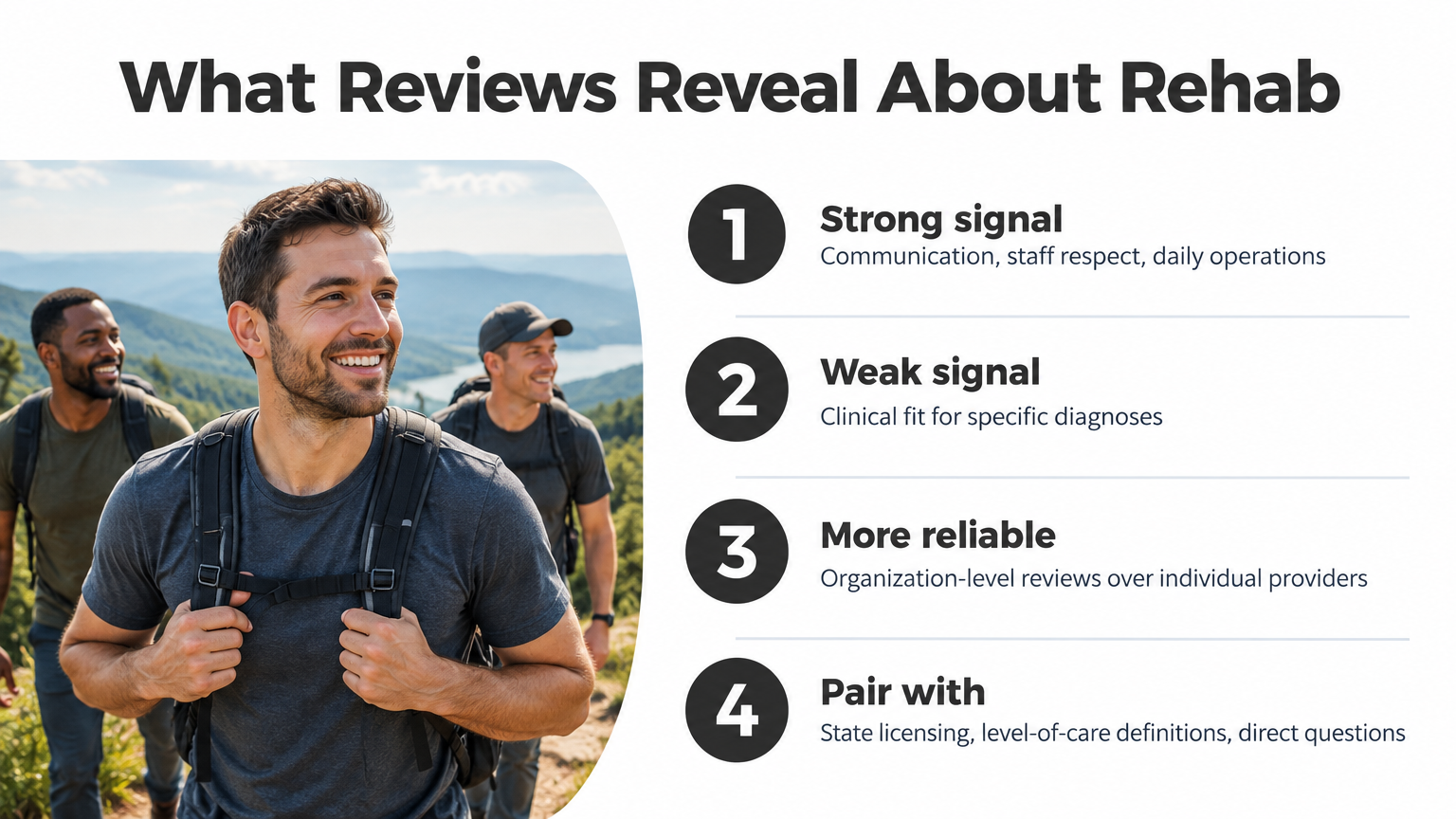
Spring Hill recovery reviews are useful for judging how a program communicates, treats people, and runs day-to-day care. They are a weaker signal for whether the clinical work matches a specific problem like opioid use disorder, co-occurring PTSD, or alcohol use disorder with liver concerns. A systematic review of 32 studies on online patient reviews found consistent positive correlations with patient experience, but mixed associations with objective clinical quality measures, and noted that organizational-level reviews tend to be more reliable than reviews of individual providers.1
That split matters when someone in Spring Hill, Columbia, or South Nashville is scrolling through star ratings at 11 p.m. A review can tell a reader whether the front desk returned calls, whether a counselor felt respectful, or whether the environment felt safe. It cannot verify whether the program is licensed by Tennessee, whether medications for opioid use disorder are on the menu, whether co-occurring anxiety or depression is treated alongside substance use, or whether the clinical hours match what the state defines as outpatient, intensive outpatient, or partial hospitalization care.
So the honest answer to the search behind "spring hill recovery reviews" is this: use reviews for experience signals, and pair them with Tennessee licensing records, published level-of-care definitions, and plain questions about therapy, medication, and aftercare. The rest of this guide walks through a repeatable method that a reader can finish in one evening, built around what reviews reveal and what they quietly leave out.
Reviews for "Spring Hill recovery" often get lumped in with Nashville results, but the market behaves differently on the ground. Spring Hill is connected to Nashville and Columbia by Interstate 65, State Route 396 (Saturn Parkway), and U.S. 31. That geography shapes which programs a reader can realistically attend five days a week for an intensive outpatient schedule versus which require a longer commute into Nashville or down to Columbia.
Commute burden matters because Tennessee's continuum of care defines intensive outpatient by multiple therapeutic contacts per week, not by distance.5 A program that looks appealing in reviews but adds forty minutes each way through I-65 congestion can quietly undercut attendance, and remaining in treatment is associated with better outcomes in treatment research.7
Spring Hill reviews also pull in facilities marketed to a wider South Nashville audience, which means a reader comparing "Spring Hill recovery reviews" is often comparing programs in Franklin, Brentwood, and Columbia at the same time. Treat the search area as a corridor rather than a single ZIP code, and judge each program by whether its location supports steady attendance for the specific level of care being considered.
Star averages flatten everything a reader actually needs to know. A 4.6 on Google can hide a program with warm front-desk staff but weak clinical hours, and a 3.9 can belong to a program that treats complex opioid use disorder well but turns off families who expected a spa. The more useful move is to sort reviews by date, read the most recent twenty, and track themes rather than scores.
Three theme buckets are worth tagging as you read.
Write down the three strongest positive themes and the three recurring complaints for each program. That short list is far more useful than any star average when it is time to compare programs side by side.
Reviews cannot confirm that a program is legally allowed to deliver the care it advertises. Tennessee's Office of Licensure is the authoritative source for that question. It licenses mental health, substance use, and personal-support providers, conducts unannounced inspections and follow-up visits, and investigates both licensed and unlicensed providers after reports of inadequate care or rule violations.2
Before scheduling an assessment, confirm three things with the state.
A clean license plus consistent positive experience reviews is a stronger signal than either alone. A gap between what the website claims and what the license actually permits is a reason to call the state and ask before anything else.2
Level of care is where reviews mislead most often. Reviewers call a program "rehab" whether they attended an outpatient group once a week, an intensive outpatient schedule three days a week, a partial hospitalization day program, or a residential stay. Tennessee's continuum of care treats these as distinct categories defined by clinical intensity, not marketing labels. Outpatient counseling and intensive outpatient treatment are both non-residential, but intensive outpatient involves multiple therapeutic contacts per week and more structured programming.5
The right level depends on the clinical problem, not on which program had the best Google reviews. A man with mild alcohol use disorder, stable housing, and a supportive partner may do well in standard outpatient. A man coming off daily opioid use, with co-occurring depression and a history of unsuccessful outpatient attempts, usually needs something more structured, often detox followed by residential or partial hospitalization, then a step down into intensive outpatient.
When reading reviews, note which level the reviewer attended before weighing their experience. A glowing review of a weekly outpatient group tells a reader almost nothing about whether that same program could handle an acute opioid detox. Ask the program directly: how many clinical hours per week, what the group-to-individual ratio is, who provides medical oversight, and under what criteria someone transitions up or down a level.5
Many men entering treatment are also living with anxiety, depression, trauma, anger, or sleep problems that have been tangled up with substance use for years. A review may praise the "amazing counselors" without saying whether a psychiatrist or psychiatric nurse practitioner is on staff, whether evaluations screen for PTSD or bipolar presentations, and whether therapy modalities actually address those conditions.
Evidence for integrated co-occurring treatment is encouraging but not unlimited. A systematic review comparing integrated and non-integrated models found an advantage for integrated treatment in psychiatric symptomatology, but no significant differences in substance misuse or treatment retention across the included studies.9 That calibrated finding matters: integrated care is reasonable to request, but a reader should not accept a program's marketing claim of "dual diagnosis" at face value.
Three questions clarify scope quickly.
Reviews rarely answer these; a ten-minute call usually does.
Medication is one of the most consequential variables a review almost never covers. For opioid use disorder, medication is described as a first-line treatment, usually combined with behavioral therapy or counseling, and behavioral therapies help people remain in treatment longer.7 A program that quietly declines to offer or refer for buprenorphine, methadone, or extended-release naltrexone is making a clinical choice that will affect outcomes, regardless of how friendly the admissions team is.
Ask three direct questions.
The last step is the one families often postpone, and it is the one that most often derails treatment. Federal parity law requires that when a plan covers mental health and substance use disorder benefits, the financial requirements and treatment limitations generally cannot be more restrictive than comparable medical or surgical benefits within the applicable classifications. Parity does not require a plan to cover these benefits in the first place, and it does not guarantee that any specific program is in network.3 Federal final rules issued in 2024 added protections against more restrictive nonquantitative treatment limitations, which affect how prior authorization and medical-necessity reviews are applied.4
Call the program and the insurance plan the same afternoon. Ask the program which plans it is in network with, what a typical out-of-pocket estimate looks like at the proposed level of care, and whether it offers single-case agreements for out-of-network coverage. Ask the insurer to confirm benefits for the specific level of care in Tennessee and whether prior authorization is required.
Then ask about aftercare. What does the step-down look like after the primary program ends? Is there an alumni group that meets in person in the Spring Hill, Columbia, or South Nashville area? Reviews from alumni six months out are more revealing than reviews written on discharge day.
Reviewers use terms the way friends and family use them: loosely. One person's "rehab stint" was a seven-day medical detox. Another's "sober living" was actually a partial hospitalization day program. A third wrote glowingly about "the halfway house" when the facility was licensed as residential treatment. These labels are not interchangeable in Tennessee, and treating them as synonyms is one of the fastest ways to pick the wrong program.
Here is how the state draws the lines.
When a review praises a program, pin down which category the reviewer actually experienced before letting the review influence a decision. If the review does not say, the program's website and a quick call to the Tennessee Office of Licensure will.2
Scroll long enough through Spring Hill recovery reviews and someone will cite a success rate. Sometimes it is the reviewer repeating a number a counselor mentioned. Sometimes it is the program itself quoting a figure on its website. Either way, those numbers almost never mean what they appear to mean, because the field has no shared definition of what counts as success.
A 2025 review of substance use disorder treatment outcomes found that definitions of retention varied substantially across studies, including treatment at 30 days, 3 months, 6 weeks, and other intervals, which means reported retention measures were not directly comparable from one study to another.8 If researchers publishing in peer-reviewed journals cannot line up their definitions, two programs quoting a "78% success rate" are almost certainly measuring different things on different timelines with different patients.
Three questions cut through the marketing.
A review that quotes a success rate without those answers is quoting a slogan. Ask the program directly, and weigh the honesty of the response as much as the number.
If you are the one weighing treatment, reviews read differently than they do for a worried spouse or parent. You are listening for whether a program would respect you, whether the other men there would be people you could actually stand next to, and whether the daily work would feel like something you could do without pretending to be someone you are not. Those signals exist in reviews, but you have to know where to look.
Scan for how men describe the group room. Reviews that mention men holding each other accountable, calling each other out without cruelty, and showing up for one another after discharge are describing peer connection that outlasts the program. Reviews that only mention amenities, food, or the view are describing a hotel. Both can be accurate, but only one of them tells you whether the brotherhood is real.
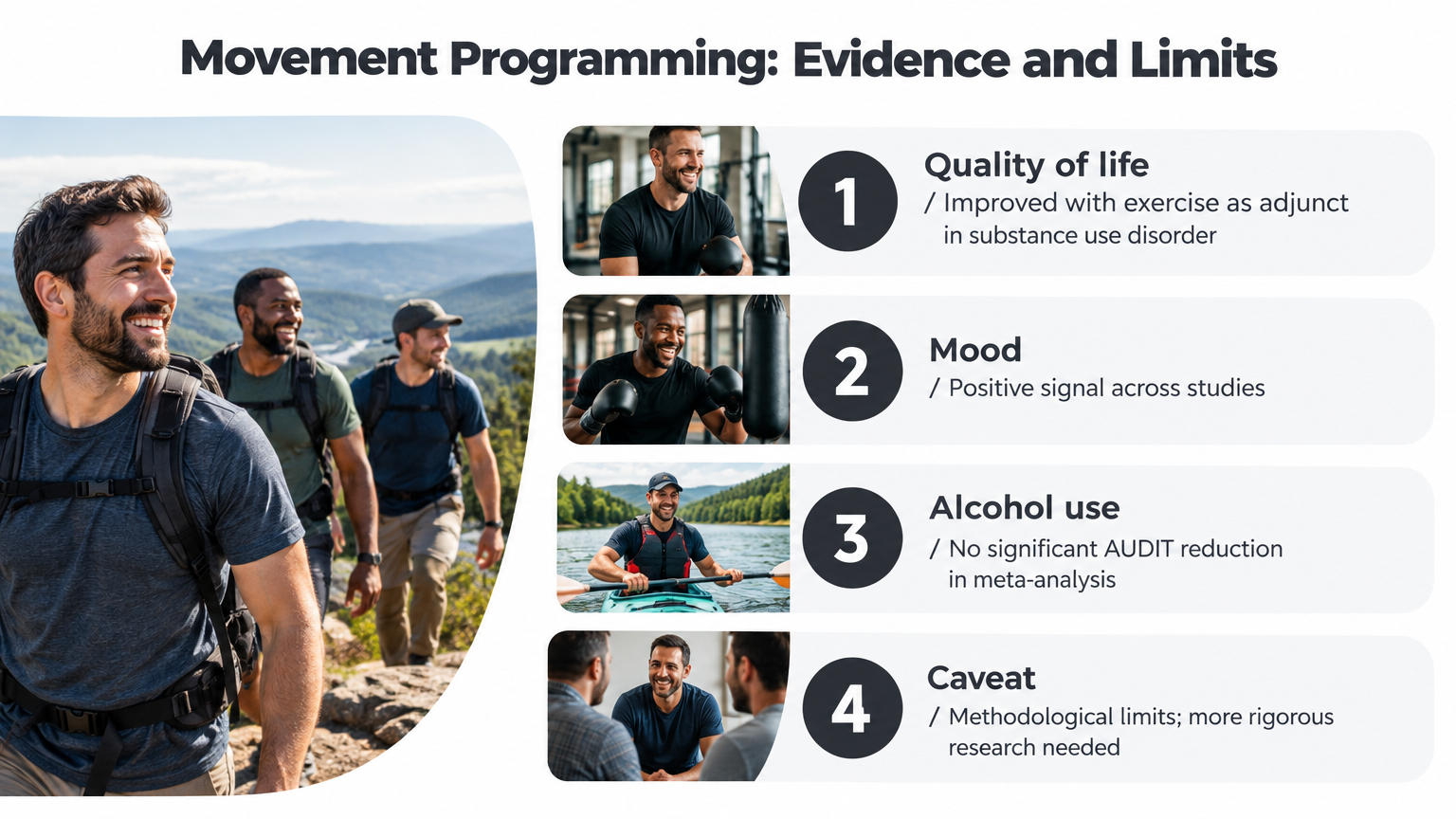
Pay attention to how reviewers describe movement programming. Boxing, jiu-jitsu, gym work, hiking, and cold exposure show up often in Tennessee program reviews, and the research on movement as an adjunct is genuinely encouraging and genuinely limited. A systematic review of 42 studies reported that quality of life improved with exercise as an adjunct intervention in people with substance use disorder, while the authors cautioned that methodological limitations across the included studies require further rigorous research.10 A separate meta-analysis on exercise for alcohol use disorder found no significant reduction in daily alcohol consumption or AUDIT scores, though depression and physical fitness improved.11 Movement belongs in the plan. It does not replace medication when indicated or evidence-based therapy.7
Finally, listen for whether reviewers sound like themselves six months later. Men who write a second review after alumni events, who name a specific counselor, or who describe what the step-down actually looked like are telling you the program held together after the discharge paperwork. That is the review worth weighing most.
Families often read reviews with a different question in mind than the person entering treatment. A spouse, parent, or sibling is usually trying to answer two things at once: is this program safe, and will it actually help him this time. That double question changes how reviews should be weighed.
Start with the negative reviews, including ones a loved one wrote about a prior program. A review that complains about being discharged after a relapse, about losing a medication without explanation, or about a counselor who dismissed trauma history is worth taking seriously, even when the reviewer was in a difficult moment. Those are the operational signals online reviews track most reliably.1 Separate those from complaints about rules, structure, or being asked to do hard emotional work, which are often part of effective treatment rather than a failure of it.
Then move the family's energy toward verification the loved one may not have the bandwidth to handle. Confirm the program's current Tennessee license and any complaint findings with the Office of Licensure.2 Ask the program directly whether co-occurring conditions like depression, PTSD, or anger are treated inside the weekly schedule or referred out, and remember that integrated care has shown an advantage for psychiatric symptoms but not consistently for substance use outcomes in the research.9 Confirm insurance benefits with the plan the same day you call the program.
Parity is one of the most misunderstood words in Spring Hill recovery reviews. A reviewer may write that their plan "had to cover rehab because of parity," and a family member reading at 1 a.m. takes that as a guarantee. The actual rule is narrower. The Mental Health Parity and Addiction Equity Act requires that when a plan covers mental health and substance use disorder benefits, the financial requirements and treatment limitations generally cannot be more restrictive than comparable medical or surgical benefits within the applicable classifications. It does not require a plan to cover these benefits at all, and it does not guarantee that any particular program is in network or that any particular level of care will be authorized.3
The 2024 federal final rules tightened the piece most relevant to treatment decisions: nonquantitative treatment limitations, which include prior authorization requirements, medical-necessity criteria, and network adequacy standards. Plans now face stronger expectations that these limits cannot be more restrictive for mental health and substance use disorder care than for medical or surgical care in the same classification.4 That matters when a reviewer complains about being bounced from partial hospitalization down to intensive outpatient after three days; the reason often lives in a utilization-review decision, not the program's clinical judgment.
Three practical calls make parity concrete.
Set aside ninety minutes, open a blank document, and build a simple grid with one row per program and these columns: level of care offered, clinical modalities, co-occurring scope, medication pathways, insurance accepted, aftercare, licensing status, and the top three positive and negative themes from recent reviews. Three programs is enough. More than that turns the evening into paralysis.
Spend the first thirty minutes on reviews. Sort by date, read the twenty most recent per program, and fill the review-theme columns with specifics rather than adjectives. Spend the next thirty on verification: pull up the Tennessee Office of Licensure to confirm each program's current license and any complaint findings at the specific Spring Hill, Columbia, or South Nashville location.2 Use the state's continuum definitions to match level of care to the actual clinical problem, not to the marketing label on the website.5
Use the last thirty minutes for phone calls. Ask each program the medication, therapy, and co-occurring questions from earlier sections, and call the insurance plan to confirm benefits for the specific level of care in Tennessee. National context on substance use treatment and recovery services continues to evolve, as reflected in SAMHSA's most recent National Survey on Drug Use and Health.12 By the end of the evening, two of the three rows usually clear the bar, and the choice between them comes down to commute, scheduling, and which program the man weighing treatment is actually willing to walk into on Monday morning.
Reviews are reliable for judging experience signals like staff communication, respect, and the day-to-day environment, but they correlate inconsistently with objective clinical quality.1 Use them to spot patterns across the most recent twenty reviews per program, then verify the clinical picture through Tennessee's Office of Licensure and direct questions about level of care, medications, therapies, and aftercare.
Residential treatment provides 24-hour clinical care in a licensed facility. Intensive outpatient is non-residential and involves multiple therapeutic contacts per week, usually alongside work or school.5 Recovery residences, often called sober living or halfway houses, are substance-free living environments built around supervised or peer-led support and do not provide medical or clinical treatment on-site apart from verifying abstinence.6
Contact the Tennessee Department of Mental Health and Substance Abuse Services Office of Licensure, which licenses providers, conducts unannounced inspections, and investigates both licensed and unlicensed programs after complaints.2 Confirm the license covers the specific service and the exact Spring Hill, Columbia, or South Nashville location a person would attend, and ask whether any recent complaint findings or corrective actions are on record.
No. Federal parity law requires that when a plan covers mental health and substance use disorder benefits, the financial requirements and treatment limitations generally cannot be more restrictive than comparable medical or surgical benefits in the same classification, but it does not require coverage in the first place.3 The 2024 final rules strengthened protections around nonquantitative treatment limitations like prior authorization and medical-necessity criteria.4 Call the specific plan to confirm benefits.
Treat it skeptically. A 2025 review of substance use disorder treatment outcomes found that definitions of retention varied substantially across studies, including measurements at 30 days, 3 months, 6 weeks, and other intervals, so reported figures are not directly comparable across programs.8 Ask what is being measured, how many former patients were actually reached for follow-up, and whether the number includes every admission or only those who completed the program.
Ask whether the program holds a current Tennessee license for the specific service and location, how co-occurring conditions like depression, PTSD, or anger are treated inside the weekly schedule, and whether medications for opioid or alcohol use disorder are available on-site or through a partner provider.7 Confirm which insurance plans the program accepts, what aftercare looks like, and how the program handles relapse without abrupt discharge.
Between facility size limits, waivers, and state-by-state rules, figuring out your Medicaid or private insurance benefits can feel like its own full-time job. Our admissions team will verify your coverage in minutes and walk you through exactly what's available — no guesswork required.
Verify Insurance Benefits →No commitment required. Confidential & HIPAA-protected.
Whether it's you or someone you love, our team can help you figure out the next step — what treatment looks like, what's covered, or just someone to talk to.
Talk to Our TeamConfidential. No commitment required.


