



How to Choose a Dual Diagnosis Partial Hospitalization Program
Use this checklist to assess a dual diagnosis partial hospitalization program, including integrated care, medication support, Tennessee licensure, PHP fit, a...
Read More
Review standards and guidelines for partial hospitalization programs, including physician oversight, weekly treatment hours, eligibility, recertification, an...
Start Your Journey NowWritten and reviewed by the clinical team at Trifecta Healthcare Institute, a men’s-only treatment center in Tennessee specializing in substance use, mental health, and dual diagnosis care.
A partial hospitalization program is intensive, structured outpatient treatment for people who need more than weekly therapy but do not require a hospital bed. Under federal rules, a qualifying PHP delivers at least 20 hours of therapeutic services per week, operates under physician direction, and follows an individualized plan of care built by a multidisciplinary team 1, 3, 17.
That weekly intensity is the clearest line between a real PHP and a program that borrows the name. If a schedule only adds up to a few group sessions and a check-in, it is intensive outpatient care at best, not partial hospitalization 2, 18.
The second line is medical oversight. A legitimate PHP has a physician certifying that the person would otherwise need inpatient psychiatric care, signing the treatment plan, and recertifying progress on a defined timeline 17. Services must be reasonable, necessary, and expected to improve the person's condition or prevent relapse and hospitalization 4.
For a man weighing PHP for substance use and co-occurring concerns, those standards translate into a simple test: structured hours, a doctor driving the plan, and a team that actually meets about his care. The rest of this guide shows where those rules come from and how to recognize a program that meets them.
The federal rules for partial hospitalization sit in two places: the Centers for Medicare & Medicaid Services (CMS) manuals and the Code of Federal Regulations. Together they describe what a program must do, who must be in charge, and who is appropriate to admit.
Under 42 CFR Part 410, covered PHP services must be reasonable and necessary, expected to improve or maintain the person's condition or prevent relapse and hospitalization, and furnished under physician certification and a plan of care 4. The regulation lists the permissible components: individual and group therapy, occupational therapy, services of social workers and psychiatric nurses, drugs and biologicals furnished for therapeutic purposes, and individualized activity therapy that is not primarily recreational or diversionary 4.
CMS's benefit policy manual adds the clinical architecture. PHP is active treatment delivered through an individualized plan under physician direction by a multidisciplinary team, and it covers both mental disorders and substance use disorder 3. The patient must need at least 20 hours of therapeutic services per week and must be able to participate without 24-hour care 2, 3.
Certification rules live in 42 CFR Part 424. A physician must certify that the person would otherwise require inpatient psychiatric care, sign the plan, and recertify progress on a defined schedule 17. For programs run by community mental health centers, 42 CFR Part 485 and 42 CFR 410.110 add provider-level conditions of participation and coverage requirements on top of the service rules 5, 6.
Tennessee layers a clinical framework on top of the federal floor. The state Department of Mental Health and Substance Abuse Services places intensive partial hospitalization inside its continuum of substance use care, describing it as an alternative to residential treatment for people who cannot be treated exclusively in an outpatient setting 7. Under ASAM's criteria, that service is generally mapped to Level 2.5, the step between intensive outpatient (Level 2.1) and residential care (Level 3.x).
For a man in Knoxville or the Nashville area in Columbia, TN weighing his options, the practical meaning is straightforward. Level 2.5 is designed for someone who needs daily structure, medical and psychiatric oversight, and group work that goes beyond a few evening sessions, but who can safely sleep at home or in a supportive living environment at night.
Where the federal and state rules diverge is in origin. The CMS framework was written around psychiatric hospitalization and uses that threshold for certification 17. Tennessee's SUD continuum uses ASAM criteria built specifically for addiction severity, co-occurring complexity, readiness to change, relapse potential, and recovery environment 7. In practice, programs serving men with substance use and co-occurring mental health concerns have to satisfy both logics at once: the Medicare clinical standard and the ASAM placement standard the state recognizes.
Most of the federal PHP language was written with psychiatric hospitalization in mind. The 20-hour minimum, the physician certification, the individualized plan, and the "would otherwise require inpatient" test all come from a mental-health-first regulatory tradition 3, 17. SAMHSA's public-facing explanation reflects the same lineage, treating PHP as an outpatient option more intensive than standard appointments and describing shared services like individual sessions, group work, coping-skills education, and care coordination 18.
SUD-focused PHP borrows the structure but adds different clinical content. The hours fill with addiction-specific group therapy, relapse-prevention work, medication management for substance use disorders, and recovery planning tied to work, family, and sober support outside program hours.
For men with co-occurring concerns, which includes most men entering PHP for substance use, the two traditions converge. CMS explicitly includes substance use disorder among qualifying conditions 3, and Tennessee's continuum assumes mental health and SUD care often run together 7. A standards-compliant PHP for a man with alcohol use disorder and depression, or opioid use disorder and PTSD, is expected to treat both at once rather than send him to separate programs on separate days.
The 20-hour weekly minimum is not an arbitrary number. It is how federal rules distinguish partial hospitalization from a stack of outpatient appointments 2, 3. The hours have to be structured, therapeutic, and tied to the individualized plan the physician signed, not padded with unstructured time on a program's campus.
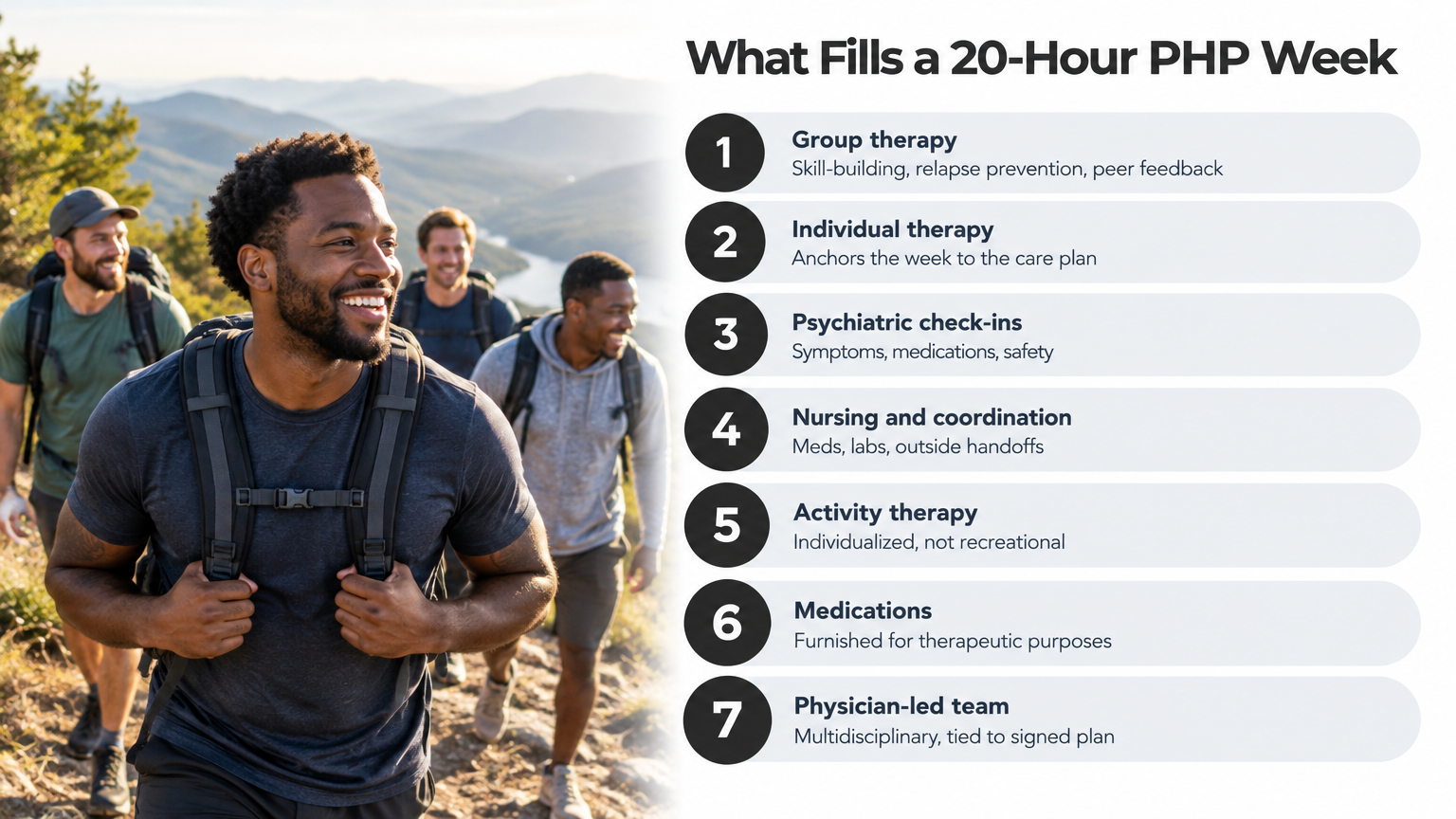
So what fills those 20 hours? Federal regulation 42 CFR Part 410 names the permissible components: individual therapy, group therapy, occupational therapy, services of social workers and psychiatric nurses, drugs and biologicals furnished for therapeutic purposes, and individualized activity therapy that is not primarily recreational or diversionary 4. CMS adds that the mix must be delivered by a multidisciplinary team under physician direction and tied to the clinical goals in the plan of care 3.
In a well-run week, that translates into a predictable rhythm. Group therapy carries the heaviest load, often several hours per day, because it does the clinical work of skill-building, relapse prevention, and peer feedback. Individual therapy sessions anchor the week to the person's specific plan. A psychiatric or medical provider checks in on symptoms, medications, and safety. A nurse or care coordinator tracks medications, labs, and the handoffs to primary care, probation, employers, or family when relevant 3, 4.
Activity therapy is the piece most often misread. The regulation is specific: it must be individualized and clinical, not primarily recreational 4. A standards-compliant program can use movement, skills work, or experiential interventions, but each has to connect to a goal in the plan, not fill time on the schedule.
PHP is designed for a narrow clinical window: a man who needs more than weekly therapy but can safely sleep at home or in a supportive living environment at night. CMS defines that window with four tests, and a standards-compliant program applies all of them before admitting anyone 2, 3.
Who does not qualify is just as important. A man actively withdrawing in a way that requires medical detox belongs in a higher level of care first. A man with no stable place to sleep, no sober support, or active suicidal intent that cannot be managed overnight typically needs residential or inpatient care 2. A man whose needs can be fully met by weekly therapy and a monthly prescriber visit is a fit for standard outpatient, not PHP 18.
Admission to a legitimate PHP is a signed clinical decision, not an intake coordinator's judgment call. Federal rules under 42 CFR Part 424 require a physician to certify, in writing, that the person needs at least 20 hours of therapeutic services per week and would otherwise require inpatient psychiatric care 17. That certification has to tie to the individualized plan of care, not sit in a separate file 3, 17.
The timeline is specific. The first recertification is due by day 18, and later recertifications must happen at least every 30 days 17. Each one is a chance for the team to document what has changed: symptom severity, substance use, participation, risk, and whether PHP is still the right level of care. If someone has stabilized, the plan should step him down to intensive outpatient. If he has worsened, the plan should step him up.
For a man or a family comparing programs in Knoxville or the Nashville area in Columbia, TN, the practical ask is simple: who is the certifying physician, when is the first recertification scheduled, and how often will the team formally review the plan? A program that cannot name the doctor or the review dates is not meeting the standard 17.
A PHP is only as good as the team running it. Federal rules require active treatment under physician direction, delivered by a multidisciplinary team that works from the same individualized plan of care 3. That is the staffing standard in one sentence, and it has real consequences for who should be in the building each week.
At minimum, a standards-compliant program has:
For men with substance use and co-occurring concerns, that usually means a psychiatrist or addiction medicine physician, masters-level therapists trained in evidence-based modalities like CBT, DBT, and motivational interviewing, and nursing staff who can safely manage medications for depression, anxiety, or opioid and alcohol use disorder.
Oversight is not a one-time signature. The physician signs the plan at admission, and the team is expected to meet, review progress, and update that plan as the person's clinical picture changes 3, 17. For Medicare-certified community mental health centers, 42 CFR Part 485 adds provider-level conditions of participation on top of the service rules, meaning the organization itself has to meet admissions and quality standards, not just the individual clinicians 5, 6.
If a program cannot name the certifying physician, describe how often the treatment team meets, or explain which clinician owns each piece of the plan, it is not meeting the oversight standard the federal rules describe 3, 17.
Partial hospitalization has a real evidence base, but it is uneven, and families deserve a straight read of what the research actually shows. The strongest finding is also the simplest: across different populations and program designs, people tend to leave PHP with measurably fewer symptoms than they came in with.
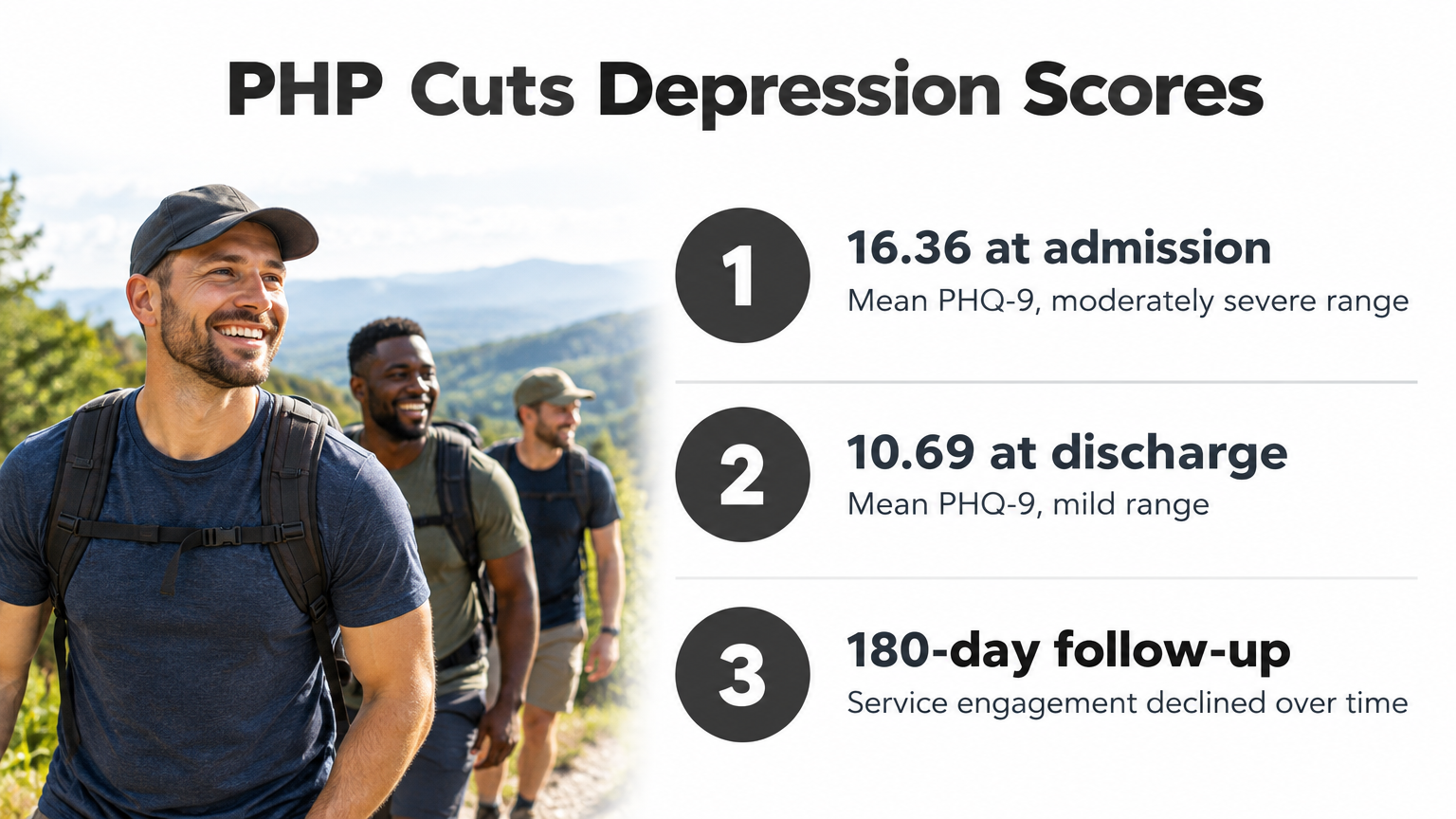
In a military mental-health PHP evaluation, the mean PHQ-9 depression score dropped from 16.36 at admission to 10.69 at discharge, a meaningful move from moderately severe into milder territory 9. That same study followed participants out to 180 days and found that engagement with mental-health services declined over time, which is why discharge planning and continuity of care matter as much as the program weeks themselves 9. Findings from a military mental-health PHP may not directly generalize to civilian men's SUD PHP programs.
A separate study of 2,000 patients in two acute psychiatric PHPs found significant improvement across four measures of symptom severity and cognitive functioning over an average stay of about 5.3 days, with effect sizes ranging from Cohen's d of 0.39 to 1.10 8. The acute, short-stay context matters: these were brief psychiatric stabilizations, not multi-week SUD programs, and the gains were measured at discharge, not years later. The authors caution that these results may not generalize to longer-term SUD-focused or co-occurring PHP programs.
Substance-use evidence is narrower. One alcohol-PHP follow-up study interviewed 113 adults during treatment; of the 89 who completed the one-month assessment, 62 (69.7%) reported abstinence in that window, and ongoing mental-health visits and 12-step attendance were associated with staying abstinent 16. The sample was not men-specific and the one-month window is short. An opioid-use-disorder study that combined inpatient and PHP treatment reassessed 113 of 143 participants at one month and reported roughly 40% complete abstinence alongside improvements in health, emotional, and substance-use domains 19. Neither number is a PHP success rate. Both reflect short follow-up, incomplete contact with discharged participants, and specific clinical populations.
The honest limits are worth stating. An older systematic review of partial versus full hospitalization in adults found no clear outcome difference among selected study populations, with satisfaction sometimes favoring partial care, though the authors cautioned about dated literature and inconsistent severity 10. A recent review of adolescent PHPs found consistent admission-to-discharge improvement but noted that only one included study compared PHP to another level of care and only one reported follow-up data 11. The pattern is clear enough to trust the direction of the evidence while staying modest about the size and durability of individual results.
Virtual and hybrid PHP has to meet the same federal floor as in-person care: 20 hours per week of structured therapeutic services, physician certification, an individualized plan, and a multidisciplinary team 2, 3, 17. The delivery mode changes, the clinical standard does not. A program that drops below 20 hours or thins out physician oversight because the care happens on a screen is not a compliant PHP.
What the evidence actually shows is narrower than most marketing suggests. In a nonrandomized before-and-after comparison of one program's in-person and telehealth periods, attendance was 89.5% in the virtual period versus 84.5% in person, and hospitalization during treatment was 8.9% virtually versus 16.5% in person, with 74.3% of virtual patients reporting improvement 14. A separate mixed-method study found reductions in depression and anxiety symptoms and high satisfaction in both virtual and in-person PHPs, with no significant difference between the two 15. The honest read: virtual PHP can work, and it can match in-person care for selected patients, but the comparison data is program-specific and nonrandomized, not proof that remote delivery is better.
Virtual PHP also carries safety obligations that in-person programs handle by default. HHS telebehavioral guidance tells providers to document the local emergency number, the patient's physical location each session, a nearby emergency contact, and a plan for a disconnected visit before treatment starts 12. Privacy standards matter just as much: verified identity, a private space on both ends, headphones, secure devices, and no public Wi-Fi, especially when a man is discussing substance use, trauma, or medications 13.
For a man in Knoxville or the Nashville area in Columbia, TN weighing a virtual option, the practical test is whether the program can show its emergency plan, name the physician certifying his care, and account for a full 20 hours of structured treatment on his schedule. If the answer to any of those is vague, the standard is not being met regardless of the delivery mode.
Everything a program adds on top of the federal floor is optional in regulation and consequential in practice. Movement-based interventions, peer-driven group culture, and integrated co-occurring care do not replace the 20-hour minimum, the physician certification, or the individualized plan 2, 3, 17. They sit on top of those requirements and shape how a man actually experiences the week.
Movement is a useful example of what the regulation permits and what it does not. 42 CFR Part 410 allows individualized activity therapy as a covered component, but it has to be clinical, tied to the plan, and not primarily recreational or diversionary 4. That means boxing, jiu-jitsu, hiking, or structured gym work can belong inside a standards-compliant PHP schedule when they are prescribed, documented, and connected to specific goals like regulating stress response, improving sleep, or building distress tolerance. No activity resets brain chemistry on a schedule, and a program should describe these interventions as supportive, not curative.
Peer connection is the second addition. Group therapy already carries much of the clinical load required by federal rules 3, 4. When men process the same material together over several weeks, accountability becomes a feature of the schedule rather than an afterthought. A band of brothers formed in group is not a substitute for the physician-directed plan; it is what makes the plan stick after discharge, which matters given the service-use decline documented in post-PHP follow-up 9.
Co-occurring care is the third. CMS includes substance use disorder among qualifying conditions and expects the multidisciplinary team to work from one plan 3. For a man carrying both alcohol use disorder and depression, or opioid use disorder and PTSD, that means one team, one plan, and integrated treatment, not parallel appointments.
Before you sign admission paperwork, the regulations give you a short list of things a legitimate program should be able to answer in writing. If you are the man weighing this step, or the family member making the calls, treat these as the floor, not a wish list.
If a program hesitates on any of these, that hesitation is the answer.
Choosing a PHP is a clinical decision, not a branding one. The standards covered here (20 structured hours per week, physician certification, an individualized plan, a multidisciplinary team, and integrated co-occurring care) are the floor every program should clear before anything else gets weighed 2, 3, 17. Movement, peer connection, and the texture of a program week matter, but they matter on top of that floor, not instead of it.
If you are a man in Knoxville, the Nashville area in Columbia, TN, or anywhere in Tennessee weighing this step, ask for the schedule, the certifying physician, and the discharge plan in writing. Trifecta Healthcare Institute's admissions team can walk through those answers and verify insurance so the decision is grounded in what a standards-compliant program actually looks like for you.
Federal Medicare rules require a minimum of 20 structured therapeutic hours per week for a program to qualify as partial hospitalization 2, 17. Those hours must be clinical and tied to an individualized plan of care, not unstructured time on a program's campus. If a schedule falls short of 20 hours, the service is intensive outpatient at best, not PHP.
Tennessee places intensive partial hospitalization within its continuum of substance use care as an alternative to residential treatment 7. Under ASAM's criteria, PHP is generally mapped to Level 2.5 and IOP to Level 2.1. PHP delivers at least 20 structured hours per week under physician direction with an individualized plan 2, 3. IOP runs fewer weekly hours, usually in evening or part-day blocks, and does not require the same physician certification. PHP is the step closer to residential care.
A man qualifies for PHP when a physician certifies that without it he would otherwise require inpatient psychiatric care, he needs at least 20 hours of structured treatment per week, and he can safely participate without 24-hour supervision 2, 3, 17. He also needs adequate support outside program hours and the cognitive and emotional capacity to engage in active group and individual treatment. Active medical detox or acute suicidal risk points to a higher level of care first.
No. Partial hospitalization is specifically for people who do not require 24-hour care and can safely sleep at home or in a supportive living environment at night 2, 3. That is the line between PHP and inpatient or residential treatment. If overnight monitoring is clinically necessary for medical, psychiatric, or withdrawal reasons, a higher level of care is appropriate.
Yes. Virtual PHP has to meet the same federal floor: 20 hours per week of structured services, physician certification, an individualized plan, and a multidisciplinary team 2, 3, 17. HHS telebehavioral guidance adds safety and privacy standards for remote delivery, including a documented emergency plan, the patient's physical location each session, a nearby emergency contact, identity verification, a private space, and secure devices 12, 13. The delivery mode changes; the clinical standard does not.
Ask for the weekly schedule in writing and confirm it adds up to at least 20 structured hours 2, 17. Ask who the certifying physician is and when the first recertification is scheduled, which federal rules set at day 18 17. Ask how the multidisciplinary team meets and reviews the plan 3. Ask how substance use and co-occurring mental health concerns are treated on one plan 3, 7. Ask what the discharge and step-down plan looks like.
Between facility size limits, waivers, and state-by-state rules, figuring out your Medicaid or private insurance benefits can feel like its own full-time job. Our admissions team will verify your coverage in minutes and walk you through exactly what's available — no guesswork required.
Verify Insurance Benefits →No commitment required. Confidential & HIPAA-protected.
Whether it's you or someone you love, our team can help you figure out the next step — what treatment looks like, what's covered, or just someone to talk to.
Talk to Our TeamConfidential. No commitment required.


