


How to Choose a Dual Diagnosis Partial Hospitalization Program
Use this checklist to assess a dual diagnosis partial hospitalization program, including integrated care, medication support, Tennessee licensure, PHP fit, a...
Read More
Learn when tianeptine withdrawal may begin, which symptoms can signal an emergency, and why medically supervised detox can help you manage risks and plan ong...
Start Your Journey NowWritten and reviewed by the clinical team at Trifecta Healthcare Institute, a men’s-only treatment center in Tennessee specializing in substance use, mental health, and dual diagnosis care.
Tianeptine withdrawal looks and feels like opioid withdrawal because, at the doses people reach when they buy it in gas stations as ZaZa, Tianaa, or Neptune's Fix, tianeptine acts on the brain's mu-opioid receptors. That is the short answer most product labels never mention. When a man stops suddenly after weeks or months of heavy use, his body reacts the way it would to stopping an opioid: agitation, sweating, muscle aches, nausea, insomnia, racing heart, and a pull toward the next dose that willpower alone rarely overrides.9, 8
This is why the quit attempts fail. A man tells himself he will skip tomorrow's bottle, then wakes up at 3 a.m. shaking, anxious, and sick, and drives to the same convenience store before sunrise. The FDA has stated plainly that the clinical effects of tianeptine misuse and withdrawal can mimic opioid toxicity and withdrawal, and that some people have serious difficulty stopping on their own.4
What makes this harder to recognize is the packaging. Tianeptine products are marketed as supplements, cognitive enhancers, or mood boosters. Many men who end up in withdrawal did not know they were taking something that behaves like an opioid. The guilt and confusion that follow can delay the one thing that actually helps: a medical assessment with clinicians who understand what tianeptine is doing to the body.
Tianeptine is a drug that is used as an antidepressant in some countries, but in the United States the FDA has never approved tianeptine for any medical use, and it is not legal to sell as a dietary supplement or food ingredient.2, 4
That gap between how tianeptine is used abroad and how it is sold here is the whole problem. American gas stations, smoke shops, and online storefronts have moved tianeptine through products with names like ZaZa Red, Tianaa, and Neptune's Fix. The bottles often advertise mood support, focus, or energy. They rarely mention that at the doses people actually take, tianeptine binds to the mu-opioid receptor and produces opioid-like effects, including tolerance, dependence, and withdrawal.8, 9
The doses tell the story. One case report described a man taking approximately 8 to 20 grams of tianeptine per day.7 A separate review documented men who escalated rapidly once tolerance set in, drinking or swallowing bottle after bottle just to feel normal.12
22.5% of tianeptine exposures reported to U.S. poison centers were attributed to withdrawal.13
Scope note: this figure comes from a poison-center surveillance study of reported contacts and does not represent population prevalence.
That share matters because it shows withdrawal is not a fringe complication of tianeptine use. It is a leading reason people and their families end up calling poison control in the first place. For a man who thought he was buying a legal mood booster, the label was the first lie. The second was the idea that stopping would be simple.
When clinicians sort through what tianeptine withdrawal actually looks like, the clearest picture comes from CDC's analysis of poison-center calls. Agitation and nausea top the list, each showing up in about a third of withdrawal-associated calls, followed by vomiting, a racing heart, high blood pressure, and the trio of diarrhea, tremor, and sweating.1 These are the symptoms that drive men to the emergency room at 2 a.m. and the ones families end up describing on the phone to a nurse hotline.
Source: CDC analysis of 218 tianeptine exposure calls reported to U.S. poison centers.1
The list is not the full story. Men describe insomnia that no amount of exhaustion can override, muscle aches that settle in the back and legs, abdominal cramping, irritability that detonates at the smallest provocation, and a flat, hollow mood that returns within hours of the last dose. The FDA's safety review captures that broader range, listing irritability, anxiety, blood-pressure changes, weakness, muscle pain, abdominal pain, and sleep disturbance among documented withdrawal symptoms, and notes that medical intervention is often required for a person to stop successfully.2
A few patterns matter for anyone trying to make sense of what they are feeling or watching at home. First, the cluster of agitation, racing heart, high blood pressure, sweating, and nausea mirrors the autonomic storm of opioid withdrawal, which fits with what the pharmacology would predict.8 Second, the gastrointestinal piece can swing in either direction. Some case reports describe diarrhea, while others describe constipation and urinary retention severe enough to mimic other medical problems.6 Third, the psychological symptoms often outlast the physical ones. A supervised detoxification account noted chills, trembling, sweating, muscle pain, anxiety, and depression, with reviewers specifically flagging that some symptoms can linger after the acute phase passes.8
What this means in practice: a man who tells himself he just has a stomach bug or a bad night of sleep is often dismissing the earliest warning signs of a dependence that has already taken hold. The symptoms are not random. They cluster, they repeat with each quit attempt, and they get worse the longer heavy use continues. Recognizing the pattern is the first step. The next is figuring out how long it lasts and when it stops being something a person should try to ride out alone.
There is no official clock for tianeptine withdrawal. The men who end up in trouble are usually dosing many times a day to stay ahead of symptoms. What the case-report and review literature describes is a predictable arc, even if the exact hours vary from one person to the next.
Two caveats worth stating plainly. Daily dose, how long a man has been using, other substances in the mix, and whether the product was adulterated all shift this timeline. And symptoms of withdrawal can overlap with symptoms of ongoing toxicity, which is one reason clinicians recommend an assessment rather than guessing at home.6
Most tianeptine withdrawal is miserable without being immediately life-threatening. But a subset of cases cross a line into territory that needs a hospital, not a bedroom and a bucket. The hard part is that the warning signs can look like a bad flu until they don't, and the men most at risk are often the ones most reluctant to call anyone. Two situations deserve separate attention: the specific red flags that mean dialing 911 cannot wait, and the adulterated-product cluster that has sent otherwise healthy men to intensive care units in ways straight tianeptine withdrawal does not predict.
Not every tianeptine emergency is a tianeptine emergency. In late 2023, New Jersey poison centers logged a cluster tied to Neptune's Fix products, and laboratory testing found some bottles contained synthetic cannabinoid receptor agonists in addition to tianeptine. Of 17 patients, 13 were admitted to an intensive care unit, 7 were intubated, 8 had seizures, and 1 went into cardiac arrest.3 A follow-up case series out of New Jersey documented 41 exposure calls and 34 unique patients with acute toxicity from adulterated products.14
This matters at the bedside. A man who used an adulterated bottle is not experiencing ordinary tianeptine withdrawal, and treatments that help with opioid-like withdrawal may not touch the synthetic-cannabinoid piece. Bring the bottle to the hospital if possible, and tell clinicians exactly what product was used.
Walking into a medical detox for tianeptine is not what most men picture. There is no gown-and-gurney scene, no lecture about choices. It looks more like a quiet intake room, a nurse taking vitals, and a clinician asking plain questions about what he has been taking, how much, how often, and what else is in the mix. For a man who has been hiding bottles in the glove compartment, the first hour is usually the hardest part. The rest is paced to keep him safe while his body adjusts.
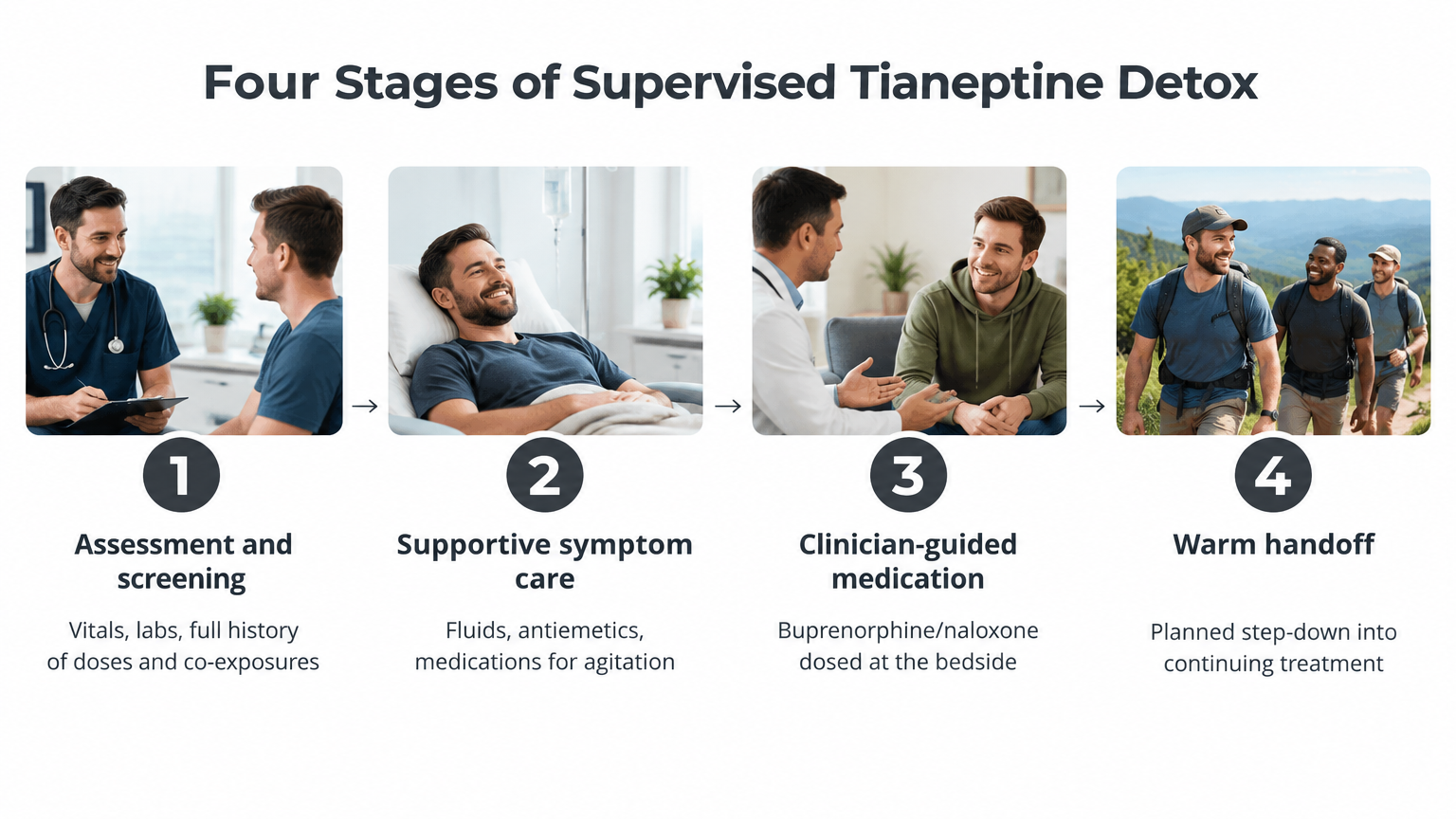
The clinical literature on tianeptine detox is still thin, so experienced programs borrow structure from opioid withdrawal management and tailor the specifics to what tianeptine actually does. Four pieces tend to show up in every reported case.
Grounded in reported clinical experience6, 7, 9, 10 and SAMHSA guidance for opioid treatment programs, applied here by analogy, that medically supervised withdrawal should be paired with ongoing treatment and overdose education.15
Assessment and screening. The first conversation is longer than most men expect. Clinicians need to know whether tianeptine is the only substance in play, because polysubstance exposure changes the plan. One published case involved a man who had used both etizolam and tianeptine; he required separate management for benzodiazepine-type and opioid-type withdrawal, including diazepam alongside a methadone taper with a planned transition to buprenorphine.11 Blood pressure, heart rate, and mental status get checked often, because tianeptine withdrawal can look a lot like tianeptine toxicity, and the overlap is one of the clearest reasons the published literature recommends monitored care over guessing at home.6
Supportive care. Most of what makes the first days bearable is unglamorous. IV fluids for the vomiting and diarrhea. Antiemetics so the nausea stops winning. Benzodiazepines when agitation and autonomic symptoms spike. One published case summarized the range of previously described approaches as benzodiazepines, intravenous fluids, antiemetics, opioid medications, and general supportive care, with the exact combination tailored to the person.6
Medication decisions. Because tianeptine acts at the mu-opioid receptor at the doses people reach, several case reports describe using medications developed for opioid use disorder. A 38-year-old man taking roughly 8 to 20 grams a day reported improvement in withdrawal symptoms within about three days of starting buprenorphine/naloxone and supportive care under supervision.7 A separate review summarized a case report in which most withdrawal symptoms and cravings resolved after buprenorphine/naloxone was initiated.9 A separate report described a seven-day low-dose buprenorphine induction while the patient continued tianeptine, with tianeptine stopped after 14 days without major withdrawal, anxiety, or depression.10 These are individual cases, not guarantees. What they establish is that there are clinician-supervised paths that have worked when willpower tapers failed, and that the decision belongs at a bedside, not in a message board.
Warm handoff. This is the piece men most often skip when they try to detox on their own. SAMHSA, writing about opioid treatment programs, states that short-term medically supervised withdrawal alone is not recommended because of high rates of return to use, and that withdrawal management should be paired with psychosocial treatment, recurrence-prevention counseling, and overdose education with naloxone.15 That guidance is written for opioid use disorder, not tianeptine specifically, but the principle carries: finishing detox is the start, not the finish. A real plan hands the man off to the next level of care before his wristband comes off.
[Verify your insurance] before the next quit attempt turns into another trip to the gas station.
The pattern is familiar enough that clinicians can almost script it. A man decides Sunday night he is done. He pours the last bottle down the drain, posts in a forum for accountability, and sets a plan to drink water, take hot showers, and ride it out. By Monday afternoon the sweating has started. By Tuesday morning he is in his car, telling himself he will just buy one bottle to stretch the taper. By Wednesday he is back to his old dose, convinced he lacks willpower. He does not. He is fighting pharmacology with a schedule.
Three things make unsupervised quitting harder than most men expect.
There is a quieter reason cold turkey fails that the forums rarely name. The men who end up on tianeptine were usually medicating something before the first bottle. Anxiety, chronic pain, trauma, burnout, a depression that never got treated. Stripping the drug out without touching what it was covering leaves the original problem fully exposed, often at the exact moment the body feels worst. A clinician can address both. A spreadsheet of milligrams cannot.
This section is written for the wife, girlfriend, parent, or sibling who found the bottles, watched a bad night, and is trying to figure out what to do next. If that is not you, you can skip ahead.
What you are seeing probably has a name. The sweating, the agitation, the restless legs at 2 a.m., the trip to the gas station before coffee, the irritability that flashes and then collapses into a flat mood by evening. These are among the symptoms the FDA lists for tianeptine withdrawal, and the agency has stated plainly that medical intervention is often required for a person to stop successfully.2 It is not laziness and it is not a character flaw. His brain and body are reacting to a product that behaves like an opioid at the doses most men reach.9
A few things help more than they sound like they should. Ask what the bottle is called and keep it; names like ZaZa, Tianaa, and Neptune's Fix matter to clinicians, and so does whether other substances are in the mix. Case reports show that polysubstance exposure changes the treatment plan entirely.11 If he has used a Neptune's Fix product, mention it specifically, because some bottles have tested positive for synthetic cannabinoids and the clinical picture is different from ordinary withdrawal.3
Know the lines that mean call 911, not wait: a seizure, chest pain, trouble breathing, confusion, a loss of consciousness, or signs of overdose like pinpoint pupils and blue lips.3, 16 You are not overreacting by making the call.
You cannot taper him yourself, and you do not have to. What you can do is help him get to a medical assessment, where clinicians can tell the difference between withdrawal and toxicity and build a plan around the actual product and dose.6 Bring the bottles. Bring the honest numbers. Stay in the room if he wants you there.
Detox clears the drug. It does not clear the reason a man started reaching for the bottle in the first place. Most men who end up on tianeptine were quietly medicating something before the first ZaZa, Tianaa, or Neptune's Fix purchase: untreated anxiety, a depression that never got a name, old trauma, chronic pain, or the slow grind of work pressure and the pull to keep providing. When the drug comes out and nothing fills the space it occupied, the original problem walks back in on day ten feeling louder than ever.
This is the part the published literature keeps circling. Reviewers note that protracted withdrawal symptoms, including low mood, anxiety, poor sleep, and persistent cravings, have been reported after complete cessation of tianeptine.8 SAMHSA, writing about opioid treatment programs, is direct about the broader principle: short-term medically supervised withdrawal alone is not recommended, because return to use rates are high when withdrawal management is not paired with psychosocial treatment, recurrence-prevention counseling, and overdose education.15 That guidance is written for opioid use disorder, not tianeptine, but the mechanism and the clinical lesson rhyme.
Continuing care at a level like partial hospitalization or an intensive outpatient program is where the co-occurring work actually happens. Therapies such as CBT, DBT, EMDR for trauma, and motivational interviewing give a man tools to sit with the symptoms the tianeptine used to flatten. Movement-based programming — gym work, boxing, jiu-jitsu, hiking, ice exposure — is offered as part of care alongside therapy and medication decisions, not as a replacement for them. It gives a restless body something honest to do while the brain recalibrates.
The other piece is other men. Isolation is where relapse plans get written. Peer connection, group work, and accountability with men who have been through the same gas-station cycle do something a solo taper spreadsheet cannot. The point is not inspiration. It is traction.
Tianeptine products have moved through Tennessee convenience stores, smoke shops, and online storefronts under names like ZaZa, Tianaa, and Neptune's Fix. The men who end up dependent on them usually did not plan to. They picked up a bottle for focus or a mood lift, found it worked, and kept going until stopping meant sweating through the sheets at 4 a.m. The right level of care for that is medically supervised care, not another weekend of trying to white-knuckle it alone.2, 4
Trifecta Healthcare Institute runs men's addiction treatment in Knoxville and in Nashville (Columbia, TN). Intake includes polysubstance screening, because the plan changes when etizolam, kratom, benzodiazepines, or alcohol are also in the picture.11 Continuing care is where the therapy, movement programming, and brotherhood-based peer work actually begin — the pieces that address what the tianeptine was covering, not just the chemistry it left behind.
If you are the man reading this at the end of another failed quit attempt, or the partner who found the bottles, the next step is a conversation, not a commitment. [Call Trifecta] or [Verify your insurance] to find out what admission in Knoxville or Nashville would actually look like this week.
Acute symptoms usually start within hours of the last dose and peak over the first several days, with one case report describing meaningful improvement within about three days once supervised care began.7 Mood changes, poor sleep, and cravings can linger for weeks after the acute phase passes, which reviewers describe as protracted withdrawal.8 The exact arc depends on daily dose, how long use has lasted, and what else is in the mix.
Often, yes. The FDA states that medical intervention is often required for a person to stop tianeptine successfully, and that the clinical effects of misuse and withdrawal can mimic opioid toxicity.2, 4 Symptoms can also overlap with ongoing toxicity, which makes it hard to tell at home what is actually happening.6 A medical assessment sorts that out and keeps the first days monitored rather than guessed at.
At the doses people reach with gas-station products, tianeptine binds to the mu-opioid receptor, the same receptor targeted by prescription opioids.9 When use stops, the body reacts the way it would to stopping an opioid: agitation, sweating, racing heart, muscle aches, nausea, insomnia, and strong cravings.8 The product labels rarely mention this mechanism, which is why many men are blindsided by how hard quitting feels.
Case reports describe buprenorphine/naloxone being used for severe tianeptine withdrawal, with one patient reporting improvement within about three days7 and a review summarizing a separate case report in which most withdrawal symptoms and cravings resolved after buprenorphine/naloxone was initiated.9 A separate report described a seven-day low-dose induction that let a patient stop tianeptine without major withdrawal.10 These are individual cases, not guarantees, and dosing decisions belong with a clinician.
Call 911 immediately. Seizures, chest pain, trouble breathing, confusion, and loss of consciousness have been reported with tianeptine products, including adulterated bottles tied to intensive-care admissions.3 If opioid overdose is suspected and naloxone is available, give it right away and still call 911, because its effects can wear off within 30 to 90 minutes and may not fully reverse emergencies involving unknown ingredients.16, 17
Trifecta Healthcare Institute offers men's addiction treatment in Knoxville and in Nashville (Columbia, TN), with intake that includes polysubstance screening because tianeptine is often used alongside kratom, benzodiazepines, or alcohol.11 Continuing care addresses the anxiety, depression, trauma, or chronic pain that the tianeptine was covering. Starting the conversation is a phone call, not a commitment to admit.
Between facility size limits, waivers, and state-by-state rules, figuring out your Medicaid or private insurance benefits can feel like its own full-time job. Our admissions team will verify your coverage in minutes and walk you through exactly what's available — no guesswork required.
Verify Insurance Benefits →No commitment required. Confidential & HIPAA-protected.
Whether it's you or someone you love, our team can help you figure out the next step — what treatment looks like, what's covered, or just someone to talk to.
Talk to Our TeamConfidential. No commitment required.


