


How to Choose a Dual Diagnosis Partial Hospitalization Program
Use this checklist to assess a dual diagnosis partial hospitalization program, including integrated care, medication support, Tennessee licensure, PHP fit, a...
Read More
Compare VA, community, and private veterans rehab options in Tennessee, including eligibility, treatment levels, costs, and how to choose the right next step.
Start Your Journey NowWritten and reviewed by the clinical team at Trifecta Healthcare Institute, a men’s-only treatment center in Tennessee specializing in substance use, mental health, and dual diagnosis care.
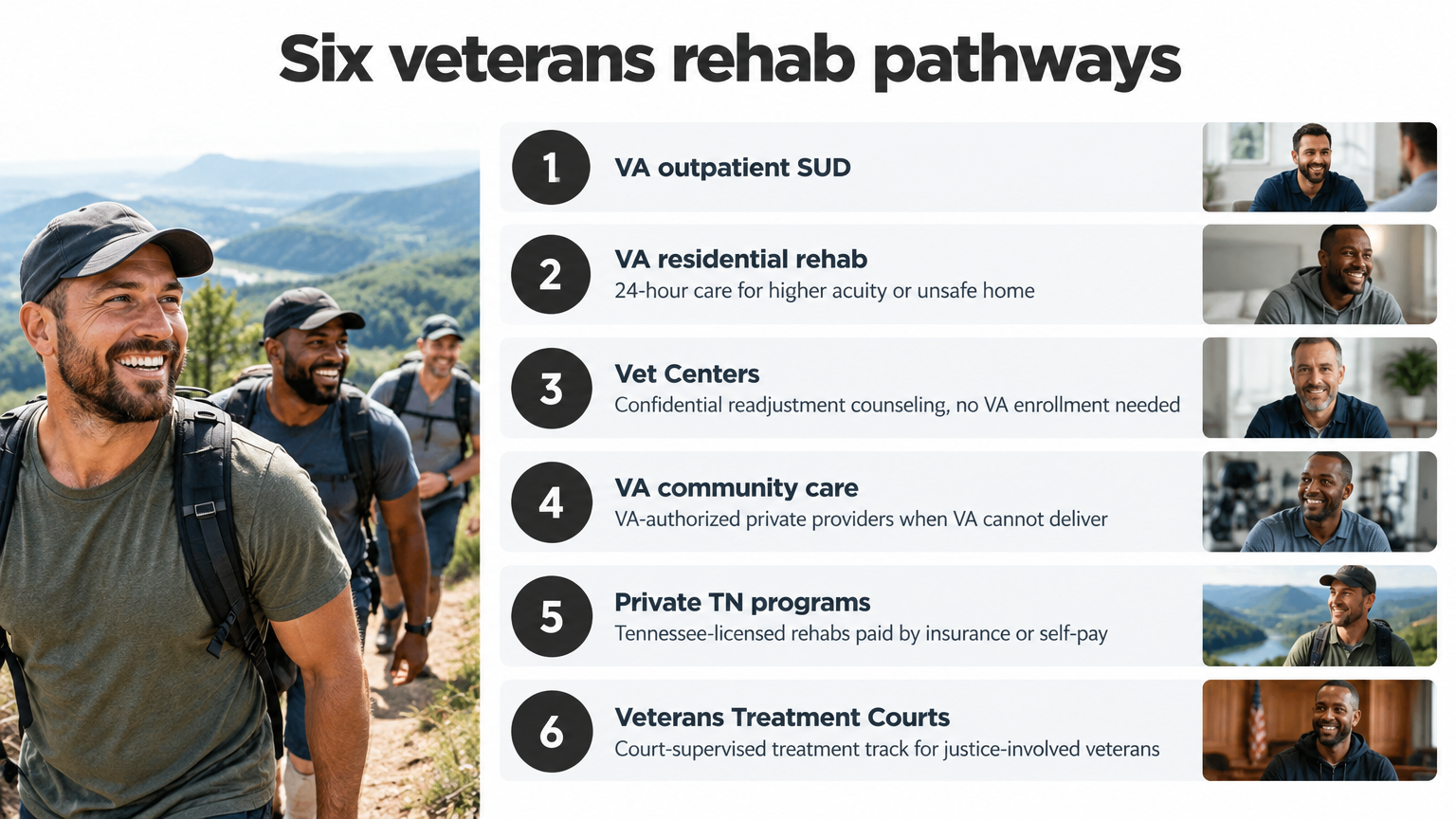
Veterans rehab isn't one thing. It's a set of distinct pathways — VA outpatient substance use care, VA residential rehabilitation, Vet Centers, VA-authorized community care, Tennessee-licensed private programs, and Veterans Treatment Courts — and the right choice depends on your clinical needs, eligibility, and life situation, not on any single program's reputation.
That matters because a veteran with alcohol use disorder and combat-related PTSD has different needs than one managing opioid use after a service-connected injury. The VA treats both, but through different doors: medically managed withdrawal, methadone or buprenorphine, outpatient counseling, intensive outpatient care, and 24-hour residential programs are all separate levels of care with separate referral paths 3. A Vet Center offers readjustment counseling without VA health care enrollment, but it won't detox you 6. A private program may admit faster, but only community care that VA authorizes in advance will be covered under VA benefits 5.
The sections ahead map each pathway against level of care, eligibility, how it's paid for, and best-fit situation — then hand you the clinical questions that actually separate strong programs from weak ones. The goal is a defensible comparison, not a ranking.
VA outpatient care is often the first door most enrolled veterans walk through. It covers a wide clinical range: medically managed withdrawal, methadone and buprenorphine for opioid use disorder, medications for alcohol use disorder, individual and group counseling, intensive outpatient programming, family counseling, mutual-help referrals, and continuing care after a higher level of treatment ends 3.
You keep living at home, which lets you hold a job or stay close to family while working on recovery. That's a real advantage if your use pattern doesn't require 24-hour monitoring and your home is stable enough to support sobriety.
Enrollment in VA health care is the gate. Eligibility depends on service history, discharge status, disability status, and income 4. Once enrolled, your care team can match you to the right level of outpatient service rather than defaulting to the most restrictive option 18.
VA residential rehabilitation — sometimes called inpatient residential or domiciliary care — is for veterans who need a structured, 24-hour setting to work on substance use disorder, PTSD, depression, and related physical or social needs at the same time 1. Programs can address co-occurring chronic pain, substance use, and traumatic brain injury under one roof, which matters when symptoms feed each other.
In Middle Tennessee, that residential pathway runs through the Alvin C. York VA Medical Center in Murfreesboro, which offers 24-hour therapeutic and educational programming 19. The Nashville VA Medical Center handles outpatient and inpatient recovery services and refers veterans into the Murfreesboro residential facility when a higher level of care is appropriate 18.
Expect a referral from your VA care team rather than a walk-in admission. Residential care is intensive by design, so clinical assessment, bed availability, and timing are all part of getting in.
Vet Centers sit in a different lane. They provide confidential readjustment counseling — not detox, not residential rehab — and many veterans, active service members, and some National Guard and Reserve members qualify without being enrolled in VA health care or receiving disability compensation 6.
If combat exposure, moral injury, or transition stress is driving your drinking or drug use, a Vet Center can be a lower-stakes starting point for counseling and referrals. Think of it as a bridge: a place to talk, get oriented, and get connected to medical care if that's what the clinical picture calls for.
Community care lets eligible veterans get treatment from a non-VA provider when VA can't deliver the service nearby or quickly enough. The published access standards include a 30-minute average drive time or a 20-day wait for mental health and primary care, and VA has to agree that community care is in your best medical interest 5.
Two details often trip people up. First, routine community care generally requires approval from your VA care team before treatment starts 5. Walking into a private program and sending VA the bill afterward usually doesn't work. Second, the provider has to be in VA's network for the authorization to pay out.
If you're weighing a private Tennessee program, ask your VA care team early whether community care authorization is possible for your situation. It's often the difference between covered care and a surprise bill.
Private programs operate outside the VA system and admit veterans directly, usually through private insurance, TRICARE, TennCare for eligible members, or self-pay. Payment pathways vary: TennCare covers withdrawal management and inpatient, residential, and outpatient substance-use treatment for eligible members 17, while commercial plans and TRICARE follow their own networks and authorization rules.
Admission can be faster than VA residential, which matters when a veteran is ready today and the clinical window is narrow. Programs also vary widely in what they actually treat. Some focus on substance use alone. Others, including men's programs in Nashville (Columbia) and Knoxville, treat substance use disorder alongside co-occurring mental health conditions and build daily movement, peer connection, and trauma-informed therapy into the schedule.
If you want VA to help pay, confirm community care authorization first 5. If you're using private insurance, verify in-network status and the levels of care your plan covers before you commit.
If a veteran's path to rehab runs through the court system, Tennessee's Veterans Treatment Courts offer a hybrid structure. They combine drug-court and mental-health-court approaches for veterans with substance use disorder, serious mental illness, or co-occurring conditions, and coordinate with VA networks, Veterans Benefits Administration resources, veteran mentors, and family-support organizations 16.
Participation has legal eligibility rules and program-specific requirements, so it's not a universal option. For court-involved veterans, though, it can connect treatment, benefits, and peer mentorship inside one structured plan.
Reading about each pathway separately is useful. Seeing them against each other is what actually helps a decision stick. The table below lines up all six — VA outpatient substance use care, VA residential rehabilitation, Vet Centers, VA-authorized community care, Tennessee-licensed private programs, and Tennessee Veterans Treatment Courts — across the factors that typically decide where a veteran ends up: what level of care is offered, who qualifies, how it gets paid for, whether a referral or pre-approval is required, and the situation each pathway fits best.
| Pathway | Level of care | Eligibility | How it's paid for | Referral or approval | Best-fit situation |
|---|---|---|---|---|---|
| VA outpatient SUD care | Medically managed withdrawal, MOUD/MAUD, counseling, IOP, continuing care 3 | Enrolled in VA health care | VA benefit | VA care team assessment | Stable home, work or family demands, no need for 24-hour setting |
| VA residential rehabilitation | 24-hour therapeutic programming for SUD, PTSD, depression, co-occurring needs 1, 19 | Enrolled in VA health care, clinical referral | VA benefit | VA referral required 18 | Higher acuity, unsafe or unstable home, co-occurring conditions needing structure |
| Vet Center | Confidential readjustment counseling; not detox or residential 6 | Many veterans, service members, some Guard/Reserve; VA enrollment not required | No cost to eligible veterans | No referral needed | Combat or transition stress; starting point before medical care |
| VA-authorized community care | Varies by provider; must be in VA network | Service unavailable at VA, 30-minute drive or 20-day wait exceeded, or best medical interest 5 | VA benefit through authorized community provider | VA pre-approval required before treatment 5 | VA access barriers; need for a specific service VA cannot deliver quickly |
| Tennessee private program | Detox, residential, PHP, IOP, outpatient (varies by facility) | Set by program; often men's or specialty tracks | Private insurance, TRICARE, TennCare for eligible members, self-pay 17 | Direct admission; VA community care authorization needed for VA to pay 5 | Faster admission, co-occurring care, specific program model |
| Tennessee Veterans Treatment Court | Court-supervised treatment plan coordinated with VA networks and mentors 16 | Court-involved veterans meeting legal and clinical criteria | Combination of VA benefits, insurance, and court resources | Court admission plus clinical assessment | Court involvement where treatment can be part of the legal plan |
Two patterns are worth noticing before moving on. First, the VA pathways only pay out if the enrollment, referral, or pre-approval step happens on the VA side — not after the fact. Second, a private Tennessee program and VA community care are not the same thing: a private program can admit a veteran directly, but VA will only help cover that stay if community care was authorized in advance.
Here's the uncomfortable math behind choosing a veterans rehab: an estimated 1.0 million U.S. veterans aged 18 or older — about 5.3% — had co-occurring substance use disorder and any mental illness in 2023, per SAMHSA's National Survey on Drug Use and Health (civilian noninstitutionalized population) 9. That's not a side issue to screen for after admission. For a large share of veterans walking into treatment, it's the clinical picture.
Dual-diagnosis capability means a program can treat substance use disorder and a co-occurring condition like PTSD or depression at the same time, under the same roof, with clinicians trained in both. The alternative — treating one and referring out for the other, or insisting on sobriety before touching trauma — is still common, and it leaves veterans cycling between providers who don't talk to each other.
So when a program is screened, three questions do most of the work. Does the program treat PTSD and substance use together, or will one be deferred? Which trauma-focused therapies are actually delivered on site — prolonged exposure, cognitive processing therapy, EMDR? And who on staff is credentialed to deliver them? A program that answers vaguely, or that routes trauma work to an outside referral, is not a dual-diagnosis program in any meaningful sense.

A good admissions call sounds less like a sales pitch and more like a clinical conversation. If you walk in with the right questions, within fifteen minutes you'll know whether a program is built for a veteran with substance use disorder and co-occurring trauma — or whether it's running a one-size approach and hoping the fit works out.
Use these eight questions on every program you consider, VA or private.
Three vague answers in a row usually tells you what you need to know.
If you live in Middle Tennessee, two VA facilities carry most of the regional substance use workload. The Nashville VA Medical Center matches veterans to counseling, group therapy, or medication based on clinical need, and handles both outpatient and inpatient recovery services 18. Expect the Nashville team to run the intake, assessment, and referral — not a direct walk-in to residential care.
When a higher level of care is appropriate, the residential pathway runs through the Alvin C. York VA Medical Center in Murfreesboro. That program delivers 24-hour therapeutic and educational programming for substance use disorder alongside co-occurring mental health conditions 19. Residential rehabilitation at that site also addresses PTSD, depression, and related physical or social needs under one roof, which matters when symptoms overlap 1.
Veterans weighing private Nashville-area treatment, including men's programs in Columbia, often use the Nashville VA as their first clinical conversation and then compare timing, program model, and payment pathway before committing.
In East Tennessee, veterans enrolled in VA health care access the same national menu of substance use services — medically managed withdrawal, methadone and buprenorphine for opioid use disorder, medications for alcohol use disorder, individual and group counseling, intensive outpatient programming, and continuing care 3. Enrollment and a care-team assessment set the sequence 4.
Private programs in the Knoxville area admit veterans directly through private insurance, TRICARE, TennCare for eligible members, or self-pay. If you want VA to help cover a private stay, community care authorization has to come first 5.
Payment pathway often decides the shortlist. VA benefits cover enrolled veterans across outpatient, residential, and community care, with eligibility shaped by service history, discharge status, disability status, and income 4. Community care through VA requires pre-approval and in-network provider status before treatment starts 5.
TRICARE serves eligible service members, retirees, and family members through its own network and authorization rules — confirm in-network status and the specific levels of care your plan covers before admission.
TennCare covers withdrawal management and inpatient, residential, and outpatient substance use treatment for eligible members at participating facilities 17. Verify that the program you're considering accepts TennCare and that your plan authorizes the level of care being recommended.
Commercial insurance (Aetna, Anthem, BCBS, Cigna, United Healthcare and others) follows the same two-step rule: in-network status and prior authorization for the level of care. Ask every program to verify benefits in writing before you commit a start date.
If a private Tennessee program is on your shortlist, the comparison shifts from eligibility and payment to how the daily schedule is actually built. Three features separate serious men's programs from the rest:
Movement is the one most often misread. A 2025 narrative review of exercise and PTSD in veterans found potential reductions in symptoms through psychological and physiological mechanisms, while noting that the optimal type, dose, and duration are still unclear 14. That makes exercise a research-supported adjunct, not a stand-alone treatment for substance use disorder. Boxing, jiu-jitsu, hiking, and strength work can anchor a day and give the nervous system somewhere to go — but they belong alongside trauma-focused therapy and medication access, not in place of them.
Peer connection does similar work. A 2025 integrative review of VA peer-specialist interventions found most included studies showed statistically significant improvement in at least one main outcome, with veterans describing peers as helpful for accountability, motivation, emotional support, and navigating care 15. In a men's program, that's the practical shape of a band of brothers: structured peer support with clinical supervision, not a group chat.
Continuity is the quietest factor and often the deciding one. Ask how the program hands you off — step-down from PHP to IOP to outpatient, continuing care, and ongoing peer support — before you commit to day one 3.
If you're a spouse, parent, or adult child making calls on his behalf, the most useful thing you can do is slow the conversation down and ask the clinical questions he may not feel ready to ask. Programs will tell you about their amenities. You want to know what they treat and how.
Four questions carry most of the weight:
Keep the tone collaborative. He's the one who has to walk through the door.
The decision that matters today is small: one phone call to one program, with the eight questions in front of you. If you're enrolled in VA health care, start with your VA care team and ask about outpatient, residential at Alvin C. York, and whether community care authorization is possible for a program you're considering 5. If you're unenrolled, a Vet Center can be a lower-stakes first conversation 6.
If a private Tennessee program is on your shortlist, Trifecta Healthcare Institute's admissions team can discuss program fit, co-occurring support, and insurance verification. [Call Trifecta] or [Verify your insurance] when you're ready. You don't have to have it all figured out before you pick up the phone.
Sometimes, yes — through community care. VA may authorize a non-VA program when the service isn't available at VA, when drive time or wait time exceeds the published access standards (a 30-minute average drive or a 20-day wait for mental health and primary care), or when community care is in your best medical interest 5. Approval generally has to come from your VA care team before treatment starts, and the provider has to be in VA's network.
No. VA's National Center for PTSD states that veterans do not have to wait until they are no longer using substances to address PTSD symptoms, and names COPE as one integrated approach that delivers prolonged exposure for PTSD alongside substance use treatment in a single program 2. If a program insists on sobriety before touching trauma work, that's a dated model worth questioning.
Vet Centers offer confidential readjustment counseling for combat exposure, moral injury, and transition stress, and many veterans qualify without being enrolled in VA health care 6. They do not provide medically managed withdrawal or 24-hour residential care. A VA rehabilitation program — outpatient substance use services or residential rehabilitation — handles detox, medications, and higher levels of clinical care 1, 3.
Yes, if the program accepts the plan and the level of care is authorized. TennCare covers withdrawal management and inpatient, residential, and outpatient substance use treatment for eligible members at participating facilities 17. Commercial insurance and TRICARE follow their own networks and prior-authorization rules. Ask every program to verify benefits in writing before you set a start date, and confirm in-network status up front.
VA covers a full continuum: medically managed withdrawal, methadone and buprenorphine for opioid use disorder, medications for alcohol-related disorders, individual and group counseling, intensive outpatient programming, 24-hour residential rehabilitation, family counseling, mutual-help referrals, and continuing care after a higher level of treatment ends 3. In Middle Tennessee, residential care runs through the Alvin C. York VA Medical Center in Murfreesboro 19.
Start with five questions. Do you treat PTSD and substance use at the same time 2? Which trauma-focused, manualized therapies do you deliver on site 13? Do you offer medications for opioid and alcohol use disorder, and can you medically manage withdrawal 3? What does continuity look like after discharge? What do you accept — VA community care authorization, TRICARE, TennCare, private insurance, or self-pay?
Between facility size limits, waivers, and state-by-state rules, figuring out your Medicaid or private insurance benefits can feel like its own full-time job. Our admissions team will verify your coverage in minutes and walk you through exactly what's available — no guesswork required.
Verify Insurance Benefits →No commitment required. Confidential & HIPAA-protected.
Whether it's you or someone you love, our team can help you figure out the next step — what treatment looks like, what's covered, or just someone to talk to.
Talk to Our TeamConfidential. No commitment required.


