


How to Choose a Dual Diagnosis Partial Hospitalization Program
Use this checklist to assess a dual diagnosis partial hospitalization program, including integrated care, medication support, Tennessee licensure, PHP fit, a...
Read More
Learn what happens at a men's rehab nashville program, from daily therapy and movement to peer support, and compare care levels to find the right fit.
Start Your Journey NowWritten and reviewed by the clinical team at Trifecta Healthcare Institute, a men’s-only treatment center in Tennessee specializing in substance use, mental health, and dual diagnosis care.
A typical day at a men's rehab in Nashville runs on a tighter clock than most men expect and feels more human than they fear. The hours alternate between clinical work, movement, meals, peer time, and quiet, and the exact shape of the day shifts based on whether a man is in medical detox, a Partial Hospitalization Program (PHP), or an Intensive Outpatient Program (IOP).3
Most pages describe the services a program offers. Few walk a man through the hours. That gap is the reason this article exists. If a man is weighing treatment for alcohol or another substance, the question he's usually asking at midnight isn't "what therapies are evidence-based" but "what will tomorrow actually look like if I say yes?"
The sections below move through a real-feeling day at a Nashville-area men's program, from the 6:30 a.m. wake-up to lights-out, and name the clinical purpose of each block. They also compare how the schedule changes across detox, PHP, and IOP, address families reading alongside, and locate the Nashville-area facility honestly, in Columbia, TN, rather than inside downtown.
When a man pictures rehab, he often pictures a locked residential ward with 24-hour beds. In Tennessee, that image doesn't match the actual system. The state's treatment landscape leans heavily toward outpatient care, which means most men's days are built around scheduled hours of therapy and movement rather than overnight confinement.
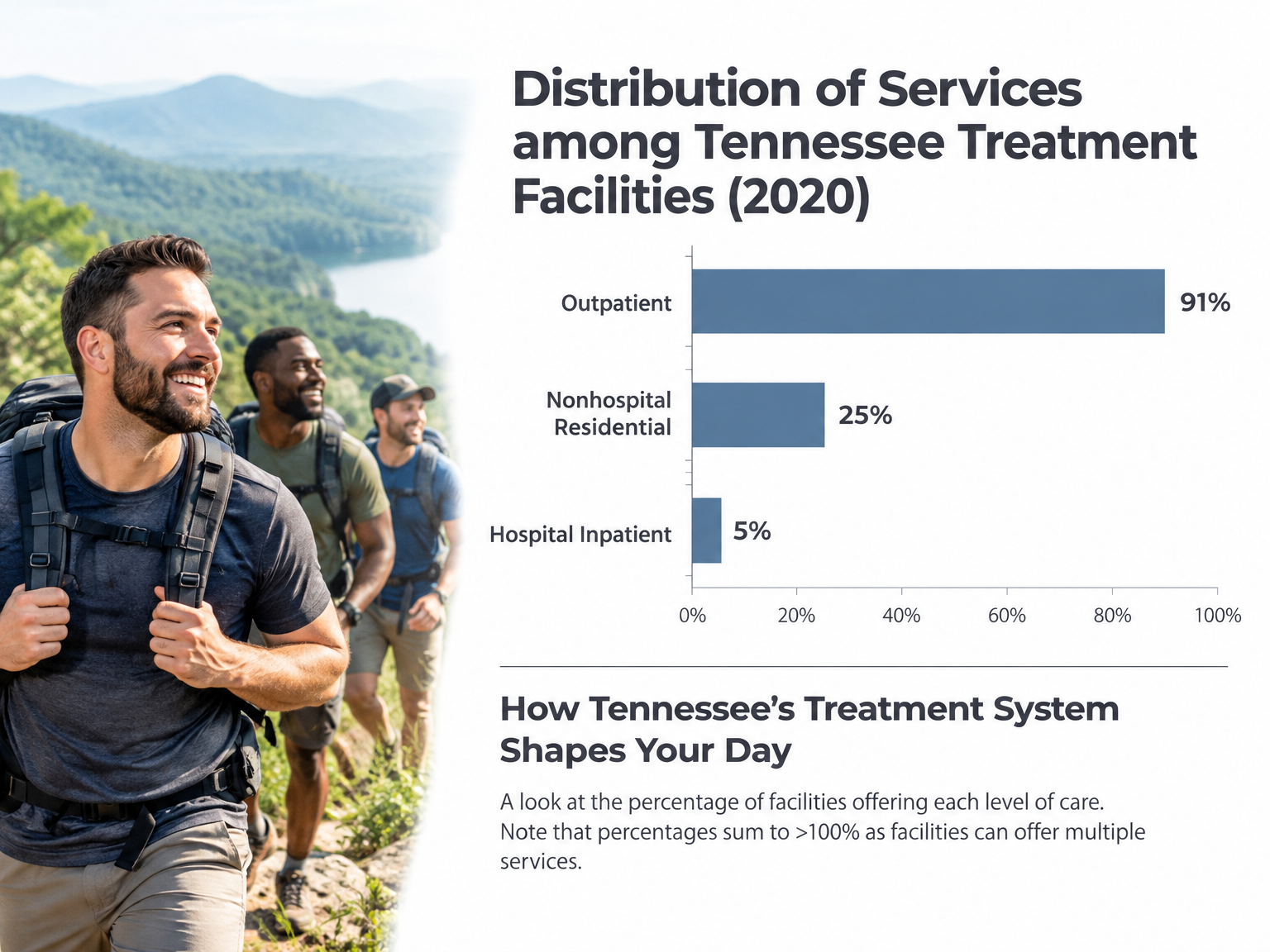
The Tennessee Comptroller's 2022 review of the state treatment system found that of the 311 treatment facilities operating in Tennessee in 2020, roughly 91% offered outpatient services, about 25% offered nonhospital residential services, and only 5% offered hospital inpatient services.4Percentages exceed 100% because many facilities offer more than one level of care. The shape of that 2020 distribution is the reason a typical day at a Nashville-area men's rehab is more likely to be a Partial Hospitalization Program (PHP) or Intensive Outpatient Program (IOP) day than a locked residential one.
PHP generally means a man spends most of the weekday in treatment and sleeps elsewhere, often in a structured recovery residence or at home. IOP is lighter, with sessions scheduled across the week. Both formats match the state's broader approach and the federal guidance that level of care should fit a man's severity, functioning, and home environment rather than default to the most intensive setting.2Medical detox, when needed, is a short stabilization window that sits before the longer outpatient arc, not a stand-in for treatment itself.3
The Nashville-area men's facility most readers of this article are weighing is in Columbia, Tennessee, not inside Nashville city limits. Columbia sits south of Nashville. Naming that honestly matters, because the daily schedule assumes a commute that doesn't exist if a man thinks the building is in Midtown.
For men and families in Davidson County communities like Downtown, Midtown, East Nashville, South Nashville, and Donelson/Hermitage, the drive to Columbia is a real part of the equation.9Nashville's own planning department notes that neighborhood boundaries in the city are advisory rather than fixed, so a man's travel time depends more on his specific starting point and the hour he leaves than on which community he claims.10From Williamson County, the drive is shorter. From the Columbia area itself, many men are already local.
Public transit between Nashville and Columbia is limited. WeGo bus routes and Access paratransit are designed around Davidson County, which means transportation to a Columbia-based program typically runs on family drop-off, rideshare, private transport, or a recovery residence closer to the facility.11If a man plans to drive himself to daily sessions, the schedule described in the next section builds that commute in.
The day starts earlier than most men expect. A 6:30 a.m. wake-up isn't punishment; it's the first clinical choice of the day. Early rising stabilizes sleep, which is often one of the first things substance use disrupts and one of the first things recovery has to rebuild.
By 7:00 a.m., you check in with nursing or clinical staff for vitals and a brief wellness screen. If you're early in care and taking medications for withdrawal management, anxiety, depression, or other co-occurring symptoms, this is where they're administered and tracked. NIDA notes that medication management belongs inside the treatment day alongside counseling and behavioral work, not off to the side.3
Breakfast runs around 7:30 a.m. Food matters here. Appetite, hydration, and blood sugar are physical markers staff watch, especially in the first two weeks.
Before the clinical block starts, there's usually a short grounding window: a check-in group, a brief reading, a few minutes outside. The point is a settled nervous system before you walk into the first therapy hour. You go in awake, fed, and oriented, which is a different starting line than most men have had in a while.
The 9:00 to 11:30 a.m. block is the clinical heart of the day. This is where group therapy and structured skills work live, and it's where most of the hours in PHP and IOP actually get spent.
Group therapy in a men's program is led by a licensed clinician and focused on a specific topic: anger and shame, relapse triggers, communication under stress, grief, the pressure of providing. Cognitive Behavioral Therapy (CBT) and Dialectical Behavior Therapy (DBT) are two of the common frameworks. CBT focuses on the thoughts and behaviors driving substance use. DBT adds distress-tolerance and emotion-regulation skills for men whose anxiety or anger has been running the show.
Between groups, there's usually a skills block. That might mean working through a trigger map (the people, places, and feelings that have historically preceded use), practicing a conversation you've been avoiding, or writing out an actual plan for the first weekend after discharge. SAMHSA's co-occurring treatment protocol recommends this kind of layered structure, with individual, group, family, and peer formats stacked across the week so men encounter the same work from different angles.2
For men new to this, the mid-morning block is usually harder than they expect and more useful than they expect. You're not just talking. You're building a specific set of tools you'll test by Friday.
Lunch isn't programming on paper, but it's where some of the real work happens. You sit with the same men you were in group with an hour ago, which means the conversation that started in session often keeps going over a sandwich.
This is where peer connection stops being an abstract idea and becomes a specific thing: another man at the table saying "same, me too" to something you'd never said out loud before. SAMHSA describes peer support as guidance, shared resources, and skill-building delivered by people with lived recovery experience, and it names group connection and mentoring as central to how it works.6
After lunch, there's usually thirty to forty-five minutes of unstructured time. Men call home, step outside, lift something, or just sit. The quiet is deliberate. A day that runs clinical hour to clinical hour without a breath burns men out by week two.
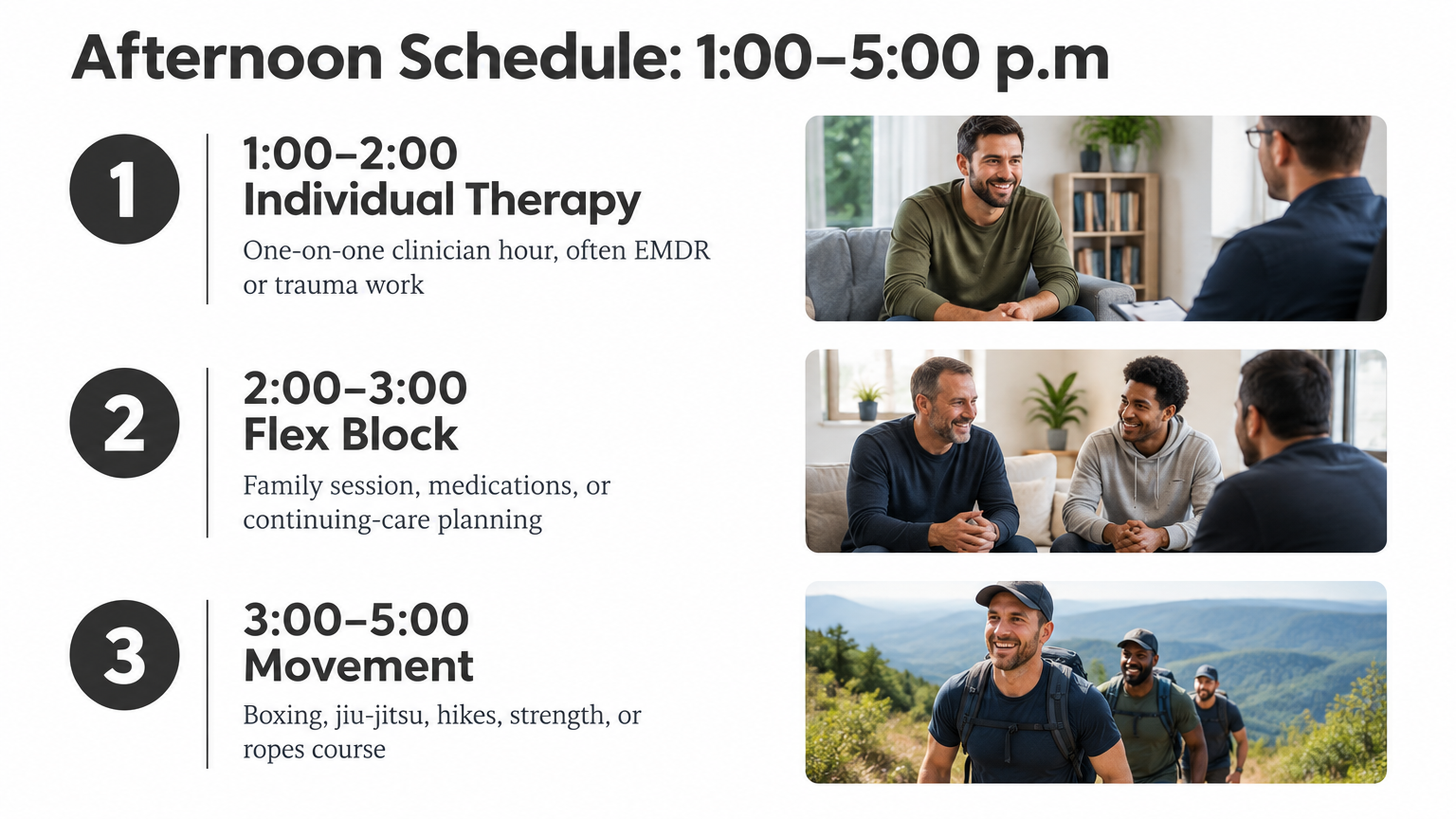
The afternoon is where the day gets personal. From roughly 1:00 to 2:00 p.m., many men have individual therapy, a one-on-one hour with a licensed clinician. This is where the material from group gets specific to your history: the childhood you don't talk about, the marriage you're trying to save, the job you lost or almost lost, the trauma you've been drinking at. EMDR (Eye Movement Desensitization and Reprocessing) and trauma-informed therapy often happen in this hour for men carrying unprocessed events.
From about 2:00 to 3:00 p.m., the schedule flexes. Some men have family sessions by phone or video; others have psychiatric medication management, case management, or a continuing-care planning meeting. NIDA frames the treatment day as a combination of counseling, coping-skills work, trigger planning, medication management, and discharge planning stacked across individual, group, family, and peer formats, not a single modality repeated.3
From 3:00 to 5:00 p.m., the day shifts into movement. This is a scheduled clinical block, not a gym break. On a given afternoon it might be boxing, jiu-jitsu, a strength session, a hike on a Middle Tennessee trail, basketball, a ropes course, or an ice bath. A clinician or trained staff member runs or monitors each block, and the purpose is named: give anger and anxiety a physical outlet, practice frustration tolerance, build the kind of physical confidence that doesn't need a drink to show up.
By 5:00 p.m., most men have been in some combination of talking, writing, and moving for seven hours. You're tired in a way that's different from the exhaustion that put you here. That difference is part of the point.
Dinner usually runs around 5:30 p.m. The tone is lighter than the morning. Men who were strangers on Monday are telling stories by Thursday, and the room sounds like it.
After dinner, the evening tends to split between a reflection or process group, a 12-step or alternative recovery meeting, and open time. Reflection group is short and specific: what was hard today, what you learned, what you're bringing into tomorrow. The recovery meetings bring in outside speakers and peers further along in their own recovery, which SAMHSA describes as a core function of peer support, mentoring, and modeling that recovery is possible.6
From about 8:30 p.m. on, the day winds down. Phone time, journaling, reading, a shower, a conversation with a roommate. Men in PHP who are sleeping at a structured recovery residence head there. Men in IOP have usually been home for hours.
Lights-out around 10:30 p.m. isn't a rule enforced by a bell; it's a routine the body starts to want. Sleep is one of the quieter wins of the first month, and the schedule is built to protect it.
The afternoon movement block isn't a perk tucked between therapy hours. It's clinical work on the schedule, run or monitored by trained staff, with a stated purpose for each session. Boxing, jiu-jitsu, strength training, hiking on a Middle Tennessee trail, basketball, a ropes course, or an ice bath each do something specific: give anger and anxiety a physical outlet, and build frustration tolerance in a setting where quitting isn't the answer.
Movement is positioned as a complement to the behavioral and coping-skills work that happens in group and individual therapy, not a replacement for counseling, medication management, or trigger planning. That is why staff treat the gym floor and the trailhead as treatment space, not downtime.
For a lot of men, this is also where confidence starts rebuilding. Finishing a round on the bag or a climb you didn't think you had in you reminds the body that it can do hard things sober. That memory shows up again later, when the hard thing is a Friday night at home.
The hour-by-hour walkthrough above is closest to a PHP day. Detox and IOP look different, and most men move through at least two of these levels on their way to a sustainable routine. Knowing which one you're entering helps you picture tomorrow accurately.
Medical detox is the shortest and most contained. Days are built around safety: vitals every few hours, medication to ease withdrawal, hydration, sleep, and short check-ins with clinical staff. Group therapy and movement are limited or paused while your body stabilizes. NIDA is explicit that this stabilization window is not treatment on its own; it's the opening before the longer work starts.3
PHP is the fullest version of the day described earlier. You spend most of the weekday on-site, moving through group, individual therapy, skills blocks, and scheduled movement, then sleeping at home or in a structured recovery residence.
IOP compresses the schedule into fewer, shorter sessions per week, often in a late-afternoon or evening block that lets men return to work or school. Group therapy stays central; individual sessions, family work, and continuing-care planning are built in on a lighter cadence.

Most men who walk into a Nashville-area men's rehab aren't only there for alcohol or another substance. They're also carrying something underneath it: anxiety that's been running on a loop for years, a depression that got labeled as being tired, trauma that never got named, anger that keeps costing them relationships. The schedule has to account for both at once.
SAMHSA's guidance on co-occurring disorders is direct: when substance use and mental-health symptoms show up together, they should be treated at the same time, by a team that coordinates care rather than handing a man off between separate systems.1That's what dual diagnosis means in practice. The intake screen asks about mood, sleep, panic, flashbacks, and suicidal thoughts alongside substance history, and the treatment plan builds from both.
Inside the day, that integration shows up in specific hours. The CBT and DBT work in morning group targets anxious thought patterns and emotion regulation. The individual hour in the afternoon is where trauma gets addressed with a trained clinician, often through EMDR or trauma-informed approaches. Medication management covers both withdrawal and conditions like depression or PTSD when a psychiatric provider determines it's appropriate.2Treating one and ignoring the other is how men end up back in the same place a year later.
One piece of state-level context is worth naming briefly, because it shapes the mood around treatment conversations in Middle Tennessee right now. The Tennessee Drug Overdose Deaths Report for 2024 shows a 31.6% decrease in provisional drug-overdose deaths among Tennessee residents from 2023 to 2024.5That's a meaningful shift, and it's reasonable to feel some cautious hope reading it.
A few limits belong next to the number. The data is provisional and statewide, drawn from death certificates that can be revised later. It measures deaths, not treatment demand or recovery rates, and it says nothing about any individual program. For a man weighing whether to walk into treatment this month, the statistic isn't a reason to wait or a promise about his outcome. It's background. The decision in front of him is still the one that matters.
A quick note to families reading alongside: the day described above is what the man in your life will likely be living once he says yes. Most of his hours will be spent in group therapy, individual sessions, scheduled movement, and meals with other men working on the same things he is. He will not be sitting idle, and he will not be alone.
Contact windows exist, though they're narrower than most families expect at first. Phone time is usually built into the evening, and family sessions, by phone or video, often fall in the early afternoon flex block. Those sessions are part of the clinical plan, not an extra. SAMHSA's co-occurring treatment guidance specifically names family as one of the formats a strong program stacks across the week.2
What helps him most in the first two weeks is steady, low-pressure contact: a short call, honest encouragement, and patience with the schedule. The structure is doing work he hasn't been able to do on his own.
The last clinical hour of PHP or IOP isn't the finish line. The schedule that held a man steady for weeks has to hand off to something lighter that can hold him for years, and the planning for that handoff starts well before discharge. Continuing-care planning is a scheduled part of the treatment day for a reason: it's where the next six months get mapped while structure is still around you.3
After formal programming ends, alumni services typically pick up the thread. That can look like a weekly alumni group, a check-in call with a peer mentor, a sober social event on a Saturday, or a text thread that keeps the men who went through the same cohort connected. SAMHSA frames peer support as guidance, mentoring, and recovery-group leadership delivered by people with lived experience, which is a different function than clinical therapy and complements it rather than replacing it.6The research on peer recovery support across treatment and community settings points in the same direction: sustained connection past the acute phase of care is where a lot of the long-term work happens.7, 8
The day described above isn't theoretical. It's the kind of schedule a man can actually walk into this week, and the first morning is usually the hardest part. Once the alarm goes off at 6:30 and someone hands him coffee, the structure starts doing its own work.
If you're the man reading this, the next move is small: a phone call, a chat window, an insurance check. You don't have to commit to a full program before you commit to a conversation. Trifecta Healthcare Institute's Nashville-area program in Columbia, TN can walk you through what your specific day would look like based on your situation, your schedule, and what your body is dealing with right now. A clearer picture is worth the ten minutes.
The Nashville-area men's facility is in Columbia, Tennessee, south of Nashville. It serves men from Davidson, Williamson, and surrounding counties, but the building itself is not inside Nashville city limits.
In a Partial Hospitalization Program (PHP), the clinical day typically runs from a 6:30 a.m. wake-up through late afternoon, with evening meetings and reflection after dinner. Intensive Outpatient (IOP) days are shorter, with sessions scheduled across the week. Per SAMHSA guidance, level of care and schedule should match a man's severity, functioning, and recovery environment.2
Medical detox is a short stabilization window focused on safety, vitals, and withdrawal medication. PHP fills most of the weekday with group, individual therapy, skills work, and scheduled movement. IOP compresses that work into a few sessions a week so you can keep working. NIDA notes detox alone is not treatment.3
IOP is built around men who need to keep working or managing family responsibilities, with evening session blocks common. PHP is harder to combine with full-time work. Family contact happens through scheduled phone or video sessions and evening phone time, and family work is part of the clinical plan.2
Through dual-diagnosis care. The intake screen covers mood, sleep, panic, and trauma symptoms alongside substance history, and the treatment plan addresses both at once. CBT and DBT target anxious thinking and emotion regulation in group, while the individual hour handles trauma, often with EMDR. SAMHSA recommends treating both concurrently rather than in sequence.1
Because it's scheduled clinical work, not recreation. Each block has a named purpose: give anger and anxiety a physical outlet, build frustration tolerance, and support the behavioral and coping-skills work that happens in therapy. It is a complement to counseling, not a replacement for it.
Between facility size limits, waivers, and state-by-state rules, figuring out your Medicaid or private insurance benefits can feel like its own full-time job. Our admissions team will verify your coverage in minutes and walk you through exactly what's available — no guesswork required.
Verify Insurance Benefits →No commitment required. Confidential & HIPAA-protected.
Whether it's you or someone you love, our team can help you figure out the next step — what treatment looks like, what's covered, or just someone to talk to.
Talk to Our TeamConfidential. No commitment required.


