


How to Choose a Dual Diagnosis Partial Hospitalization Program
Use this checklist to assess a dual diagnosis partial hospitalization program, including integrated care, medication support, Tennessee licensure, PHP fit, a...
Read More
Learn what is a step-down after long-term rehab nashville means, compare care options, and plan medication, housing, and 90-day support.
Start Your Journey NowWritten and reviewed by the clinical team at Trifecta Healthcare Institute, a men’s-only treatment center in Tennessee specializing in substance use, mental health, and dual diagnosis care.
A step-down after long-term rehab in Nashville is the planned move from residential treatment to a less intensive level of substance use disorder care, such as a partial hospitalization program (PHP), an intensive outpatient program (IOP), standard outpatient counseling, medication management, and peer or recovery support. Tennessee describes these services as a connected continuum, with placement guided by an individualized clinical assessment rather than by a fixed number of days completed.1
Think of it less as graduation and more as changing rungs on a ladder. The structure of residential care comes off, but clinical treatment, medications, and recovery supports keep working in the background while a man rebuilds work, family, and community life in Davidson County.
Federal clinical guidance makes the same point from a different angle: treatment is a continuum where people may step up or down in intensity as needs change, and finishing a detox or residential stay without continuing care generally leads back to substance use.5, 6 The rest of this guide walks through how Tennessee defines each level, the four moving parts of a strong step-down plan, and how men and families in the Nashville area can put one together.
Tennessee treats substance use disorder care as a connected ladder rather than a series of separate programs. The Tennessee Department of Mental Health and Substance Abuse Services names four main rungs: residential, partial hospitalization, intensive outpatient, and outpatient services, with peer and recovery supports threaded through each.1
Residential care is the top rung: a 24-hour, substance-free setting where a man lives on-site while receiving clinical treatment. The step directly below it is a partial hospitalization program (PHP), which Tennessee describes as an intensive, nonresidential alternative for people who need more structure than outpatient can provide but no longer require 24-hour care.1 A man in PHP typically spends most of the day in treatment and returns to a home or recovery residence at night.
An intensive outpatient program (IOP) is the next rung down. Tennessee's FY 2024-25 service guideline defines IOP as evidence-based treatment with professional supervision requiring at least 9 hours per week, generally delivered across 3 to 5 days.2 It offers more contact than standard outpatient care but leaves room for part-time work, school, or family responsibilities.
Standard outpatient treatment sits at the bottom rung in terms of hours, usually one to a few sessions per week. Below and alongside all of these, alumni groups, peer recovery support, and mutual-help meetings keep the connection going after formal sessions end.1
The most common misconception families bring to a step-down conversation is that the next level is decided by how many days someone has completed. In Tennessee, placement is driven by an individualized clinical assessment that weighs current symptoms, risk, co-occurring mental health needs, medications, housing stability, transportation, and the person's ability to participate in a given schedule.1
Federal clinical guidance echoes this. The National Institute on Alcohol Abuse and Alcoholism describes treatment intensity as a continuum, with people stepping up or down as their needs change rather than following a single fixed path.5 A man who is stable in week six of residential care may be ready for PHP; another may need two more weeks or a short step up before moving down. Neither is a failure.
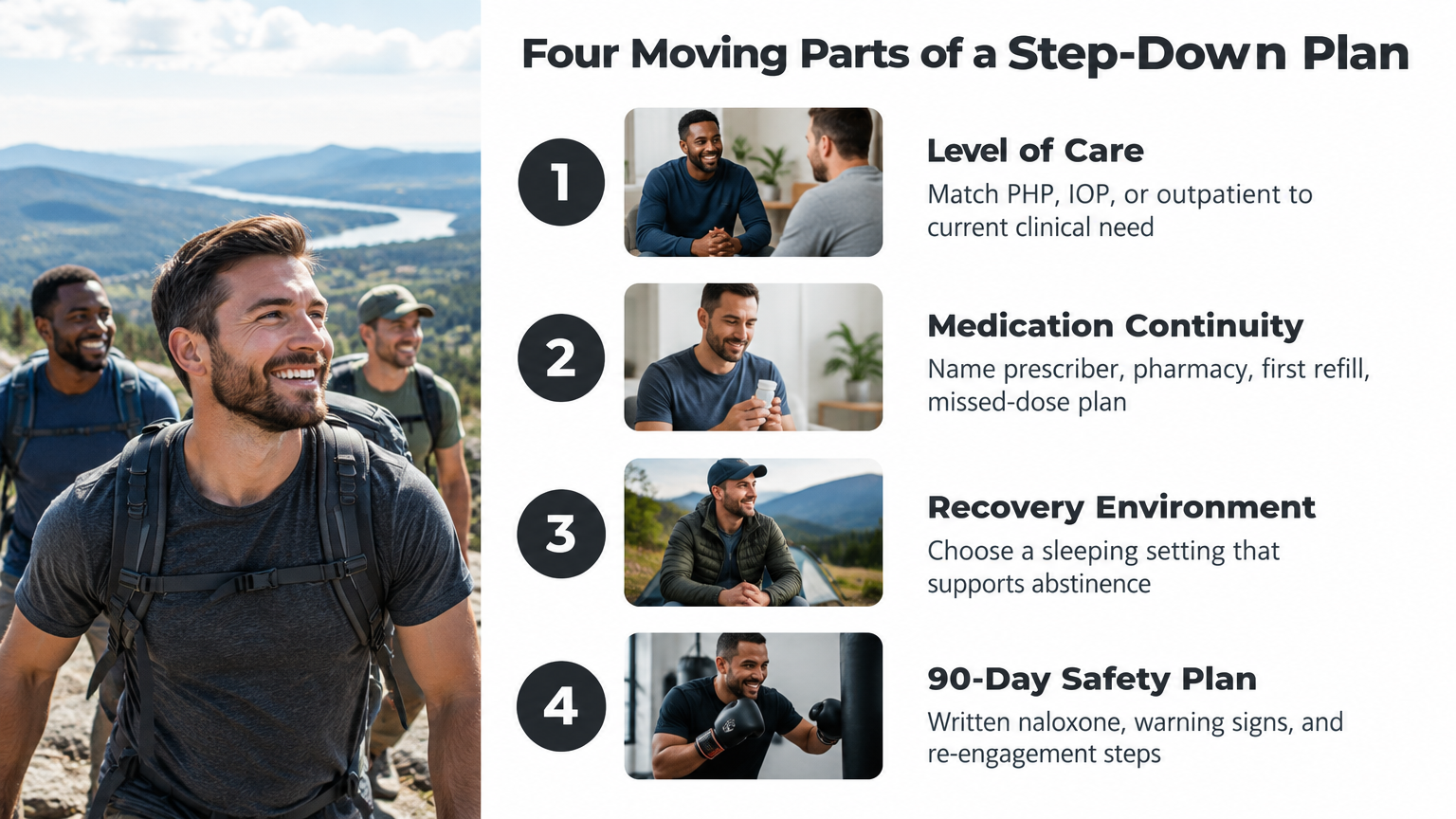
The first moving part is the clinical rung itself. A clean step-down from residential care in the Nashville area usually lands at PHP or IOP first, with standard outpatient waiting a few weeks or months out depending on how the man is holding up at home, at work, and in his own head.
PHP keeps the therapy hours high while removing the overnight piece. IOP pulls the hours down to at least 9 per week across 3 to 5 days, which creates room for a job or school without walking away from structure.2 Standard outpatient narrows to one or a few sessions a week, often paired with medication management and a peer group.
The right rung is the one that matches today's risk, not last month's progress. A continuing-care meta-analysis of 19 randomized trials found a small but real benefit for staying engaged in some form of ongoing treatment after a formal program ends, which supports staying engaged in continuing care after residential treatment.7
The second moving part is medication. For men with opioid or alcohol use disorder, buprenorphine, methadone, naltrexone, or acamprosate are often part of the clinical picture, and federal guidance is direct that these medications help people stay in treatment and reduce the risk of returning to use.6
The gap tends to open at the handoff. A recent peer-reviewed study found that medication treatment for opioid use disorder during residential stays rose from 30.4% in 2017 to 58.5% in 2021, but that same level of treatment was not sustained during the months after discharge.12 In plain terms: more men are starting medication inside residential care, and too many are losing access to it right when the environment around them changes the most.
A step-down plan built in Davidson County should name the prescriber, the pharmacy, the first refill date, and the backup plan if a dose is missed, before the man leaves residential care. It should also account for how the medication will be managed around PHP or IOP hours, work schedules, and transportation. Medication is not an add-on to the step-down; for many men, it is the floor the rest of the plan stands on.
The third moving part is where a man actually lives during the first weeks after residential care. The clinical hours matter, but so do the other 20 hours a day. A 2025 systematic review of recovery housing identified five studies with 6 to 24 months of follow-up and found that recovery housing performed better than usual care on abstinence, income, and employment, with the authors rating the evidence as moderate and calling for more research.9
That does not mean every man needs a sober living bed. Some return to a stable spouse, a supportive parent, or a quiet apartment and do well. Others step back into a house where someone is still drinking, a roommate still uses, or old patterns live in every room. The honest question is not Do I want to go home? but What will the first Friday night in that house actually look like?
A 2024 systematic review of recovery-supportive interventions, including peer support and recovery housing, found evidence that these services can improve outcomes, while noting wide variation in study quality.8 Treat the environment as part of the prescription.
The fourth moving part is a written safety plan built for the first 90 days. A 2025 systematic review of relapse risk after discharge from non-hospital residential treatment for opioid use disorder describes that transition period as a clinically important window that calls for direct attention to overdose and relapse risk.11
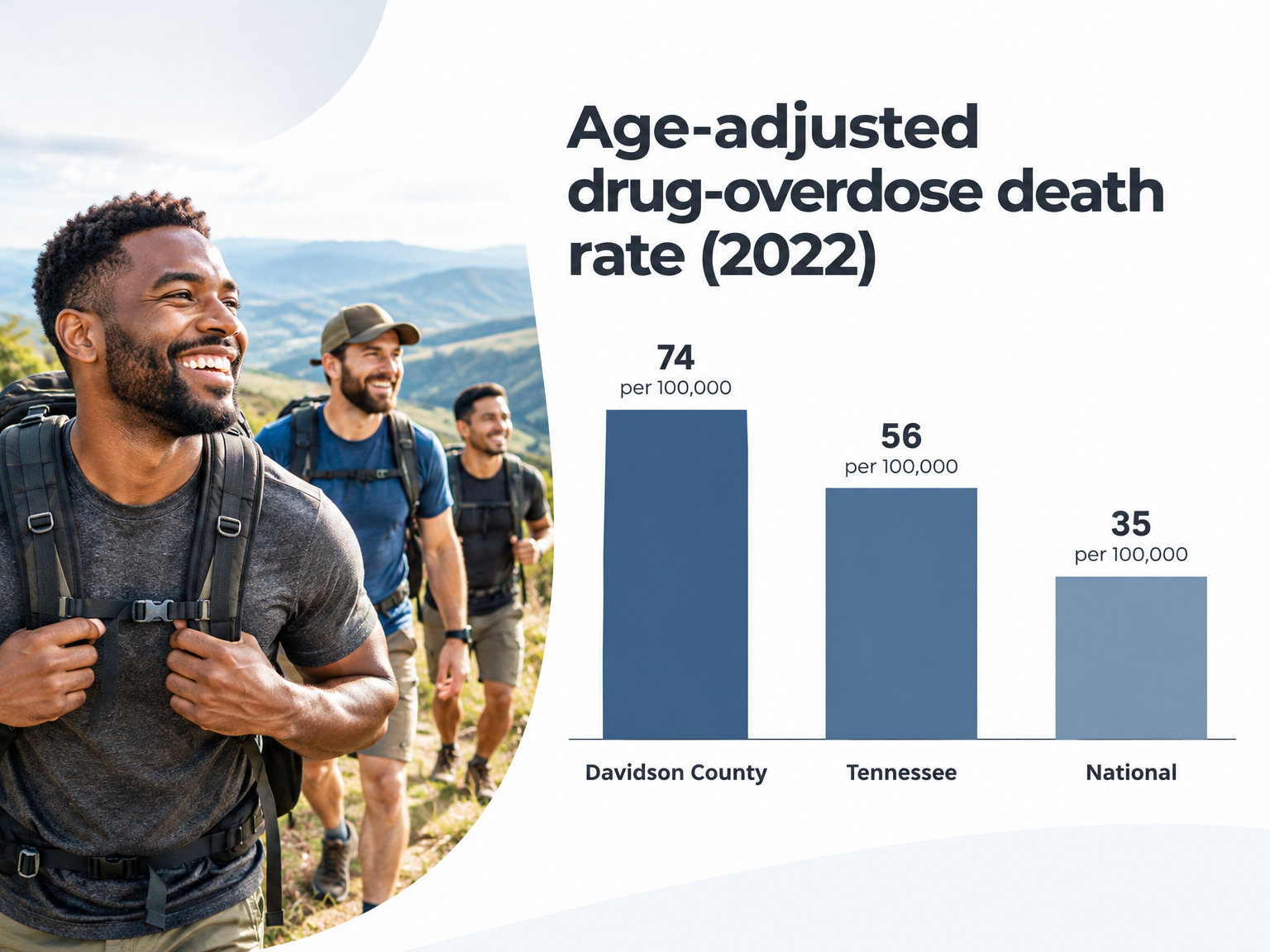
Davidson County is not a gentle setting for a stumble at the population level. The 2024-2025 Community Health Assessment reports a Davidson County age-adjusted drug-overdose death rate of 74 per 100,000 in 2022, compared with 56 for Tennessee and 35 nationally.13 More recent surveillance from the Metro Public Health Department recorded 513 suspected drug-overdose deaths among Davidson County residents in 2024, down from 609 in 2023 but still a sizable local burden that a Nashville step-down plan has to account for.14
A workable safety plan names a few specific things:
Re-engagement is the part most families miss. Tennessee's continuum of care framework treats placement as something that can move up as well as down when the assessment calls for it, so stepping back to PHP for two weeks after a hard patch is a planned clinical response, not a failure.1
The right next rung is a clinical call, but families and the man himself can walk into that conversation prepared. The matrix below pairs common life and clinical factors with the level of care that most often fits in the Nashville area. It is a planning tool, not a prescription; Tennessee's framework still requires an individualized assessment to make the final call.1
| Factor | Likely next rung | Why |
|---|---|---|
| Just finished residential, home environment stable, no co-occurring crisis | PHP, then IOP | Keeps therapy hours high while removing overnight structure; eases the drop in intensity |
| On medication for opioid or alcohol use disorder, prescriber and pharmacy already set | IOP with medication management | Protects the medication floor during the handoff period12 |
| Returning to a home with active substance use or heavy conflict | PHP plus recovery residence | Changes the sleeping environment while clinical hours stay high9 |
| Full-time job or caregiving role, stable supports, moderate risk | Evening or hybrid IOP | Tennessee IOP runs at least 9 hours a week across 3 to 5 days, often schedulable around work2 |
| Co-occurring anxiety, depression, or PTSD symptoms flaring | PHP with integrated behavioral health | Integrated care has shown an advantage for psychiatric symptom improvement10 |
| Several months stable in IOP, working, connected to peers | Standard outpatient plus alumni or peer support | Lower clinical hours with ongoing continuing-care contact7 |
| Hard patch, missed sessions, early-warning signs | Step back up to PHP or IOP | Tennessee's continuum allows planned re-intensification without starting over1 |
Families often ask which row “counts” most. The clinical team weighs them together, but two factors tend to carry extra weight after long-term rehab: the environment a man will sleep in and whether a medication plan is already in motion. If either of those is unsettled, the next rung usually needs to be higher, not lower.
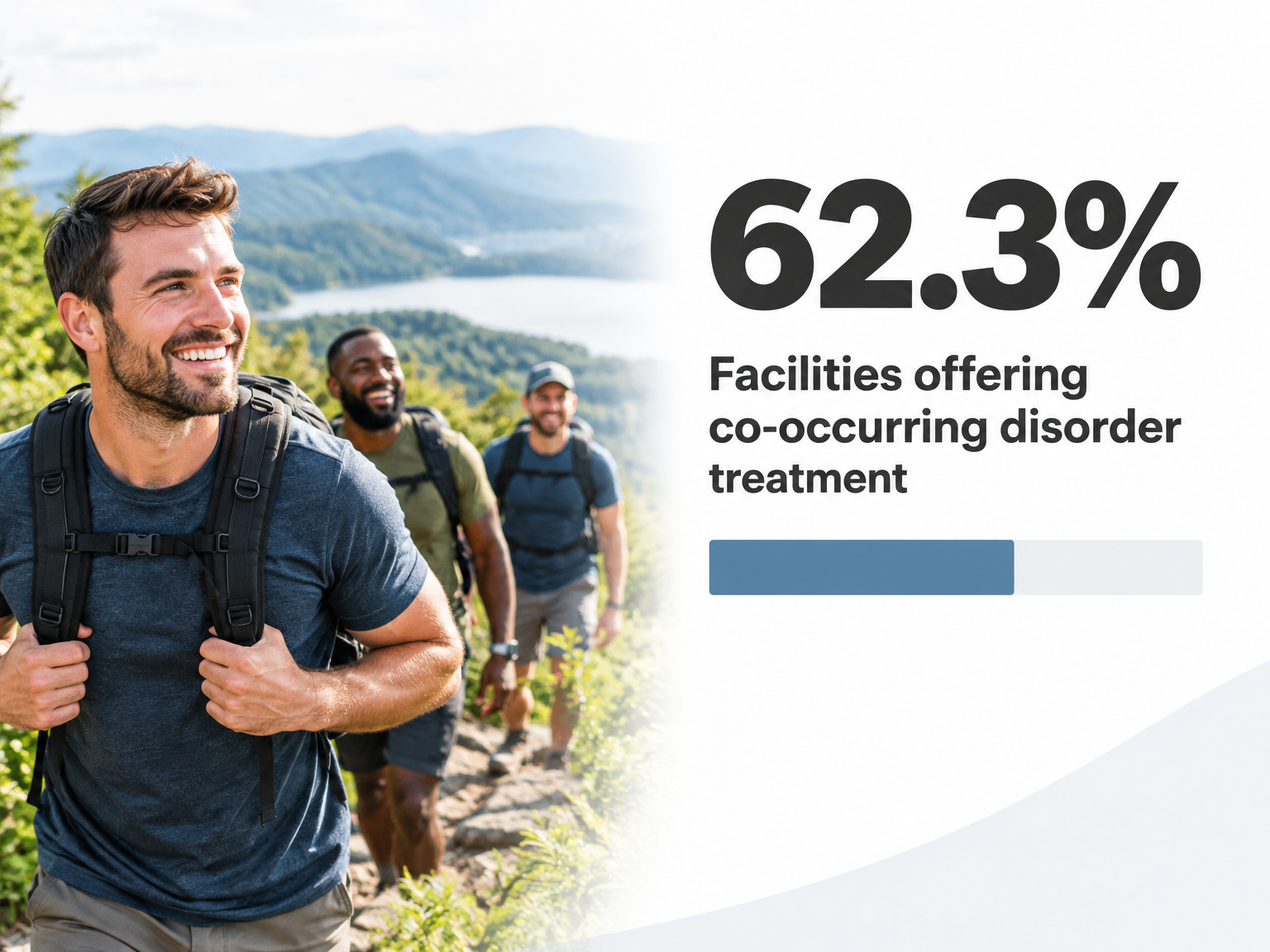
Substance use rarely travels alone. For many men leaving long-term rehab, anxiety, depression, grief, anger, or post-traumatic stress symptoms are already in the room, sometimes quieter during residential care and louder once the structure comes off. SAMHSA's 2024 national survey found that 62.3% of substance use treatment facilities offer treatment for co-occurring disorders involving serious mental illness or serious emotional disturbance, so coordinated care at the step-down rung is widely available, though quality and fit still vary.4
A 2023 systematic review of dual diagnosis treatment is worth stating plainly: integrated care showed an advantage for psychiatric symptom improvement, but no clear advantage for substance-use outcomes or treatment retention compared with non-integrated approaches.10 That does not mean co-occurring work is optional. It means a man and his family should expect concrete attention to mental health symptoms during PHP or IOP, with evidence-based therapies such as CBT, DBT, EMDR, and motivational interviewing, while keeping realistic expectations about what any single model guarantees.
Practical signs the plan is doing its job: panic that used to drive a drink is being named and worked on in therapy, sleep is tracked, trauma triggers are mapped, and medication for depression or anxiety, if prescribed, has a clear follow-up schedule. Trifecta Healthcare Institute addresses co-occurring mental health conditions alongside substance use care in its Columbia, TN program serving the greater Nashville area; it does not provide primary mental healthcare on its own.
The rhythm of a step-down week is the part most men can picture only after they live it. A partial hospitalization program in the Nashville area is typically a full-day, weekday schedule, with mornings weighted toward group therapy and afternoons toward individual sessions, medication check-ins, skills work, and family contact; exact hours vary by program. A man sleeps at home or in a recovery residence, drives in for the day, and leaves with homework that is more journal than worksheet.
An intensive outpatient week looks different. Tennessee's service guideline sets IOP at a minimum of 9 hours a week across 3 to 5 days, which in practice often means three evening blocks of about three hours each, or two longer weekday sessions plus a Saturday morning.2 That schedule is designed so a man can hold a job, take a child to school, or finish a semester without stepping away from clinical care.
A typical IOP block in the Nashville area pairs a process group with a targeted skills group, such as relapse prevention, trauma coping, or anger regulation, and leaves time for a brief individual check-in every week or two. Medication appointments, drug screens, and peer meetings sit around the clinical hours.1
Between sessions, the hours that used to belong to substance use have to belong to something else. This is where movement, peer connection, and daily structure stop being extras and start acting as clinical supports. A 2024 systematic review of recovery-oriented interventions found that peer support and recovery-oriented services can improve substance use and health outcomes, with the authors noting wide variation across study designs and populations.8
Movement does similar work from a different angle. Programming at men's programs in Middle Tennessee often includes boxing, jiu-jitsu, hiking in the surrounding hills, basketball, and ice baths, used as clinical tools within a weekly schedule rather than as weekend recreation. They are prescribed into the week the way a group session is, with the same attention to attendance.
Structure is the quietest piece. A step-down week built around fixed wake times, scheduled meals, named workouts, group therapy, and one or two peer meetings gives a man fewer blank hours to defend. When men in PHP or IOP stand together through those first weeks, the accountability that residential care provided from the walls starts coming from the people in the room.
The question most families ask next is a practical one: who pays for PHP, IOP, and ongoing medication after residential care ends? In Tennessee, TennCare covers withdrawal management and substance use disorder treatment at inpatient, residential, and outpatient levels for eligible adults, adolescents, and children, which includes the lower rungs most men step down into after long-term rehab.3 Coverage is not the same as automatic approval, though. Network status, medical necessity, and prior authorization still shape which specific program a man can start on which date.
Commercial plans in Middle Tennessee commonly cover PHP, IOP, outpatient counseling, and medication management, with the specific benefit, copay, and authorization rules varying by plan. Outpatient infrastructure is widely available: SAMHSA's 2024 national facility survey found that 83.8% of substance use treatment facilities offer outpatient care, so the services exist in volume, even when a particular plan narrows which doors are open.4
Two steps keep the money question from stalling a step-down. Verify benefits for the exact level of care and prescriber before the discharge date, and ask the clinical team to document medical necessity for the next rung in the same assessment that recommends it.1
Most step-downs don't fail at the clinical rung. They fail in the quiet gaps around it. Four stall-points show up again and again in the Nashville area, and each has a concrete fix built into the plan before discharge.
The medication gap. A man leaves residential care with a prescription but no scheduled appointment, no pharmacy on file, and no backup if the first refill hits a snag. Medication treatment for opioid use disorder is more common inside residential stays than it used to be, but continuity after discharge is still a known weak point.12 Fix it by naming the prescriber, the pharmacy, the first appointment date, and the missed-dose protocol in writing before the step down.
The schedule gap. PHP ends on a Friday and IOP doesn't start until the following Wednesday. Those five days are where many men slip. Tennessee's continuum is designed to hand off without a seam, so the next rung's first session should be on the calendar before the current rung ends.1
The environment gap. A man returns to the same house, same route home, same Friday night. Recovery housing or a changed routine, backed by moderate evidence, can shift the odds.9
The silence gap. He stops texting his peer group, skips one session, then two. A written re-engagement rule, one missed session triggers a call from the clinical team the same day, closes it fast.
A step-down works when the plan is written down before the discharge date, not sketched out in the parking lot after it. The four moving parts, level of care, medication continuity, recovery environment, and a 90-day safety plan, each need a name attached: a clinician, a prescriber, a sleeping address, and a person who gets the call if a session gets missed.1
Trifecta Healthcare Institute runs its Middle Tennessee men's program in Columbia, TN, serving the greater Nashville area with PHP, IOP, outpatient, and alumni services alongside co-occurring mental health support. For men finishing residential care and the families planning the next rung with them, the useful move is a short conversation about what the assessment calls for and which door opens on which day. [Verify your insurance] or [Call Trifecta] to start that plan. The next rung is already there; the work is just stepping onto it.
Stepping down means moving from residential care to a less intensive level of substance use disorder treatment while continuing clinical work. In Tennessee, that usually means partial hospitalization, intensive outpatient, or standard outpatient care, paired with medication management and peer support. Placement is based on a clinical assessment, not a fixed number of days.1
There is no single required length, because Tennessee treats placement as a clinical decision rather than a fixed timeline.1IOP is defined as at least 9 hours per week across 3 to 5 days, and most men spend several weeks in PHP and several months in IOP before stepping to standard outpatient, with the duration adjusted to progress and risk.2
You should. Federal guidance is clear that medications such as buprenorphine, methadone, naltrexone, and acamprosate help people stay in treatment and reduce the risk of returning to use.6The known weak point is continuity after residential discharge, so ask the clinical team to confirm the prescriber, pharmacy, first appointment date, and missed-dose plan in writing before you leave.12
TennCare covers withdrawal management and substance use treatment at inpatient, residential, and outpatient levels for eligible members, which includes PHP, IOP, and outpatient care.3Commercial plans in Middle Tennessee commonly cover the same levels of care, with specific benefits, copays, and prior-authorization rules varying by plan. Verify benefits for the exact next rung before discharge.
Stepping back up is part of the design, not a failure. Tennessee's continuum allows placement to move up when a clinical assessment calls for it, so a hard patch in IOP can mean a planned return to PHP for a few weeks rather than starting over.1A good discharge plan names the trigger, the contact, and the re-engagement step before you ever need them.
Families help most by handling the logistics clinical teams cannot see. Confirm the sleeping address, the ride schedule, the pharmacy, naloxone in the home, and one named person who gets the call if a session is missed. Peer and recovery-oriented supports can improve outcomes alongside clinical care, with evidence varying across studies, so help your loved one keep those connections scheduled, not optional.8
Between facility size limits, waivers, and state-by-state rules, figuring out your Medicaid or private insurance benefits can feel like its own full-time job. Our admissions team will verify your coverage in minutes and walk you through exactly what's available — no guesswork required.
Verify Insurance Benefits →No commitment required. Confidential & HIPAA-protected.
Whether it's you or someone you love, our team can help you figure out the next step — what treatment looks like, what's covered, or just someone to talk to.
Talk to Our TeamConfidential. No commitment required.


