


How to Choose a Dual Diagnosis Partial Hospitalization Program
Use this checklist to assess a dual diagnosis partial hospitalization program, including integrated care, medication support, Tennessee licensure, PHP fit, a...
Read More
Learn how a Nashville therapeutic community structures residential recovery, what evidence says about its benefits, and what to compare before choosing a pro...
Start Your Journey NowWritten and reviewed by the clinical team at Trifecta Healthcare Institute, a men’s-only treatment center in Tennessee specializing in substance use, mental health, and dual diagnosis care.
A therapeutic community for addiction is a structured, drug-free residential program where men live together and use shared routines, group counseling, peer accountability, and gradual role progression to change the behaviors tied to substance use 8. The approach treats the community itself as the main instrument of change, which is why practitioners often describe it as "community as method."
In Nashville, a therapeutic community is one option inside Tennessee's licensed continuum of care, which also includes medical detox, partial hospitalization, intensive outpatient, and standard outpatient treatment 13. It is not the same thing as a sober living house or a recovery residence. Those settings offer peer support and structure but do not provide on-site clinical treatment.
The honest evidence picture is mixed. Peer-reviewed reviews describe therapeutic communities as potentially helpful across substance use, employment, and psychological functioning 8, while systematic reviews caution that community-based programs have not clearly outperformed outpatient care in randomized trials 10. What follows explains how the model is built, what the research actually supports, and how its core principles show up in modern men's programs in Middle Tennessee.
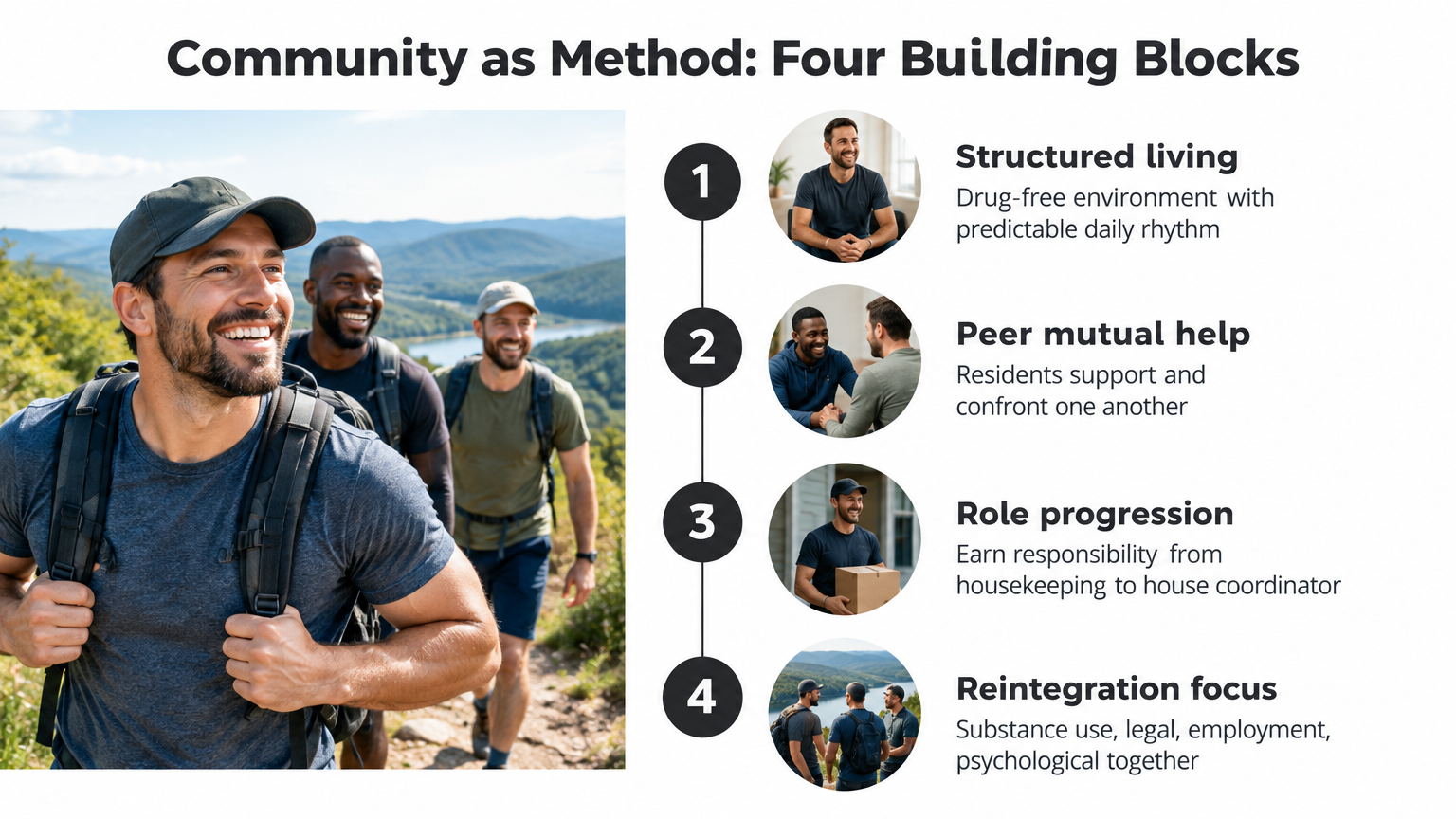
The therapeutic community model treats the residential community itself as the primary tool of change. Clinicians and residents share the daily work of recovery through four building blocks:
Days follow a predictable rhythm. Residents wake, eat, work, attend group counseling, participate in community meetings, and share chores on a schedule that is deliberately tight. That structure replaces the chaos many men describe before treatment and creates repeated chances to practice new behaviors in real time.
Role progression is what distinguishes a TC from a dorm with a therapist. A newer resident might start with basic housekeeping duties, then step into roles like peer mentor, group leader, or house coordinator as he demonstrates reliability. Each promotion carries more responsibility to other men, which is where the peer accountability piece does its work.
Group members confront one another about missed commitments, dishonesty, or old patterns, and they also recognize progress out loud. The method is social: men learn to live differently by living with other men who are trying to do the same thing.
Time in the program is one of the clearest predictors of how a therapeutic community works in practice. A National Academies review of treatment techniques found that residents who stayed for at least one-third to one-half of the planned course tended to show better functioning afterward, while 75% or more of enrollees in some historical TC settings did not complete the planned stay 4.
That gap is the honest tension at the center of the model. Programs are built to produce change through sustained exposure to structure, roles, and peer accountability, yet many men leave before that exposure can accumulate. Researchers are careful to note that completion effects may partly reflect motivation and selection rather than the treatment alone, so staying longer is not a guarantee by itself 4.
Modern programs in Middle Tennessee rarely ask a man to commit to a classic TC up front. Instead, residential or partial hospitalization time is paired with step-downs into intensive outpatient and outpatient care so the exposure to structure continues even after a man moves out of a 24-hour setting. The practical point: the longer a man stays engaged across levels of care, the more the TC-style mechanisms have a chance to take hold.
The research on therapeutic communities tells two true stories at the same time. A recovery-oriented peer-reviewed review found that TCs produced significantly better substance-use and legal outcomes in two of three studies examined, with five studies showing superior employment and psychological functioning compared to alternatives 8. Men came out working more, using less, and reporting better daily mental health. That is a real signal and worth taking seriously.
The counterweight is just as important. A systematic review of randomized trials comparing TCs to no treatment, other treatment, or another TC identified only five publications from four randomized trials and found serious methodological limitations across them 10. Community-based therapeutic communities did not show clear superiority to outpatient treatment for substance use, crime, or unemployment at the 12-month mark. Prison-based findings were more favorable, but that is a different setting with a different population.
Classic therapeutic communities were designed around substance use alone, which left a gap for men also living with anxiety, depression, PTSD, or other mental health conditions. The modified therapeutic community (MTC) was built to close that gap. It keeps the structure, peer accountability, and role progression, but softens the pace, adjusts expectations for symptom days, and weaves mental health treatment into the daily schedule rather than treating it as a separate appointment somewhere else.
A single-investigator meta-analysis of modified TCs for co-occurring disorders pooled four comparisons from three studies with 569 participants 9. Modified TCs showed significant effects in five of six measured domains: substance use, mental health, crime, employment, and housing. HIV-risk behavior did not show a meaningful treatment effect. The authors called for independent replications and stronger clinical trials, so the finding should be read as supportive rather than settled.
For Middle Tennessee men who arrive at treatment with more than one diagnosis, that research matters. It suggests that a TC-style environment can be adapted to handle mental health symptoms alongside substance use rather than forcing a man to choose which problem to work on first.
Numbers help, but one study makes the pattern easier to picture. A longitudinal study followed men with severe substance dependence and complex presentations through a therapeutic community and tracked them over time 11. At the nine-month mark, 68% of participants reported complete 90-day drug abstinence. Alcohol frequency and quantity dropped by more than half, and psychiatric-severity scores were roughly cut in half as well. Men who stayed at least nine months reported substantially better outcomes than those who left earlier.
Two caveats belong next to those figures. First, this was not a randomized comparison, so some of the gain likely reflects which men were able and willing to remain in the program. Second, results from one TC do not transfer automatically to another. Still, the direction is consistent with the broader TC literature: sustained engagement in a structured, peer-driven setting tends to be where the real change compounds, especially for men whose presentations include both substance use and mental health symptoms.
Men are carrying a disproportionate share of that loss. Males accounted for 68% of suspected fatal overdose deaths year to date in the same surveillance period, with substantial male representation also noted in overdose-related emergency-department visits 7.
For a man weighing whether a structured residential or step-down program is worth the disruption, this is the context that changes the math. The margin for continuing to white-knuckle it alone is thinner than it used to be, and that is a core reason the TC-style emphasis on 24-hour structure and peer accountability has resurfaced as a serious option in Middle Tennessee.
A therapeutic community is one step on a longer staircase of care in Tennessee, not a standalone category. The state's licensed continuum generally runs from medical detox and withdrawal management, into residential and partial hospitalization programs (PHP), down to intensive outpatient (IOP), standard outpatient, and alumni support. TC-style programs sit in the residential and PHP band, where men live or spend most of their day in a structured, drug-free environment with group counseling, peer accountability, and gradual role progression 8.
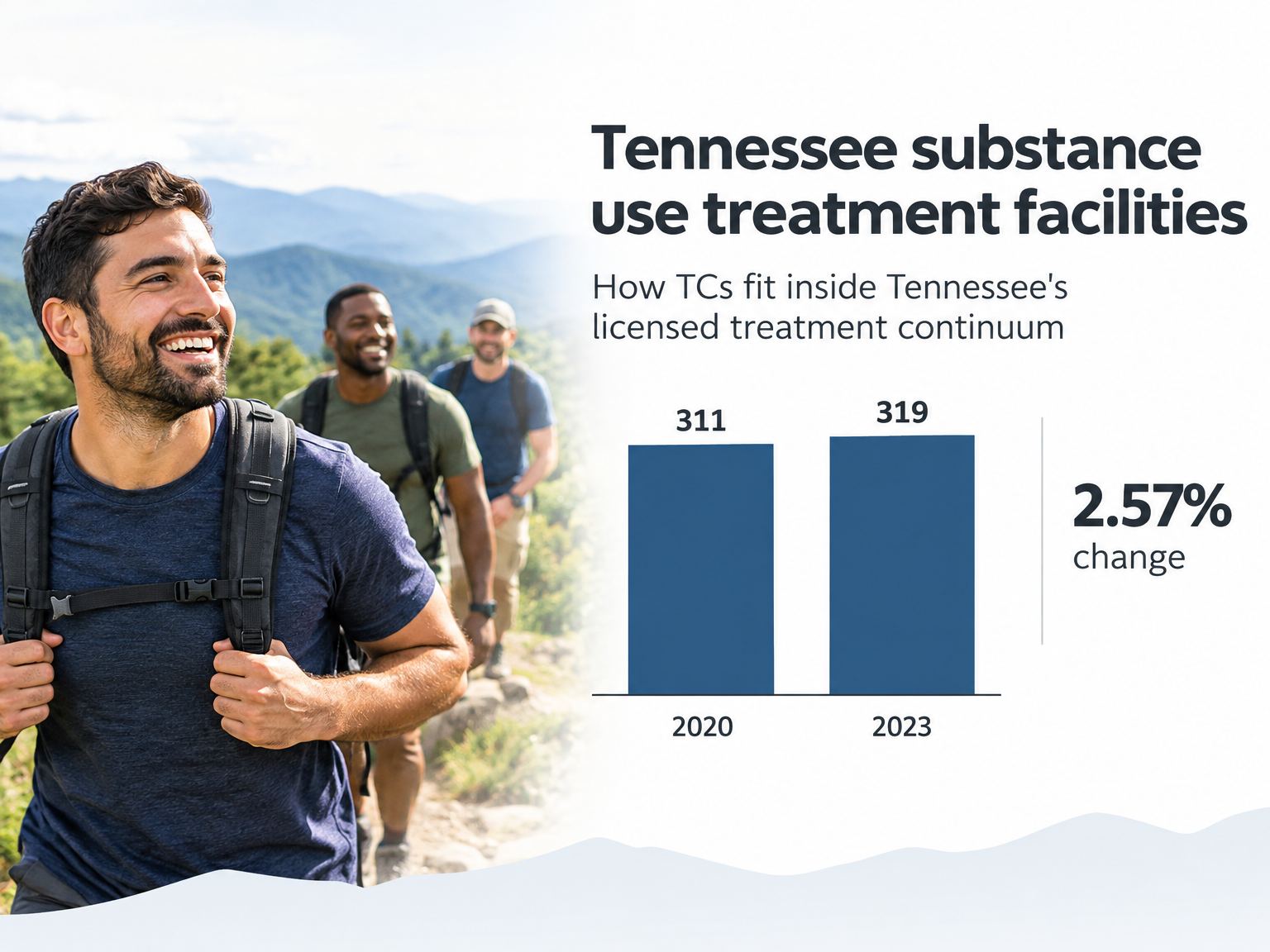
That staircase has gotten noticeably more crowded. Tennessee reported 319 substance use treatment facilities with 34,244 clients in treatment on March 31, 2023, compared with 311 facilities and 18,865 clients on March 31, 2020, per the 2023 SAMHSA state profile 13. The facility count barely moved, but the one-day client census grew by roughly 81% between those two single-day snapshots. These are point-in-time census figures, not annual treatment totals, and they describe service capacity and census rather than treatment quality or outcomes 13.
For a Nashville-area man, the practical read is that a modern men's program rarely looks like the stereotype of a yearlong commune. It usually starts with medical detox when needed, moves into a residential or PHP phase that applies TC principles, and then steps down into IOP and outpatient care so structure continues after a man returns home or to work.
This distinction trips up a lot of Nashville families, and it's worth getting right before anyone signs paperwork.
The practical difference shows up in the schedule. Inside a therapeutic community or a residential program using TC principles, a man's day is organized around clinical work: individual counseling, group sessions, assigned community roles, and integrated support for co-occurring mental health symptoms when they are present 12. Staff include licensed clinicians who assess, plan treatment, and adjust it over time.
In a recovery residence, the house itself is the service. Residents typically hold outside jobs or attend treatment elsewhere, pay rent, and follow community agreements about curfews, meetings, and sobriety. Many men use a recovery residence after they finish residential or PHP care, as a lower-cost way to keep structure around sleep, work, and peer connection while they step down through IOP or outpatient treatment.
Neither setting replaces the other. For men in Middle Tennessee, the honest frame is that clinical TC-style care addresses what substance use has been masking, and a recovery residence can help protect that work after discharge.
Most men who show up for addiction treatment are not dealing with substance use alone. Anxiety, depression, PTSD, grief, and unprocessed anger are common passengers, and the old habit of treating them as separate problems in separate buildings tends to fail both. Federal guidance has moved firmly in the other direction. SAMHSA recommends integrated care for people with co-occurring substance-use and mental-health conditions, built around a 'no wrong door' approach in which someone presenting for either concern is screened for the other 1.
The National Institute of Mental Health describes integrated care as mental-health and substance-use treatment delivered together in a coordinated setting, with behavioral therapies, medications, and care management working from the same plan 2. SAMHSA's TIP 42 advisory pushes that further, calling for screening, assessment, integrated treatment planning, and stage-appropriate interventions inside the same program rather than scattered across referrals 12.
Inside a modern Middle Tennessee men's program applying TC principles, that looks concrete. A man's intake includes mental-health screening alongside the substance-use assessment. His therapist, his psychiatric provider, and the group he sits with each morning share one treatment plan. Trauma-informed modalities such as EMDR and CBT are used within integrated care so the two sides of what he's carrying get addressed together rather than passed back and forth.
Physical activity has earned a serious seat at the clinical table, though the research still comes with asterisks. A 2023 systematic review of physical-activity interventions during substance use disorder treatment analyzed 43 studies involving 3,135 participants and found that 75% of studies assessing substance-use outcomes reported a decrease following the intervention 6. The authors were explicit that programs varied widely and that more rigorous research is needed before anyone claims a specific prescription, so this is best read as supportive evidence, not a guarantee.
What that means in practice for a men's program in Middle Tennessee is simple: movement is scheduled like any other therapy block, not treated as filler between groups. Boxing, jiu-jitsu, gym work, hiking, and cold exposure show up on the weekly calendar for reasons tied to the clinical goals of the week, whether that's regulating a nervous system that has been running hot, giving a man a legitimate way to meet physical intensity he used to meet with substances, or building the kind of consistent routine that supports sleep and mood.
Describing this as 'movement as medicine' is accurate only when it stays alongside counseling, group work, and integrated co-occurring treatment. The research supports movement as a credible part of care associated with decreases in substance use across most studies assessed 6. It does not support movement as a substitute for the therapy and peer accountability that do the heavier lifting.
The 'community as method' idea at the center of the TC model lives or dies on peer accountability. A 2025 systematic review of peer recovery support services and recovery coaching for substance use disorder looked at 28 publications; of the 12 that reported substance-use outcomes:
Peer connection is a credible ingredient, not a guaranteed one, and the research varies on when and how it helps most.
What travels well from the TC tradition into a modern men's program is the daily shape of peer accountability rather than any single ritual. Men share living space or long program days with other men who know their story, their triggers, and the specific ways they tend to drift. A missed commitment gets named. A win gets witnessed. The men a few weeks ahead model what the next phase looks like, and the men a few weeks behind are a reason to keep showing up for yourself.
That's where a brotherhood frame earns its weight. Not as a slogan, but as the mechanism that turns a treatment plan into something a man actually practices every day.
If you're a man weighing treatment in Middle Tennessee, here's what a modern TC-informed program tends to look like in practice. You arrive, get medically assessed, and if withdrawal management is needed, that comes first. From there, you step into a residential or partial hospitalization phase where your day has a clear shape: morning community meeting, individual counseling, group therapy, a scheduled movement block, and shared meals with the same men you're working through this with.
Your treatment plan is one plan, not two. If anxiety, depression, PTSD, or anger have been riding alongside substance use, the therapist running your trauma-informed sessions is on the same team as the group leader you sit with every morning 12. Nothing gets passed off to a referral across town.
When you're ready, you step down into IOP and outpatient care, often while living in a recovery residence. Trifecta Healthcare Institute's Nashville-area program is located in Columbia, TN. The structure stays with you long enough for the TC-style mechanisms, routine, peer accountability, honest feedback, to actually take hold.
If you're the one running the searches at midnight, a few things are worth knowing before the next conversation. A therapeutic community is clinical treatment, not a punishment or a place to drop someone off. Men live together, follow a structured daily schedule, and work through counseling, group therapy, and peer accountability with staff who assess and adjust the plan over time 8.
If he's also dealing with anxiety, depression, PTSD, or anger that predate the substance use, ask whether the program delivers integrated co-occurring care rather than referring mental health out. Federal guidance is clear that screening and treating both conditions together, inside the same plan, produces better outcomes than running them on parallel tracks 1, 12.
Two practical notes. First, length of engagement matters more than any single admission date; men who stay through residential, PHP, and step-down IOP tend to get more from the model than those who leave early 4. Second, you are not expected to diagnose him or sell him on a program. A short call with an admissions clinician can clarify level of care, insurance, and what the first week would actually look like, which is often what moves a hesitant man from maybe to yes.
The hardest part is rarely picking a program. It's making the call that turns research into a plan. If you've read this far, you already know the shape of what a therapeutic community offers and how its principles show up in a modern men's program in Middle Tennessee: structure, peer accountability, integrated co-occurring care, and movement that supports the clinical work rather than replacing it.
A short conversation with an admissions clinician at Trifecta can clarify the level of care that fits, what insurance covers, and what the first week in Columbia would actually look like. You don't have to have your mind made up to make the call. [Verify your insurance] or [Call Trifecta] when you're ready to stand with men doing the same work.
Length of stay varies widely. Research links longer engagement to better functioning, though 75% or more of enrollees in some historical TC settings did not complete the planned course 4. Most modern Middle Tennessee programs use a shorter residential or PHP phase, then step down through IOP and outpatient care to keep structure in place.
No. A therapeutic community is a licensed clinical treatment setting that delivers counseling, group therapy, and medical oversight as part of the daily program 8. A sober living house or recovery residence is a drug-free place to live with peer rules and routines, but no on-site clinical treatment. Many men use a recovery residence after residential or PHP care to protect the structure they built.
It can, when the program delivers integrated care instead of referring mental health out. A meta-analysis of modified therapeutic communities for co-occurring disorders found significant effects across substance use, mental health, crime, employment, and housing in five of six measured domains 9. Federal guidance also favors screening and treating both conditions together inside the same plan rather than running parallel tracks 1, 12.
Not clearly. A systematic review of randomized trials found that community-based therapeutic communities did not show superiority to outpatient treatment for substance use, crime, or unemployment at 12 months, with serious methodological limitations across the available studies 10. A broader psychosocial-interventions review reached a similar cautious read 3. The honest answer is that the right level of care depends on assessment, severity, and support at home.
Trifecta Healthcare Institute's Nashville-area facility is in Columbia, TN. The location serves men from across Middle Tennessee as part of Trifecta's continuum of care.
That call belongs to a clinician, not a website. Admissions staff look at withdrawal risk, how long and how heavily substances have been used, co-occurring mental health symptoms, home stability, and prior treatment history. Residential or PHP tends to fit when detox is medically indicated, when home has become part of the problem, or when outpatient attempts have not held. A short intake call sorts most of this quickly.
Between facility size limits, waivers, and state-by-state rules, figuring out your Medicaid or private insurance benefits can feel like its own full-time job. Our admissions team will verify your coverage in minutes and walk you through exactly what's available — no guesswork required.
Verify Insurance Benefits →No commitment required. Confidential & HIPAA-protected.
Whether it's you or someone you love, our team can help you figure out the next step — what treatment looks like, what's covered, or just someone to talk to.
Talk to Our TeamConfidential. No commitment required.


