


How to Choose a Dual Diagnosis Partial Hospitalization Program
Use this checklist to assess a dual diagnosis partial hospitalization program, including integrated care, medication support, Tennessee licensure, PHP fit, a...
Read More
Learn how withdrawal symptoms vary by substance, which signs require emergency care, how long symptoms may last, and why ongoing support matters after detox.
Start Your Journey NowWritten and reviewed by the clinical team at Trifecta Healthcare Institute, a men’s-only treatment center in Tennessee specializing in substance use, mental health, and dual diagnosis care.
Withdrawal is what happens when a brain and body that adapted to a substance suddenly lose it. Symptoms range from miserable to medically dangerous depending on the substance, how much was used, how long, and what other health conditions are in play. Alcohol and benzodiazepines sit in a different risk category than everything else: stopping suddenly after heavy or prolonged use can cause seizures and other complications that are potentially life-threatening, so medical supervision is the standard of care.1, 6
Opioid withdrawal is usually not medically fatal on its own, but the risk of relapse and overdose immediately after is high enough that the CDC does not recommend detox alone for opioid use disorder.8Stimulant, cannabis, and nicotine withdrawal rarely cause direct medical death on their own, though the depression, insomnia, and cravings can be heavy enough to derail a quit attempt without support, and stimulant withdrawal in particular can bring depressive symptoms with suicidal thinking that require clinical attention.13, 14, 15
If a man has been drinking heavily every day, taking benzodiazepines regularly, or using multiple substances, this is the moment to call a medical team rather than tough it out alone.
When a substance enters the system regularly, the brain adjusts. It dials down or dials up its own chemistry to balance out whatever the substance is doing. Alcohol and benzodiazepines quiet the nervous system, so the brain compensates by cranking up the circuits that keep you alert. Opioids blunt pain and flood the reward system, so the brain pulls back on its own feel-good signals. Stimulants push dopamine hard, so the brain downshifts to protect itself.
Take the substance away suddenly, and that compensation has nowhere to go. The nervous system that was holding steady against a daily depressant is now overactive on its own, which is why alcohol and benzodiazepine withdrawal can bring tremors, racing heart, high blood pressure, and seizures.10, 2The reward system that was running on borrowed dopamine goes flat, which is why stimulant and opioid withdrawal hit hard with fatigue, low mood, and relentless cravings.12, 9
None of this is weakness. It is a physical rebound, and it explains why the severity depends on which substance, how much, how long, and what else is going on medically.10
Alcohol and benzodiazepines belong in their own category because stopping suddenly after regular, heavy use can trigger seizures and other complications that can kill a healthy adult. NIAAA is direct about it: sudden cessation after prolonged heavy drinking can be life-threatening, with severe presentations including withdrawal seizures and delirium tremens.1, 3The FDA carries a boxed warning that abruptly stopping or reducing benzodiazepines too quickly can cause serious withdrawal reactions, including seizures that may be life-threatening, and no single taper schedule fits every patient.6
Clinical guidance for benzodiazepine withdrawal is unambiguous: do not manage it without medical supervision, and plan a gradual taper rather than an abrupt stop.11If a man has been drinking daily for months, taking a prescribed benzodiazepine for anxiety or sleep, or combining the two, this tier is where he lives, and the next call should be to a medical team.
Opioid withdrawal is brutal, but it is usually not medically fatal in a physically healthy adult on its own. The real danger shows up on the other side. Tolerance drops fast during withdrawal, so the dose a man used last week can stop his breathing this week. The CDC is explicit that detoxification alone, without medications for opioid use disorder, is not recommended because of increased risks of resuming opioid use, overdose, and overdose death.8
That is why the standard of care pairs withdrawal management with medication, usually buprenorphine or methadone, and naloxone education for the household.8Getting through the sickness is step one. Staying alive after is the point.
Stimulant, cannabis, and nicotine withdrawal rarely cause direct medical death the way alcohol or benzodiazepine withdrawal can, but "lower acute danger" does not mean easy, and mental health risks still require clinical attention. Stimulant withdrawal often brings a crash of fatigue and depressed mood, followed by weeks of low mood, insomnia, anxiety, and paranoia; the ASAM/AAAP guideline notes that depressive symptoms with suicidal thinking are the most serious concern during this stretch.13Cannabis withdrawal is real and typically shows up as irritability, anxiety, sleep disturbance, depressed mood, and appetite changes in the first week.14Nicotine withdrawal brings strong cravings that CDC recommends managing with quit-smoking medication, distraction, activity, and time around supportive nonsmokers.15
Medical emergency is unlikely with these substances. Quitting without a plan still fails most of the time.
Alcohol withdrawal usually starts within a few hours of the last drink and follows a recognizable arc. Early symptoms show up in the first 6 to 24 hours: tremor in the hands, sweating, a racing heart, elevated blood pressure, nausea, insomnia, and anxiety that feels bigger than the situation calls for.4, 3Symptoms typically peak between 36 and 72 hours and can last anywhere from 2 to 10 days depending on how heavy and how long the drinking has been.4
The symptoms that put alcohol withdrawal in its own risk category are the ones that show up later and the ones that escalate fast. Generalized seizures can occur in the first day or two. Alcohol-withdrawal delirium, often called delirium tremens or DTs, can begin after 1 to 3 days and brings disorientation, disrupted sleep-wake cycles, hallucinations, and dangerous shifts in blood pressure and temperature.3, 4This is the presentation that can kill a physically healthy adult.
Practically, that means a man in Knoxville or the Nashville area (Trifecta's Nashville-area facility is located in Columbia, TN) who has been drinking heavily every day for months, who has seized before during a dry spell, or who is also taking a benzodiazepine should not try to stop at home. Call a detox line or get to an emergency department. Shakes that get worse by the hour, a fever, confusion, hallucinations, or any seizure activity are reasons to call 911 now, not later.
Benzodiazepines like alprazolam, clonazepam, lorazepam, and diazepam work on the same brake pedal in the nervous system that alcohol does, which is why their withdrawal looks similar and carries similar risks. Stopping suddenly after regular use can trigger anxiety that spikes past anything the original prescription was treating, insomnia, tremor, racing heart, and in serious cases, seizures. The FDA's boxed warning spells it out: abruptly stopping or reducing benzodiazepines too quickly can cause serious withdrawal reactions, including seizures that may be life-threatening, and no single tapering schedule works for every patient.6
Clinical guidance is firm that benzodiazepine withdrawal should not be managed without medical supervision, and that the medication should be tapered gradually rather than stopped cold.11Acute symptoms can stretch across 1 to 4 weeks, longer than most other substances, because the body needs time to rebuild its own calming chemistry.16If you have been taking a prescribed benzodiazepine daily for months, or combining one with alcohol or opioids, the next move is a conversation with a prescriber or a detox team, not a decision to flush the bottle.
Opioid withdrawal has a reputation for a reason. It typically shows up within hours of the last dose for short-acting opioids like heroin, oxycodone, or fentanyl, and a day or two later for methadone. The physical side reads like a bad flu stacked on top of restless agony: fast pulse, insomnia, dilated pupils, sweating, gooseflesh, tearing eyes, yawning, runny nose, muscle spasms, abdominal cramps, nausea, vomiting, diarrhea, and deep bone and muscle pain.9Cravings run alongside all of it, loud and constant.
The good news is that medications shorten this stretch and take the edge off in a way willpower cannot. Buprenorphine and methadone both quiet withdrawal and cravings by acting on the same receptors the opioid was hitting, without the same high. Clonidine, a blood-pressure medication, calms the autonomic symptoms, and lofexidine is approved for acute opioid-withdrawal symptoms (per NIDA), though it is not a long-term treatment for opioid use disorder.7, 9
Here is the part that matters most: getting through withdrawal is not the same as treating the disorder. CDC guidance is explicit that detoxification alone, without medications for opioid use disorder, is not recommended because of the increased risks of resuming opioid use, overdose, and overdose death.8Tolerance drops during withdrawal, so a return to the previous dose can stop breathing. Naloxone in the home and a plan for continued medication treatment are not optional add-ons. They are the point.8
Stimulant withdrawal from cocaine, methamphetamine, or prescribed stimulants used in high doses tends to move through phases rather than one long peak. The first stretch, often called the crash, commonly includes 12 to 24 hours of heavy somnolence and irritability after abrupt stimulant reduction or discontinuation, as the brain stops running on borrowed dopamine.13Sleep gets long and broken, appetite comes back hard, and energy bottoms out.
What catches men off guard is what comes after. Post-acute stimulant withdrawal can carry depression, anxiety, insomnia, poor concentration, and paranoia for weeks to months, with cravings that spike without warning.13, 12Depressive symptoms with suicidal thinking are the most serious concern in this window, which is why a calm environment and real support matter more than a prescription pad; no medication is currently established for stimulant withdrawal itself, so care is supportive and rehabilitation-focused.13, 11If a man's mood is sliding dark in week two or three, that is the signal to get a clinical team involved, not evidence that recovery is not working.
Cannabis withdrawal is often dismissed as a myth, which makes it harder to prepare for. Symptoms usually show up in the first week after stopping daily use and include irritability, anxiety, sleep disturbance, vivid dreams, depressed mood, appetite loss, restlessness, and gastrointestinal upset.14Sleep tends to be the hardest piece, and it is often what sends a man back to using within the first few nights. No medication is approved specifically for cannabis withdrawal, so care focuses on sleep hygiene, structure, and support while symptoms resolve over the following weeks.14
Nicotine withdrawal is lower acute risk but famously stubborn. Cravings are the dominant symptom, and CDC recommends combining quit-smoking medication with distraction, physical activity, and time around supportive nonsmokers.15Neither substance tends to require a hospital. Both still benefit from a plan, because quitting on grit alone fails most of the time.
Acute withdrawal timelines vary by substance, but SAMHSA's approximate ranges give a realistic frame: alcohol runs about 5 to 7 days, benzodiazepines about 1 to 4 weeks, opioids about 4 to 10 days, stimulants about 1 to 2 weeks, cannabis around 5 days, and nicotine about 2 to 4 weeks.16These are population-level estimates, not promises for any one man's course.
A few things stretch those windows. Long-acting substances like methadone and some benzodiazepines take longer to clear, so symptoms arrive later and taper off more slowly. Polysubstance use (alcohol plus a benzodiazepine, opioids plus cocaine) can layer withdrawals on top of each other and extend the whole arc. Co-occurring medical conditions, poor sleep, dehydration, and underlying anxiety or depression can all drag out how long symptoms feel active, even after the acute phase has technically closed.10, 16
The practical read: expect the hardest days to fall inside these windows, and plan support that goes well past them.
The acute phase ends and a lot of men expect to feel better. Instead, something flatter sets in: sleep still broken, mood low, concentration thin, cravings arriving out of nowhere on an otherwise normal Tuesday. SAMHSA calls this protracted withdrawal, and it is a recognized stretch of symptoms that can persist well after the acute phase closes across alcohol, benzodiazepines, opioids, stimulants, cannabis, and nicotine.16
Stimulants are the clearest example. The ASAM/AAAP guideline notes that depression, anxiety, insomnia, and paranoia can last weeks to months after the crash resolves, with cravings that spike unpredictably.13Alcohol and benzodiazepine recovery can carry its own long tail of anxiety and sleep disruption as the nervous system rebuilds its own calming chemistry.
The practical read: feeling worse at week three is not a sign of failure or a hidden relapse brewing. It is the brain still catching up. This is the window where structure, peer support, and continued clinical care do most of the heavy lifting, and where going it alone tends to end badly.
Some withdrawal signs are reasons to call a detox line in the morning. Others are reasons to call 911 right now. The difference is worth knowing before the moment arrives.
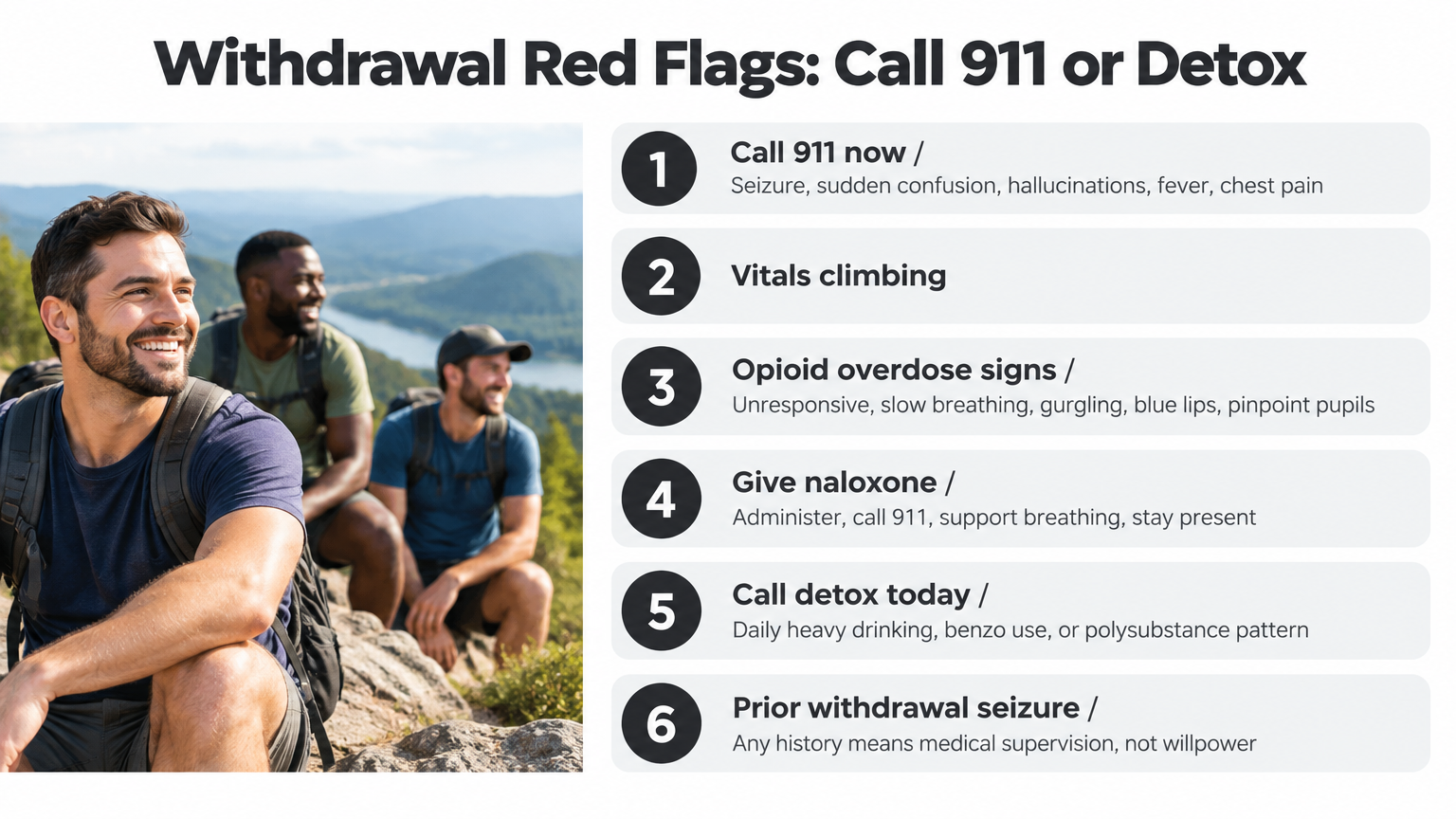
Call emergency services immediately for any seizure activity, confusion that comes on fast, hallucinations, a fever, chest pain, or a heart rate and blood pressure that keep rising instead of settling. These are classic signs of severe alcohol withdrawal or alcohol-withdrawal delirium, and they can escalate quickly in a physically healthy adult.4The same thresholds apply to benzodiazepine withdrawal, where the FDA has flagged seizures as a life-threatening possibility after abrupt reduction.6
With opioids, the emergency picture flips. Withdrawal itself is rarely the crisis. Overdose is. CDC lists the warning signs that mean naloxone and 911, not patience: inability to wake the person, slow or shallow breathing, choking or gurgling sounds, lips or fingernails turning blue or gray, and pinpoint pupils.17If any of those are present, give naloxone if it is in the house, call 911, support breathing, and stay until help arrives.17
Short of those emergency signs, a call to a detox line within the next few hours is the right move for daily heavy drinking, regular benzodiazepine use, polysubstance use, or any prior history of withdrawal seizures. Willpower does not out-muscle a nervous system in rebound.
A note to the wife, girlfriend, parent, or sibling reading this with a phone in hand: your read on the situation matters, and a few specifics will tell you whether to call 911, call a detox line, or stay close while things settle.
Call 911 if he is unresponsive, breathing is slow or shallow, you hear choking or gurgling, his lips or fingernails look blue or gray, or his pupils are pinpoint. Those are opioid overdose signs. Give naloxone if it is in the house, start rescue breathing, put him on his side, and stay until paramedics arrive.17Also call 911 for any seizure, sudden confusion, hallucinations, a fever, or vitals that keep rising rather than settling, especially after heavy daily drinking or regular benzodiazepine use.4, 6
Short of those signs, call a detox line today if he has been drinking heavily every day for weeks or months, taking a benzodiazepine regularly, mixing substances, or has seized before during a dry stretch. Trying to tough it out alone is where this gets dangerous.
A lot of men stall on calling because they picture a cold hospital room and a loss of control. The reality is closer to a short clinical stay with people who have seen this exact situation hundreds of times. The first step is an assessment: what substances, how much, how long, medical history, prior withdrawal episodes, mental-health picture, and anything else in the body right now. That read sets the plan.
For alcohol withdrawal, clinicians typically grade severity with a tool like the CIWA-Ar and treat moderate-to-severe cases with benzodiazepines on either a fixed schedule or a symptom-triggered protocol, with vitals checked repeatedly rather than judged from a single moment.5, 4Benzodiazepine withdrawal is handled with a gradual, individualized taper, because no single schedule fits every patient.6, 11Opioid withdrawal is usually managed with buprenorphine or methadone to quiet symptoms and cravings, often with clonidine or lofexidine for the autonomic piece.7, 9
Sleep, hydration, nutrition, and a calm environment do more work than most men expect. The point is not to white-knuckle it. The point is to clear the acute phase safely so the real treatment can start.
Detox clears the acute phase. It does not treat the disorder underneath. For opioid use disorder, CDC guidance is explicit that detoxification alone is not recommended because of the increased risks of resuming opioid use, overdose, and overdose death; medication treatment and household naloxone are part of the standard, not optional additions.8The same principle holds across substances: withdrawal management is meant to be linked to continuing care, not treated as the finish line.9
What that continuing care actually looks like is a step down into structured programming where the real patterns get addressed. Partial hospitalization and intensive outpatient programs give a man a weekly schedule, clinical therapies like CBT and EMDR, movement built into the day, and a group of other men doing the same work. Substances are often an unhealthy answer to real problems, including pain, anxiety, trauma, and the pressure to keep providing. Those do not resolve during a detox stay. They resolve over months of showing up with a band of brothers who stand together and refuse to let anyone drift. That is where Trifecta Healthcare Institute's continuum of PHP, IOP, and alumni support, with a referral pathway for detox, is built to carry the next stretch.
Yes, from some substances. Sudden cessation after heavy, prolonged alcohol use can be life-threatening because of seizures and alcohol-withdrawal delirium.1, 3Abruptly stopping benzodiazepines carries a similar risk, which is why the FDA warns against rapid reduction.6Opioid, stimulant, cannabis, and nicotine withdrawal rarely cause direct medical death on their own, though opioid relapse after detox carries high overdose risk and stimulant withdrawal can bring depressive symptoms with suicidal thinking that require clinical attention.8, 13
SAMHSA's approximate acute ranges are 5 to 7 days for alcohol, 1 to 4 weeks for benzodiazepines, 4 to 10 days for opioids, 1 to 2 weeks for stimulants, around 5 days for cannabis, and 2 to 4 weeks for nicotine.16Post-acute symptoms like low mood, poor sleep, and cravings can stretch weeks to months, especially after stimulant or benzodiazepine use.13, 16
Usually not after regular heavy use. NIAAA identifies sudden cessation after prolonged heavy drinking as potentially life-threatening, and the VA/DoD guideline supports inpatient care for severe withdrawal or any prior seizure or delirium tremens.1, 5Benzodiazepine withdrawal should not be managed without medical supervision and requires a gradual, individualized taper rather than an abrupt stop.11, 6Call a detox team before stopping.
Withdrawal is the body rebounding after a substance is removed, often with sweating, shaking, anxiety, nausea, or cravings. Opioid overdose looks different and demands 911. CDC warning signs include inability to wake the person, slow or shallow breathing, choking or gurgling, lips or nails turning blue or gray, and pinpoint pupils.17Give naloxone if available, call 911, support breathing, and stay until help arrives.17
SAMHSA calls this protracted withdrawal, a stretch of post-acute symptoms that can persist well after the acute phase closes across alcohol, benzodiazepines, opioids, stimulants, cannabis, and nicotine.16After stimulants in particular, depression, anxiety, insomnia, and paranoia can last weeks to months as the brain's reward and sleep systems rebuild.13It is not a relapse brewing. It is the nervous system still catching up.
Detox clears the acute phase but does not treat the disorder underneath. CDC guidance is explicit that detoxification alone is not recommended for opioid use disorder because of increased risks of resuming opioid use, overdose, and overdose death.8Clinical guidance across substances treats withdrawal management as a bridge into continuing care, not an endpoint.9Plan for structured treatment, medication where indicated, and ongoing peer support.
Between facility size limits, waivers, and state-by-state rules, figuring out your Medicaid or private insurance benefits can feel like its own full-time job. Our admissions team will verify your coverage in minutes and walk you through exactly what's available — no guesswork required.
Verify Insurance Benefits →No commitment required. Confidential & HIPAA-protected.
Whether it's you or someone you love, our team can help you figure out the next step — what treatment looks like, what's covered, or just someone to talk to.
Talk to Our TeamConfidential. No commitment required.


